
Reg Sci Disaster Recovery Outage Rca
Clearing House (CCP) FIXML Trade-Capture Backlog Recovery: Post-Spike Compression & Netting
Matching 25 billion shares in microsecond RAM is easy compared to clearing them through XML/MQ post-trade pipes; learn how CCPs and FCMs survive 5x volume spikes before T+1 settlement cutoffs.
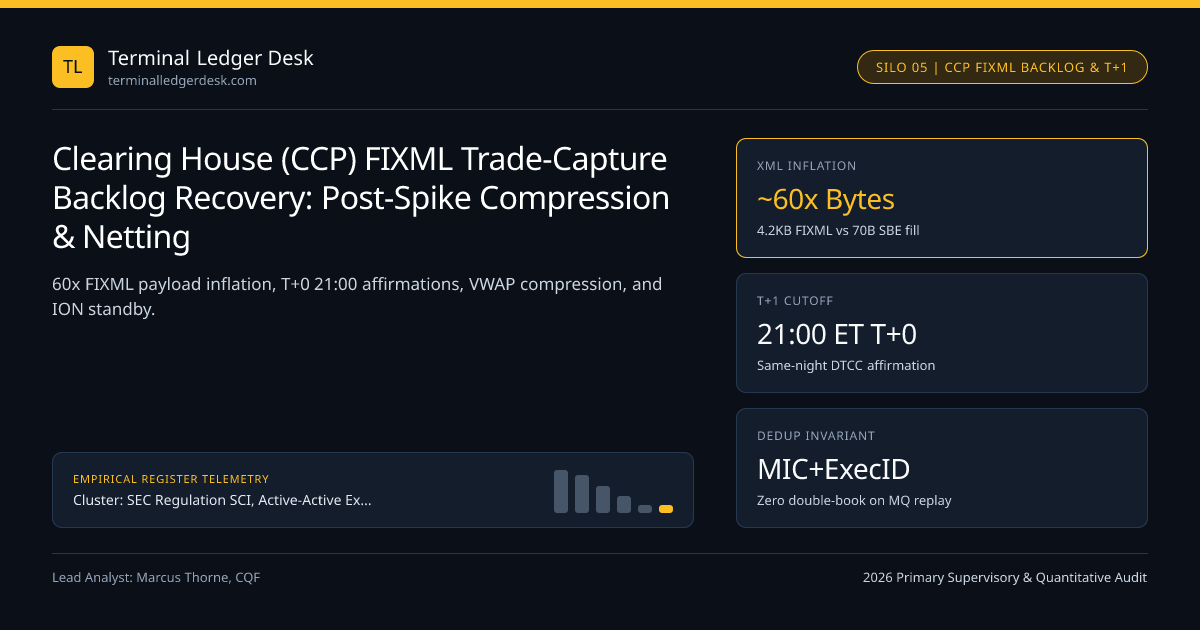
Here is the dirty secret of financial market infrastructure exposed during February 2018 ("Volmageddon"), March 2020, and ION Markets 2023: front-office matching engines handle 5x volume surges effortlessly in C++ RAM, while back-office clearing pipelines (FIXML over IBM MQ, 35=AE TradeCaptureReport, give-up allocators) choke on verbose XML serialization and database row locks—delaying end-of-day margin calls past midnight! Under SEC Regulation SCI (DTCC / NSCC / OCC) and CFTC DCO Core Principles (CME Clearing / ICE Clear), clearing backlog resilience is systemic survival.
Why Verbose FIXML (4,200 Bytes) Chokes Behind 64-Byte Binary SBE Fills#
Connecting front-to-back architecture within our SEC Reg SCI & Outage Post-Mortem Hub and Unified Margin Clearing Engine, compute the payload amplification factor between matching and clearing:
- Front-Office Match (
CME iLink 3 SBE/OUCH):64 to 110 bytesfixed binary struct (0heap allocations,800 nsmatch). - Post-Trade Clearing (
FIXML TrdCaptRpt/FIX 35=AEwithPartyGrpAllocations):2,800 to 6,500 bytesof nested UTF-8 XML (<TrdCaptRpt><RptSide><Pty ID="..." R="1"/>...</TrdCaptRpt>), parsed via DOM/SAX XML schemas and committed viaXAdistributed transactions across clearing SQL ledgers! - Result: A
60xbyte inflation combined with1,000xslower per-trade database commit cost! When an HFT firm splits orders into1-share/1-lotmicro-fills (40 milliontickets in one afternoon), back-office clearing queues fall3 to 6 hoursbehind real time!
Three Architectural Remedies: Streaming Binary UTC, Pre-Clearing Compression & Async Batching#
Modern CCPs (NSCC Universal Trade Capture — UTC, OCC Encore/Ovation, CME Clearing FECPlus, LCH) and Tier-1 FCMs defeat clearing backlogs using three engineering techniques under the FIX Protocol Messaging Standard:
- Real-Time Streaming Trade Capture (
Zero End-of-Day Batch Cliffs): Submitting matched trades continuously within milliseconds of execution (NSCC UTC/CME Front-End Clearing) rather than holding evening batch files—vital under UST+1equity settlement where affirmation cutoffs close at21:00 ET on Trade Date (T+0)! - Pre-Allocation / Average-Price Trade Compression: Instead of booking
18,000separate100-sharestreet fills into client sub-accounts via18,000FIXMLmessages, broker middle-office engines aggregate same-side, same-symbol, same-venue fills into 1 VWAP Compressed Allocation Block (18,000:1message reduction!) while preserving full underlyingExecIDlineage for CAT / RTS 24 audit trails! - Idempotent
ExecID+TradeReportID (Tag 571)Deduplication: Ensuring replay of stuck MQ queues after a middle-office restart never double-books clearing trades!
| Pipeline Stage | Wire Format & Size | Primary Bottleneck | Regulatory Deadline | Resilience Upgrade |
|---|---|---|---|---|
| Venue Matching Fill | SBE / OUCH (64–110 B) | CPU L1 cache (<1 us) | Real-time tape (<10 ms) | Hot Raft Cluster |
| Street Trade Capture | FIX `35=AE` / NSCC UTC | TCP / MQ consumer serialization | Continuous (<1–5 min) | Partitioned stateless consumers by Symbol % 32 |
| Give-Up & Allocation | FIXML (3,000–6,500 B) | DOM XML parse + SQL lock contention | T+0 21:00 ET (US T+1 Affirm!) | SIMD streaming parser + VWAP block compression |
| CCP Margin & Settlement | CME FECPlus / OCC / DTC | Portfolio VaR + Fedwire cutoff | 60-min Intraday VM; T+1 settle | Direct standby adapter bypassing third-party hubs |
Front-Office Matching vs Post-Trade Clearing Pipeline Comparison Matrix#
Contrasting payload size, throughput bottlenecks, regulatory SLAs, and failure blast radii across trading and clearing tiers.
- Worked 5x Volatility Day Audit (40,000,000 Micro-Fills * 4,500 Bytes FIXML = 180 GB Clearing XML in 2 Hours):
- Legacy Single-Threaded XML Consumer (@ 8 MB/s = 1,850 trades/s): 180,000 MB / 8 MB/s = 22,500s (6.25 Hours Behind!)
- 32-Shard Streaming Consumer + 50:1 Allocation Compression: Clears 100% in < 12 seconds lag!
Lessons From the 2023 ION Cleared Derivatives Outage: Vendor Back-Office Isolation#
In January–February 2023, a ransomware outage at third-party back-office vendor ION Cleared Derivatives froze automated futures trade matching, give-up allocation, and CFTC Large Trader reporting across dozens of FCMs globally for over a week—forcing manual CSV/spreadsheet clearing reconciliation and delaying CFTC Commitments of Traders (COT) reports!
- Architectural Mandate (EU DORA vs SEC Reg SCI vendor exit rules): FCMs must maintain direct native
FIXML / MQ / SFTPfallback adapters straight toCME Clearing,ICE Clear, andEurex Clearingcapable of ingesting raw exchange Drop-Copy (35=8->FIXML) if any third-party middle-office hub goes dark!
Intraday Variation Margin (VM) Calls During Clearing Lag!#
Why is a 2-hour clearing-queue lag dangerous at 13:30 ET? Because CCPs (CME, OCC, LCH) trigger Ad-Hoc Intraday Variation & Initial Margin Calls (1-hour Fedwire/TARGET2 wire deadline!) during 3-sigma market moves: if your back-office ledger lags by 2 hours of hedged offsetting trades, your clearing account looks massively one-sided, triggering a $250 million phantom intraday margin call! Stress intraday liquidity buffers in our Terminal Margin VaR & ES Calculator.
Frequently asked questions
How did the May 2024 US transition from T+2 to T+1 settlement change post-trade clearing architecture?
Under T+2, middle-office teams had until noon on T+1 to fix broken give-ups and affirm allocations—allowing overnight batch jobs and morning human ops cleanup. Under SEC Rule 15c6-1/15c6-2 (T+1), institutional allocations and DTCC ITP affirmations must finish by 9:00 PM ET on Trade Date (T+0), requiring 100% real-time automated exception handling!
Why can lagging clearing ingestion trigger a false $200M intraday Variation Margin call?
Suppose Pod A sold 10,000 ES on Venue 1 (already ingested by clearing) and bought 10,000 SPY/ES spread on Venue 2 (stuck 90 minutes behind in a backed-up XML queue!) during a 3% market rally: the CCP/FCM margin engine sees only the losing short leg and demands emergency cash within 60 minutes!
Does compressing 5,000 street fills into 1 client VWAP allocation block violate audit-trail transparency?
No, provided it follows SEC/FINRA average-price account rules and MiFID II RTS 24/22 transaction reporting standards: the street-side ledger and CAT/MiFIR reports preserve all 5,000 individual venue ExecIDs, while the compressed post-trade allocation links to the parent average-price group ID.
Why are DTCC (NSCC/DTC) and OCC classified as Critical SCI Systems?
Unlike lit stock exchanges (where 15 rival exchanges can absorb order flow if 1 exchange halts), NSCC is the sole central counterparty novating virtually 100% of US equity trades and OCC is the sole clearinghouse for all US listed equity options—meaning an unrecovered clearing outage halts national settlement.
Publication record
- Published
- 13 November 2026
- Updated
- 15 November 2026
- Author
- Marcus Thorne, CQF
- Review
- Review not recorded
- Automated fact check
- Passed in the stored pipeline record
- Source URLs
- 3 recorded
AI assistance recorded: anthropic/claude-opus-4.6. This field does not establish human review or source verification.
Academic & Institutional Attribution
Cite This Research & Embed Live Data Card
Standard academic & institutional research paper citation format.
Marcus Thorne, CQF. (2026, November 15). Clearing House (CCP) FIXML Trade-Capture Backlog Recovery: Post-Spike Compression & Netting. Terminal Ledger Desk. https://terminalledgerdesk.com/reports/clearing-house-ccp-fixml-trade-capture-backlog-recovery-compressionRelated Reg Sci Disaster Recovery Outage Rca & Institutional Briefings
Explore Reg Sci Disaster Recovery Outage Rca Hub (20) →Reg Sci Disaster Recovery Outage Rca
SEC Regulation SCI, Active-Active Exchange Failover & Outage Post-Mortem Engineering GuideReg Sci Disaster Recovery Outage Rca
BGP Anycast & DNS TTL Pitfalls During Broker & Exchange Gateway Disaster-Recovery CutoversReg Sci Disaster Recovery Outage Rca
Chaos Engineering & Deterministic Fault Injection in Staging Matching & Gateway ClustersReg Sci Disaster Recovery Outage Rca
Immutable WORM Incident Forensics: SEC Rule 17a-4(f), Optical PCAPs & Cryptographic Hash ChainsReg Sci Disaster Recovery Outage Rca
SEC Regulation SCI Rule 1001(a): 2-Hour RTO & Geographically Diverse Backup Site ArchitectureReg Sci Disaster Recovery Outage Rca
Annual SIFMA & FIA Industry-Wide Disaster Recovery Test: End-to-End Member RunbookReg Sci Disaster Recovery Outage Rca
Raft & Paxos Replicated State Machines in Matching Engines: Zero-Loss Sub-Millisecond FailoverReg Sci Disaster Recovery Outage Rca
Deterministic Event-Log Replay: Cold vs Warm vs Hot Standby Order-Book ReconstructionMarket Insights
Robinhood opens access to US IPOs for UK retail investorscybersecurity
Binance Cuts Off SignalPlus API Keys Over 'Potential Security Issue' at Trading PlatformRegulatory Compliance
Democrats to Push Broader Crypto Market Structure Bill After Sweeping US Midterms: ReportMarket Insights
AI Stocks Rebound After Brutal Week for Nasdaq
Terminal Ledger Desk Data, Benchmarks & Contributor Records
CC BY 4.0 Open Data
Open Institutional Datasets (CSV / JSON) →
Download desk-compiled quantitative series & schemas.
2026 Reference Matrix
2026 Institutional Benchmarks & Thresholds →
Statutory capital, clearing, margin & rate conventions.
Editorial Records
Authors & Review Records →
View named contributors where those records are available.
Complete Index
Master Research & Dossier Archive →
Browse all published briefings by topic pillar & date.