
Reg Sci Disaster Recovery Outage Rca
BGP Anycast & DNS TTL Pitfalls During Broker & Exchange Gateway Disaster-Recovery Cutovers
Switching DNS records with a 60-second TTL fails 40% of trading clients during a real disaster because JVMs cache IPs forever and firewalls whitelist static /32 addresses—learn resilient dual-VIP failover design.
Every disaster-recovery tabletop slide deck includes a deceptively simple bullet: "Step 3: Flip fix.broker.com DNS record (TTL = 60s) from Primary NY4 IP to Backup CH4 IP." When executed during an actual outage—or during the annual October SIFMA DR failover test—nearly half of connected institutional FIX engines fail to connect to DR for over an hour! Why? Because stateful long-lived FIX TCP sockets, corporate /32 egress firewalls, JVM infinite DNS caches, and asymmetric BGP Anycast routing obey completely different laws than stateless HTTP web browsers!
Four Reasons "Flip the 60-Second DNS Record" Fails Catastrophically in FIX Trading#
Detailed in our SEC Reg SCI & Outage Post-Mortem Hub and FIX Session Layer Specification, DNS-based failover breaks institutional trading connectivity in four simultaneous ways:
- Outbound
/32Destination-IP Firewall Whitelists: Regulated banks and hedge funds lock colocation egress ACLs to explicit numerical/32destination IPv4 CIDR blocks—blocking outboundTCP SYNpackets dynamically resolving to a newly announced cloud/DR IP! - JVM & C++ Startup-Only
getaddrinfoCaching: Many Java FIX engines (without explicitnetworkaddress.cache.ttl=30security properties) and C++ engines that callgetaddrinfoonce at04:00 AMprocess boot cache the Primarysockaddr_instruct in RAM all day—retrying the deadNY4IP every 5 seconds forever regardless ofTTL = 10s! - Recursive Resolver TTL Clamp (
ISP Min-TTL Floor): Enterprise DNS forwarders (Infoblox,Bind, cloud resolvers) routinely ignoreTTL = 30sand enforce a300s to 3,600sminimum cache floor—or fail completely if the authoritative nameserver itself sat inside the dead primary data center! - Split-Horizon / Stale Connection Pinning: Existing half-open TCP sockets wait for kernel
tcp_retries2(~15 minutesLinux default!) before even attempting a fresh reconnect!
Stateful TCP Over BGP Anycast vs Unicast BGP /24 Prefix Portability#
What about advertising the exact same gateway IP block (e.g. 198.51.100.0/24) from Chicago DR via BGP so zero client IP configs or /32 firewall rules ever change?
- TRAP — Active-Active BGP Anycast Breaks Long-Lived FIX TCP!: While BGP Anycast works brilliantly for single-packet
UDP DNS, running simultaneous Active-Active BGP Anycast across NY4 and CH4 for6-hourstateful FIX API TCP sessions means any mid-day carrier MED/AS-path flap routes packet#50,412of an existing NY4 TCP flow to Chicago—which has zero TCP TCB state and blasts an immediateTCP RST! - GOLD STANDARD — Pre-Provisioned Dual Static IPs (
SocketConnectHost+SocketConnectHost1) OR Mutually-Exclusive BGP/24Cutover: Either (a) give clients bothPrimary_IP (NY4)andDR_IP (CH4)pre-whitelisted inQuickFIX / C++rotary failover lists (tested every SIFMA October!), OR (b) withdraw the dedicated/24Unicast prefix completely from Primary NJ (STONITH) and announce that exact/24exclusively from Chicago DR!
| DR IP Cutover Design | Client /32 Firewall Safe? | Stateful 6h FIX TCP Safe? | Convergence Speed | Key Operational Requirement |
|---|---|---|---|---|
Dual Static VIPs (Host0, Host1) | Yes (Both pre-whitelisted at onboarding) | Yes (100% deterministic) | 3 – 8 seconds (tuned TCP) | Mandatory test during annual SIFMA DR Saturday |
Exclusive /24 BGP Swing | Yes (Same IP moves to DR!) | Yes (if NJ fenced 100% first) | 30 – 90 seconds | Must own portable /24 minimum (RPKI valid for both ASNs!) |
| Active-Active BGP Anycast | Yes (Same IP) | NO! (Route flaps trigger TCP RST!) | N/A (Unstable mid-day) | Restrict Anycast strictly to stateless UDP/DNS |
Dynamic DNS A-Record Flip | NO! (New IP blocked by bank ACLs) | Fails startup-cached getaddrinfo | 15 – 120+ minutes | Never use as sole mechanism for institutional FIX! |
Gateway IP Failover Mechanisms Compared for Stateful FIX / SBE Sessions#
Evaluating firewall compatibility, TCP stability, convergence speed, and Reg SCI compliance across four failover designs.
- Untuned Default Linux Host vs Tuned Institutional FIX Host:
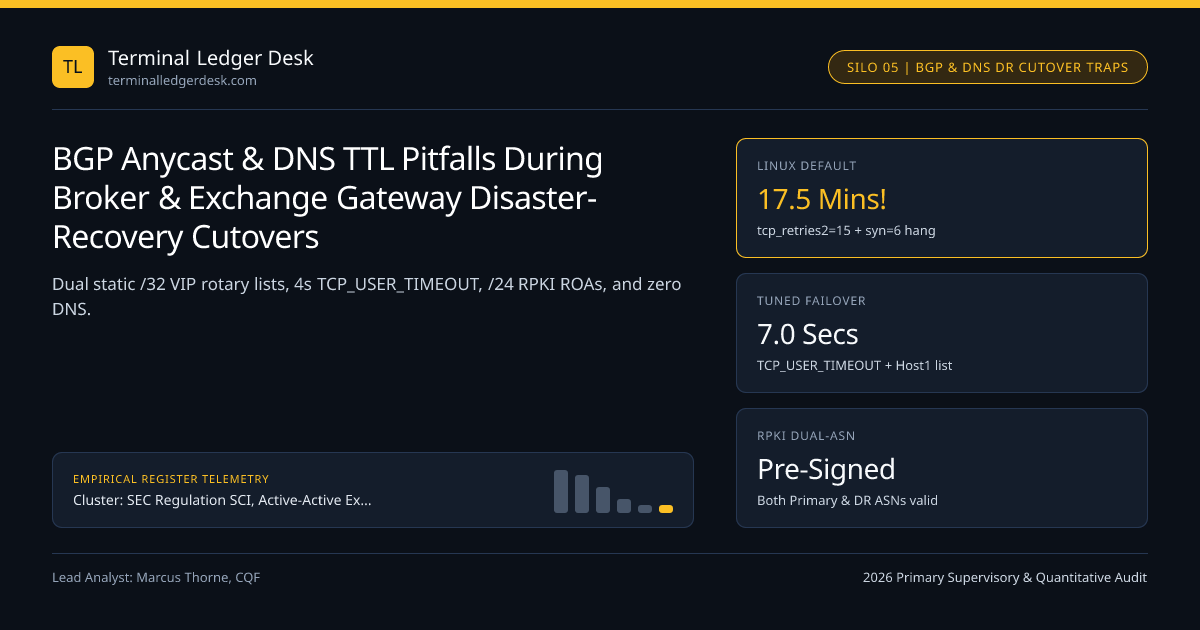
- Default Kernel (tcpretries2 = 15, tcpsyn_retries = 6): 924.6s + (1 * 127.0s) = 1,051.6 seconds (17.5 Minutes Lost!)
- Tuned Socket (TCPUSERTIMEOUT = 4000ms, syn_retries = 2): 4.0s + (1 * 3.0s) = 7.0 seconds (150x Faster Cutover!)
Tuning Linux Kernel TCP Timeouts So Dead Sockets Fail Over in Seconds, Not 15 Minutes!#
Out of the box, Linux net.ipv4.tcp_retries2 = 15 causes an active socket with unacknowledged bytes in its send buffer to retry exponential backoff for 924.6 seconds (15.4 minutes!) before returning ETIMEDOUT to your C++/Java FIX engine so it can try SocketConnectHost1 (DR_IP)!
- Under our HA Trading Failover Architecture, tune colocation gateway sockets explicitly via
setsockopt(fd, IPPROTO_TCP, TCP_USER_TIMEOUT, &timeout_ms, sizeof(timeout_ms))(e.g., 4,000 ms) +net.ipv4.tcp_syn_retries = 2(~3sdead-host SYN skip instead of127s!) paired with application-layer FIXTestRequest (35=1)timers (Cancel-On-Disconnect heartbeat windows)!
Never Host Your Status Page or Out-of-Band Kill API on Your Primary Trading Subnet!#
Classic outage anti-pattern: an exchange or prime broker hosts status.venue.com and its emergency REST Kill-Switch API inside the exact same NY4 BGP ASN/power zone that just caught fire! Host status communications and emergency out-of-band controls on multi-region geo-independent infrastructure, and stress cutover delay risk in our Terminal Margin VaR & ES Calculator.
Frequently asked questions
Why must a portable BGP failover block be at least a /24 IPv4 prefix (256 IPs) rather than a smaller /28 or /32?
Global Default-Free Zone (DFZ) internet and extranet carrier routers universally filter out IPv4 BGP announcements more specific than /24 to prevent global routing-table explosion! Announcing a /29 from your DR site will be silently dropped by upstream tier-1 carriers.
What happens if we swing a /24 prefix to our Chicago DR ASN in BGP, but forgot to add our Chicago ASN to our RPKI ROA record?
Disaster! Every RPKI-enforcing extranet and carrier router will classify your own legitimate emergency Chicago BGP announcement as an "RPKI Invalid Route Hijack" and black-hole 100% of your DR traffic! Always pre-authorize BOTH Primary ASN and DR ASN inside RPKI Route Origin Authorizations on Day 0!
Why do Java trading applications cache DNS resolutions forever if SecurityManager or default settings are misconfigured?
Historically, JVM InetAddress cached successful lookups indefinitely (-1) to prevent DNS-rebinding attacks unless networkaddress.cache.ttl was explicitly set inside java.security before JVM startup—catching countless enterprise apps during AWS/DR failovers.
Why does TCP_KEEPALIVE alone NOT fix slow failover when there is already unacknowledged data in the socket send buffer?
Famous Linux kernel gotcha documented by Cloudflare and trading network engineers: once unacknowledged application bytes sit inside the TCP send queue, Linux ignores TCP_KEEPALIVE timers completely and falls back to tcp_retries2 (~15 minutes) UNLESS TCP_USER_TIMEOUT is explicitly set on the socket!
Publication record
- Published
- 13 November 2026
- Updated
- 15 November 2026
- Author
- Marcus Thorne, CQF
- Review
- Review not recorded
- Automated fact check
- Passed in the stored pipeline record
- Source URLs
- 3 recorded
AI assistance recorded: anthropic/claude-opus-4.6. This field does not establish human review or source verification.
Academic & Institutional Attribution
Cite This Research & Embed Live Data Card
Standard academic & institutional research paper citation format.
Marcus Thorne, CQF. (2026, November 15). BGP Anycast & DNS TTL Pitfalls During Broker & Exchange Gateway Disaster-Recovery Cutovers. Terminal Ledger Desk. https://terminalledgerdesk.com/reports/bgp-anycast-dns-ttl-pitfalls-during-broker-gateway-dr-ip-cutoversRegulatory Directory Cross-Reference
Referenced Institutions & Regulatory Registries
Referenced Supervisory Authorities
Related Reg Sci Disaster Recovery Outage Rca & Institutional Briefings
Explore Reg Sci Disaster Recovery Outage Rca Hub (20) →Reg Sci Disaster Recovery Outage Rca
SEC Regulation SCI, Active-Active Exchange Failover & Outage Post-Mortem Engineering GuideReg Sci Disaster Recovery Outage Rca
Chaos Engineering & Deterministic Fault Injection in Staging Matching & Gateway ClustersReg Sci Disaster Recovery Outage Rca
Immutable WORM Incident Forensics: SEC Rule 17a-4(f), Optical PCAPs & Cryptographic Hash ChainsReg Sci Disaster Recovery Outage Rca
SEC Regulation SCI Rule 1001(a): 2-Hour RTO & Geographically Diverse Backup Site ArchitectureReg Sci Disaster Recovery Outage Rca
Annual SIFMA & FIA Industry-Wide Disaster Recovery Test: End-to-End Member RunbookReg Sci Disaster Recovery Outage Rca
Raft & Paxos Replicated State Machines in Matching Engines: Zero-Loss Sub-Millisecond FailoverReg Sci Disaster Recovery Outage Rca
Deterministic Event-Log Replay: Cold vs Warm vs Hot Standby Order-Book ReconstructionReg Sci Disaster Recovery Outage Rca
Multicast A/B Market-Data Feed Arbitration: Air-Gapped Switch Fabrics & Microburst Recoverycybersecurity
Binance Cuts Off SignalPlus API Keys Over 'Potential Security Issue' at Trading PlatformRegulatory Compliance
Democrats to Push Broader Crypto Market Structure Bill After Sweeping US Midterms: ReportMarket Insights
AI Stocks Rebound After Brutal Week for NasdaqRegulatory Benchmarks
Trading Platforms, OMS/EMS Execution Engines & Server Infrastructure 2026 Licensing Benchmark: 6D Prudential Scorecard Across 227 Audited Entities
Terminal Ledger Desk Data, Benchmarks & Contributor Records
CC BY 4.0 Open Data
Open Institutional Datasets (CSV / JSON) →
Download desk-compiled quantitative series & schemas.
2026 Reference Matrix
2026 Institutional Benchmarks & Thresholds →
Statutory capital, clearing, margin & rate conventions.
Editorial Records
Authors & Review Records →
View named contributors where those records are available.
Complete Index
Master Research & Dossier Archive →
Browse all published briefings by topic pillar & date.