
Mifid Rts6 Pretrade Kill Switch Controls
Exchange Cancel-On-Disconnect (COD): Heartbeat Grace Windows Across CME, Nasdaq & Eurex
Cancel-On-Disconnect is the market maker safety net when switches crash or fiber snaps—yet silent black-hole timeouts, 5-second grace windows, and GTD/GTC order exclusions routinely leave "protected" books exposed.
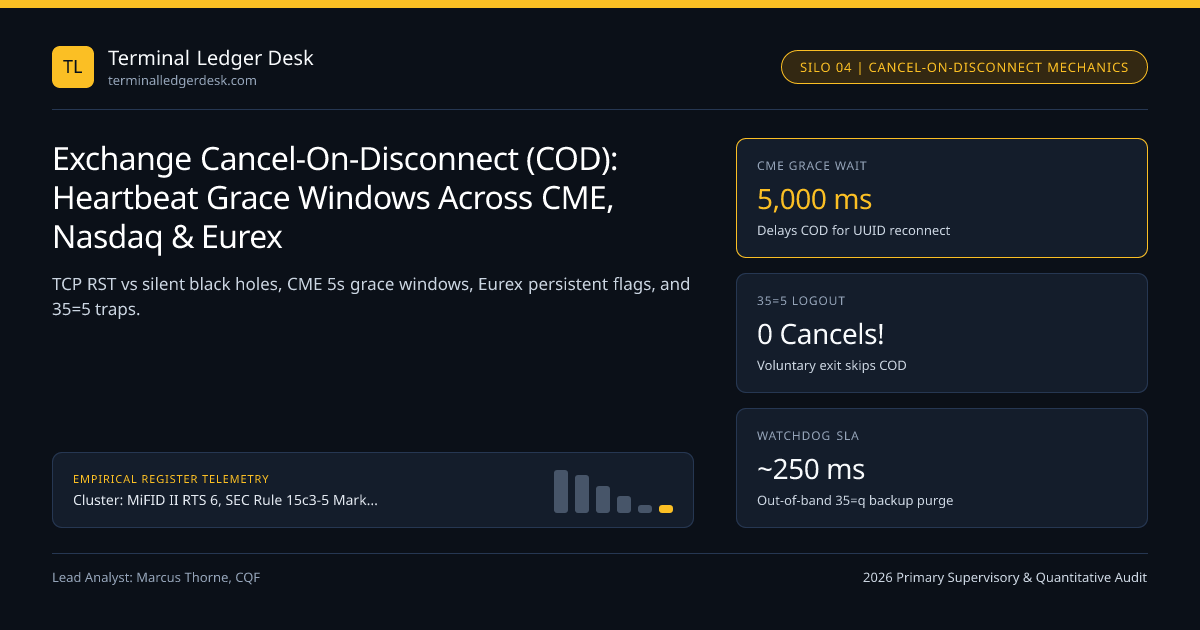
Every electronic market maker assumes that pulling the power cord or killing a trading process triggers exchange-native Cancel-On-Disconnect (COD) instantaneously. In reality, how a connection dies—and which order lifetimes (Day vs GTC vs Auction-Only) were flagged at submission—determines whether resting quotes vanish in 150 microseconds (TCP FIN/RST) or sit naked on the order book for 5,000 to 35,000 milliseconds during a silent routing black hole!
Explicit TCP RST/FIN vs Silent Network Black-Hole Detection Timers#
Connecting the session recovery mechanics from our MiFID II RTS 6 & SEC 15c3-5 Architecture Hub and FIX Session Layer Specification, an exchange order-entry gateway detects client loss through two radically different mechanisms:
- Clean OS Kernel Tear-Down (
kill -9or NIC Link-Down on Direct Cross-Connect): When a Linux trading process terminates (while the host OS kernel stays alive), the kernel network stack immediately emits aTCP FINorTCP RSTpacket (~150 usinside Aurora DC3 or NY4). The exchange gateway seesEOFimmediately. - Silent Black Hole (
Kernel Panic, Power Loss Behind L2/L3 Switch, or WAN Partition): NoTCP FINorRSTis ever transmitted! The exchange gateway remains completely blind to the dead client until itsHeartBtInt/ KeepAlive timer plus Grace Window expires—commonly3,000 ms to 36,000 msdepending on venue configuration!
The Reconnection Grace-Window Trap: CME iLink 3, Nasdaq OUCH & Eurex T7#
Even after an exchange detects a broken TCP socket, several major derivatives venues insert a deliberate Reconnection Grace Period before purging orders so transient micro-flaps do not wipe queue priority:
- CME Globex iLink 3 (
Mandatory COD): When an iLink 3 TCP session drops involuntarily, CME starts a5-second(5,000 ms) Grace Period! If the client reconnects and re-establishes the sameUUIDsession within5.0 seconds, no orders are canceled; COD fires only after the full5,000 msgrace timer expires without reconnect (unless an out-of-band Auto-Cancel / Mass Action API or Drop-Copy shadow kill switch purges them immediately)! - Nasdaq OUCH 5.0 (
AIQ / Port COD): Supports configurable port-level Cancel-On-Disconnect that initiates immediate asynchronous sweeps of openDayorders upon SoupBinTCP loss (1-secondserver/client heartbeat timeout). - Eurex T7 (
ETIBinary Sessions): distinguishes High-Frequency (HF) and Low-Frequency (LF) ETI sessions, deleting non-persistent (Standard) orders immediately on session loss while retaining Persistent orders unless explicitly configured or mass-deleted!
| Exchange & Protocol | Min Heartbeat / KeepAlive | Reconnect Grace Window | Polite Logout Behavior | Default GTC / Persistent Handling |
|---|---|---|---|---|
CME Globex (iLink 3 SBE) | 5,000 ms (KeepAliveInterval) | 5,000 ms grace wait | Voluntary Terminate does NOT fire COD | Resting GTC/GTD canceled only if ExecInst / COD scope configured |
Nasdaq (OUCH 5.0 / SoupBinTCP) | 1,000 ms client/server HB | 0 ms (Immediate on EOF) | Unsequenced Logout skips involuntary COD | Port-level COD sweeps open continuous Day orders |
Eurex T7 (ETI Binary) | Configurable ms heartbeat | Immediate on HF session loss | Standard Logout retains Persistent orders | Standard (Non-Persistent) purged; Persistent retained! |
| Broker DMA (FIX 4.4) | Typically 15s – 30s (Tag 108) | Broker-specific (0–10s) | 35=5 leaves all orders working! | Requires explicit per-account COD subscription |
Venue-by-Venue Cancel-On-Disconnect Behavior & Pitfall Matrix#
Comparing involuntary disconnect timers, reconnection grace delays, and dangerous order-type exclusions across leading global exchanges.
- Worked Exposure Window Comparison (CME iLink 3 Market Maker During Top-of-Rack Switch Power Loss):
- Scenario A — Default 30,000 ms KeepAlive + 5,000 ms CME Grace Window:
- Tworstsilent_cod = (1 * 30,000 ms) + 1,000 ms + 5,000 ms = 36,000 ms (36 full seconds of stale quotes!)
- Scenario B — Tuned 5,000 ms Min KeepAlive + Out-of-Band Backup Host Firing 35=q after 250 ms missed UDP ping:
- Tactivewatchdog = 250 ms detection + 1.2 ms OrderMassActionRequest (35=q) = 251.2 ms (143x faster!)
Deadly COD Exclusions: Why GTC, GTD, Cross-Session & Halted Orders Survive!#
Post-mortem investigations of multi-million-dollar disconnect losses repeatedly uncover four categories of resting orders that survive COD untouched:
GTC(Good-Till-Cancel,59=1) >D(Good-Till-Date,59=6) Orders: On many venues and EurexPersistentorder flags,GTC/GTDorders are legally classified as multi-session persistent instructions and exempt from default session COD unless the firm opts intoCancel-All-Including-GTCport attributes!- Graceful
Logout (35=5)Shutdowns: On standard FIX and CME iLink 3, COD triggers ONLY on involuntary connection loss! If a developer stops a trading container cleanly (SIGTERM) and the engine politely sends a FIXLogout (35=5)handshake before exiting, CME does NOT treat that as an involuntary disconnect—leaving every resting quote live! - Halted / Auction-Locked Instruments: If a symbol is mid-halt (CME Velocity Logic or LULD pause) in a
No-Cancelfreeze state when COD fires, the cancel queues or rejects until auction transition. - Orders Entered on Backup Ports (
Session B): COD is scoped strictly to the disconnectedSessionID(unless Group/Firm-level COD is enabled).
Hardening Disconnect Architecture: Aggressive Heartbeats + Dual-Path Kill Switches#
Never rely on passive socket loss alone as your primary emergency brake! Institutional HA Trading Failover Architectures enforce three rules:
- Negotiate the shortest venue-permitted
KeepAliveInterval(1,000 mson SoupBinTCP;5,000 msminimum on CME iLink 3). - In emergency shutdown hooks (
SIGINT / SIGTERM / Panic), explicitly broadcastOrderMassActionRequest (35=q)FIRST, wait50 msfor35=rACK, and if unacknowledged, tear down via rawSO_LINGER {l_onoff=1, l_linger=0}(TCP RST) rather than polite35=5 Logout! - Pair every trading host with an independent out-of-band watchdog (Drop-Copy shadow kill switch) and size unhedged 5-second drift exposure in our Terminal Margin VaR & ES Calculator.
Frequently asked questions
Why did our graceful Docker container restart leave 400 resting futures orders working on CME Globex?
Docker stop sends SIGTERM, triggering your FIX/iLink library clean shutdown hook which transmitted a polite Logout / Terminate handshake! Exchanges only trigger Cancel-On-Disconnect on INVOLUNTARY drops. Always send OrderMassActionRequest (35=q) and verify 35=r acknowledgment BEFORE closing sessions!
How can a C++ shutdown handler force an immediate involuntary TCP RST instead of a clean FIN/Logout?
If an emergency kill-switch path fails to receive a 35=r Mass Action ACK within 50ms, configure setsockopt(fd, SOL_SOCKET, SO_LINGER, &linger{1, 0}, sizeof(linger)) and call close(fd): the Linux kernel immediately blasts a raw TCP RST without any FIX Logout frame.
Why does CME Globex wait 5 seconds before executing Cancel-On-Disconnect?
Institutional futures desks holding deep FIFO queue priority in Eurodollar/SOFR or Treasury books demanded protection against sub-second network micro-flaps; if the engine reconnects the same UUID within 5 seconds, queue priority is preserved—which is why latency market makers supplement COD with explicit CME Mass Action / Auto-Cancel APIs.
How do we verify after a disconnect that 100% of resting orders were actually canceled?
Subscribe an independent, geographically or network-diverse Drop-Copy / Execution session (which stays connected when the order-entry port dies) to collect every unsolicited ExecutionReport (39=4 Canceled, ExecRestatementReason / Text = COD) and alert humans immediately if Open_Order_Count != 0.
Publication record
- Published
- 13 November 2026
- Updated
- 14 November 2026
- Author
- Marcus Thorne, CQF
- Review
- Review not recorded
- Automated fact check
- Passed in the stored pipeline record
- Source URLs
- 3 recorded
AI assistance recorded: anthropic/claude-opus-4.6. This field does not establish human review or source verification.
Academic & Institutional Attribution
Cite This Research & Embed Live Data Card
Standard academic & institutional research paper citation format.
Marcus Thorne, CQF. (2026, November 14). Exchange Cancel-On-Disconnect (COD): Heartbeat Grace Windows Across CME, Nasdaq & Eurex. Terminal Ledger Desk. https://terminalledgerdesk.com/reports/cancel-on-disconnect-cod-heartbeat-grace-windows-cme-nasdaq-eurexRelated Mifid Rts6 Pretrade Kill Switch Controls & Institutional Briefings
Explore Mifid Rts6 Pretrade Kill Switch Controls Hub (20) →Mifid Rts6 Pretrade Kill Switch Controls
MiFID II RTS 6, SEC Rule 15c3-5 Market Access & Inline Pre-Trade Kill-Switch Architecture GuideMifid Rts6 Pretrade Kill Switch Controls
FIX Tag 35=q OrderMassActionRequest & Venue Firm-Level Kill-Switch APIs BenchmarkedMifid Rts6 Pretrade Kill Switch Controls
Self-Match Prevention (SMP): Cancel-Oldest, Cancel-Newest & Decrement-and-Cancel MechanicsMifid Rts6 Pretrade Kill Switch Controls
Order-to-Trade Ratio (OTR) & MiFID II RTS 9: Token-Bucket Message Throttling EngineeringMifid Rts6 Pretrade Kill Switch Controls
NMS Limit Up-Limit Down (LULD) Plan: Reference Price Bands, Limit States & 5-Minute PausesMifid Rts6 Pretrade Kill Switch Controls
CME Globex Velocity Logic & Dynamic Circuit Breakers: Sub-Second Futures Volatility GuardsMifid Rts6 Pretrade Kill Switch Controls
CFTC Regulation 1.73: FCM Automated Pre-Execution Clearing Credit Screens & Give-Up LimitsMifid Rts6 Pretrade Kill Switch Controls
Options Market-Maker Mass Quote Risk (MMR): Rolling Delta, Vega & Percentage-Swept Purge TriggersReg Sci Disaster Recovery Outage Rca
Exchange Outage Post-Mortem: Opening-Auction Reference-Price Errors & LULD Halt CascadesReg Sci Disaster Recovery Outage Rca
Exchange Outage Post-Mortem: WAN BGP Route Leaks, Extranet Partitions & Asymmetric HaltsReg Sci Disaster Recovery Outage Rca
CTA & UTP SIP Market-Data Processor Failover: NBBO Staleness, Reg NMS Rule 611 & Direct FeedsReg Sci Disaster Recovery Outage Rca
SEC Regulation SCI Rule 1002: Incident Triage Trees, Immediate SEC Notification & De Minimis Safe Harbor
Terminal Ledger Desk Data, Benchmarks & Contributor Records
CC BY 4.0 Open Data
Open Institutional Datasets (CSV / JSON) →
Download desk-compiled quantitative series & schemas.
2026 Reference Matrix
2026 Institutional Benchmarks & Thresholds →
Statutory capital, clearing, margin & rate conventions.
Editorial Records
Authors & Review Records →
View named contributors where those records are available.
Complete Index
Master Research & Dossier Archive →
Browse all published briefings by topic pillar & date.