
Mifid Rts6 Pretrade Kill Switch Controls
CFTC Regulation 1.73: FCM Automated Pre-Execution Clearing Credit Screens & Give-Up Limits
Under CFTC Regulation 1.73, clearing Futures Commission Merchants cannot blindly accept executed trades—every DMA, sponsored, and give-up futures order must pass automated pre-trade margin and clip-size screens.
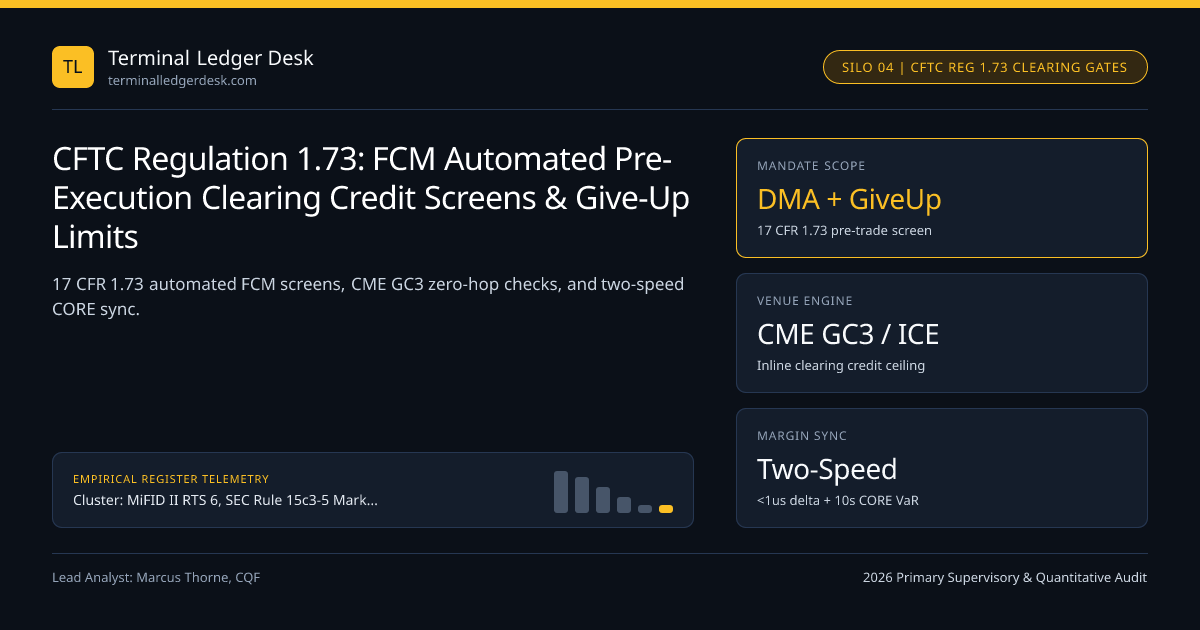
In global listed derivatives, an Executing Broker (EB) and a Clearing Futures Commission Merchant (Clearing FCM) are frequently two separate banks linked by an FIA Standard Give-Up Agreement: a hedge fund executes 2,000 lots of SOFR futures through Executing Broker A and "gives up" the trade at day-end to Clearing FCM B. CFTC Regulation 1.73 (17 CFR 1.73) eliminated unscreened clearing exposure—mandating that every Clearing FCM establish automated pre-execution order-size and portfolio credit limits across 100% of proprietary, DMA, and give-up flow.
Statutory Mechanics of 17 CFR 1.73 & CFTC Regulation 38.255#
Working in tandem with SEC Rule 15c3-5 (detailed in our MiFID II RTS 6 & SEC 15c3-5 Architecture Hub), CFTC and NFA enforce a two-sided regulatory ring-fence:
- CFTC Reg 1.73(a)(1) & (2) (
Clearing FCM Mandate): Requires every clearing FCM to establish risk-based limits per account (Max Order Size+Intraday Margin/Position Cap) AND use automated means to screen orders for compliance PRIOR to execution whenever orders are routed electronically! - CFTC Reg 1.73(a)(2)(iii) (
Give-Up / Executing Broker Allocation): When a customer routes through an outside Executing Broker rather than the Clearing FCM own gateway, the Clearing FCM must either set pre-trade limits directly inside the Designated Contract Market (DCM) exchange-hosted risk portal (CME Globex Credit Controls / GC3,ICE Risk Management) OR contractually verify and audit the Executing Broker automated pre-trade screens! - CFTC Reg 38.255 (
DCM Mandate): Obligates futures exchanges (CME,ICE,Cboe Futures) to provide clearing members native automated pre-trade credit controls and immediate kill switches.
Exchange-Hosted Clearing Credit Controls: CME GC3 & ICE Inline Margin Math#
How can Clearing FCM B block a toxic order sent through Executing Broker A private Aurora DC3 FPGA in zero extra network hops? Via Exchange-Hosted Inline Clearing Risk (CME Globex Credit Controls — GC3) inside the Unified Margin Clearing Engine:
- Clearing FCM B logs into CME Risk Management API and assigns
Account 88412(Executing Firm = EB_A, Clearing Firm = FCM_B) a$15,000,000Peak Intraday Initial Margin Risk Limit plus500-lotMax Clip Size. - Every outbound
iLink 3order carryingClearing Account 88412is evaluated inside the CME gateway using simplified real-time SPAN / CME CORE Delta-Equivalent Risk Arrays before reaching the CLOB! - At
70%and90%utilization, CME pushes automated warning alerts to Clearing FCM B; at100%breach, CME automatically rejects risk-increasing orders (or triggersAuto-Cancelof open quotes) with zero extra cable latency!
| Futures Execution Route | Who Owns Pre-Trade Gate? | How Clearing FCM Complies With 17 CFR 1.73 | Kill-Switch Authority |
|---|---|---|---|
| FCM Direct DMA (FIX / TT / CQG) | Clearing FCM Directly | FCM sets clip & SPAN/CORE margin inside its own ISV/FIX gateway | FCM Risk Desk (< 2 ms direct) |
| Colocated Sponsored Access | Clearing / Sponsoring FCM | Broker-exclusive inline FPGA (cut-through FPGA gates) + Exchange GC3 | Both FCM FPGA + CME RMI |
Third-Party Executing Broker (Give-Up) | Executing Broker + DCM | Clearing FCM sets hard caps in CME GC3 / ICE + audits EB gates (1.73(a)(2)(iii)) | Clearing FCM revokes Give-Up ID in RMI! |
| Voice / Block / EFRP Desk | Desk Broker / ClearPort | Mandatory pre-submission credit check in CME ClearPort / ICE Block | Pre-clear credit rejection |
CFTC Reg 1.73 Enforcement Paths by Futures Execution Channel#
How Clearing FCMs satisfy 17 CFR 1.73 across Direct FCM Gateways, Colocated Sponsored Access, Give-Up Executing Brokers, and Block Trades.
- Worked Two-Speed Sync Example (RV Treasury Fund, FCM GC3 Cap = $5,000,000):
- At t_sync = 10:00:00: Portfolio holds +1,000 ZN / -1,450 ZF -> Exact CME CORE Margin = $620,000
- At t = 10:00:03: Algo sends +200 ZN outright Buy (Outright ZN Margin M_ZN = $2,200/lot):
- Fast-Path Check = $620,000 + (200 * $2,200) = $620,000 + $440,000 = $1,060,000 <= $5,000,000 -> PASS (< 1 us)!
- (At t_sync = 10:00:10, once -290 ZF hedge leg fills, Exact CORE drops back to ~$744,000!)
Simplified Pre-Trade SPAN / VaR vs Exact Post-Trade CME CORE Margin#
Full multi-commodity CME CORE ( VaR-based ) / SPAN portfolio margin across 400 option strikes and inter-commodity Treasury curves (2Y vs 5Y vs 10Y vs 30Y) requires matrix math too heavy for sub-microsecond gateways. Production FCM risk engines (Pre-Trade Risk Control Standard) bridge the gap with Two-Speed Margin Synchronization:
- Fast Path (
< 1 usInline Gate): Uses conservative Per-Product Net Delta Equivalent Margin Weights (e.g. $13,200 per net ES lot, granting partial intra-commodity calendar spread credit while capping cross-product offsets at50%–70%of theoretical SPAN). - Reconciliation Path (
Every 5–15 Secondsvia Drop-Copy): Recomputes exact CME CORE / ICE IRM portfolio margin on actual filled positions and dynamically adjusts the fast-pathAvailable_Margin_Headroomregister (gross vs net intraday credit accounting).
Preventing "Orphaned Give-Up" Rejections in FIA Electronic Give-Up Systems (EGUS)#
If an Executing Broker executes 1,500 lots exceeding the 1,000-lot schedule inside the FIA Electronic Give-Up System (EGUS / Traiana Harmony), the Clearing FCM legally has the contractual right (within strict exchange timestamps) to reject the excess 500 lots back onto the Executing Broker house error account! Harmonizing EB pre-trade caps with FCM GC3 limits prevents multi-million-dollar give-up disputes.
Compute initial and extreme tail Expected Shortfall margin per contract in our Terminal Margin VaR & ES Calculator and size multi-future risk budgets in the Algorithmic Kelly Allocation Calculator.
Frequently asked questions
Can a Clearing FCM rely solely on post-trade Drop-Copy monitoring to satisfy CFTC Regulation 1.73?
No! Post-trade Drop-Copy monitoring is an essential secondary safety layer (see our Drop-Copy Shadow Kill-Switch report), but 17 CFR 1.73(a)(2)(i) explicitly requires automated screening PRIOR to execution for all electronically routed orders.
How do relative-value futures funds trade 10Y-vs-5Y yield curve spreads without exhausting outright margin before the second leg fills?
Two ways: (1) execute native CME Inter-Commodity Spread (ICS, e.g., FYT 5Y-10Y Note Spread) instruments where both legs fill atomically at pre-discounted spread margin, or (2) use Two-Speed Sync where exact CME CORE portfolio margin resets open headroom every few seconds.
What happens if a Clearing FCM clicks "Block" on a Give-Up Executing Firm inside CME RMI mid-session?
CME Globex immediately rejects any new order tagged with that Executing Firm + Clearing Firm account pair and (if Auto-Cancel is selected) purges all working orders under that allocation, while leaving the Executing Broker other clearing relationships untouched.
Does CFTC Reg 1.73 apply to cleared Interest Rate Swaps (IRS) on Swap Execution Facilities (SEFs)?
Yes! Parallel CFTC rules (17 CFR 1.73 and SEF/DCO "Push / Hub" pre-trade credit certainty mandates on Tradeweb, Bloomberg SEF, and LCH/CME Clearing) require sub-second automated FCM credit reservation before any cleared swap executes on a SEF CLOB or RFQ.
Publication record
- Published
- 13 November 2026
- Updated
- 15 November 2026
- Author
- Marcus Thorne, CQF
- Review
- Review not recorded
- Automated fact check
- Passed in the stored pipeline record
- Source URLs
- 3 recorded
AI assistance recorded: anthropic/claude-opus-4.6. This field does not establish human review or source verification.
Academic & Institutional Attribution
Cite This Research & Embed Live Data Card
Standard academic & institutional research paper citation format.
Marcus Thorne, CQF. (2026, November 15). CFTC Regulation 1.73: FCM Automated Pre-Execution Clearing Credit Screens & Give-Up Limits. Terminal Ledger Desk. https://terminalledgerdesk.com/reports/cftc-reg-1-73-fcm-automated-clearing-credit-screen-latency-mandatesRegulatory Directory Cross-Reference
Referenced Institutions & Regulatory Registries
Related Mifid Rts6 Pretrade Kill Switch Controls & Institutional Briefings
Explore Mifid Rts6 Pretrade Kill Switch Controls Hub (20) →Mifid Rts6 Pretrade Kill Switch Controls
MiFID II RTS 6, SEC Rule 15c3-5 Market Access & Inline Pre-Trade Kill-Switch Architecture GuideMifid Rts6 Pretrade Kill Switch Controls
Options Market-Maker Mass Quote Risk (MMR): Rolling Delta, Vega & Percentage-Swept Purge TriggersMifid Rts6 Pretrade Kill Switch Controls
Runaway Loop & Quote-Stuffing Detection: Stateful Duplicate-Order & Reject-Storm GatesMifid Rts6 Pretrade Kill Switch Controls
SEC Regulation SHO Pre-Trade Gates: Rule 203(b) Locate Accounting & Rule 201 Short-Sale Circuit BreakersMifid Rts6 Pretrade Kill Switch Controls
Drop-Copy Shadow Kill Switches: Out-of-Band Clearing Risk Monitors & Session Disconnect ArchitectureMifid Rts6 Pretrade Kill Switch Controls
Algorithmic Trading Software Deployment Gates: Canary Releases, SHA-256 Attestation & Config DiffsMifid Rts6 Pretrade Kill Switch Controls
UK FCA MAR 7A & PRA SS5/18 Algorithmic Trading Governance: SM&CR Accountability & MaterialityMifid Rts6 Pretrade Kill Switch Controls
Consolidated Audit Trail (CAT) & MiFID II RTS 24: Nanosecond Order-Lifecycle Telemetry EngineeringReg Sci Disaster Recovery Outage Rca
Hybrid-Cloud Exchange Migration: AWS Outposts, Google Cloud & the Microsecond Determinism GapReg Sci Disaster Recovery Outage Rca
Graceful Market-Halt Reopening Architecture: Cancel-Only Purge Windows & Call-Auction UncrossReg Sci Disaster Recovery Outage Rca
EU DORA (Regulation 2022/2554) vs US SEC Regulation SCI: Global ICT Operational Resilience ComparedReg Sci Disaster Recovery Outage Rca
Clearing House (CCP) FIXML Trade-Capture Backlog Recovery: Post-Spike Compression & Netting
Terminal Ledger Desk Data, Benchmarks & Contributor Records
CC BY 4.0 Open Data
Open Institutional Datasets (CSV / JSON) →
Download desk-compiled quantitative series & schemas.
2026 Reference Matrix
2026 Institutional Benchmarks & Thresholds →
Statutory capital, clearing, margin & rate conventions.
Editorial Records
Authors & Review Records →
View named contributors where those records are available.
Complete Index
Master Research & Dossier Archive →
Browse all published briefings by topic pillar & date.