
Reg Sci Disaster Recovery Outage Rca
Graceful Market-Halt Reopening Architecture: Cancel-Only Purge Windows & Call-Auction Uncross
Flipping a halted matching engine straight back into Continuous Trading slaughters resting market makers on pre-outage prices; orderly reopenings enforce Cancel-Only scrubs, IOP broadcasts, and randomized uncrosses.
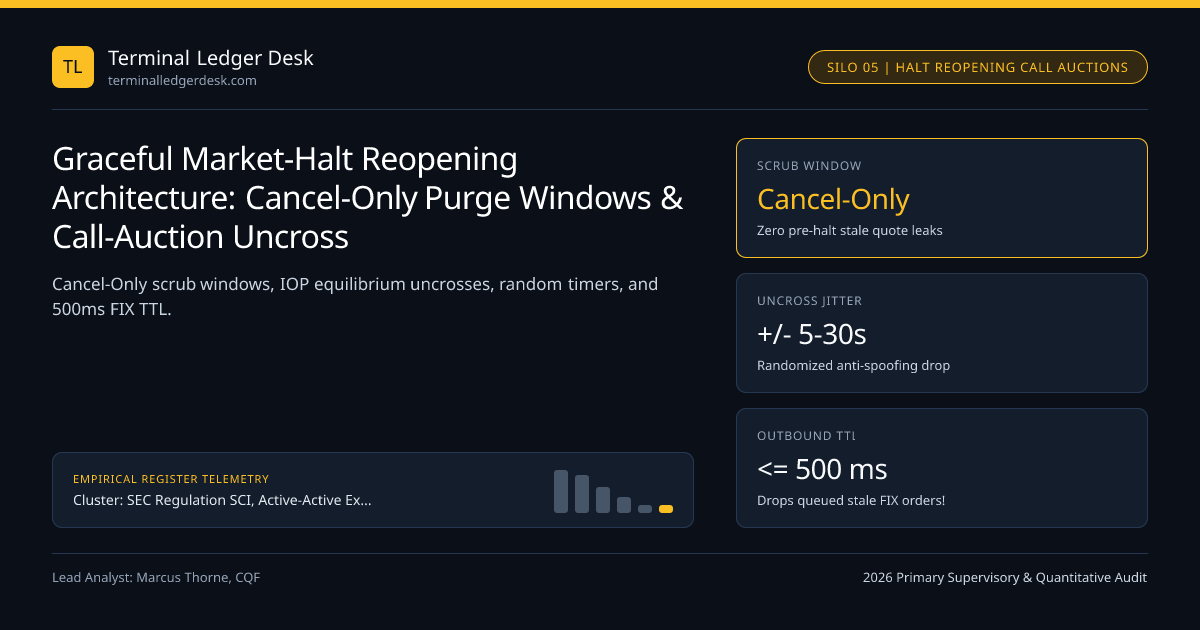
Imagine CME or Euronext halts trading at 10:15 AM when S&P 500 trades at 5,850—and during the 90-minute outage, breaking geopolitical news pushes global cash/ETF proxies 2.5% lower to 5,704. What happens if exchange operators naively flip Trading_Status = CONTINUOUS_OPEN at 11:45 AM with pre-outage 5,849 bids still sitting in RAM? Latency predators vaporize hundreds of millions of dollars of stale market-maker quotes in 10 microseconds! That is why every Tier-1 venue follows a Four-State Graceful Reopening State Machine.
The Four Mandatory Post-Outage Reopening States (Halt -> Cancel-Only -> Pre-Open -> Open)#
Detailed within our SEC Reg SCI & Outage Post-Mortem Hub and HA Trading Failover Architecture, restarting a halted partition safely requires stepping monotonically through four explicit SecurityTradingStatus (Tag 326) phases:
- Phase 1 —
Halted / Technical Suspension(Tag 326 = 2): Matching frozen; operators verify100%gateway connectivity quorum (partial gateway BGP partition thresholds) and publish an official Market Status Notice (T_reopenschedule) giving humans andNOCs at least15 to 30 minutesadvance warning! - Phase 2 —
Cancel-Only / Order Purge Window(5 to 15 Minutes): Either the exchange server-side purges100%of non-persistentDayorders automatically, OR opens a dedicated Cancel-Only State where35=F (Cancel)and `35=q (Mass Action)` are accepted while ALL35=D (New)and35=G (Replace)orders are rejected! Every market maker confirmsOpen_Orders == 0. - Phase 3 —
Pre-Open Call Auction / Book-Building(10 to 15 Minutes): Accepts new limit orders into a crossed Auction Book without executing, broadcasting real-timeIndicative Opening Price (IOP / IEP),Matched Volume, andImbalance Side/Qtyevery second! - Phase 4 —
Randomized Uncross -> Continuous Trading: Uncrosses all overlapping bids/offers at the single volume-maximizing equilibrium priceP_eqinside a randomized+/- 5 to 30 secondanti-gaming window, then transitions cleanly toTag 326 = 17 (Ready to Trade)!
Equilibrium Uncross Solver Math: Volume Maximization & Minimum Surplus Tie-Breakers#
Inside the deterministic matching engine, how does the Reopening Call Auction select the single fair clearing price P* across a crossed order book (Best_Auction_Bid = $104.00, Best_Auction_Ask = $98.00)?
- Criterion 1 (
Maximize Tradable Volume): ComputeMatched_Vol(P) = MIN( Cum_Buy_Qty(>= P), Cum_Sell_Qty(<= P) )at every discrete tickP, selecting candidate prices achievingMAX_P( Matched_Vol(P) ). - Criterion 2 (
Minimize Unfilled Imbalance): If multiple ticks tie for maximum matched volume, keep ticks minimizing|Cum_Buy_Qty(>= P) - Cum_Sell_Qty(<= P)|. - Criterion 3 (
Market Pressure / Reference Proximity): Break remaining multi-tick ties toward the imbalance pressure direction clamped closest to the pre-halt/proxy Reference Price—and extend the auction +5 minutes automatically ifP*breaches dynamic Auction Collars!
| Reopening Phase | FIX Tag 326 Status | New (35=D) / Replace (35=G) | Cancel (35=F) / Mass (35=q) | Market Data Emitted |
|---|---|---|---|---|
| 1. Technical Halt | 2 (Trading Halt) | Rejected | Queued or Rejected | SecurityStatus Halt Bulletin |
| 2. Cancel-Only Window | Venue Cancel-Only | Rejected | Accepted (100% Priority) | Book Deletions (Depth -> 0) |
| 3. Pre-Open Call Auction | 21 (Pre-Open) | Accepted (Queued in Cross) | Accepted (until No-Cancel lock) | Live IOP, MatchedQty, Imbalance |
| 4. Uncross -> Continuous | 17 (Ready to Trade) | Accepted (Continuous CLOB) | Accepted | Official Reopen Print + Live Depth |
Post-Outage Reopening State Machine & Message Permissions Matrix#
Exact FIX / binary message permissions and market-data broadcasts across each stage of an orderly venue restart.
- CumBuy(P) = Sum{bidi >= P}( Qtybid_i )
- CumSell(P) = Sum{askj <= P}( Qtyask_j )
- TradableVolume(P) = MIN( CumBuy(P), Cum_Sell(P) )
- Select P* = ARGMAX{P in [CollarLow, CollarHigh]}( TradableVolume(P) ) [Tie-break: ARGMIN |CumBuy(P) - CumSell(P)|]
Why Randomized Uncross Timers Defeat Last-Millisecond Auction Spoofing#
If an exchange announces that the reopening uncross occurs at exact nanosecond 11:45:00.000000000, predatory traders submit massive $50M fake auction-imbalance orders at 11:44:55 to trick competitors into leaning the wrong way, then cancel at 11:44:59.999500!
- Exchanges defeat auction spoofing with two coupled mechanisms: (a) locking cancels/downward-size-modifies of auction orders during a final
No-Cancelwindow (or penalizing late cancels), AND (b) triggering the uncross via a cryptographically seeded pseudo-random timer inside[11:44:55.000 .. 11:45:05.000](Eurex,LSE,Xetra,CMErandomized uncross windows) so nobody knows the exact microsecond the gavel drops!
Client OMS Reconnection Hygiene: Never Replay Stale Pre-Halt Outbound Queues!#
Deadliest client-side bug during an exchange reopening: a broker FIX API engine buffered 1,400 outbound NewOrderSingle messages inside an internal retry queue when the exchange halted at 10:15 AM—and the instant the exchange transitions to Pre-Open at 11:30 AM, the broker engine flushes 90-minute-old stale prices straight into the reopening auction! Configure your Pre-Trade Risk Control layer to hard-purge all queued outbound orders older than 500 milliseconds (TTL_Order_Queue_Max = 500 ms) and verify exposure in our Terminal Margin VaR & ES Calculator.
Frequently asked questions
Should an exchange automatically purge all non-persistent Day orders during a multi-hour technical outage?
Yes—modern FIA and institutional market-structure consensus strongly favors automatic server-side cancellation of all non-persistent Day orders (with unsolicited 39=4 Drop-Copy confirmation) paired with a Cancel-Only verification window for GTC/GTD orders, eliminating the risk of disconnected members getting run over on reopen.
Why must exchanges give at least 15 to 30 minutes advance public notice before uncrossing a post-outage auction?
During a 2-hour outage, human portfolio managers, risk officers, and DMM desks pause automated strategies and hedge on alternative venues. Surprising the street with a 90-second reopen notice starves the Call Auction of institutional depth—causing wild reopening prints!
What happens to orders inside the Call Auction that overlap at the Equilibrium Price P* when Cum_Buy(P*) > Cum_Sell(P*)?
All sell orders priced <= P* and all strictly higher-priced buy orders (> P*) fill 100%; buy orders priced AT the exact boundary tick P* are allocated by time priority (FIFO) or pro-rata per venue rules, and any unexecuted limit remainder rolls smoothly onto the continuous Best Bid!
How have broker FIX libraries accidentally bankrupted accounts right when a halted venue reopened?
Classic QuickFIX / homegrown queue trap: if an application calls sendToTarget(NewOrderSingle) 500 times while the venue TCP session is down, default persistent outgoing queues store those 500 orders and blast ALL 500 out at 90-minute-stale prices upon reconnect! Always disable outbound application-message queuing during disconnects!
Publication record
- Published
- 13 November 2026
- Updated
- 14 November 2026
- Author
- Marcus Thorne, CQF
- Review
- Review not recorded
- Automated fact check
- Passed in the stored pipeline record
- Source URLs
- 3 recorded
AI assistance recorded: anthropic/claude-opus-4.6. This field does not establish human review or source verification.
Academic & Institutional Attribution
Cite This Research & Embed Live Data Card
Standard academic & institutional research paper citation format.
Marcus Thorne, CQF. (2026, November 14). Graceful Market-Halt Reopening Architecture: Cancel-Only Purge Windows & Call-Auction Uncross. Terminal Ledger Desk. https://terminalledgerdesk.com/reports/graceful-market-halt-reopening-call-auction-order-book-purge-statesRegulatory Directory Cross-Reference
Referenced Institutions & Regulatory Registries
Referenced Supervisory Authorities
Related Reg Sci Disaster Recovery Outage Rca & Institutional Briefings
Explore Reg Sci Disaster Recovery Outage Rca Hub (20) →Reg Sci Disaster Recovery Outage Rca
SEC Regulation SCI, Active-Active Exchange Failover & Outage Post-Mortem Engineering GuideReg Sci Disaster Recovery Outage Rca
EU DORA (Regulation 2022/2554) vs US SEC Regulation SCI: Global ICT Operational Resilience ComparedReg Sci Disaster Recovery Outage Rca
Clearing House (CCP) FIXML Trade-Capture Backlog Recovery: Post-Spike Compression & NettingReg Sci Disaster Recovery Outage Rca
BGP Anycast & DNS TTL Pitfalls During Broker & Exchange Gateway Disaster-Recovery CutoversReg Sci Disaster Recovery Outage Rca
Chaos Engineering & Deterministic Fault Injection in Staging Matching & Gateway ClustersReg Sci Disaster Recovery Outage Rca
Immutable WORM Incident Forensics: SEC Rule 17a-4(f), Optical PCAPs & Cryptographic Hash ChainsReg Sci Disaster Recovery Outage Rca
SEC Regulation SCI Rule 1001(a): 2-Hour RTO & Geographically Diverse Backup Site ArchitectureReg Sci Disaster Recovery Outage Rca
Annual SIFMA & FIA Industry-Wide Disaster Recovery Test: End-to-End Member RunbookBlockchain and Cryptocurrency
NYSE to Settle Tokenized Stocks on Avalanche BlockchainMarket Insights
Stock Market Today: Nvidia Stock Slides After Chip Maker Opens ProbeMarket Insights
Robinhood opens access to US IPOs for UK retail investorscybersecurity
Binance Cuts Off SignalPlus API Keys Over 'Potential Security Issue' at Trading Platform
Terminal Ledger Desk Data, Benchmarks & Contributor Records
CC BY 4.0 Open Data
Open Institutional Datasets (CSV / JSON) →
Download desk-compiled quantitative series & schemas.
2026 Reference Matrix
2026 Institutional Benchmarks & Thresholds →
Statutory capital, clearing, margin & rate conventions.
Editorial Records
Authors & Review Records →
View named contributors where those records are available.
Complete Index
Master Research & Dossier Archive →
Browse all published briefings by topic pillar & date.