
Mifid Rts6 Pretrade Kill Switch Controls
UK FCA MAR 7A & PRA SS5/18 Algorithmic Trading Governance: SM&CR Accountability & Materiality
Operating an algorithmic desk in London Equinix LD4 subjects banks and investment firms to dual UK FCA MAR 7A and PRA SS5/18 supervision—binding Senior Managers personally under SM&CR to algorithmic risk controls.
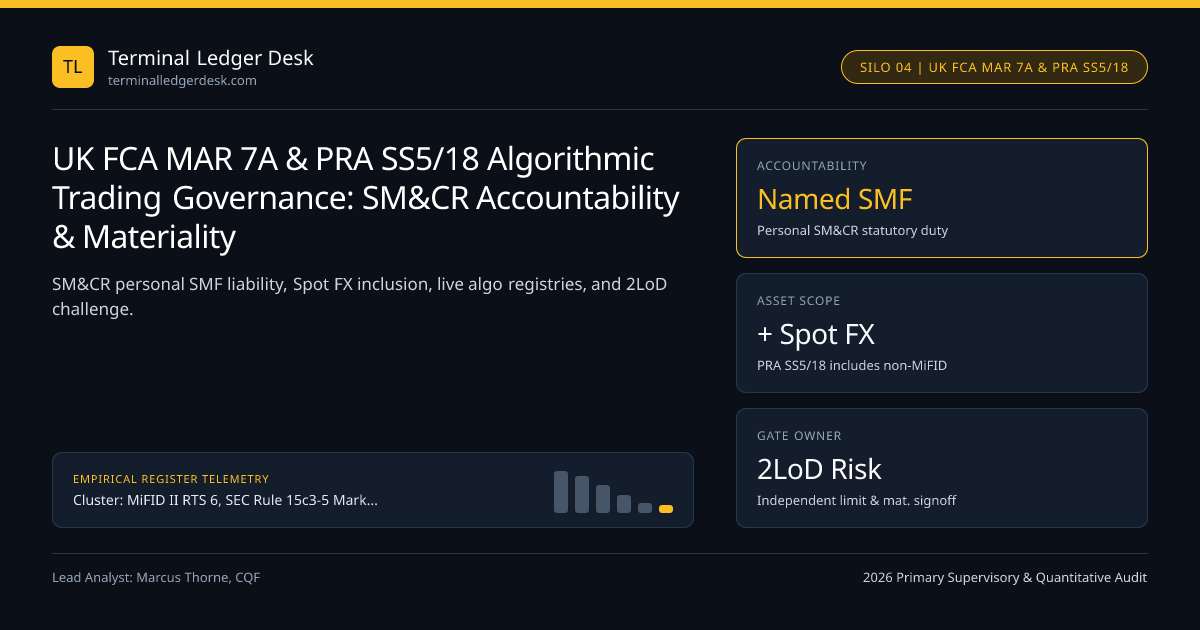
London (Equinix LD4 Slough) sits at the crossroads of global G10 FX, gilt/rates, and European equity algorithmic execution—governed jointly by the UK Financial Conduct Authority (`FCA`) under Handbook MAR 7A / UK Onshored RTS 6 and the Prudential Regulation Authority (`PRA`) under *Supervisory Statement SS5/18 (Algorithmic Trading). What sets the British regime apart globally is personal individual accountability: a named Senior Management Function (SMF)* executive signs personal statutory responsibility for algorithmic governance under the Senior Managers and Certification Regime (SM&CR)!
Dual-Regulated UK Architecture: PRA SS5/18 Prudential Safety vs FCA MAR 7A Market Integrity#
Building on our MiFID II RTS 6 & SEC 15c3-5 Architecture Hub, firms operating inside Equinix LD4 face complementary supervisory lenses:
- PRA
SS5/18(Prudential Solvency & Safety): Applies to PRA-regulated UK banks, building societies, and designated investment firms—including cross-asset non-MiFID instruments such as Spot FX and Cash Deposits!SS5/18demands that algorithmic trading risks never threaten firm capital, liquidity, or operational continuity. - FCA
MAR 7A& UK RTS 6 (Market Conduct & Fair Orderly Markets): Applies to all FCA-authorized algorithmic trading firms and DEA providers, targeting spoofing, quote stuffing, disorderly cascades, and annual validation (RTS 6 annual self-assessment & 2x stress testing).
Five Core Pillars of PRA SS5/18 Inspected in Section 166 Skilled-Person Audits#
When the PRA or FCA commissions a FSMA Section 166 ("Skilled Person") technical audit of an algorithmic desk under the Pre-Trade Risk Control Standard, reviewers examine five concrete deliverables:
- Explicit SMF Statement of Responsibilities (
SoR): Naming the exactSMFholder (e.g. SMF4 Chief Risk Officer/SMF24 Chief Operations/SMF21) accountable for algorithmic trading governance—eliminating diffused committee blame. - Comprehensive Live Algorithm Inventory: A central, real-time metadata registry cataloging every pricing, quoting, hedging, smart-order-routing (
SOR), and execution algorithm (including Spot FX!) with owner, approved venues, risk limits, kill-switch procedure, and currentSHA-256version (canary & SHA-256 deployment gates). - Board-Approved Algorithmic Risk Appetite: Quantitative firm-wide tolerances for intraday exposure, messaging rates, and latency-degradation halts.
- Independent Second-Line (
2LoD) Risk Ownership: Second-line Risk Management and Compliance must independently approve pre-trade control calibration and materiality definitions—never rubber-stamping Front Office (1LoD) self-limits! - Tested Manual & Automated Kill Switches: Clear operational playbooks specifying who pulls the kill switch, how open exposure is verified flat, and who authorizes restart.
| Governance Dimension | UK PRA SS5/18 + FCA MAR 7A | EU MiFID II RTS 6 (ESMA) | US SEC Rule 15c3-5 + FINRA 15-09 |
|---|---|---|---|
| Executive Personal Liability | Named SMF under SM&CR (SoR) | Management body collective duty | Annual CEO Certification (15c3-5(e)) |
| Spot FX Algo Coverage | Explicitly Included (SS5/18 Para 1.4) | Excluded from MiFID (FX Global Code) | Excluded from SEC (CFTC anti-fraud only) |
| Algorithm Inventory | Mandatory comprehensive central register | Implicit via RTS 6 Art. 9 + RTS 24 IDs | Recommended (FINRA 15-09) / Reg SCI |
Third-Party Vendor (ISV) Algos | Full due diligence; firm retains 100% duty | RTS 6 Art. 4/7 vendor testing obligation | Broker retains 15c3-5(d) exclusive duty |
UK PRA SS5/18 vs EU MiFID II RTS 6 vs US SEC 15c3-5 Comparison Matrix#
Highlighting unique UK obligations—Spot FX coverage, SM&CR personal liability, and 2LoD Risk sign-off—versus EU and US peers.
- InApprovedCentralInventory(algoid) == True
- AND DaysSinceLastAnnual2LoDValidation(algoid) <= 365
- AND BinarySHA256 == ApprovedReleaseHash(algoid)
- AND AssignedSMFOwner_Active == True
- )
- If FALSE -> Block LD4 Gateway Session Logon & Escalate to 2LoD Operational Risk!
Why Spot FX & Internalizing B-Book Pricing Engines Fall Inside SS5/18!#
A frequent blind spot for global FX banks and London Prime-of-Prime brokers: under EU MiFID II, rolling Spot FX is technically not a "MiFID Financial Instrument" (governed instead by the voluntary FX Global Code). Not so under UK PRA SS5/18!
- Paragraph
1.4ofSS5/18explicitly extends PRA algorithmic trading expectations to all algorithmic trading activities of a PRA-regulated firm, including unregulated financial instruments such as Spot Foreign Exchange! - Therefore, an automated LD4 Spot FX e-commerce pricing/auto-hedging engine must sit inside the firm Algorithm Inventory, pass pre-release stress testing, and sit behind independent
2LoD-approved Net Open Position (NOP) and kill-switch gates!
Designing an Audit-Ready Algorithm Inventory & Incident Escalation Matrix#
Replace stale Excel spreadsheets with a Git-synced Database Registry linked directly to productionFIX/binary logon gates: if an Algo_ID lacks a current < 12-month annual review sign-off or 2LoD limit approval in the registry, automated morning boot scripts block session startup.
Align Board-approved intraday risk appetite metrics with our Terminal Margin VaR & ES Calculator and Algorithmic Kelly Allocation Calculator.
Frequently asked questions
If our London desk uses a third-party bank or ISV execution algorithm (VWAP/TWAP) rather than writing C++ in-house, does FCA MAR 7A / PRA SS5/18 still apply?
Yes! Both FCA multi-firm reviews and PRA SS5/18 emphasize that using vendor-supplied or broker-supplied algorithms does NOT outsource regulatory responsibility: the firm must include third-party execution algos in its Algorithm Inventory, understand their order-routing parameters/halting behavior, and set appropriate pre-trade limits.
How does PRA SS5/18 interact with the newer UK PRA Model Risk Management standard (SS1/23)?
For UK banks, quantitative pricing and machine-learning alpha/execution models now sit at the intersection of SS5/18 (execution controls, inventories, kill switches) and SS1/23 (model validation, conceptual soundness, drift monitoring)—requiring unified governance registries.
Who should hold the SM&CR Senior Management Function (SMF) allocation for Algorithmic Trading?
PRA SS5/18 allows firms to allocate ownership to the appropriate SMF matching their org structure (commonly SMF24 Chief Operations, SMF4 Chief Risk, or Head of Markets SMF) provided there is unambiguous end-to-end accountability across development, approval, deployment, and controls with zero gaps between SMFs.
Can Front-Office quant developers decide on their own whether a Git pull request is a "Minor" vs "Material" algorithm change?
No! PRA SS5/18 (Paragraph 2.16) explicitly stipulates that the Second Line of Defense (Risk / Compliance) must approve the objective materiality policy criteria and periodically audit 1LoD change classifications to prevent "salami-slicing" major logic rewrites as minor tweaks.
Publication record
- Published
- 13 November 2026
- Updated
- 15 November 2026
- Author
- Marcus Thorne, CQF
- Review
- Review not recorded
- Automated fact check
- Passed in the stored pipeline record
- Source URLs
- 3 recorded
AI assistance recorded: anthropic/claude-opus-4.6. This field does not establish human review or source verification.
Academic & Institutional Attribution
Cite This Research & Embed Live Data Card
Standard academic & institutional research paper citation format.
Marcus Thorne, CQF. (2026, November 15). UK FCA MAR 7A & PRA SS5/18 Algorithmic Trading Governance: SM&CR Accountability & Materiality. Terminal Ledger Desk. https://terminalledgerdesk.com/reports/uk-fca-pra-ss5-18-algorithmic-trading-governance-materiality-auditsRegulatory Directory Cross-Reference
Referenced Institutions & Regulatory Registries
Referenced Supervisory Authorities
Related Mifid Rts6 Pretrade Kill Switch Controls & Institutional Briefings
Explore Mifid Rts6 Pretrade Kill Switch Controls Hub (20) →Mifid Rts6 Pretrade Kill Switch Controls
MiFID II RTS 6, SEC Rule 15c3-5 Market Access & Inline Pre-Trade Kill-Switch Architecture GuideMifid Rts6 Pretrade Kill Switch Controls
Consolidated Audit Trail (CAT) & MiFID II RTS 24: Nanosecond Order-Lifecycle Telemetry EngineeringMifid Rts6 Pretrade Kill Switch Controls
SEC Rule 15c3-5 Market Access Control: Ban on Unfiltered Sponsored Access & Annual CEO AttestationMifid Rts6 Pretrade Kill Switch Controls
MiFID II RTS 6 Compliance: Annual Self-Assessment, 2x Stress Testing & DEA GovernanceMifid Rts6 Pretrade Kill Switch Controls
Inline FPGA Pre-Trade Risk Gateways: Cut-Through FCS Stomping & Sub-Microsecond Credit CollarsMifid Rts6 Pretrade Kill Switch Controls
Dynamic Pre-Trade Price Collars & Fat-Finger Guards: NBBO Reference Anchoring vs Static TicksMifid Rts6 Pretrade Kill Switch Controls
Gross vs Net Intraday Pre-Trade Credit Accounting: Open-Order Exposure & Cancel-Replace InflationMifid Rts6 Pretrade Kill Switch Controls
Exchange Cancel-On-Disconnect (COD): Heartbeat Grace Windows Across CME, Nasdaq & EurexReg Sci Disaster Recovery Outage Rca
Immutable WORM Incident Forensics: SEC Rule 17a-4(f), Optical PCAPs & Cryptographic Hash ChainsDigital Assets
Standard Chartered, 24X Expand Digital Assets Prime Brokerage - Markets MediaBroker Fees and Calculators
Stock market outlook today, 12 Nov: Sensex, Nifty prediction - DJIA, S&P, NASDAQ, GIFT Nifty, Kospi, Nikkei, Taiwan cues - TradingViewBroker Fees and Calculators
Nasdaq turns positive as traders shake off Nvidia CEO exit, AMD shares gain: Live updates
Terminal Ledger Desk Data, Benchmarks & Contributor Records
CC BY 4.0 Open Data
Open Institutional Datasets (CSV / JSON) →
Download desk-compiled quantitative series & schemas.
2026 Reference Matrix
2026 Institutional Benchmarks & Thresholds →
Statutory capital, clearing, margin & rate conventions.
Editorial Records
Authors & Review Records →
View named contributors where those records are available.
Complete Index
Master Research & Dossier Archive →
Browse all published briefings by topic pillar & date.