
Mifid Rts6 Pretrade Kill Switch Controls
MiFID II RTS 6 Compliance: Annual Self-Assessment, 2x Stress Testing & DEA Governance
Commission Delegated Regulation (EU) 2017/589 (MiFID II RTS 6) codifies Europe strictest algorithmic trading rulebook—mandating annual validation reports, 2x peak-volume stress tests, and real-time Direct Electronic Access controls.
Whereas US SEC Rule 15c3-5 focuses primarily on the market-access boundary, MiFID II Regulatory Technical Standard 6 (RTS 6, Commission Delegated Regulation (EU) 2017/589) regulates the entire software engineering lifecycle of investment firms engaged in algorithmic trading across European RM, MTF, and OTF venues. Under RTS 6, every prop desk, market maker, and Direct Electronic Access (DEA) provider must survive twice-peak historical volume stress tests, maintain segregated conformance sandboxes, and file comprehensive Article 9 Annual Self-Assessments ready for national competent authority (BaFin, AMF, AFM, Central Bank of Ireland) inspection on demand.
Structural Anatomy of EU 2017/589: Articles 1 Through 27 Mapped to Engineering#
Supplementing our MiFID II RTS 6 & SEC 15c3-5 Architecture Hub, RTS 6 divides technical obligations into four operational blocks under the Pre-Trade Risk Control Standard:
- Governance & Material Change (
Articles 1–5): Clear lines of accountability, compliance staff empowered to trigger emergency trading halts without developer permission, and segregated sign-off before deploying new or materially modified trading algorithms (canary release & binary checksum deployment gates). - Conformance & Disorderly-Market Testing (
Articles 6–10): Mandatory testing inside venue-supplied conformance sandboxes (Eurex T7 Simulation,Euronext Optiq EUA) plus behavioral tests ensuring strategies do not contribute to disorderly markets under extreme illiquidity. - Pre-Trade Gates & Kill Switch (
Articles 12–17): Automated price collars, maximum order values/volumes, message-rate caps (RTS 9 OTR throttling buckets), and Article 12 immediate unassisted kill switches. - DEA Provider Due Diligence (
Articles 18–23): Prospective client onboarding audits, per-DEA sub-ID tagging (DEA indicatorin RTS 24 order records), and prohibition of unauthorized sub-delegation.
Article 10 Annual Stress Testing: Surviving 2x Peak Historical Message Throughput#
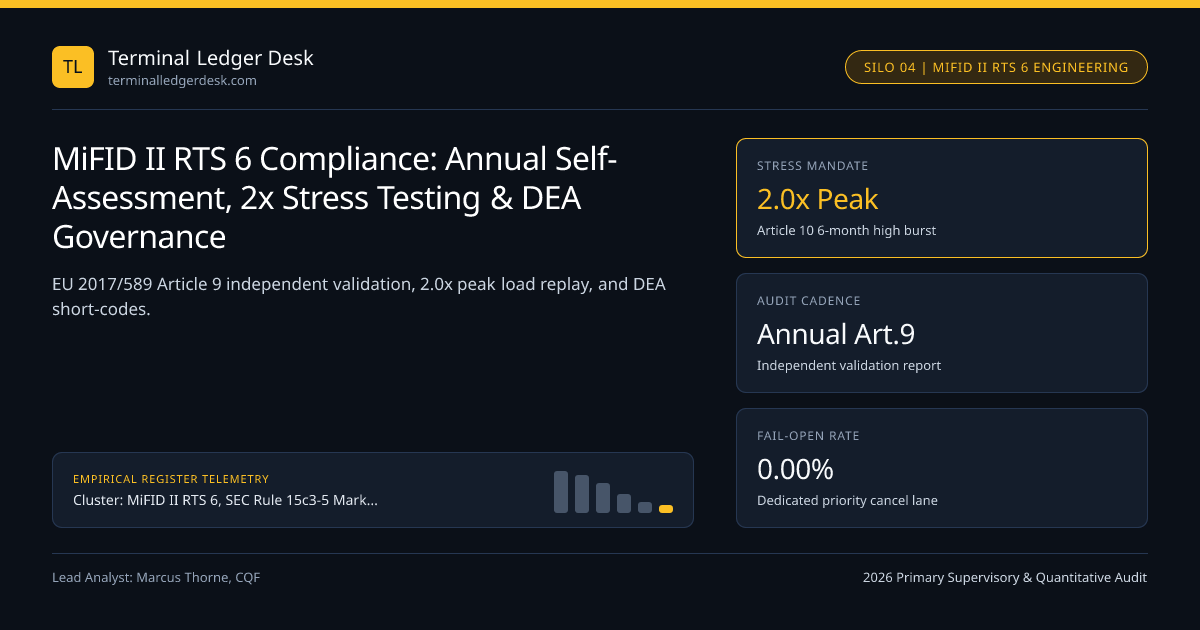
Article 10 of RTS 6 explicitly requires algorithmic trading firms to run annual high-load stress tests running at least twice (2.0x) the highest volume of messages received and sent by the firm over the preceding six months!
Passing an Article 10 test on a Disruptor matching/execution engine requires proving three technical invariants simultaneously:
- Core Strategy & Risk Survival: Pre-trade collar and intraday credit modules remain
100%active without failing open or dropping Drop-Copy execution acks. - Tail-Latency Degradation Bound: Order-cancel (
35=F) andOrderMassActionRequest (35=q)(FIX 35=q kill-switch APIs) continue executing within SLA even when ring buffers hit200%peak message load. - Graceful Backpressure: Instead of OOM-crashing or corrupting sequence counters, saturated gateways shed non-critical telemetry while preserving cancel/risk priority queues.
| MiFID II RTS 6 Article | Regulatory Mandate | Required Technical Control | Audit Evidence Inspected by NCA |
|---|---|---|---|
| Article 5 & 7 | Controlled deployment & venue conformance | Separate dev/UAT/prod environments; mandatory venue sandbox pass | Signed venue conformance certificates + CI/CD release approvals |
| Article 9 | Annual self-assessment & validation | Independent audit of algo inventory, incidents, and risk breaches | Board-submitted Annual Validation Report + remediation tracker |
| Article 10 | High-volume stress testing | Replay >= 2.0x highest 6-month message rate against full risk stack | PCAP replay logs + CPU/NIC p99 telemetry proving fail-closed behavior |
| Article 12 & 15 | Pre-trade limits & unassisted kill switch | Hard price collars, max order notional/qty, OTR caps, instant order pull | Quarterly kill-switch drill timestamps (< 1.5 ms mass purge logs) |
MiFID II RTS 6 Control Matrix by Article & Engineering Artifact#
Mapping key RTS 6 articles to concrete engineering evidence demanded by European and UK regulators during supervisory reviews.
- Worked RTS 6 Article 10 Stress Test Sizing (European Equity & Eurex Market Maker):
- 6-Month Peak 1-Second Burst (ECB Rate Decision) = 62,000 ITCH/EOBI ticks + 14,500 quotes + 15,500 acks
- Peak Observed Total Message Rate (R_peak) = 92,000 messages / second
- Mandatory RTS 6 Stress Injection Rate = 2.0 * 92,000 = 184,000 messages / second
- Pass Criterion: 0 unscreened orders, 0 dropped ExecutionReports, 35=q Kill Switch SLA <= 2.0 ms!
Article 9 Annual Self-Assessment & Independent Validation Report#
Every 12 months, Article 9 obligates the investment firm to execute a formal Self-Assessment and Validation Process culminating in a board-reviewed validation report. Crucially, Article 9(2) dictates that the validation function must be operationally independent from the quantitative researchers and C++ developers who authored the strategies—conducted by dedicated Risk, Internal Audit, or external third-party technical auditors.
In the United Kingdom, post-Brexit onshored RTS 6 rules intersect directly with Senior Managers Regime (SM&CR) personal liability—explored in our companion report on UK FCA MAR 7A & PRA SS5/18 algorithmic governance (UK FCA).
DEA Client Sub-ID Tagging (Tag 1724 / Short Codes) & Kill-Switch Granularity#
When a Tier-1 bank provides Direct Market Access (DMA) or Sponsored Access (SA) to 80 buy-side desks on Eurex T7 or Xetra, Article 20 requires per-client granular kill switches: if Hedge Fund B triggers a runaway loop, the DEA provider must freeze and purge only Hedge Fund B resting orders via its mapped DEA short-code without disrupting the other 79 healthy institutional clients sharing the clearing membership!
Risk teams calibrate RTS 6 Article 15 maximum order value and intraday capital limits using our Terminal Margin VaR & ES Calculator and Algorithmic Kelly Allocation Calculator.
Frequently asked questions
What constitutes a "material change" to a trading algorithm requiring re-testing under RTS 6 Article 5?
Firms must define clear materiality criteria in writing: modifying order-sizing formulas, switching execution aggression (passive to IOC sweep), adding new asset classes, changing message-throttling logic, or refactoring core C++ order-state machines always trigger full sandbox and risk sign-off, whereas recalibrating a bounded regression weight within pre-approved collars may qualify as non-material.
Must Compliance officers be able to trigger the RTS 6 Article 12 Kill Switch without calling IT?
Yes! Article 1(2) and Article 12 explicitly require that compliance and risk staff have at least read-only real-time visibility into algorithmic activity AND direct, unassisted authority/tooling to trigger an emergency trading halt and order purge without waiting for developers.
How are algorithmic IDs tracked in order messages sent to European exchanges?
Every order submitted to an EU venue carries standardized numeric short codes (mapped in venue reference files to long-form MiFID II identifiers) identifying the Investment Decision Within Firm algorithm ID and the Execution Within Firm algorithm ID—enabling instant per-algo surveillance and targeted halts.
Does a non-EU hedge fund accessing Eurex via a Frankfurt DEA broker fall under RTS 6?
While the non-EU fund itself may sit outside direct EU authorization, RTS 6 Articles 18–23 obligate the EU DEA provider to impose full RTS 6 pre-trade collars, kill switches, conformance checks, and due-diligence audits contractually and technically on every third-country DEA client.
Publication record
- Published
- 13 November 2026
- Updated
- 14 November 2026
- Author
- Marcus Thorne, CQF
- Review
- Review not recorded
- Automated fact check
- Passed in the stored pipeline record
- Source URLs
- 3 recorded
AI assistance recorded: anthropic/claude-opus-4.6. This field does not establish human review or source verification.
Academic & Institutional Attribution
Cite This Research & Embed Live Data Card
Standard academic & institutional research paper citation format.
Marcus Thorne, CQF. (2026, November 14). MiFID II RTS 6 Compliance: Annual Self-Assessment, 2x Stress Testing & DEA Governance. Terminal Ledger Desk. https://terminalledgerdesk.com/reports/mifid-ii-rts-6-annual-self-assessment-conformance-stress-testingRegulatory Directory Cross-Reference
Referenced Institutions & Regulatory Registries
Related Mifid Rts6 Pretrade Kill Switch Controls & Institutional Briefings
Explore Mifid Rts6 Pretrade Kill Switch Controls Hub (20) →Mifid Rts6 Pretrade Kill Switch Controls
MiFID II RTS 6, SEC Rule 15c3-5 Market Access & Inline Pre-Trade Kill-Switch Architecture GuideMifid Rts6 Pretrade Kill Switch Controls
Inline FPGA Pre-Trade Risk Gateways: Cut-Through FCS Stomping & Sub-Microsecond Credit CollarsMifid Rts6 Pretrade Kill Switch Controls
Dynamic Pre-Trade Price Collars & Fat-Finger Guards: NBBO Reference Anchoring vs Static TicksMifid Rts6 Pretrade Kill Switch Controls
Gross vs Net Intraday Pre-Trade Credit Accounting: Open-Order Exposure & Cancel-Replace InflationMifid Rts6 Pretrade Kill Switch Controls
Exchange Cancel-On-Disconnect (COD): Heartbeat Grace Windows Across CME, Nasdaq & EurexMifid Rts6 Pretrade Kill Switch Controls
FIX Tag 35=q OrderMassActionRequest & Venue Firm-Level Kill-Switch APIs BenchmarkedMifid Rts6 Pretrade Kill Switch Controls
Self-Match Prevention (SMP): Cancel-Oldest, Cancel-Newest & Decrement-and-Cancel MechanicsMifid Rts6 Pretrade Kill Switch Controls
Order-to-Trade Ratio (OTR) & MiFID II RTS 9: Token-Bucket Message Throttling EngineeringReg Sci Disaster Recovery Outage Rca
Raft & Paxos Replicated State Machines in Matching Engines: Zero-Loss Sub-Millisecond FailoverReg Sci Disaster Recovery Outage Rca
Deterministic Event-Log Replay: Cold vs Warm vs Hot Standby Order-Book ReconstructionReg Sci Disaster Recovery Outage Rca
Multicast A/B Market-Data Feed Arbitration: Air-Gapped Switch Fabrics & Microburst RecoveryReg Sci Disaster Recovery Outage Rca
Exchange Outage Post-Mortem Anatomy: 32-Bit Sequence Wraparounds & Timestamp Epoch Overflows
Terminal Ledger Desk Data, Benchmarks & Contributor Records
CC BY 4.0 Open Data
Open Institutional Datasets (CSV / JSON) →
Download desk-compiled quantitative series & schemas.
2026 Reference Matrix
2026 Institutional Benchmarks & Thresholds →
Statutory capital, clearing, margin & rate conventions.
Editorial Records
Authors & Review Records →
View named contributors where those records are available.
Complete Index
Master Research & Dossier Archive →
Browse all published briefings by topic pillar & date.