
Mifid Rts6 Pretrade Kill Switch Controls
Inline FPGA Pre-Trade Risk Gateways: Cut-Through FCS Stomping & Sub-Microsecond Credit Collars
To enforce SEC Rule 15c3-5 and MiFID II RTS 6 without surrendering queue priority in NY4 or Aurora DC3, Tier-1 prime brokers deploy cut-through FPGA gateways that inspect SBE/OUCH frames in 310 nanoseconds.
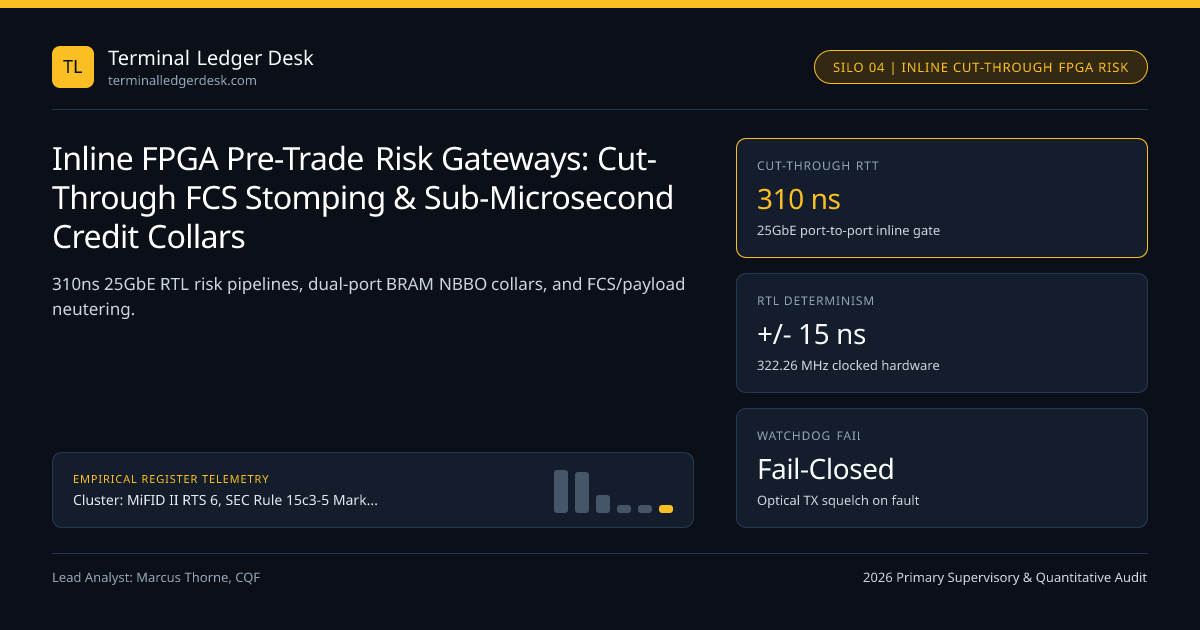
In colocated futures and equity arbitrage inside CME Aurora DC3 and Equinix NY4, the entire round-trip race from market-data tick arrival to outbound order transmission completes in under 950 nanoseconds. Routing that outbound packet through a traditional Linux software risk proxy (40 to 120 microseconds) would increase latency 100-fold! Hardware risk engineering solves this dilemma with broker-exclusive Layer-1/Layer-2 Cut-Through FPGA Risk Gateways (AMD/Xilinx Alveo U50/U55C, Exablaze ExaNIC, Enyx) that inspect 12+ pre-trade collars in 280 to 360 nanoseconds with +/- 15 ns determinism.
Store-and-Forward vs Cut-Through FCS-Stomping FPGA Datapaths#
As outlined in our MiFID II RTS 6 & SEC 15c3-5 Architecture Hub, hardware inline risk appliances operate in one of two Ethernet forwarding modes:
- Store-and-Forward Mode (
~880 to 1,150 ns): The FPGA buffers the entire128-byteTCP/IP + OUCH 5.0orCME iLink 3 SBEframe in Block RAM (BRAM), runs parallel risk comparators, and either transmits the clean packet out the venue SFP28 optical transceiver or drops it silently while synthesizing a TCP reset/reject. - Cut-Through ("FCS Stomping") Mode (
~280 to 340 ns): On10GbE / 25GbElinks (1 byte every 0.8 ns / 0.32 ns), the FPGA begins clocking the Ethernet preamble, MAC/IP/TCP headers, and early payload bytes straight out the exchange-facing TX SERDES before the tail of the packet has even arrived! If the parallel RTL comparators detect a collar or credit breach at byte offset82, the FPGA inverts the final4-byte Ethernet Frame Check Sequence (FCS CRC-32)trailer (~CRC32), guaranteeing the exchange Layer-2 top-of-rack switch discards the corrupted frame at the MAC layer with zero matching-engine impact!
Parallel RTL Clock-Cycle Pipeline: Checking 14 Rules in 48 Clock Ticks#
At a 322.265 MHz (3.10 ns period) FPGA user clock on 25GbE PCS/PMA lanes, deterministic RTL state machines evaluate all Pre-Trade Risk Control Standard checks in parallel rather than sequentially:
- Fixed-Offset Protocol Extraction: Zero-copy extraction of
InstrumentID / Token,Side,OrderQty, andPricedirectly fromCME iLink 3 SBE(NewOrderSingle514) orNasdaq OUCH 5.0byte offsets. - Single-Cycle BRAM Symbol Lookup:
InstrumentIDindexes a dual-portSRAM/BRAMtable returningRestrictedFlag,Multiplier,Live_NBBO_Bid,Live_NBBO_Ask,Collar_Pct(dynamic NBBO price collars), andMax_Clip_Qtyin2 clock cycles(6.2 ns). - DSP48E2 Notional Multiply & Credit Accumulator: Dedicated hardware
DSPslices computePrice * OrderQty * Multiplierin3 cyclesand compare against worst-case open+filled registers (gross vs net intraday credit accounting). - Sliding-Window Token Bucket: Hardware leaky-bucket counters check
100msand1smessage-rate limits (RTS 9 OTR message throttles).
| Risk Gateway Architecture | Median Latency | p99 Jitter | TCP Continuity on Reject | Ideal Protocol Match |
|---|---|---|---|---|
| Cut-Through FPGA (FCS Stomp) | 290–330 ns | +/- 15 ns | Breaks TCP seq -> pair with TCP RST + COD | CME iLink 3 SBE, OUCH 5.0, BOE |
| Cut-Through FPGA (Payload Neuter) | 320–380 ns | +/- 18 ns | Preserves TCP stream (venue app-rejects) | Fixed-length binary (OUCH, SBE) |
| Store-and-Forward FPGA Proxy | 880–1,150 ns | +/- 35 ns | Full dual-TCP termination; clean 35=8 reject | ASCII FIX 4.2/4.4 + Binary |
Solarflare ef_vi C++ Software | 3,400–4,800 ns | +/- 2,900 ns | Full application ExecutionReport (39=8) | Multi-asset DMA / MT5/FIX |
Cut-Through vs Store-and-Forward vs Kernel-Bypass Risk Gateway Matrix#
Comparing wire-to-wire latency, TCP session implications, protocol support, and administrative isolation across risk gateway tiers.
- Worked Cut-Through Feasibility Check (112-Byte TCP+OUCH 5.0 Frame on 25GbE):
- Packet Serialization Duration on 25GbE = (112 bytes * 8 bits) / 25 Gbps = 35.84 ns!
- Wait: On 25GbE, a 112-byte packet serializes in 35.84 ns, whereas Price/Qty sit at bytes 70..86!
- Bytes Remaining After Offset 86 = 112 - 86 = 26 bytes = 208 bits = 8.32 ns before FCS!
- Therefore: RTL must finish BRAM+DSP comparison within 2 clock cycles (6.2 ns) after byte 86,
- OR insert a tiny 12-cycle (37 ns) elastic FIFO so FCS arrives AFTER the 22-cycle DSP check completes!
The TCP Sequence Gap Problem After an FCS Stomp—and How Gateways Recover#
Wait: if a Cut-Through FPGA stomps the Ethernet FCS on an offending TCP packet (Seq = 104,500), the exchange TCP stack never receives those 110 bytes—so when the client sends its next valid order (Seq = 104,610), the exchange sees an out-of-order TCP sequence gap and emits duplicate ACK 104,500s!
Production cut-through risk appliances (Exablaze / Cisco Nexus SmartNIC, Metamako/Arista 7130) solve TCP desynchronization immediately in one of two ways:
- Payload Neuter / No-Op Overwrite (Preferred): Instead of corrupting the Ethernet
FCS(which breaks Layer-4 TCP continuity), if the venue binary protocol begins order side/price early enough—or by overwriting the trailingPrice / TimeInForcebytes into a harmless invalid value (Qty = 0or invalidOrdType) while recomputing valid TCP Checksum + valid Ethernet FCS on the fly—the exchange application cleanly application-rejects the single order while keeping the TCP byte stream100%intact! - Session Kill on Breach: Treating any hard
15c3-5FPGA trip as a critical fault that stompsFCSAND immediately injects a bidirectionalTCP RST, triggering exchange Cancel-On-Disconnect (COD).
Out-of-Band PCIe / Management Plane Isolation for SEC 15c3-5(d)#
When a broker installs an FPGA SmartNIC inside a sponsored-access appliance, physical security and management-plane air-gapping are mandatory: the risk card management NIC connects solely to the broker private VLAN (never the client host PCIe root complex if client-accessible), with signed encrypted bitstreams attested at boot.
Size session-level BRAM notional ceilings using our Terminal Margin VaR & ES Calculator and compare software vs hardware protocols on FIX API.
Frequently asked questions
How does an inline FPGA know the current NBBO bid/ask to check dynamic price collars without CPU lag?
A second optical port on the exact same FPGA subscribes directly to the colocation multicast market-data feed (Nasdaq ITCH or CME MDP 3.0), decoding top-of-book updates in hardware and writing fresh Bid/Ask integers into dual-port BRAM every microsecond—zero PCIe or Linux CPU involvement!
Why is ASCII FIX 4.2 harder to inspect in a cut-through FPGA than CME iLink 3 SBE?
In ASCII FIX, fields like 38=1500| and 44=192.45| appear in arbitrary tag order with variable character lengths and decimal strings, forcing the FPGA to run a byte-by-byte SOH delimiter scanner and ASCII-to-integer multiplier before comparing notional!
What happens if an algorithmic strategy packs two OUCH orders inside a single coalesced TCP segment?
Compliant FPGA risk gateways explicitly inspect TCP payload length against expected message length and either parse multi-message frames iteratively or enforce strict 1-order-per-TCP-segment framing rules (rejecting/stomping coalesced or jumbo segments that attempt to smuggle uninspected trailing orders).
How are executed fills subtracted from open-order credit inside the FPGA?
The FPGA taps the inbound exchange-to-client RX lane simultaneously, parsing ExecutionReport / Executed-Order packets in hardware to decrement resting open-order notional and update net filled exposure atomically within nanoseconds.
Publication record
- Published
- 13 November 2026
- Updated
- 14 November 2026
- Author
- Marcus Thorne, CQF
- Review
- Review not recorded
- Automated fact check
- Passed in the stored pipeline record
- Source URLs
- 3 recorded
AI assistance recorded: anthropic/claude-opus-4.6. This field does not establish human review or source verification.
Academic & Institutional Attribution
Cite This Research & Embed Live Data Card
Standard academic & institutional research paper citation format.
Marcus Thorne, CQF. (2026, November 14). Inline FPGA Pre-Trade Risk Gateways: Cut-Through FCS Stomping & Sub-Microsecond Credit Collars. Terminal Ledger Desk. https://terminalledgerdesk.com/reports/inline-fpga-pretrade-risk-gateways-sub-microsecond-credit-collarsRelated Mifid Rts6 Pretrade Kill Switch Controls & Institutional Briefings
Explore Mifid Rts6 Pretrade Kill Switch Controls Hub (20) →Mifid Rts6 Pretrade Kill Switch Controls
MiFID II RTS 6, SEC Rule 15c3-5 Market Access & Inline Pre-Trade Kill-Switch Architecture GuideMifid Rts6 Pretrade Kill Switch Controls
Dynamic Pre-Trade Price Collars & Fat-Finger Guards: NBBO Reference Anchoring vs Static TicksMifid Rts6 Pretrade Kill Switch Controls
Gross vs Net Intraday Pre-Trade Credit Accounting: Open-Order Exposure & Cancel-Replace InflationMifid Rts6 Pretrade Kill Switch Controls
Exchange Cancel-On-Disconnect (COD): Heartbeat Grace Windows Across CME, Nasdaq & EurexMifid Rts6 Pretrade Kill Switch Controls
FIX Tag 35=q OrderMassActionRequest & Venue Firm-Level Kill-Switch APIs BenchmarkedMifid Rts6 Pretrade Kill Switch Controls
Self-Match Prevention (SMP): Cancel-Oldest, Cancel-Newest & Decrement-and-Cancel MechanicsMifid Rts6 Pretrade Kill Switch Controls
Order-to-Trade Ratio (OTR) & MiFID II RTS 9: Token-Bucket Message Throttling EngineeringMifid Rts6 Pretrade Kill Switch Controls
NMS Limit Up-Limit Down (LULD) Plan: Reference Price Bands, Limit States & 5-Minute PausesReg Sci Disaster Recovery Outage Rca
Deterministic Event-Log Replay: Cold vs Warm vs Hot Standby Order-Book ReconstructionReg Sci Disaster Recovery Outage Rca
Multicast A/B Market-Data Feed Arbitration: Air-Gapped Switch Fabrics & Microburst RecoveryReg Sci Disaster Recovery Outage Rca
Exchange Outage Post-Mortem Anatomy: 32-Bit Sequence Wraparounds & Timestamp Epoch OverflowsReg Sci Disaster Recovery Outage Rca
Exchange Outage Post-Mortem: Opening-Auction Reference-Price Errors & LULD Halt Cascades
Terminal Ledger Desk Data, Benchmarks & Contributor Records
CC BY 4.0 Open Data
Open Institutional Datasets (CSV / JSON) →
Download desk-compiled quantitative series & schemas.
2026 Reference Matrix
2026 Institutional Benchmarks & Thresholds →
Statutory capital, clearing, margin & rate conventions.
Editorial Records
Authors & Review Records →
View named contributors where those records are available.
Complete Index
Master Research & Dossier Archive →
Browse all published briefings by topic pillar & date.