
Mifid Rts6 Pretrade Kill Switch Controls
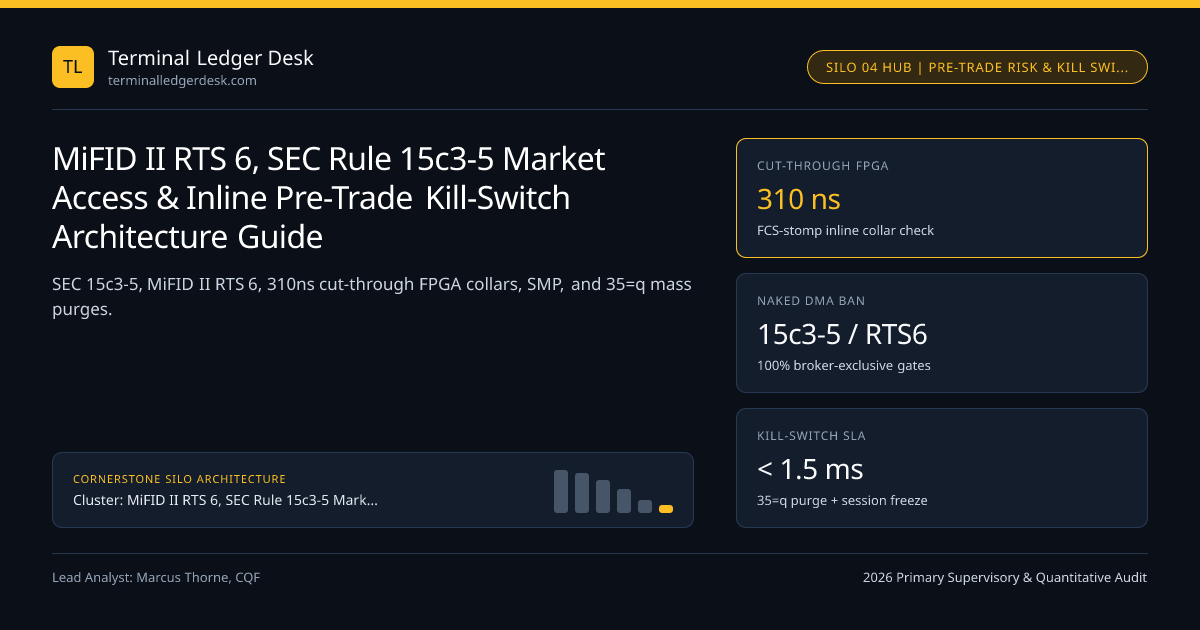
MiFID II RTS 6, SEC Rule 15c3-5 Market Access & Inline Pre-Trade Kill-Switch Architecture Guide
Modern electronic trading venues prohibit unfiltered market access: every algorithmic order must clear sub-microsecond credit, fat-finger collar, locate, and message-throttle gates backed by independent exchange-native kill switches.
On August 1, 2012, a dormant PowerPeg code path deployed across seven of eight production servers at Knight Capital Group sprayed 4 million unintended equity orders into NYSE and Nasdaq in 45 minutes, crystallizing a $440 million pre-tax loss ($163,000 per second) and ending the firm independence. Every regulatory and hardware mandate governing modern market access—from SEC Rule 15c3-5 (17 CFR 240.15c3-5) and CFTC Regulation 1.73 in the United States to MiFID II RTS 6 (Commission Delegated Regulation (EU) 2017/589) and UK PRA SS5/18 in Europe—exists to guarantee that a runaway algorithm is severed in microseconds before breaching clearing capital.
Statutory Foundations: Banning Naked Sponsored Access Across US, EU & UK Venues#
Prior to 2011, ultra-low-latency hedge funds routinely leased a clearing broker Market Participant Identifier (MPID) under Unfiltered ("Naked") Sponsored Access, firing packets straight from customer racks into exchange matching engines while the sponsoring broker audited fills hours later via end-of-day clearing files. Both U.S. SEC and European supervisors outlawed that topology permanently.
Under our Pre-Trade Risk Control Standard, institutional compliance rests on four statutory pillars:
- Broker-Controlled Exclusive Gateways: Examined in SEC Rule 15c3-5 banning unfiltered naked sponsored DMA and CFTC Reg 1.73 FCM automated clearing credit screens overseen by CFTC and FINRA.
- Annual Algorithmic Conformance & Governance: Detailed in MiFID II RTS 6 annual self-assessment & stress testing, UK FCA & PRA SS5/18 materiality governance (UK FCA), and canary release & binary checksum deployment gates.
Sub-Microsecond Inline Enforcement: FPGA Collars, Credit Accounting & Short-Sale Gates#
If a broker-controlled risk gateway adds 85 microseconds of software jitter inside Equinix NY4 or Aurora DC3, latency-sensitive market makers lose every queue race. Consequently, Tier-1 prime brokers enforce mandatory pre-trade checks directly inside cut-through Layer-1/Layer-2 FPGAs (180 to 420 nanoseconds wire-to-wire) or pinned kernel-bypass C++ gateways on FIX API and binary sessions:
- Hardware Cut-Through Inspection: Covered in inline FPGA pre-trade risk gateways & sub-microsecond credit collars and dynamic fat-finger price collars anchored to live NBBO.
- Worst-Case Open-Order Exposure & Locates: Modeled in gross vs net intraday credit exposure & pending-order VaR, SEC Reg SHO Rule 203(b) locate & Rule 201 short-sale circuit gates, and stateful runaway-loop & quote-stuffing detectors.
| Regulatory Framework | Primary Supervisor | Core Statutory Mandate | Mandatory Pre-Trade Controls | Emergency Kill-Switch Requirement |
|---|---|---|---|---|
SEC Rule 15c3-5 (17 CFR 240.15c3-5) | U.S. SEC / FINRA | Bans unfiltered/naked sponsored access | Broker-controlled credit, price collar, duplicate/erroneous & Reg SHO gates | Annual CEO certification + immediate block capability |
MiFID II RTS 6 (EU 2017/589) | ESMA / EU NCAs | Algo governance, annual self-assessment & DEA gates | Price collars, max order value/volume, message-rate caps, 2x stress tests | Article 12 mandatory unassisted Kill Switch (pull all open orders) |
| CFTC Reg 1.73 & 38.255 | CFTC / NFA | Automated FCM clearing risk & DCM ring-fencing | Pre-execution order size & margin credit screens across futures/swaps | Exchange-level Cancel-On-Disconnect + FCM risk-portal mass cancel |
| UK FCA MAR 7A & PRA SS5/18 | UK FCA / UK PRA | Senior Managers (SM&CR) algo inventory & materiality | Board-approved risk appetite, bespoke material-change sign-off, throttles | Tested manual & automated multi-desk kill switches |
Global Pre-Trade Risk & Kill-Switch Regulatory Architecture Matrix#
Comparing statutory scope, mandatory inline checks, latency budgets, and emergency order-purge SLAs across major global regulatory regimes.
- Worked SEC Rule 15c3-5 Pre-Trade Credit Gate Check (Single MPID Equity Session, Cap = $25,000,000):
- Current Executed Net Position = +$8,400,000 Long
- Resting Unfilled Buy Limit Book = $12,200,000 across 340 open orders
- Resting Unfilled Sell Limit Book = $15,900,000 across 410 open orders
- New Inbound Buy Order (10k NVDA) = $1,350,000
- If all Buy orders fill -> |$8.40M + $12.20M + $1.35M| = $21,950,000 <= $25.00M
- If all Sell orders fill -> |$8.40M - $15.90M| = $7,500,000 <= $25.00M
- Conservative Gross Cap -> $8.40M + MAX($12.20M + $1.35M, $15.90M) = $24,300,000 <= $25,000,000 -> PASS (310 ns)!
Multi-Tier Kill Switches, Self-Match Prevention & Exchange Circuit Breakers#
Blocking new inbound orders is never sufficient if 14,000 resting limit quotes remain exposed on the central limit order book during a macro shock. Defense-in-depth execution architecture layers five independent circuit-breaker planes:
- Session-Drop Auto-Purge: Audited in Cancel-On-Disconnect (COD) heartbeat grace windows across CME, Nasdaq & Eurex.
- Explicit Firm & Clearing Purge APIs: Contrasted in FIX Tag 35=q OrderMassActionRequest kill-switch APIs, options market-maker Mass Quote Risk (MMR) delta/vega purges, and out-of-band Drop-Copy shadow clearing kill switches.
- Wash-Trade & Throttle Controls: Analyzed in Self-Match Prevention (SMP) cancel-oldest, cancel-newest & decrement modes and MiFID II RTS 9 Order-to-Trade Ratio (OTR) throttling buckets.
- Venue-Wide Price & Velocity Halts: Benchmarked in NMS Limit Up-Limit Down (LULD) straddle-state pauses and CME Globex Velocity Logic microsecond dynamic circuit breakers.
Forensic Lifecycle Reconstruction: CAT, MiFID RTS 24 & Pre-Trade VaR Sizing#
Every rejected fat-finger order, SMP cancel, and 35=q mass-action freeze must be recorded with synchronized clock-drift attestations inside immutable regulatory ledgers—explored in Consolidated Audit Trail (CAT) & MiFID II RTS 24 nanosecond lifecycle logs.
Execution risk officers calibrate per-session gross credit caps and fat-finger bands quantitatively using our Terminal Margin VaR & ES Calculator, size algorithmic participation limits via the Algorithmic Kelly Allocation Calculator, and track live venue incidents in the Outages & Halts Ledger. Explore all 20 engineering reports in the MiFID RTS 6 & Pre-Trade Risk Topic Hub.
Frequently asked questions
Why did regulators outlaw Naked Sponsored Access even for sophisticated quantitative funds?
Under naked sponsored access, a bug in a client binary shared the sponsoring clearing broker MPID without passing through any broker-owned firewall—meaning a 30-second client infinite loop could bankrupt the clearing broker and destabilize the national market system before post-trade drop-copies even alerted human staff.
Can a hedge fund satisfy SEC Rule 15c3-5 using risk software compiled inside its own trading binary?
No! Rule 15c3-5(d) explicitly mandates "direct and exclusive control" by the broker-dealer with market access. Client-editable configuration files or risk libraries linked inside customer-managed servers fail FINRA examinations unless backed by an independent upstream broker or exchange-administered hard gate.
How can an inline FPGA block a bad order that has already started streaming toward the exchange?
In cut-through mode, the FPGA begins forwarding the Ethernet header and early bytes immediately while decoding price and quantity at fixed SBE/OUCH byte offsets. If a collar breaches mid-packet, the FPGA overwrites the trailing 4-byte Ethernet Frame Check Sequence (FCS CRC-32) with an intentional error—forcing the exchange switch to drop the corrupt frame harmlessly!
What is the difference between a Soft Block and a Hard Kill Switch during an algorithmic incident?
A Soft Block ("Order Entry Freeze") rejects new outbound NewOrderSingle (35=D) and OrderCancelReplaceRequest (35=G) messages while leaving existing quotes untouched or allowing cancels; a Hard Kill Switch simultaneously blocks new entry AND dispatches OrderMassActionRequest (35=q) to purge every resting quote across all venues.
Publication record
- Published
- 14 November 2026
- Updated
- 15 November 2026
- Author
- Marcus Thorne, CQF
- Review
- Review not recorded
- Automated fact check
- Passed in the stored pipeline record
- Source URLs
- 4 recorded
AI assistance recorded: anthropic/claude-opus-4.6. This field does not establish human review or source verification.
Academic & Institutional Attribution
Cite This Research & Embed Live Data Card
Standard academic & institutional research paper citation format.
Marcus Thorne, CQF. (2026, November 15). MiFID II RTS 6, SEC Rule 15c3-5 Market Access & Inline Pre-Trade Kill-Switch Architecture Guide. Terminal Ledger Desk. https://terminalledgerdesk.com/reports/mifid-ii-rts-6-sec-rule-15c3-5-pretrade-risk-kill-switch-sla-guideRegulatory Directory Cross-Reference
Referenced Institutions & Regulatory Registries
Related Mifid Rts6 Pretrade Kill Switch Controls & Institutional Briefings
Explore Mifid Rts6 Pretrade Kill Switch Controls Hub (20) →Mifid Rts6 Pretrade Kill Switch Controls
SEC Rule 15c3-5 Market Access Control: Ban on Unfiltered Sponsored Access & Annual CEO AttestationMifid Rts6 Pretrade Kill Switch Controls
MiFID II RTS 6 Compliance: Annual Self-Assessment, 2x Stress Testing & DEA GovernanceMifid Rts6 Pretrade Kill Switch Controls
Inline FPGA Pre-Trade Risk Gateways: Cut-Through FCS Stomping & Sub-Microsecond Credit CollarsMifid Rts6 Pretrade Kill Switch Controls
Dynamic Pre-Trade Price Collars & Fat-Finger Guards: NBBO Reference Anchoring vs Static TicksMifid Rts6 Pretrade Kill Switch Controls
Gross vs Net Intraday Pre-Trade Credit Accounting: Open-Order Exposure & Cancel-Replace InflationMifid Rts6 Pretrade Kill Switch Controls
Exchange Cancel-On-Disconnect (COD): Heartbeat Grace Windows Across CME, Nasdaq & EurexMifid Rts6 Pretrade Kill Switch Controls
FIX Tag 35=q OrderMassActionRequest & Venue Firm-Level Kill-Switch APIs BenchmarkedMifid Rts6 Pretrade Kill Switch Controls
Self-Match Prevention (SMP): Cancel-Oldest, Cancel-Newest & Decrement-and-Cancel MechanicsReg Sci Disaster Recovery Outage Rca
SEC Regulation SCI, Active-Active Exchange Failover & Outage Post-Mortem Engineering GuideFix Protocol Sbe Ouch Session Latency
FIX 4.4 ASCII Tag-Value Parsing Overhead vs SBE Zero-Copy Wire Struct LatencyFix Protocol Sbe Ouch Session Latency
CME iLink 3 SBE Session Architecture: UUID Negotiation, Establish & HMAC State MachineFix Protocol Sbe Ouch Session Latency
FIXT.1.1 Transport Independence & ApplVerID Routing in FIX 5.0 SP2 Gateways
Terminal Ledger Desk Data, Benchmarks & Contributor Records
CC BY 4.0 Open Data
Open Institutional Datasets (CSV / JSON) →
Download desk-compiled quantitative series & schemas.
2026 Reference Matrix
2026 Institutional Benchmarks & Thresholds →
Statutory capital, clearing, margin & rate conventions.
Editorial Records
Authors & Review Records →
View named contributors where those records are available.
Complete Index
Master Research & Dossier Archive →
Browse all published briefings by topic pillar & date.