
Fix Protocol Sbe Ouch Session Latency
CME iLink 3 SBE Session Architecture: UUID Negotiation, Establish & HMAC State Machine
CME Globex iLink 3 decouples transport authentication from weekly sequence continuity via a two-phase Negotiate (500) and Establish (503) state machine backed by 64-bit session UUIDs and HMAC-SHA256 signatures.
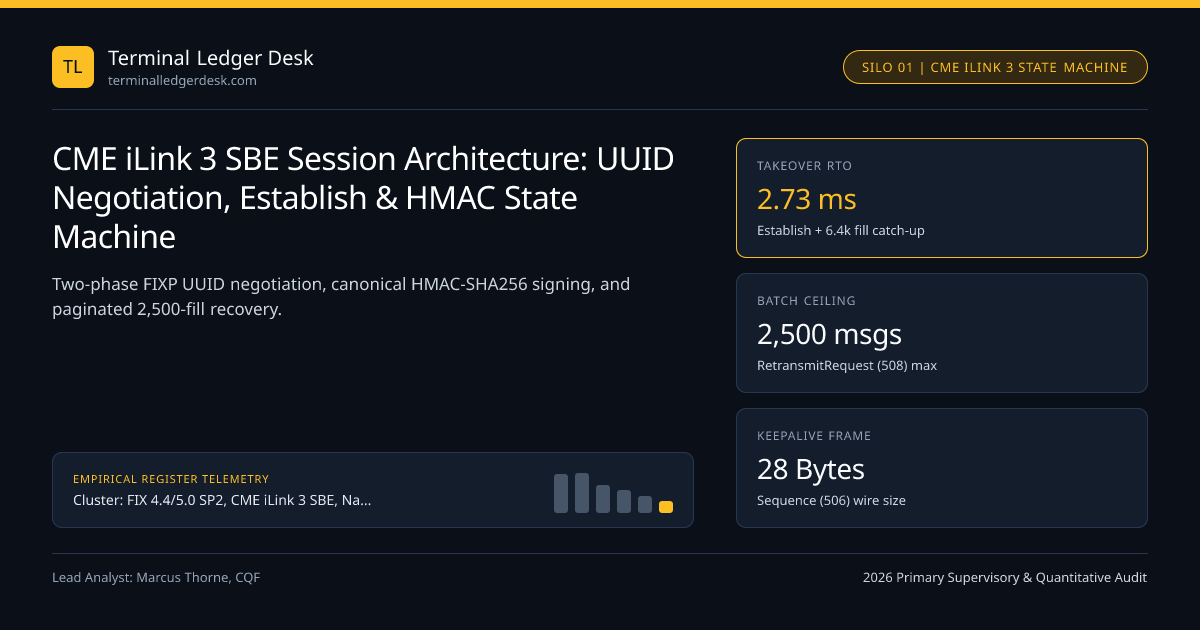
Connecting directly to a CME Globex Market Segment Gateway (MSGW) in Aurora DC3 requires executing a deterministic two-step FIXP binary handshake—Negotiate (TemplateId=500) followed by Establish (TemplateId=503)—signed with a canonical 32-byte HMAC-SHA256 digest before a single NewOrderSingle (514) is accepted. Unlike legacy iLink 2 ASCII Logon (35=A) sessions where CompID restarts risked sequence ambiguity after mid-week hardware crashes, iLink 3 anchors state ownership to an immutable 64-bit client-generated UUID, cutting fault-tolerant primary-to-backup session takeover below 4.5 milliseconds.
Two-Phase FIXP Handshake: Negotiate (500) to Establish (503)#
Traditional FIX 4.2/4.4 conflated cryptographic authentication, session creation, and sequence-gap reconciliation inside a single Logon (35=A) frame. Under the FIX Session Layer (FIXP) specification deployed on CME Globex, session startup separates into two distinct state transitions framed by a 6-byte Simple Open Framing Header (SOFH containing 2-byte messageLength and 2-byte encodingType=0xCAFE for little-endian SBE):
- Phase 1 — Negotiate (Template 500 -> NegotiateResponse 501): Whenever a client establishes a fresh
UUID(typically Sunday evening before weekly Globex open), it sendsNegotiate (500)containing its 20-charAccessKeyID, microsecondRequestTimestamp,UUID,Session,Firm, and a 32-byteHMACSignature. MSGW validates the signature and replies withNegotiateResponse (501), binding theUUIDon the exchange ledger without starting heartbeat timers yet. - Phase 2 — Establish (Template 503 -> EstablishmentAck 504): To transition into active order routing—or to reconnect to an already negotiated
UUIDafter a mid-week socket drop—the gateway sendsEstablish (503)specifyingNextSeqNoandKeepAliveInterval(5,000 to 60,000 ms). MSGW replies withEstablishmentAck (504)reporting itsNextSeqNoandPreviousSeqNo, immediately triggering RetransmitRequest (508) gap recovery if any executions occurred during the disconnect.
Canonical HMAC-SHA256 Signing Pitfalls and Clock-Skew Rejections#
In production certification inside CME New Release environments, over 60% of NegotiationReject (502) and EstablishmentReject (505) failures trace back to malformed canonical HMAC input strings or host clock drift. CME constructs the HMAC-SHA256 message payload by concatenating newline-delimited (\n) ASCII representations of exact header and session fields (RequestTimestamp, UUID, Session, Firm, TradingSystemName, KeepAliveInterval) signed using the base64url-decoded 32-byte SecretKey issued by CME Request Center.
Crucially, MSGW enforces a strict timestamp freshness window around RequestTimestamp to defeat TCP replay attacks. If an execution host inside CME Aurora colocation loses PTPv2 grandmaster lock and drifts beyond the exchange tolerance window, Establish (503) fails immediately. Furthermore, computing base64url decode + SHA256 on the main matching thread adds ~1.8 microseconds of latency; institutional gateways pre-decode the binary key at daemon startup and offload re-establishment signing to a dedicated administrative worker thread.
| Session Feature / Parameter | Legacy CME iLink 2 (Retired) | CME Globex iLink 3 (MSGW) | Institutional FIX 4.4 Prime Hub |
|---|---|---|---|
| Wire Framing & Encoding | ASCII FIX 4.2 + Custom Tags | 6B SOFH (0xCAFE) + SBE v8 | ASCII SOH (0x01) over TLS 1.3 |
| Session Identity Key | SenderCompID (3-char Session + Firm) | 64-bit UUID + 3-char Session + Firm | SenderCompID (49) + TargetCompID (56) |
| Authentication Mechanism | Password / Encrypted Logon Tag | Canonical String + 32B HMAC-SHA256 | Username (553) / Password (554) + mTLS |
| Inbound Gap Notification | Implicit ResendRequest (35=2) | Explicit NotApplied (513) (FromSeqNo, MsgCount) | ResendRequest (35=2) with EndSeqNo |
| Outbound Fill Recovery | Unbounded 35=2 Replay | RetransmitRequest (508) (Max 2,500 msgs) | ResendRequest + Drop Copy |
iLink 3 Session State Machine & Fault-Tolerant Failover Matrix#
CME supports native active-standby high-availability failover architectures using the FaultToleranceIndicator (FTI) enum (0=Backup, 1=Primary). Below is the operational state-transition matrix across CME Globex MSGW ports compared with legacy iLink 2 and multi-asset broker FIX endpoints.
- Trecovery = Nbatches * (RTTaurora + Tmsgwfetch + 2500 * Tsbe_parse)
- Where:
- Seqmsgwprev = EstablishmentAck.PreviousSeqNo reported by CME MSGW
- Seqclientlast = Last durable inbound sequence committed to OMS NVMe log
- RTT_aurora = 85 us (Aurora DC3 GLink cross-connect round-trip + gateway queue)
- Tmsgwfetch = 420 us per 2,500-message historical cache slice
- Tsbeparse = 0.19 us per ExecutionReport (Templates 522–525)
- Worked Failover Recovery (6,400 missed fills during blade switchover):
- Gap = 6,400 messages -> N_batches = ceil(6400 / 2500) = 3 batches
- T_recovery = 3 * (85 us + 420 us) + (6,400 * 0.19 us)
- = 1,515 us + 1,216 us = 2,731 us (2.73 milliseconds total catch-up).
Managing UUID Lifecycles Across Primary/Backup Takeover and Retransmit Caps#
When a primary execution server suffers a NIC link loss in Aurora DC3, the warm-standby server—already replicating outbound sequence state via RDMA or multicast—promotes itself by sending Establish (503) with the identical UUID, FTI=Primary, and the next expected sequence number. Should a crash leave the backup node uncertain of the final 2–3 in-flight packets, engineers face a strategic choice: reuse the UUID and parse EstablishmentAck.PreviousSeqNo to reconcile, or generate a brand-new UUID via Negotiate (500) while fetching missed fills via PreviousUUID and RetransmitRequest (508).
Unlike ASCII FIX ResendRequest (35=2) where open-ended EndSeqNo=0 can flood the socket (see FIX ResendRequest vs SequenceReset-GapFill storm control), CME iLink 3 strictly caps a single RetransmitRequest (508) at 2,500 messages. If an OMS falls 8,200 fills behind during an outage, its recovery state machine must slice the gap into four sequential 2,500-message windows (1..2500, 2501..5000, 5001..7500, 7501..8200), otherwise MSGW returns RetransmitReject (510). Pair this session logic with MDP 3.0 incremental book arbitration and Terminal Margin VaR & ES checks before re-enabling quoting under CFTC rules.
Sequence Liveness: Sequence (506) KeepAlive vs Application Traffic#
In FIXP iLink 3, administrative heartbeats are replaced by the ultra-compact 22-byte Sequence (506) message (UUID, NextSeqNo, FaultToleranceIndicator, KeepAliveIntervalLapsed). Any outbound application frame (NewOrderSingle 514, OrderCancelReplaceRequest 515, OrderCancelRequest 516) resets the sender's KeepAliveInterval countdown, eliminating redundant heartbeat noise during active quoting.
However, if zero messages arrive from MSGW before KeepAliveInterval expires, the client sends Sequence (506) with KeepAliveIntervalLapsed=1. If a second interval elapses without a response, the gateway must immediately sever the socket, trigger local risk halts, and initiate backup MSGW failover rather than risking blind order transmission into a blackholed path—a critical complement to FIX Heartbeat and TCP half-open socket detection. Review further binary gateway implementations across our FIX, SBE & OUCH Topic Hub and FIX API software directory.
Frequently asked questions
When should a CME iLink 3 gateway send Negotiate (500) versus jumping straight to Establish (503)?
Send Negotiate (500) followed by Establish (503) only when initializing a brand-new 64-bit UUID, such as at the Sunday Globex weekly open or after an unrecoverable local state loss. For mid-week reconnects or warm-standby failovers reusing the active UUID, send Establish (503) directly.
How should an OMS respond when CME MSGW sends a NotApplied (513) message?
NotApplied (513) notifies the client that MSGW received an order with a sequence number higher than expected, specifying FromSeqNo and MsgCount. The OMS should either retransmit those exact application frames if still valid, or send a Sequence (506) message advancing NextSeqNo past stale quotes to skip execution.
Can an iLink 3 client recover fills from an older UUID after re-negotiating a new UUID mid-week?
Yes. RetransmitRequest (508) includes an explicit LastUUID field. By populating LastUUID with the prior 64-bit session identifier while connected under the new UUID, the OMS can retrieve up to 2,500 historical ExecutionReports per batch from the previous session.
What value should engineers use when generating the 64-bit session UUID in iLink 3?
CME recommends using the current UTC epoch timestamp in microseconds or nanoseconds as the unsigned 64-bit UUID. Monotonically increasing timestamp UUIDs guarantee uniqueness across weekly resets and simplify chronological audit trail correlation across primary and backup hosts.
Publication record
- Published
- 14 November 2026
- Updated
- 14 November 2026
- Author
- Marcus Thorne, CQF
- Review
- Review not recorded
- Automated fact check
- Passed in the stored pipeline record
- Source URLs
- 3 recorded
AI assistance recorded: anthropic/claude-opus-4.6. This field does not establish human review or source verification.
Academic & Institutional Attribution
Cite This Research & Embed Live Data Card
Standard academic & institutional research paper citation format.
Marcus Thorne, CQF. (2026, November 14). CME iLink 3 SBE Session Architecture: UUID Negotiation, Establish & HMAC State Machine. Terminal Ledger Desk. https://terminalledgerdesk.com/reports/cme-ilink-3-sbe-uuid-session-negotiation-establish-state-machineRelated Fix Protocol Sbe Ouch Session Latency & Institutional Briefings
Explore Fix Protocol Sbe Ouch Session Latency Hub (20) →Fix Protocol Sbe Ouch Session Latency
FIX 4.4/5.0 SP2, CME iLink 3 SBE & Nasdaq OUCH 5.0 Session Latency Architecture GuideFix Protocol Sbe Ouch Session Latency
FIXT.1.1 Transport Independence & ApplVerID Routing in FIX 5.0 SP2 GatewaysFix Protocol Sbe Ouch Session Latency
FIX ResendRequest (35=2) vs SequenceReset-GapFill (35=4): Preventing Replay StormsFix Protocol Sbe Ouch Session Latency
PossDupFlag (Tag 43) vs PossResend (Tag 97): Idempotent FIX Execution DeduplicationFix Protocol Sbe Ouch Session Latency
FIX Drop-Copy (35=8) Reconciliation Gateways: Shadow Position & Clearing ArchitectureFix Protocol Sbe Ouch Session Latency
Nasdaq OUCH 5.0 Binary Order Entry: SoupBinTCP Framing & Optional Tag AppendagesFix Protocol Sbe Ouch Session Latency
Nasdaq TotalView-ITCH 5.0 & MoldUDP64: L3 Multicast Order Book ReconstructionFix Protocol Sbe Ouch Session Latency
CME MDP 3.0 SBE Market Data: A/B Multicast Arbitration & Snapshot SynchronizationMatching Engine Clob Colocation Ptp
FIFO Price-Time vs Pro-Rata Matching Algorithms: CME Split, LMM & TOP MechanicsMatching Engine Clob Colocation Ptp
US Equities Liquidity Triangle: Equinix NY4, ICE Mahwah & Nasdaq Carteret SLAsMatching Engine Clob Colocation Ptp
Equinix LD4 Slough FX Colocation Topology: LMAX, EBS, Currenex & Prime BridgesMatching Engine Clob Colocation Ptp
Multi-Region Colocation Architecture: CME Aurora, Equinix FR2 Frankfurt & TY3 Tokyo
Terminal Ledger Desk Data, Benchmarks & Contributor Records
CC BY 4.0 Open Data
Open Institutional Datasets (CSV / JSON) →
Download desk-compiled quantitative series & schemas.
2026 Reference Matrix
2026 Institutional Benchmarks & Thresholds →
Statutory capital, clearing, margin & rate conventions.
Editorial Records
Authors & Review Records →
View named contributors where those records are available.
Complete Index
Master Research & Dossier Archive →
Browse all published briefings by topic pillar & date.