
Matching Engine Clob Colocation Ptp
FIFO Price-Time vs Pro-Rata Matching Algorithms: CME Split, LMM & TOP Mechanics
While equities and equity-index futures reward sub-microsecond queue entry via Price-Time FIFO, short-term interest-rate (SOFR) and options venues allocate fills via Pro-Rata size fractions, TOP overlays, and Split FIFO/Pro-Rata hybrids.
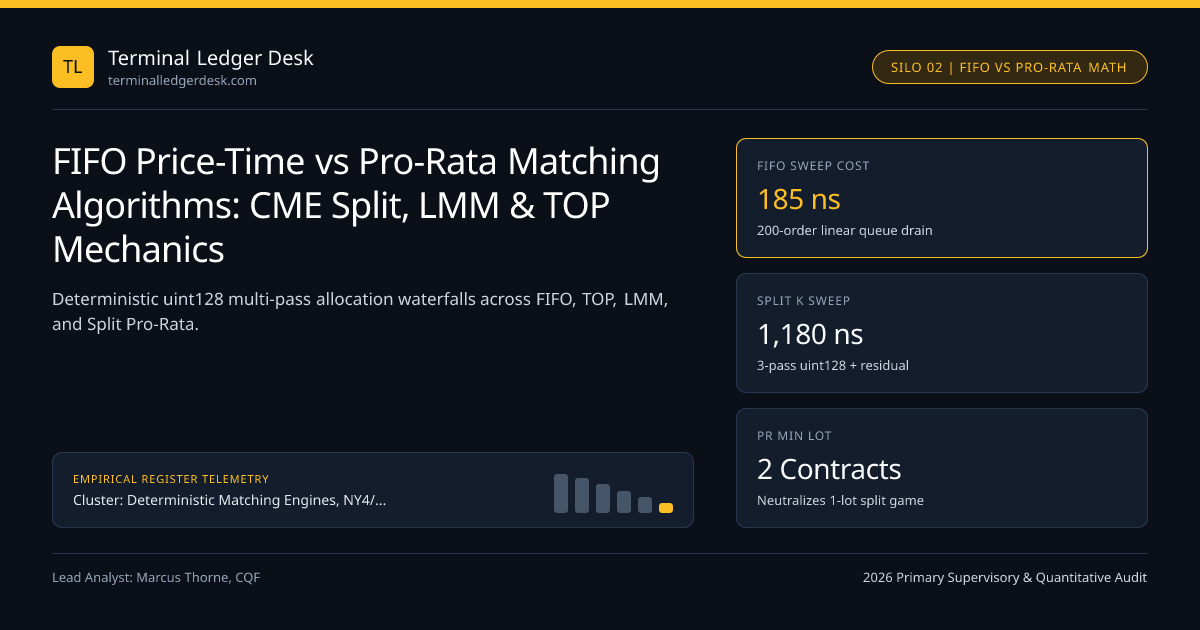
Not every Central Limit Order Book rewards the fastest trader to arrive at a price level. While cash equities (Nasdaq, NYSE, Cboe) and CME E-mini S&P 500 (ES) run pure Price-Time FIFO—where Order #1 must fill 100% before Order #2 receives a single lot—short-term interest-rate (STIR) futures like CME Three-Month SOFR (SR3) and multi-listed US equity options (Cboe, ISE, PHLX) run Pro-Rata and Split FIFO / Pro-Rata algorithms (CME Algorithm K, C, T, F). Under Pro-Rata, arriving 50 milliseconds late still captures 40% of an incoming sweep if you quote 40% of visible book size—fundamentally inverting execution strategy, over-quoting risk, and matching-engine CPU math!
Pure Price-Time FIFO (Algorithm F): Speed Races & Queue-Position Alpha#
In pure Price-Time FIFO (First-In, First-Out), every price level is an intrusive doubly-linked queue sorted strictly by exchange gateway arrival sequence. Matching an aggressive 500-lot sweep requires zero division instructions: the engine simply drains head orders sequentially until 500 lots fill.
Economically, FIFO incentivizes sub-microsecond latency competition at the exact tick when an old price level clears and a new tick opens—driving demand for FPGA cut-through pipelines inside CME Aurora. However, on ultra-thick 1-tick spread instruments (like 3-Month SOFR SR3 where 150,000+ contracts sit on the best bid for hours), pure FIFO paralyzes liquidity turnover because newcomers sitting behind 150,000 contracts have zero hope of filling without crossing the spread.
Pure Pro-Rata, TOP (Top Order), LMM & CME Split FIFO/Pro-Rata Pass Cascades#
To keep thick interest-rate and options books liquid, CME Globex and options exchanges execute multi-pass deterministic allocation cascades (MatchAlgorithm field in CME MDP 3.0 MDInstrumentDefinition):
- TOP (
Top Order PriorityOverlay): Before splitting lots proportionally, the single resting order that established the new Best Bid/Offer first receives100%of its size up to a venueTOP_Cap(e.g.,min(OrderQty, 200 lots)), rewarding price-improving pioneers! - LMM (
Lead Market MakerAllocation): Designated market makers meeting continuous two-sided quoting SLAs capture a fixed contractual percentage (e.g., 15%–40%) ahead of general Pro-Rata. - Split
FIFO+Pro-Rata(Algorithm K— e.g.,40% FIFO / 60% Pro-Rata):X%of the aggressor order fillsFIFOfrom the queue head, and the remaining(100 - X)%distributes across all resting orders at that price via integer floor rounding:alloc_i = floor(RemQty * restingQty_i / TotalLevelQty). - Residual Lot Pass (
FIFOor Largest-Order): Fractional rounding remainders (1 lotper order) go sequentially by size-then-time untilaggressorLeaves == 0!
| Market / Product | CME / Venue Code | Allocation Waterfall | Primary Alpha / Execution Edge |
|---|---|---|---|
US Equities & CME E-mini (ES, NQ) | F (Pure FIFO) | 100% Price-Time Arrival | Sub-microsecond Aurora / Carteret queue entry |
CME 3-Month SOFR (SR3) & Eurodollar | K / C (Split / TOP+PR) | TOP -> LMM -> FIFO% -> Pro-Rata -> Resid | Optimal quote sizing + instant sweep cancel |
CME US Treasury Futures (ZF, ZN) | F or K (Contract-specific) | Pure FIFO (ZN/ZB) or Split (ZT) | Implied-spread + cash-futures basis speed |
| US Equity Options (Cboe, ISE, MIAX) | Customer-Overlay PR | Public Customer FIFO -> PMM/LMM -> Pro-Rata | Mass-Quote MMR protection + Volatility skew |
Exchange Matching Algorithm Matrix Across Global Asset Classes#
Comparing venue-specific allocation waterfalls and resulting strategic equilibrium across US equities, CME futures, and US options.
- Qprrem = Qagg - Qtop - Qfifopass
- AllocPR(i) = ( floor( (Qprrem * qi) / Qlevelrem ) >= 2 ) ? floor( (Qprrem * qi) / Qlevel_rem ) : 0
- Qresiduallots = Qprrem - Sum{i=1..N}( AllocPR(i) )
- Worked Split 40% FIFO / 60% Pro-Rata Fill (No TOP, Q_agg = 500 lots, Resting = [A: 1000, B: 2000, C: 2000]):
- Pass 1 (40% FIFO = 200 lots) : Order A fills 200 lots -> Remaining resting: [A: 800, B: 2000, C: 2000] (Total = 4,800)
- Pass 2 (60% PR = 300 lots) : A gets floor(300800/4800)=50; B gets floor(3002000/4800)=125; C gets 125 (Sum = 300, Residual = 0)
- Final Total Fills : Order A = 250 lots (50%), Order B = 125 lots (25%), Order C = 125 lots (25%).
Fixed-Point 128-Bit Integer Division & Over-Quoting Risk Controls#
Inside a deterministic matching core (see our Deterministic Matching Engines & Colocation Guide), IEEE-754 floating-point math (double) is strictly forbidden for Pro-Rata splits because minor rounding differences between Intel and AMD FPU pipelines or compiler flags could cause primary and backup state machines to diverge by 1 lot! Instead, matching engines compute exact integer quotients using uint128_t ((__uint128_t)remQty * orderQty / totalLevelQty).
For trading desks, Pro-Rata creates a dangerous over-quoting trap: to win 100 lots of an expected 1,000-lot sweep on a 9,000-lot book, a trader quotes 1,000 lots (10% book share). What if a macro shock unleashes a 50,000-lot sweep that fills all 1,000 lots instantly—10x desired risk?! Institutional EMS gateways wire CFTC-mandated mass-cancel purges and size Pro-Rata tail exposure in the Terminal Margin VaR & ES Calculator.
Minimum Pro-Rata Thresholds (MinLot = 2) & Tail-Split Gaming Prevention#
If CME rounded fractional Pro-Rata shares nearest (>= 0.5 -> 1), a trader could split 1,000 lots into 1,000 separate 1-lot orders to steal rounding residuals! Exchanges defeat order-splitting gaming via two strict rules:
- Strict
floorTruncation + Minimum2-LotThreshold: On CME Pro-Rata books, any computedfloorshare< 2 lots(0or1) receives zero lots during the Pro-Rata pass (MinAlloc = 2), deferring tiny quotes to the residual FIFO tail! - Size-Then-Time Residual Tie-Breaking: Residual lots allocate largest-resting-order-first, rewarding genuine size commitment on FIX API and iLink 3 sessions. Explore more order-book mechanics in the Matching Engine, Colocation & PTP Topic Hub.
Frequently asked questions
What is a TOP (Top Order Priority) overlay in CME Globex Pro-Rata matching?
When a trader places the very first order that improves the market to establish a brand-new Best Bid or Best Offer, CME stamps that order with Top Order status—guaranteeing it fills 100% (up to a contract-defined cap/min) before general Pro-Rata size splitting begins.
Does modifying order quantity upward lose TOP status or FIFO priority on Pro-Rata books?
Yes. Increasing order quantity cancels TOP pioneer status and resets the order timestamp to the tail of the FIFO residual queue, whereas decreasing order quantity preserves existing time priority (subject to minimum TOP size retention rules).
Why do US equity options exchanges prioritize Public Customer orders ahead of Pro-Rata market makers?
Under SEC-approved options exchange rules on Cboe, Nasdaq ISE/PHLX, and MIAX, non-professional Public Customer limit orders resting at the NBBO execute in Price-Time FIFO ahead of both Lead Market Maker participation guarantees and Pro-Rata professional quotes.
How do trading algorithms manage over-quoting risk on CME SOFR Pro-Rata books?
Algorithms monitor real-time cumulative sweep volume across correlated expiries via CME MDP 3.0 Feed A/B; the microsecond sweep volume crosses a preset threshold or adjacent contract ticks break, an iLink 3 OrderMassActionRequest (35=q) purges remaining inflated quotes.
Publication record
- Published
- 14 November 2026
- Updated
- 14 November 2026
- Author
- Marcus Thorne, CQF
- Review
- Review not recorded
- Automated fact check
- Passed in the stored pipeline record
- Source URLs
- 3 recorded
AI assistance recorded: anthropic/claude-opus-4.6. This field does not establish human review or source verification.
Academic & Institutional Attribution
Cite This Research & Embed Live Data Card
Standard academic & institutional research paper citation format.
Marcus Thorne, CQF. (2026, November 14). FIFO Price-Time vs Pro-Rata Matching Algorithms: CME Split, LMM & TOP Mechanics. Terminal Ledger Desk. https://terminalledgerdesk.com/reports/fifo-price-time-vs-pro-rata-allocation-matching-algorithm-mechanicsRelated Matching Engine Clob Colocation Ptp & Institutional Briefings
Explore Matching Engine Clob Colocation Ptp Hub (20) →Matching Engine Clob Colocation Ptp
Deterministic Matching Engines, NY4/LD4/TY3 Colocation & PTPv2 Clock Sync GuideMatching Engine Clob Colocation Ptp
US Equities Liquidity Triangle: Equinix NY4, ICE Mahwah & Nasdaq Carteret SLAsMatching Engine Clob Colocation Ptp
Equinix LD4 Slough FX Colocation Topology: LMAX, EBS, Currenex & Prime BridgesMatching Engine Clob Colocation Ptp
Multi-Region Colocation Architecture: CME Aurora, Equinix FR2 Frankfurt & TY3 TokyoMatching Engine Clob Colocation Ptp
Solarflare Onload / ef_vi vs DPDK Kernel Bypass: NIC RX/TX Ring & PIO TuningMatching Engine Clob Colocation Ptp
FPGA Tick-to-Trade Pipelines: Cut-Through PCS/MAC & Sub-200ns Order TriggeringMatching Engine Clob Colocation Ptp
IEEE 1588v2 PTP Clock Synchronization: GNSS Grandmasters, Boundary Clocks & NIC PHCMatching Engine Clob Colocation Ptp
MiFID II RTS 25 & FINRA CAT Clock Drift Audits: 100us HFT Traceability ComplianceMt5 Ctrader Bridge Dealer Architecture
A-Book STP, B-Book Internalization & C-Book Hybrid Dealing Desk ClassifiersMt5 Ctrader Bridge Dealer Architecture
Virtual Dealer Plugins vs True Market Execution: Auditing Asymmetric SlippageMt5 Ctrader Bridge Dealer Architecture
MT5 Execution Modes & Fill Policies: Instant, Request, Market, Exchange & IOC/FOKMt5 Ctrader Bridge Dealer Architecture
Decoding MT5 & cTrader Client Journal Logs: Millisecond TCA, Requotes & Off Quotes
Terminal Ledger Desk Data, Benchmarks & Contributor Records
CC BY 4.0 Open Data
Open Institutional Datasets (CSV / JSON) →
Download desk-compiled quantitative series & schemas.
2026 Reference Matrix
2026 Institutional Benchmarks & Thresholds →
Statutory capital, clearing, margin & rate conventions.
Editorial Records
Authors & Review Records →
View named contributors where those records are available.
Complete Index
Master Research & Dossier Archive →
Browse all published briefings by topic pillar & date.