
Matching Engine Clob Colocation Ptp
Solarflare Onload / ef_vi vs DPDK Kernel Bypass: NIC RX/TX Ring & PIO Tuning
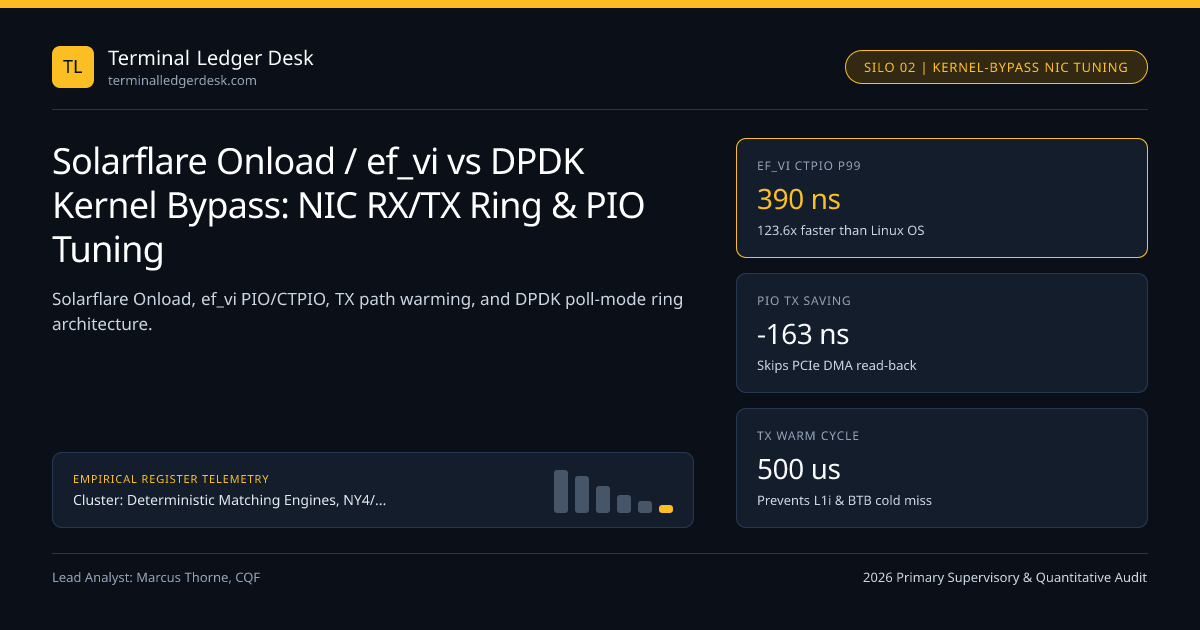
Standard Linux socket syscalls burn 8 to 15 microseconds in interrupt and sk_buff overhead; AMD/Solarflare ef_vi Programmed I/O (PIO) and Onload user-space stacks trim host RX/TX latency down to 290 nanoseconds.
When an ITCH 5.0 or CME MDP 3.0 UDP frame hits a standard Linux server NIC, the hardware raises a MSI-X interrupt, wakes the kernel NAPI softirq handler, allocates an sk_buff, traverses iptables/netfilter, copies payload bytes across the ring-0/ring-3 Spectre/KPTI boundary, and finally unblocks epoll_wait—burning 8 to 15 microseconds before your strategy sees byte zero! Inside Equinix NY4 and CME Aurora, institutional C++/Rust gateways eliminate the OS kernel from the packet datapath using three distinct architectures: OpenOnload (LD_PRELOAD POSIX TCP/UDP), ef_vi (EtherFabric Virtual Interface Layer-2 direct rings), and DPDK Poll-Mode Drivers (PMD).
OpenOnload vs ef_vi vs DPDK: Choosing the Right Kernel-Bypass Layer#
Not every kernel-bypass framework solves the same trading problem—picking DPDK for single-session exchange TCP order entry often backfires:
- AMD/Solarflare OpenOnload (
X2522/X3522NICs): Intercepts standard POSIXsocket,recv, andsendviaLD_PRELOAD, running a battle-tested RFC-compliant TCP/IP state machine entirely inside user space mapped directly to NIC hardware queues (VI). Zero application code rewrite;~1.05 ushalf-RTT; preserves Linux ARP/routing control plane. - Solarflare
ef_vi+ Custom User-Space TCP (TCPDirect/ Custom): Exposes raw Layer-2 DMA RX descriptor rings and Programmed I/O (PIO) TX buffers directly to C++. Ideal for raw UDP multicast (ITCH/MDP 3.0) and single-connection binary order ports (OUCH 5.0,iLink 3 SBE), hitting280–340 nsTX+RX! - DPDK (
mlx5Mellanox/NVIDIA ConnectX-6/7 or Intel E810): Detaches the entire NIC port (or bifurcated queue inmlx5) into avfio-pciPoll-Mode Driver capable of saturating100GbEline rate (148.8 Mpps), yet requires bundling an external user-space TCP stack (F-Stack,mTCP, or custom) for TCP exchange sessions.
Programmed I/O (PIO) vs Bus-Master DMA on Outbound Order Bursts#
How a NIC fetches your 64-byte outbound OUCH EnterOrder packet makes a 110-nanosecond difference! Under standard DMA TX, your CPU writes a ring descriptor and rings a PCIe doorbell; the NIC must then issue a PCIe Memory Read Request TLP back across the root complex to pull payload bytes (~160 ns PCIe round-trip penalty).
With Solarflare Programmed I/O (ef_pio) (and NVIDIA BlueFlame / WQE Inline), the CPU copies the pre-templated order frame directly across PCIe Write-Combining (WC) BAR memory into on-NIC SRAM, triggering instant MAC transmission on the final 64-byte flush without any PCIe read-back! Because market makers send orders rarely relative to market-data ticks, keeping WC buffers and TCP paths warm via dummy TX Warm (MSG_WARM / onload_zc_send dry-run) prevents instruction-cache and TLB decay—detailed in our Deterministic Matching Engines & Colocation Guide.
| Bypass Architecture | API Abstraction | TCP/IP Stack Support | TX Hardware Mechanism | Typical Host Tick-to-Trade |
|---|---|---|---|---|
Linux Kernel (epoll) | POSIX socket | Native Kernel sk_buff | Ring-0 DMA Descriptor | 11.4 us p50 / 48.2 us p99 |
Solarflare OpenOnload | Zero-code POSIX (LD_PRELOAD) | Full User-Space RFC TCP/UDP | PIO + MSG_WARM dry-run | 1.05 us p50 / 1.62 us p99 |
DPDK (mlx5 / ice PMD) | rte_eth_rx_burst Layer-2 | External (F-Stack) or Custom | WQE Inline / Doorbell DMA | 0.41 us p50 / 0.58 us p99 |
Solarflare ef_vi / TCPDirect (Aurora) | Raw Layer-2 / zft_* Zero-Copy | Ultra-lean single-peer TCP | On-NIC PIO / CTPIO SRAM | 0.29 us p50 / 0.39 us p99 |
Kernel-Bypass NIC Stack Comparison Matrix (10GbE / 25GbE Colocation)#
Measured wire-to-application RX + TX half-round-trip latency on isolated bare-metal cores (isolcpus, C-states disabled).
- Ttxctpio = Twcbarfirst64B + Tcutthrough_mac [No PCIe Read-Back RTT!]
- Where (128-byte OUCH / iLink 3 Order over PCIe Gen4 x8 @ 25GbE):
- Tpciedoorbell = 55 ns; Tpciereadreqrtt = 155 ns; Tmacserialize = 41.0 ns
- Twcbarfirst64B = 62 ns; Tcutthrough_mac = 38.0 ns
- Worked Outbound Order Silicon Savings:
- Ttxdma = 12 + 55 + 155 + 41 = 263 nanoseconds
- Ttxctpio = 62 + 38 = 100 nanoseconds (saves 163 ns on every outbound order!).
Cut-Through RX Streaming (ctpio / X3522) & Ring Sizing Tradeoffs#
Sizing ef_vi or DPDK RX descriptor rings involves a sharp L3-cache tradeoff: setting rx_ring_size = 4096 absorbs massive CPI multicast bursts without hardware rx_nodesc_drop_cnt drops, yet cycling through 4,096 x 2,048-byte packet buffers (8.0 MiB) evicts strategy state from L2/L3 cache! Instead, low-latency feed handlers run compact 512 or 1,024 descriptor rings backed by 2MB HugePages while polling tightly on a dedicated isolcpus-pinned core that drains every datagram in < 90 ns.
On latest AMD Alveo X3522 hybrid NICs, CTPIO (Cut-Through PIO) begins streaming outbound Ethernet frames onto the optical transceiver before the final PCIe cache line even finishes arriving from the CPU—bridging the gap toward pure FPGA cut-through pipelines.
Hardware Drop Counters & Compliance Tap Visibility#
Remember one operational caveat when switching from Linux sockets or Onload to raw ef_vi or vfio-pci DPDK: host-based tcpdump / libpcap can no longer see bypassed kernel traffic! Under SEC and MiFID II audit rules, always capture compliance PCAPs off an external Layer-1 passive optical tap or Arista 7130 switch rather than host software hooks.
Monitor ethtool -S (rx_crc_errors, rx_fifo_errors, port_rx_nodesc_drop) continuously via FIX API health telemetry, size slippage buffers in the Terminal Margin VaR & ES Calculator, and browse more NIC engineering guides in the Matching Engine, Colocation & PTP Topic Hub.
Frequently asked questions
When should a trading team use OpenOnload instead of writing directly to raw ef_vi?
Use OpenOnload when accelerating multi-session OMS gateways, QuickFIX/C++ routers, or vendor binaries where rewriting full TCP retransmission, ARP, and VLAN handling from scratch is impractical; reserve raw ef_vi/TCPDirect for dedicated ultra-low-latency market-data and sniper loops.
What is TX Path Warming (onload_zc_send MSG_WARM) and why does rare order flow need it?
If an HFT strategy processes 500,000 market-data ticks per second but fires an order only once every 3 seconds, the outbound TCP/SBE code path goes cold in L1i cache, uTLB, and branch predictors—adding 400–900 ns on the real order unless exercised every 500 us with a no-wire dry run.
Why does tcpdump miss packets when DPDK or ef_vi kernel bypass is active?
Because bypassed NIC queues DMA frames straight into user-space HugePages without ever allocating a Linux kernel sk_buff, the kernel packet tap hook (AF_PACKET) never sees them. Colocated cages tap optical splitters into dedicated hardware capture appliances instead.
How does NVIDIA/Mellanox bifurcated driver mode differ from Intel vfio-pci in DPDK?
Intel DPDK via vfio-pci unbinds the entire physical port from Linux (hiding eth0 from SSH/ARP), whereas Mellanox mlx5 uses a bifurcated kernel/user architecture that steers specific UDP/TCP flow rules to user-space DPDK queues while leaving ARP, PTP, and SSH on the kernel.
Publication record
- Published
- 14 November 2026
- Updated
- 14 November 2026
- Author
- Marcus Thorne, CQF
- Review
- Review not recorded
- Automated fact check
- Passed in the stored pipeline record
- Source URLs
- 3 recorded
AI assistance recorded: anthropic/claude-opus-4.6. This field does not establish human review or source verification.
Academic & Institutional Attribution
Cite This Research & Embed Live Data Card
Standard academic & institutional research paper citation format.
Marcus Thorne, CQF. (2026, November 14). Solarflare Onload / ef_vi vs DPDK Kernel Bypass: NIC RX/TX Ring & PIO Tuning. Terminal Ledger Desk. https://terminalledgerdesk.com/reports/solarflare-onload-ef-vi-vs-dpdk-kernel-bypass-nic-rx-tx-ring-tuningRelated Matching Engine Clob Colocation Ptp & Institutional Briefings
Explore Matching Engine Clob Colocation Ptp Hub (20) →Matching Engine Clob Colocation Ptp
Deterministic Matching Engines, NY4/LD4/TY3 Colocation & PTPv2 Clock Sync GuideMatching Engine Clob Colocation Ptp
FPGA Tick-to-Trade Pipelines: Cut-Through PCS/MAC & Sub-200ns Order TriggeringMatching Engine Clob Colocation Ptp
IEEE 1588v2 PTP Clock Synchronization: GNSS Grandmasters, Boundary Clocks & NIC PHCMatching Engine Clob Colocation Ptp
MiFID II RTS 25 & FINRA CAT Clock Drift Audits: 100us HFT Traceability ComplianceMatching Engine Clob Colocation Ptp
Linux Kernel & BIOS Jitter Elimination: isolcpus, nohz_full & C-State LockingMatching Engine Clob Colocation Ptp
Implied Spread Matching Engines: Synthetic IN/OUT Liquidity & Cycle DetectionMatching Engine Clob Colocation Ptp
Opening & Closing Call Auction Engines: Equilibrium Uncrossing Price AlgorithmsMatching Engine Clob Colocation Ptp
Layer-1 Matrix Switches & Passive Optical Taps: Arista 7130 5ns Fan-Out & MuxingMt5 Ctrader Bridge Dealer Architecture
Tick-Filtering Gateways: Off-Market Spike Suppression & Quote Aggregation ThrottlesMt5 Ctrader Bridge Dealer Architecture
Spotware cTrader Open API (Protobuf) vs cTrader FIX 4.4: Quotas, Auth & LatencyMt5 Ctrader Bridge Dealer Architecture
MT5 Netting vs Hedging Position Ledgers: Orders, Deals, CloseBy & Margin MathMt5 Ctrader Bridge Dealer Architecture
OTC FX Last-Look Hold Windows: FX Global Code Principle 17 & Firm Liquidity TCA
Terminal Ledger Desk Data, Benchmarks & Contributor Records
CC BY 4.0 Open Data
Open Institutional Datasets (CSV / JSON) →
Download desk-compiled quantitative series & schemas.
2026 Reference Matrix
2026 Institutional Benchmarks & Thresholds →
Statutory capital, clearing, margin & rate conventions.
Editorial Records
Authors & Review Records →
View named contributors where those records are available.
Complete Index
Master Research & Dossier Archive →
Browse all published briefings by topic pillar & date.