
Matching Engine Clob Colocation Ptp
Opening & Closing Call Auction Engines: Equilibrium Uncrossing Price Algorithms
Roughly 12% to 18% of daily developed-market equity volume executes inside a single microsecond Closing Call Auction—solved via deterministic four-stage objective hierarchies that maximize matched shares and minimize imbalance.
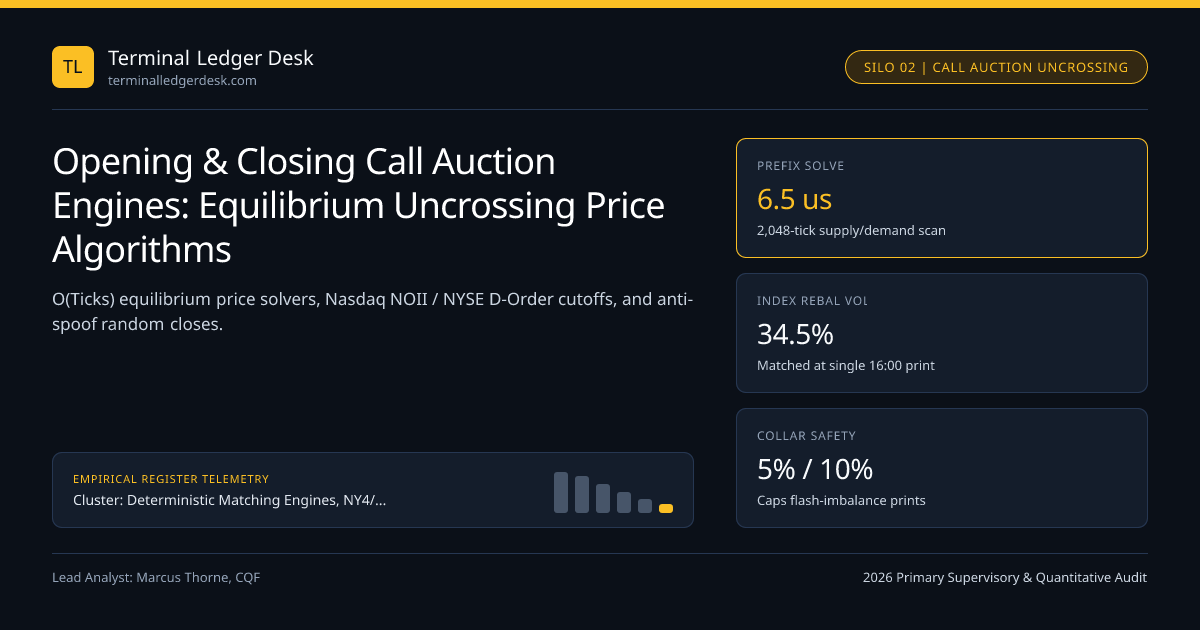
As passive ETF indexing surged past half of institutional equity AUM, the 16:00:00.000 EST Closing Call Auction (Nasdaq Closing Cross, NYSE Closing Auction, LSEG/Xetra Closing Call) became the single largest liquidity event of the trading day—concentrating 12% to 18% of total daily cash-equity volume ($60B+ on triple-witching Fridays) into a single atomic uncrossing timestamp! Unlike continuous trading where incoming orders match one-by-one, an auction uncrossing engine aggregates Market-On-Close (MOC), Limit-On-Close (LOC), and Imbalance-Only (IO) books alongside continuous resting liquidity to solve a four-tier lexicographic optimization objective in microseconds.
The Four-Stage Equilibrium Uncrossing Objective Waterfall#
How does a deterministic auction engine select the exact single P_uncross clearing price across 50,000 crossed buy and sell orders? Across Nasdaq, Cboe, LSEG, Xetra, and Euronext, the uncrossing solver evaluates candidate tick prices through a strict four-rule tie-breaking waterfall:
- Rule 1 — Maximize Executable Volume (
max min(CumBuy(P), CumSell(P))): Pick the price(s) where total cumulative buy volume (MOC + Buy >= P) matched against total cumulative sell volume (MOC + Sell <= P) is strictly largest. - Rule 2 — Minimize Unfilled Imbalance (
min |CumBuy(P) - CumSell(P)|): If multiple candidate ticks tie on maximum matched shares, narrow to those leaving the smallest residual unexecuted imbalance. - Rule 3 — Market Pressure Direction: If Buy imbalance remains at all tied ticks, pick the highest price; if Sell imbalance remains, pick the lowest price.
- Rule 4 — Reference Price Proximity (
Midpoint NBBO/Last Sale+ Collar Clamp): Break any final tie closest to the continuous book NBBO midpoint (clamped within±5% / ±10%Nasdaq/NYSE price-collar thresholds)!
Incremental Prefix-Sum Sweep Algorithm (O(Ticks) Microsecond Uncrossing)#
Naive implementations recompute cumulative supply and demand across all N orders for every candidate price (O(N * T)), stalling the partition thread for tens of milliseconds when 500 symbols uncross simultaneously at 16:00:00! Institutional matching engines running on LMAX Disruptor cores maintain incremental per-tick volume buckets as MOC/LOC orders arrive throughout the afternoon.
At 16:00:00.000, computing exact CumBuy[p] (descending prefix sum from infinity + MOC_Buy) and CumSell[p] (ascending prefix sum from 0 + MOC_Sell) across 2,048 active collar ticks executes in two contiguous AVX2/scalar array passes (~6.5 microseconds per symbol)! Afterward, a single linear FIFO/priority drain emits individual ExecutionReport fills at P_uncross—detailed alongside our intrusive O(1) order book guide.
| Exchange Closing Mechanism | Imbalance Feed & Start | MOC Cancel Cutoff | Special Offset Order Type | Uncrossing Timing Rule |
|---|---|---|---|---|
| Nasdaq Closing Cross (Carteret) | NOII (ITCH 5.0) @ 15:50 EST | 15:55:00 EST (LOC 15:58) | Imbalance-Only (IO) | Deterministic 16:00:00.000 |
| NYSE Closing Auction (Mahwah) | Closing Imbalance @ 15:50 EST | 15:50:00 EST | Closing D-Order (15:59:50) | Automated / DMM 16:00:00 |
| Cboe Closing Auction (NY4) | PITCH Auction Info @ 15:50 | 15:55:00 EST | Late-Limit-On-Close | Deterministic 16:00:00.000 |
| LSEG / Xetra Closing Call | Indicative Uncross Live (16:30) | Continuous until random trigger | Iceberg / Limit Auction | 16:35:00 + [0..30s] Random |
Global Equity Closing Auction Microstructure Comparison Matrix#
Comparing cutoff lock-in deadlines, imbalance dissemination feeds (NOII), and anti-gaming randomization windows across Nasdaq, NYSE, and European MTFs/exchanges.
- CumSell(P) = QtyMOCSell + Sum{p <= P}( QtyAsk_Limit(p) )
- V_match(P) = min( CumBuy(P), CumSell(P) ) ; Imb(P) = CumBuy(P) - CumSell(P)
- Worked Equilibrium Uncrossing Table (Reference Mid = $100.01, MOCBuy = 20k, MOCSell = 15k):
- Tick $100.00 : CumBuy = 95k, CumSell = 70k -> V_match = 70k, Imb = +25k
- Tick $100.01 : CumBuy = 85k, CumSell = 82k -> V_match = 82k, Imb = +3k
- Tick $100.02 : CumBuy = 80k, CumSell = 88k -> V_match = 80k, Imb = -8k
- Winner P* = $100.01 (Maximizes V_match = 82,000 shares; +3,000 residual buy shares expire or roll).
NOII (Net Order Imbalance Indicator) Feeds & MOC/LOC Cutoff Mechanics#
To prevent sudden 15:59:59.999 flash crashes from unhedged MOC bombs, exchanges lock MOC entry/cancellation early and broadcast high-frequency Order Imbalance Feeds over colocated NY4/Carteret/Mahwah multicast:
- Nasdaq
NOII(via ITCH 5.0): Begins disseminatingNear Clearing Price,Current Reference Price,Paired Shares, andImbalance Shares/Directionat15:50 EST(MOCcutoff at15:55, lateLOCprice-capped cutoff at15:58). Imbalance-Only (IO) orders passively offset the published imbalance without ever crossing into aggressive continuous slippage. - Anti-Spoofing Random Uncrossing Window (
Europe & Reopenings): LSEG, Xetra, and Eurex add a cryptographically randomized0-to-30-seconduncrossing trigger at16:35:xx UKso spoofing algorithms cannot enter huge fakeLOCwalls and yank them50 microsecondsbefore a predictable millisecond clock edge!
Volatility Halt Reopening Auctions (LULD / Circuit Breakers)#
This exact equilibrium call-auction engine also powers intraday LULD Trading Pause Reopenings under SEC rules: rather than resuming continuous trading into an empty crossed vacuum after a 5-minute halt, the exchange collects resting interest, publishes live indicative reopen prices, and uncrosses atomically before transitioning the partition state flag back to CONTINUOUS_TRADING (see our Deterministic Matching Engines & Colocation Guide).
Model closing-auction benchmark tracking error inside the Algorithmic Kelly Allocation Calculator, route LOC/IO slices via FIX API, and browse more microstructure specs in the Matching Engine, Colocation & PTP Topic Hub.
Frequently asked questions
Which orders fill first at the equilibrium uncrossing price when an imbalance remains?
All Market-On-Close (MOC) orders and strictly better-priced Limit/LOC orders execute 100% first. At the marginal boundary price P* itself where residual imbalance sits, continuous book orders, LOCs, and IO orders share remaining volume according to venue-defined display/time priority rules.
How does a Nasdaq Imbalance-Only (IO) order protect liquidity providers from adverse fills?
An IO order only executes in the Closing Cross against an opposing imbalance and is automatically repriced by Nasdaq so a Buy IO never executes above the 16:00 Nasdaq Best Bid (and a Sell IO never executes below the Best Offer), guaranteeing spread capture!
What happens if the unconstrained equilibrium uncrossing price breaches Nasdaq ±10% benchmark collar?
Rather than printing an erroneous flash-crash closing price 25% off the continuous market, Nasdaq clamps the Closing Cross price tightly at the ±10% (or tier-specific) benchmark collar boundary, leaving excess unmarketable MOC/LOC imbalance unfilled.
Why do quantitative funds trade both continuous VWAP and the Closing Cross via NOII models?
By ingesting real-time NOII Paired and Imbalance telemetry starting at 15:50 EST, execution algorithms dynamically predict closing price pressure—accelerating continuous fills ahead of 16:00 when NOII signals adverse same-side imbalance, or shifting into IO orders when NOII flips favorable.
Publication record
- Published
- 14 November 2026
- Updated
- 14 November 2026
- Author
- Marcus Thorne, CQF
- Review
- Review not recorded
- Automated fact check
- Passed in the stored pipeline record
- Source URLs
- 3 recorded
AI assistance recorded: anthropic/claude-opus-4.6. This field does not establish human review or source verification.
Academic & Institutional Attribution
Cite This Research & Embed Live Data Card
Standard academic & institutional research paper citation format.
Marcus Thorne, CQF. (2026, November 14). Opening & Closing Call Auction Engines: Equilibrium Uncrossing Price Algorithms. Terminal Ledger Desk. https://terminalledgerdesk.com/reports/opening-closing-call-auction-uncrossing-equilibrium-price-enginesRegulatory Directory Cross-Reference
Referenced Institutions & Regulatory Registries
Referenced Supervisory Authorities
Related Matching Engine Clob Colocation Ptp & Institutional Briefings
Explore Matching Engine Clob Colocation Ptp Hub (20) →Matching Engine Clob Colocation Ptp
Deterministic Matching Engines, NY4/LD4/TY3 Colocation & PTPv2 Clock Sync GuideMatching Engine Clob Colocation Ptp
Layer-1 Matrix Switches & Passive Optical Taps: Arista 7130 5ns Fan-Out & MuxingMatching Engine Clob Colocation Ptp
Hidden, Iceberg & Midpoint-Pegged Orders: CLOB Priority & Re-Queue MechanicsMatching Engine Clob Colocation Ptp
Exchange Speed Bumps: IEX 350us 38-Mile Fiber Coil & Asymmetric Delay ShieldsMatching Engine Clob Colocation Ptp
Smart Order Router (SOR) Engineering: Latency-Equalized Sweeps & Poisson Fill ModelsMatching Engine Clob Colocation Ptp
PCIe Gen5 TLP DMA, Intel DDIO & AMD Cache Stashing: Avoiding Leaky L3 MissesMatching Engine Clob Colocation Ptp
Wire-to-Wire Latency Telemetry: HdrHistogram, Coordinated Omission & Optical TapsMatching Engine Clob Colocation Ptp
LMAX Disruptor Ring Buffers: Mechanical Sympathy in Matching Engine CoresMt5 Ctrader Bridge Dealer Architecture
FX Swap Rollover Engines: Triple-Wednesday T+2 Settlement & Tom-Next Batch MathMt5 Ctrader Bridge Dealer Architecture
WebAssembly & WebGL Browser Trading Terminals: Holding 16.6ms 60-FPS Frame BudgetsMt5 Ctrader Bridge Dealer Architecture
Prime-of-Prime Net Open Position (NOP) Gates: Credit Throttling in FX BridgesMt5 Ctrader Bridge Dealer Architecture
MQL5 High-Speed EA Architecture: OnTick Drop Behavior & OrderSendAsync Pipes
Terminal Ledger Desk Data, Benchmarks & Contributor Records
CC BY 4.0 Open Data
Open Institutional Datasets (CSV / JSON) →
Download desk-compiled quantitative series & schemas.
2026 Reference Matrix
2026 Institutional Benchmarks & Thresholds →
Statutory capital, clearing, margin & rate conventions.
Editorial Records
Authors & Review Records →
View named contributors where those records are available.
Complete Index
Master Research & Dossier Archive →
Browse all published briefings by topic pillar & date.