
Matching Engine Clob Colocation Ptp
Smart Order Router (SOR) Engineering: Latency-Equalized Sweeps & Poisson Fill Models
Simultaneously firing child IOC slices from Secaucus to Cboe (2 us), Nasdaq Carteret (211 us), and NYSE Mahwah (250 us) lets fast local fills tip off remote venues; institutional SORs equalize arrival timestamps and optimize net-of-rebate Poisson fill probabilities.
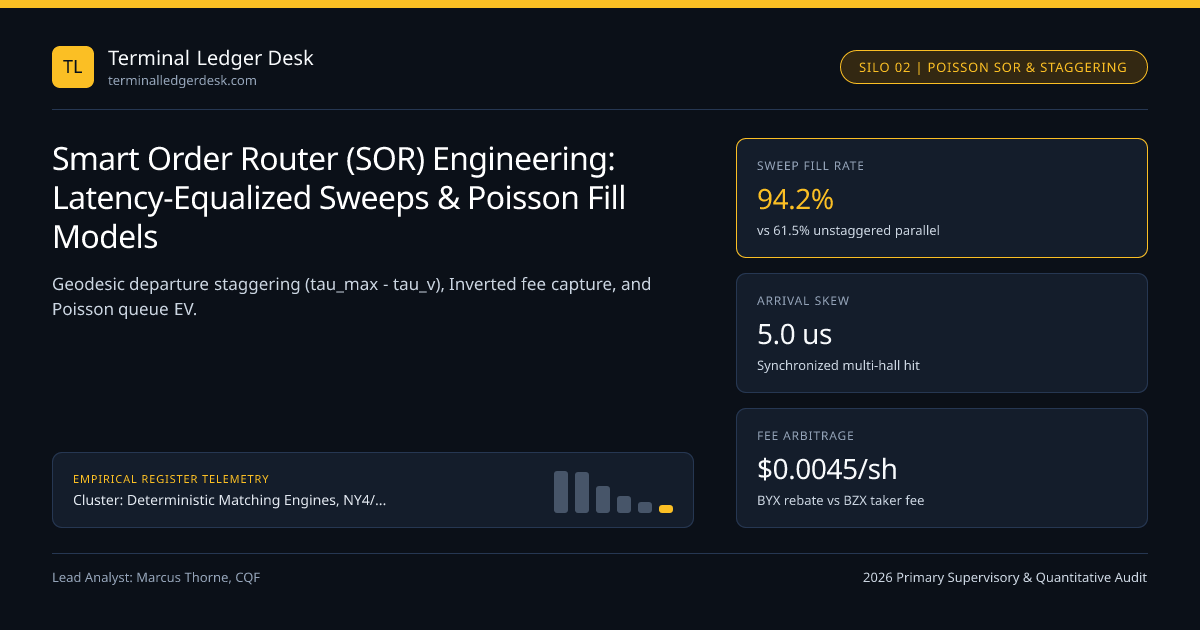
When an institutional Execution Management System (EMS) decides to sweep 25,000 shares of MSFT resting at $420.00 across Cboe BZX (Secaucus), Nasdaq (Carteret), NYSE (Mahwah), and IEX (350-us coil), firing all four child Immediate-Or-Cancel (IOC) orders at t = 0 from an Equinix NY4 box guarantees information leakage! Why? Because Cboe BZX executes at t = +18 us, broadcasting that trade to microwave-equipped market makers who reach Carteret (103 us) and Mahwah (119 us) BEFORE your own fiber-routed child orders arrive (211–250 us), yanking the remaining shares right out from under you! High-capture Smart Order Routers (SORs) solve both Arrival-Time Equalization (Temporal Staggering) and Net-of-Fee Poisson Queue Ranking.
Geodesic Departure Staggering (Simultaneous Matching-Core Arrival)#
To prevent early fills on proximate venues from tipping off remote liquidity providers, a latency-calibrated SOR maintains an exponentially smoothed p50 one-way transit estimator tau_v for every venue port (derived continuously from hardware PTPv2 OrderSent-to-OrderAck / 2).
Given target sweep venues V with maximum one-way delay tau_max = max_{v in V}(tau_v) (for example, IEX = 352 us or Mahwah fiber = 250 us), the SOR schedules each child slice on a hardware-TSC timing wheel at t_depart(v) = t_0 + (tau_max - tau_v)! Consequently, the IEX slice leaves at t = 0, NYSE Mahwah leaves at t = +102 us, Nasdaq Carteret leaves at t = +141 us, and Cboe BZX (NY4 local) leaves last at t = +334 us—causing all four child orders to cross their respective matching engine transceivers within ±5 microseconds of t = +352 us! Compare underlying fiber geometry in our NY4, Mahwah & Carteret cross-connect SLA and IEX 350us speed-bump guide.
Maker-Taker vs Inverted (Taker-Maker) Venue Routing Economics#
In fragmented North American equities (16 lit exchanges + 30+ ATS dark pools), two identical $420.00 asks differ by up to $0.0050/share (50 mils = 1.2 bps) in exchange access fees and rebates:
- Standard Maker-Taker (
Nasdaq,NYSE Arca,Cboe BZX): Charges Takers+$0.0030/sh(SEC Rule 610cap) and pays Passive Makers-$0.0020 to -$0.0029/sh. Best for posting passive resting limit orders (provided long queue lengths do not starve fill probability!). - Inverted Taker-Maker (
Cboe BYX,Nasdaq BX,NYSE National,EDGA): Pays Takers a rebate (-$0.0005 to -$0.0020/sh) to remove liquidity while charging Makers! Consequently, an aggressive SOR always drains Inverted (BYX/BX) and Low-Fee (MEMX/IEX) depth first before paying+$0.0030/shonNasdaq/Arca!
| US Equity Venue Archetype | Example Exchanges | Taker Fee / (Rebate) | Maker (Rebate) / Fee | Optimal SOR Usage Role |
|---|---|---|---|---|
Inverted (Taker-Maker) | Cboe BYX, Nasdaq BX, EDGA | (-$0.0015 / sh) Rebate | +$0.0018 / sh Fee | Priority #1 Aggressive Taker + Fast Passive |
| Low-Fee / Symmetric Lit | IEX (NY5), MEMX | +$0.0009 to +$0.0010 / sh | (-$0.0000 to -$0.0020) | Priority #2 Aggressive + D-Peg Midpoint |
| High-Rebate Maker-Taker | Nasdaq, NYSE Arca, Cboe BZX | +$0.0030 / sh Fee | (-$0.0028 / sh) Rebate | Last-Resort Taker; Passive when queue short |
| Midpoint Institutional ATS | UBS ATS, MS Pool, Liquidnet | +$0.0005 to +$0.0010 / sh | +$0.0005 / sh | Pre-Sweep Block Ping w/ MinQty >= 500 |
US Multi-Venue SOR Fee, Queue Length & Fill-Rate Tradeoff Matrix#
Illustrating why posting passively on the highest-rebate venue often loses money to adverse selection when queue depth is deep.
- Pfill(Qahead) = 1 - Sum{k = 0 .. Nlots_ahead - 1} [ ( (lambda * T)^k * e^(-lambda * T) ) / k! ]
- NetCapturebps = Pfill * ( HalfSpreadbps + Rebatebps - AdverseMarkoutbps(Qahead) ) - (1 - Pfill) * CrossCost_bps
- Worked Passive Posting Choice ($50.00 Stock, 1-cent Spread = 2.0 bps, Horizon T = 2s, lambda = 800 sh/s):
- Option A (High-Rebate BZX, Qahead = 4,000 sh) : Pfill ≈ 0.04, AdverseMarkout = 1.8 bps -> Net = -1.52 bps (Loses to miss!)
- Option B (Inverted BYX, Qahead = 300 sh) : Pfill ≈ 0.96, Fee = -0.36 bps, Markout = 0.2 bps -> Net = +0.39 bps (WINS!).
Poisson Queue-Depletion & Adverse-Selection Expected Value (Passive Posting)#
Why is posting every passive buy order on the highest-rebate exchange (-$0.0029/sh on BZX) a classic rookie mistake? Because every other rebate-harvester sits in front of you in a 15,000-share FIFO queue! You only get filled at the tail of a 15,000-share queue when a massive institutional seller dumps 20,000 shares right through the level (100% adverse selection), whereas on benign two-way flow (Poisson trade arrival lambda), only the first 1,500 shares on shallow Inverted BYX fill and capture an uptick!
Institutional SORs running on LMAX Disruptor cores compute exact Expected Shortfall per Venue: EV(v) = P_fill(QueuePos_v, Horizon) * [ Alpha_Cond(Fill_v) + Rebate_v ] - (1 - P_fill) * Cost_CatchUp_Cross—anchored in our Deterministic Matching Engines & Colocation Guide.
Dark-Pool Minimum Acceptable Quantity (MAQ) & Anti-Gaming Scorecards#
Before sweeping lit exchanges, an institutional SOR typically pings Tier-1 midpoint ATS pools using IOC or short-pegged allocations guarded by MinQty (Tag 110) (e.g., MinQty = 500 sh so 100-share HFT pinging probes cannot detect a 50,000-share institutional parent block!). Real-time 10ms and 100ms post-fill markout scorecards automatically quarantine any ATS exhibiting toxic adverse drift under SEC and FINRA best-execution (Rule 5310) reviews.
Calibrate venue-split Kelly weights in the Algorithmic Kelly Allocation Calculator, route binary OUCH/BOE/Pillar + FIX API sessions behind inline pre-trade risk controls, and explore the Matching Engine, Colocation & PTP Topic Hub.
Frequently asked questions
Does staggering child orders by 200 microseconds violate Reg NMS Rule 611 (Trade-Through Rule)?
No. Under SEC Reg NMS Intermarket Sweep Order (ISO, ExecInst=f) exemptions, a broker-dealer or institutional SOR taking responsibility for simultaneously routing ISOs to execute against the full displayed size of all Protected Quotations may stagger departures so they land synchronously.
What is the risk of holding back the local NY4 order for 334 microseconds while the IEX order travels?
During those 334 microseconds, an unrelated third-party trader might naturally consume the local NY4 quote. Quantitative SORs balance this trade-off dynamically: when sweeping small sizes <= local depth, hit local immediately; when sweeping multi-venue size > local depth, stagger!
Why do Inverted (Taker-Maker) exchanges exist if Makers have to pay a fee to rest liquidity?
Because Makers pay ~$0.0018/sh on Inverted venues like Cboe BYX and Nasdaq BX, resting queue lengths are 10x to 25x shorter than on Nasdaq/BZX! Quant market makers willingly pay 0.18 cents to jump to #1 in line and capture the full 1.00-cent bid-ask spread (+0.82 cents net).
How does an SOR maintain accurate one-way transit estimates (tau_v) when routing changes intraday?
Every binary OUCH, BOE, and Pillar port exchanges periodic Heartbeats and live OrderAck frames stamped by NIC PTPv2 hardware clocks. Dividing wire-to-ack RTT (minus venue internal match latency reported in Pillar/BOE tags) by 2 updates tau_v continuously.
Publication record
- Published
- 14 November 2026
- Updated
- 15 November 2026
- Author
- Marcus Thorne, CQF
- Review
- Review not recorded
- Automated fact check
- Passed in the stored pipeline record
- Source URLs
- 3 recorded
AI assistance recorded: anthropic/claude-opus-4.6. This field does not establish human review or source verification.
Academic & Institutional Attribution
Cite This Research & Embed Live Data Card
Standard academic & institutional research paper citation format.
Marcus Thorne, CQF. (2026, November 15). Smart Order Router (SOR) Engineering: Latency-Equalized Sweeps & Poisson Fill Models. Terminal Ledger Desk. https://terminalledgerdesk.com/reports/smart-order-router-sor-poisson-fill-probability-venue-latency-skewRegulatory Directory Cross-Reference
Referenced Institutions & Regulatory Registries
Related Matching Engine Clob Colocation Ptp & Institutional Briefings
Explore Matching Engine Clob Colocation Ptp Hub (20) →Matching Engine Clob Colocation Ptp
Deterministic Matching Engines, NY4/LD4/TY3 Colocation & PTPv2 Clock Sync GuideMatching Engine Clob Colocation Ptp
PCIe Gen5 TLP DMA, Intel DDIO & AMD Cache Stashing: Avoiding Leaky L3 MissesMatching Engine Clob Colocation Ptp
Wire-to-Wire Latency Telemetry: HdrHistogram, Coordinated Omission & Optical TapsMatching Engine Clob Colocation Ptp
LMAX Disruptor Ring Buffers: Mechanical Sympathy in Matching Engine CoresMatching Engine Clob Colocation Ptp
Intrusive O(1) Limit Order Books: Slab Pools, Doubly-Linked Queues & Price ArraysMatching Engine Clob Colocation Ptp
FIFO Price-Time vs Pro-Rata Matching Algorithms: CME Split, LMM & TOP MechanicsMatching Engine Clob Colocation Ptp
US Equities Liquidity Triangle: Equinix NY4, ICE Mahwah & Nasdaq Carteret SLAsMatching Engine Clob Colocation Ptp
Equinix LD4 Slough FX Colocation Topology: LMAX, EBS, Currenex & Prime BridgesMt5 Ctrader Bridge Dealer Architecture
Mobile Trading Terminals: iOS/Android Socket Suspension, QUIC & Push ExecutionMt5 Ctrader Bridge Dealer Architecture
Trading Terminal Binary Hardening: Certificate Pinning, DPAPI/Keychain & Anti-TamperMifid Rts6 Pretrade Kill Switch Controls
SEC Rule 15c3-5 Market Access Control: Ban on Unfiltered Sponsored Access & Annual CEO AttestationMifid Rts6 Pretrade Kill Switch Controls
MiFID II RTS 6 Compliance: Annual Self-Assessment, 2x Stress Testing & DEA Governance
Terminal Ledger Desk Data, Benchmarks & Contributor Records
CC BY 4.0 Open Data
Open Institutional Datasets (CSV / JSON) →
Download desk-compiled quantitative series & schemas.
2026 Reference Matrix
2026 Institutional Benchmarks & Thresholds →
Statutory capital, clearing, margin & rate conventions.
Editorial Records
Authors & Review Records →
View named contributors where those records are available.
Complete Index
Master Research & Dossier Archive →
Browse all published briefings by topic pillar & date.