
Matching Engine Clob Colocation Ptp
US Equities Liquidity Triangle: Equinix NY4, ICE Mahwah & Nasdaq Carteret SLAs
Roughly 98% of US equity and options volume matches inside a 35-mile New Jersey triangle linking Equinix NY4/NY5 (Secaucus), ICE/NYSE (Mahwah), and Nasdaq (Carteret)—governed by equal-length optical SLAs and microwave arbitrage.
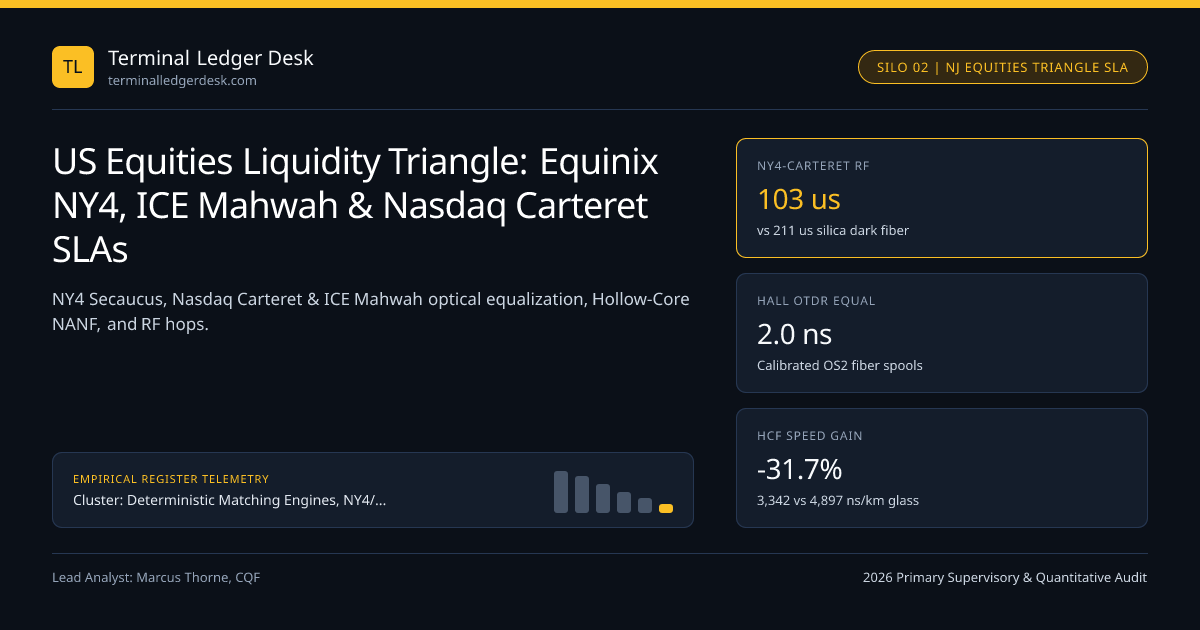
Wall Street no longer trades in Lower Manhattan. Nearly every lit and dark US equity share—across Nasdaq, NYSE, Cboe (BZX, BYX, EDGX, EDGA), IEX, MEMX, and MIAX Pearl—executes inside a 35-mile northern New Jersey triangle anchored by Equinix NY4/NY5/NY6 in Secaucus, ICE Data Center in Mahwah, and Nasdaq Data Center in Carteret. For Smart Order Routers and market makers, surviving inside that triangle requires mastering two distinct physical regimes: OTDR-equalized intra-hall single-mode fiber cross-connects and millimeter-wave / hollow-core inter-center links where refractive index (n = 1.0003 air vs 1.4682 glass) decides every race!
Inside the Cage: Equalized Cross-Connects & Optical Dispersion Budgets#
Within Equinix NY4/NY5 Secaucus (home to Cboe four equity exchanges, MEMX, and IEX POP), NYSE Mahwah, and Nasdaq Carteret, SEC-approved colocation tariffs mandate latency-equalized patch panels. Regardless of whether your cabinet sits in Phase 1 or Phase 4, the exchange winds calibrated single-mode OS2 fiber spools inside Overhead Patching Enclosures so every participant port measures within ±1 to ±3 nanoseconds on a 1550 nm Optical Time-Domain Reflectometer (OTDR)!
Even transceiver selection matters at sub-microsecond scale: 10GBASE-SR / 25GBASE-SR without Forward Error Correction (RS-FEC) beats 25GBASE-LR with RS(528,514) FEC enabled because Reed-Solomon FEC block interleaving adds 80 to 120 nanoseconds of PHY latency on every hop! Wherever venue rules permit No-FEC (Base-R or short-reach clean optical budgets < -6 dBm), execution engineers explicitly disable RS-FEC on QSFP28 ports.
Inter-Site Geometry: Secaucus (NY4) <-> Carteret <-> Mahwah#
Because no server can sit inside Secaucus, Carteret, and Mahwah simultaneously, cross-venue arbitrageurs and Poisson-calibrated Smart Order Routers confront hard geodesic speed-of-light bounds:
NY4Secaucus <-> Nasdaq Carteret (~18.5 miles / 29.8 kmline-of-sight): Standard underground dark fiber (~43 kmduct route) takes~211 microsecondsone-way (~422 usRTT). Line-of-sight millimeter-wave (E-band 70/80 GHz) microwave towers cut one-way flight to~103 microseconds! New Hollow-Core Nested Antiresonant Nodeless Fiber (NANF,n ≈ 1.002) bridges the weather-reliability gap at~145 microsecondsone-way with99.999%rain-fade immunity.NY4Secaucus <-> NYSE Mahwah (~21.6 miles / 34.8 kmline-of-sight): Dark fiber duct (~51 km) takes~250 usone-way; microwave achieves~119 usone-way.- Carteret <-> Mahwah (
~34.2 miles / 55.0 kmline-of-sight): Dark fiber (~78 km) takes~382 usone-way; microwave achieves~187 usone-way.
| NJ Triangle Route | Geodesic Distance | Standard Dark Fiber (1-Way) | Hollow-Core Fiber (Est. 1-Way) | Millimeter-Wave RF (1-Way) |
|---|---|---|---|---|
| Equinix NY4 <-> Nasdaq Carteret | 29.8 km (18.5 mi) | 211 us (43 km duct) | ~144 us (43 km duct) | 103 us (Tower hops + radio) |
| Equinix NY4 <-> NYSE Mahwah | 34.8 km (21.6 mi) | 250 us (51 km duct) | ~171 us (51 km duct) | 119 us (Tower hops + radio) |
| Nasdaq Carteret <-> NYSE Mahwah | 55.0 km (34.2 mi) | 382 us (78 km duct) | ~261 us (78 km duct) | 187 us (Tower hops + radio) |
| CME Aurora (IL) <-> NJ Triangle | 1,180 km (733 mi) | 6,950 us (1,420 km rail) | ~4,750 us (Partial HCF) | 3,980 us (30-tower RF chain) |
New Jersey US Equities Triangle Latency & Medium Matrix#
Comparing one-way propagation latency and weather availability across standard silica dark fiber, Hollow-Core Fiber (HCF), and licensed microwave links.
- DeltaTsaved = Dductkm * (4,897 ns/km - 3,342 ns/km) [Hollow-Core NANF vs Standard Silica]
- Worked Carteret <-> Mahwah (78 km Underground Duct vs 55 km Line-of-Sight RF):
- Tsilicafiber = 78 km * 4,897 ns/km = 381,966 ns (381.97 us)
- Thollowcore = 78 km * 3,342 ns/km = 260,676 ns (260.68 us -> saves 121.29 us with fiber reliability!)
- Tmicrowaverf = 55 km * 3,337 ns/km + 3,500 ns (4 RF transceivers) = 187,035 ns (187.04 us).
SIP Geographic Latency Revisited: Carteret UTP vs Mahwah CTA#
A classic US market-structure nuance governed by SEC Regulation NMS involves the Securities Information Processors (SIPs): Nasdaq operates the UTP SIP (Tape C) in Carteret, while SIAC/NYSE operates the CTA SIP (Tape A & B) in Mahwah! Consequently, a quote change on Cboe BZX in Secaucus (NY4) must travel ~211–250 us over fiber to Carteret or Mahwah to update the public NBBO, and another ~211–250 us back—whereas subscribers ingesting direct binary feeds (Cboe PITCH, Nasdaq ITCH, NYSE Integrated) colocated at each node reconstruct the synthetic NBBO 350+ microseconds earlier!
Review how intentional fiber coils counteract cross-venue sniper latency in our IEX 350us speed-bump engineering analysis and our Deterministic Matching Engines & Colocation Guide.
Hybrid Microwave + Dark-Fiber Arbitration (Bandwidth vs Latency)#
Because E-band / C-band microwave links carry limited RF bandwidth (100 Mbps – 2 Gbps) and drop packets during summer New Jersey thunderstorms (rain fade > 25 mm/hr), institutional desks never route full ITCH feeds over radio. Instead, an FPGA in Mahwah extracts a 16-byte compressed trigger signal (SPY/QQQ BBO break or index sweep) onto the microwave link while streaming full redundant recovery over diverse-path dark fiber into high-availability failover routers.
Price adverse-selection latency penalties inside the Algorithmic Kelly Allocation Calculator, connect multi-venue ports via FIX API, and explore international colocation topologies in the Matching Engine, Colocation & PTP Topic Hub.
Frequently asked questions
Which exchanges are physically hosted inside Equinix NY4 and NY5 in Secaucus, New Jersey?
Equinix NY4/NY5/NY6 hosts the primary matching engines for Cboe four US equity exchanges (BZX, BYX, EDGX, EDGA), MEMX, Cboe Options, MIAX Pearl Equities, IEX Point-of-Presence (ahead of its 350us coil to NY5), and major FX ECNs (EBS/Currenex/360T NY nodes).
Why is underground dark fiber more than 2x slower than microwave between NY4 and Carteret?
Two multiplicative physics factors combine: first, silica glass slows light by 31.9% compared to air (n = 1.4682 vs 1.0003); second, underground fiber conduits follow highways, bridges, and railway rights-of-way (~43 km) rather than straight geodesic tower lines (~29.8 km).
Why do HFT desks run independent execution servers inside all three NJ data centers?
Sending an order remotely from NY4 to Nasdaq Carteret incurs a 211-microsecond fiber delay. Instead, firms deploy local FPGA/C++ execution nodes inside NY4, Carteret, and Mahwah simultaneously, transmitting ultra-compact 16-byte RF signals between nodes to trigger local pre-staged orders.
What is Hollow-Core Fiber (NANF) and why are exchanges and carriers deploying it?
Hollow-Core Nested Antiresonant Nodeless Fiber guides laser pulses through a microscopic air-filled central channel instead of solid glass, achieving 99.8% of the speed of light in vacuum with 100Gbps+ DWDM capacity and zero storm outages.
Publication record
- Published
- 14 November 2026
- Updated
- 14 November 2026
- Author
- Marcus Thorne, CQF
- Review
- Review not recorded
- Automated fact check
- Passed in the stored pipeline record
- Source URLs
- 3 recorded
AI assistance recorded: anthropic/claude-opus-4.6. This field does not establish human review or source verification.
Academic & Institutional Attribution
Cite This Research & Embed Live Data Card
Standard academic & institutional research paper citation format.
Marcus Thorne, CQF. (2026, November 14). US Equities Liquidity Triangle: Equinix NY4, ICE Mahwah & Nasdaq Carteret SLAs. Terminal Ledger Desk. https://terminalledgerdesk.com/reports/equinix-ny4-secaucus-mahwah-carteret-equal-cable-cross-connect-slaRegulatory Directory Cross-Reference
Referenced Institutions & Regulatory Registries
Referenced Supervisory Authorities
Related Matching Engine Clob Colocation Ptp & Institutional Briefings
Explore Matching Engine Clob Colocation Ptp Hub (20) →Matching Engine Clob Colocation Ptp
Deterministic Matching Engines, NY4/LD4/TY3 Colocation & PTPv2 Clock Sync GuideMatching Engine Clob Colocation Ptp
Equinix LD4 Slough FX Colocation Topology: LMAX, EBS, Currenex & Prime BridgesMatching Engine Clob Colocation Ptp
Multi-Region Colocation Architecture: CME Aurora, Equinix FR2 Frankfurt & TY3 TokyoMatching Engine Clob Colocation Ptp
Solarflare Onload / ef_vi vs DPDK Kernel Bypass: NIC RX/TX Ring & PIO TuningMatching Engine Clob Colocation Ptp
FPGA Tick-to-Trade Pipelines: Cut-Through PCS/MAC & Sub-200ns Order TriggeringMatching Engine Clob Colocation Ptp
IEEE 1588v2 PTP Clock Synchronization: GNSS Grandmasters, Boundary Clocks & NIC PHCMatching Engine Clob Colocation Ptp
MiFID II RTS 25 & FINRA CAT Clock Drift Audits: 100us HFT Traceability ComplianceMatching Engine Clob Colocation Ptp
Linux Kernel & BIOS Jitter Elimination: isolcpus, nohz_full & C-State LockingMt5 Ctrader Bridge Dealer Architecture
Virtual Dealer Plugins vs True Market Execution: Auditing Asymmetric SlippageMt5 Ctrader Bridge Dealer Architecture
MT5 Execution Modes & Fill Policies: Instant, Request, Market, Exchange & IOC/FOKMt5 Ctrader Bridge Dealer Architecture
Decoding MT5 & cTrader Client Journal Logs: Millisecond TCA, Requotes & Off QuotesMt5 Ctrader Bridge Dealer Architecture
Tick-Filtering Gateways: Off-Market Spike Suppression & Quote Aggregation Throttles
Terminal Ledger Desk Data, Benchmarks & Contributor Records
CC BY 4.0 Open Data
Open Institutional Datasets (CSV / JSON) →
Download desk-compiled quantitative series & schemas.
2026 Reference Matrix
2026 Institutional Benchmarks & Thresholds →
Statutory capital, clearing, margin & rate conventions.
Editorial Records
Authors & Review Records →
View named contributors where those records are available.
Complete Index
Master Research & Dossier Archive →
Browse all published briefings by topic pillar & date.