
Matching Engine Clob Colocation Ptp
FPGA Tick-to-Trade Pipelines: Cut-Through PCS/MAC & Sub-200ns Order Triggering
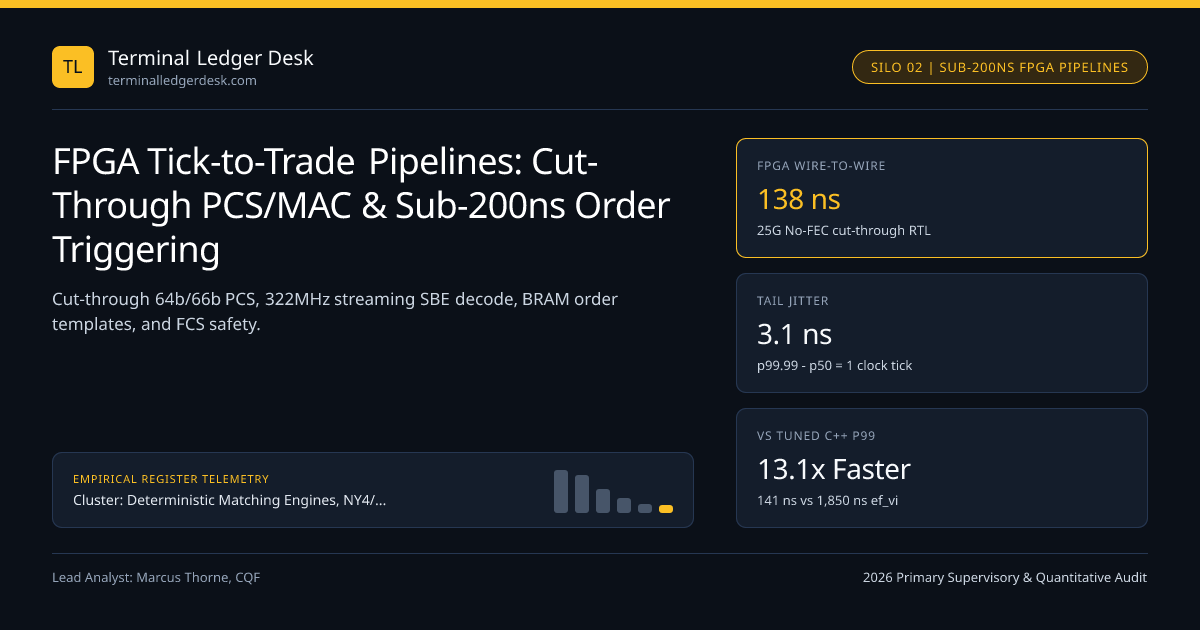
By decoding ITCH/MDP bytes directly off a 322.26 MHz 64-bit AXI-Stream bus as bits arrive from the optical transceiver, cut-through FPGA pipelines fire pre-staged exchange orders in 118 to 195 nanoseconds wire-to-wire.
Even the fastest ef_vi C++ server must wait for the entire Ethernet frame to finish arriving (store-and-forward), cross a PCIe Gen4/Gen5 root complex (~120 ns each way), and traverse CPU caches—setting a hard software floor around ~650–850 nanoseconds wire-to-wire. Top-decile futures and equities liquidity providers inside CME Aurora and Nasdaq Carteret shatter that PCIe barrier with field-programmable gate arrays (AMD/Xilinx Virtex UltraScale+ VU9P / VU23P and Intel Agilex 7) that evaluate book triggers mid-packet and begin streaming outbound TCP/SBE bytes before the inbound market-data FCS checksum even hits the fiber!
Cycle-by-Cycle Cut-Through Datapath: GTY SerDes -> PCS -> MAC -> Parser#
At 10GbE (10.3125 Gbps 64b/66b line rate), an FPGA internal datapath typically clocks 64 bits (8 bytes) every 6.4 nanoseconds (156.25 MHz)—or 64 bits every 3.103 nanoseconds (322.26 MHz) on 25GbE (No-FEC)! Look at how a custom low-latency Verilog/SystemVerilog pipeline shaves off vendor IP bloat:
- Optical SFP28/QSFP28 + GTY SerDes PMA (
~24–34 nsRX+TX): Bypasses elastic phase-compensation FIFOs via comma-aligned RXCDR phase locking. - Ultra-Lean 64b/66b PCS + Gearbox (
~19–26 ns): Replaces general-purpose Xilinx 10G/25G Ethernet Subsystem (~110 nsRTT) with a custom deterministic descrambler (x^58 + x^39 + 1). - Zero-Buffer Cut-Through MAC (
1–2 clock cycles = 3.1–6.4 ns): StreamsEth + IPv4 + UDP + MoldUDP64/MDPheaders straight into a streaming state-machine FSM as each 8-byte word arrives!
Speculative Pre-FCS Triggering & Corrupt-Frame FCS Kill-Bit Safety#
Wait—if an outbound OUCH 5.0 or CME iLink 3 order begins transmitting at byte 68 of a 240-byte inbound CME MDP 3.0 packet (saving 172 bytes = 137.6 ns of 10GbE serialization wait!), what happens if byte 239 fails its 32-bit Ethernet Frame Check Sequence (CRC-32) due to a cosmic ray or dirty optical ferrule?! Firing an order on corrupted price bits would violate pre-trade risk control standards!
Hardware engineers use Speculative TX with Deliberate FCS Poisoning: while streaming the outbound 98-byte TCP order (~78.4 ns wire duration), if the inbound packet fails its trailing CRC-32 check before the outbound packet finishes sending its own last 4 bytes, the FPGA inverts the outbound Ethernet CRC-32 (~fcs)! Every exchange Layer-2 switch immediately drops the stomped frame silently at the MAC port—zero bad order ever reaches the matching engine! (Note: if the inbound packet is much longer than the outbound packet, the FPGA inserts dummy IP options/padding or delays TX tail closure until inbound CRC_OK latches!)
| Pipeline Stage | Stock Vendor FPGA IP (Store & Fwd) | Custom Low-Latency RTL (Cut-Through) | Software ef_vi C++ Equivalent |
|---|---|---|---|
| Optical SFP28 + GTY SerDes (RX+TX) | 48 ns (Elastic buffer enabled) | 28 ns (Buffer-bypass CDR) | ~65 ns (NIC PHY + SerDes) |
| 64b/66b PCS + MAC Layer (RX+TX) | 145 ns (Xilinx MAC + AXI FIFO) | 24 ns (Direct 64b gear + 0-FIFO) | ~490 ns (PCIe Gen4 DMA + CTPIO) |
Frame Arrival Wait (200B Packet) | 160 ns (10G) / 64 ns (25G) | 0 ns post-price-field! | 160 ns / 64 ns (Full DMA wait) |
| Parser + Book + Risk + TCP Sum | 137 ns (44 HLS cycles) | 86 ns (28 RTL cycles @ 322MHz) | 240 – 1,250 ns (CPU L1/L3 jitter) |
Total Wire-to-Wire (p99.99) | ~505 ns | ~141 ns | ~1,850 ns (Aurora) |
10GbE / 25GbE FPGA Tick-to-Trade Nanosecond Component Budget#
Comparing standard vendor FPGA IP cores against custom low-latency PCS/MAC and speculative pre-staged BRAM order templates.
- ConditionFCSSafe : (ByteInTotal - BytePriceEnd) / Ringbps <= (ByteOutTotal - 4) / Routgbps
- Where (25GbE No-FEC @ 322.26 MHz, T_clk = 3.103 ns):
- Tqsfpphy = 8 ns; Trxpcs = 13 ns; Ttxpcs = 11 ns
- BytePriceEnd = 64 bytes (20.48 ns from start of frame); Nrtlcycles = 27 cycles (83.78 ns)
- Worked Cut-Through Wire-to-Wire Latency:
- Tfpgacut_through = 8 + 13 + 20.48 + 83.78 + 11 = 136.26 nanoseconds!
- FCS Safety Check : Inbound remaining (140 - 64 = 76B) <= Outbound pre-CRC (108 - 4 = 104B) -> 100% Safe to Stomp!
Host-CPU + FPGA Hybrid Division of Labor: Pre-Staged BRAM Order Templates#
Trying to implement complex options volatility surface fitting, TCP congestion recovery, and FIX session GapFill inside Verilog LUTs creates multi-month synthesis nightmares. Instead, institutional architectures split intelligence cleanly across PCIe:
- C++ Host CPU (
Slow Control Plane — every 50–500 us): Computes theoretical fair values, Greek skews, and SEC / CFTC position limits; writes pre-built binaryiLink 3/OUCHTCP packets (complete with pre-summed partial IPv4/TCP pseudo-header checksums!) into FPGA Block RAM (BRAM) trigger slots (Slot[symbolId] = { triggerBidPx, triggerAskPx, maxOrderQty, rawTcpFrame[96] }). - FPGA Fabric (
Fast Reflex Plane — 138 ns): ParsesSecurityID, updates on-chip BRAM top-of-book, checks inline hardware kill-switch credit registers, patchesTCP SeqNum+Timestampin 1 cycle, and fires—complementing Solarflare ef_vi C++ gateways and our Deterministic Matching Engines & Colocation Guide.
Deterministic Zero-Jitter Tail (p99.99 - p50 < 4 Nanoseconds)#
Perhaps the biggest advantage of synchronous RTL over even tuned C++ is zero tail variance: because an FPGA pipeline has no instruction cache, no TLB, no branch predictor, and no SMI interrupts, processing packet #1 and packet #10,000,000 takes the exact same integer number of 3.103-ns clock ticks (p99.99 - p50 = ±3.1 ns clock-domain crossing phase)!
Evaluate capital-efficiency trade-offs of sub-200ns queue capture inside the Algorithmic Kelly Allocation Calculator, integrate host management via FIX API, and explore hardware timing in the Matching Engine, Colocation & PTP Topic Hub.
Frequently asked questions
What happens at the exchange switch when an FPGA poisons the FCS (CRC-32) of a speculative order?
Every IEEE 802.3 Ethernet switch verifies the trailing 32-bit FCS before forwarding a store-and-forward frame to the matching engine. Inverting the FCS causes the exchange ingress MAC to discard the aborted speculative packet silently as a physical layer CRC error—Note: excessive stomps will trigger exchange port monitoring alerts, so only stomp genuine rare corruptions, never normal strategy cancels!
Why must firms never use FCS poisoning as a routine strategy cancellation trick?
Exchanges like CME, Nasdaq, and Eurex strictly forbid intentional FCS corruption to abort valid strategy decisions! Exchange network operations monitor per-port CRC error counters and fine or disconnect ports abusing Layer-2 stomping; FCS poisoning is strictly an electrical/optical bit-error safety guard.
How does an FPGA maintain a live TCP connection to CME iLink 3 or Nasdaq OUCH without a full TCP stack?
In hybrid TCP offload, the Linux/Onload host establishes the TCP handshake, handles heartbeats, and performs rare packet retransmissions, while the FPGA sits inline snooping Sequence/ACK numbers and injecting single pre-templated fast-path orders seamlessly into the TCP byte stream.
Why disable 25GbE Reed-Solomon FEC (Clause 108 RS-FEC) on FPGA colocation links when permitted?
25GbE RS(528,514) FEC accumulates 5,280-bit codewords before correcting burst bit errors, adding ~80–110 ns of mandatory serialization latency. On short, cleanintra-hall OS2 fiber patches (< 150m) where raw BER is < 10^-13, running 25GBASE-R No-FEC eliminates that penalty.
Publication record
- Published
- 14 November 2026
- Updated
- 14 November 2026
- Author
- Marcus Thorne, CQF
- Review
- Review not recorded
- Automated fact check
- Passed in the stored pipeline record
- Source URLs
- 3 recorded
AI assistance recorded: anthropic/claude-opus-4.6. This field does not establish human review or source verification.
Academic & Institutional Attribution
Cite This Research & Embed Live Data Card
Standard academic & institutional research paper citation format.
Marcus Thorne, CQF. (2026, November 14). FPGA Tick-to-Trade Pipelines: Cut-Through PCS/MAC & Sub-200ns Order Triggering. Terminal Ledger Desk. https://terminalledgerdesk.com/reports/fpga-tick-to-trade-cut-through-mac-pcs-transceiver-pipeline-budgetsRegulatory Directory Cross-Reference
Referenced Institutions & Regulatory Registries
Related Matching Engine Clob Colocation Ptp & Institutional Briefings
Explore Matching Engine Clob Colocation Ptp Hub (20) →Matching Engine Clob Colocation Ptp
Deterministic Matching Engines, NY4/LD4/TY3 Colocation & PTPv2 Clock Sync GuideMatching Engine Clob Colocation Ptp
IEEE 1588v2 PTP Clock Synchronization: GNSS Grandmasters, Boundary Clocks & NIC PHCMatching Engine Clob Colocation Ptp
MiFID II RTS 25 & FINRA CAT Clock Drift Audits: 100us HFT Traceability ComplianceMatching Engine Clob Colocation Ptp
Linux Kernel & BIOS Jitter Elimination: isolcpus, nohz_full & C-State LockingMatching Engine Clob Colocation Ptp
Implied Spread Matching Engines: Synthetic IN/OUT Liquidity & Cycle DetectionMatching Engine Clob Colocation Ptp
Opening & Closing Call Auction Engines: Equilibrium Uncrossing Price AlgorithmsMatching Engine Clob Colocation Ptp
Layer-1 Matrix Switches & Passive Optical Taps: Arista 7130 5ns Fan-Out & MuxingMatching Engine Clob Colocation Ptp
Hidden, Iceberg & Midpoint-Pegged Orders: CLOB Priority & Re-Queue MechanicsMt5 Ctrader Bridge Dealer Architecture
Spotware cTrader Open API (Protobuf) vs cTrader FIX 4.4: Quotas, Auth & LatencyMt5 Ctrader Bridge Dealer Architecture
MT5 Netting vs Hedging Position Ledgers: Orders, Deals, CloseBy & Margin MathMt5 Ctrader Bridge Dealer Architecture
OTC FX Last-Look Hold Windows: FX Global Code Principle 17 & Firm Liquidity TCAMt5 Ctrader Bridge Dealer Architecture
Margin Stop-Out Liquidation Engines: Tick Evaluation, Smart Partial Close & NBP
Terminal Ledger Desk Data, Benchmarks & Contributor Records
CC BY 4.0 Open Data
Open Institutional Datasets (CSV / JSON) →
Download desk-compiled quantitative series & schemas.
2026 Reference Matrix
2026 Institutional Benchmarks & Thresholds →
Statutory capital, clearing, margin & rate conventions.
Editorial Records
Authors & Review Records →
View named contributors where those records are available.
Complete Index
Master Research & Dossier Archive →
Browse all published briefings by topic pillar & date.