
Matching Engine Clob Colocation Ptp
IEEE 1588v2 PTP Clock Synchronization: GNSS Grandmasters, Boundary Clocks & NIC PHC
Software NTP drifts by milliseconds under microbursts; IEEE 1588v2 Precision Time Protocol (PTPv2) with on-NIC PTP Hardware Clocks (PHC) and Boundary Switches locks distributed trading racks within 15 to 40 nanoseconds of UTC.
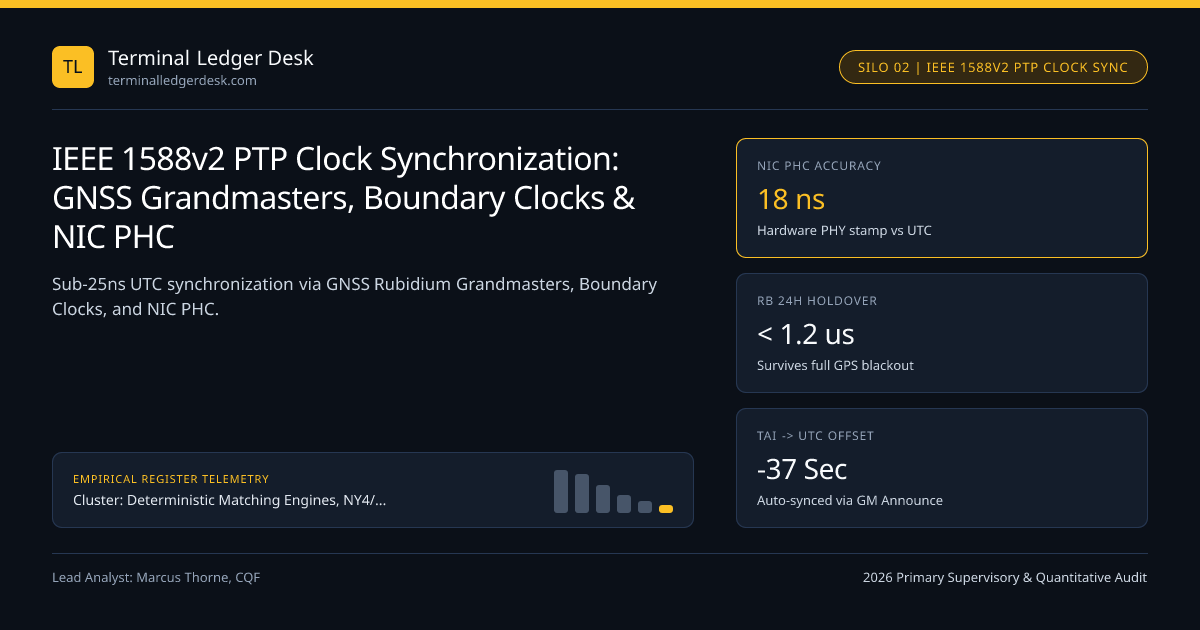
When an execution gateway inside Equinix NY4 or LD4 receives a market-data packet stamped 14:30:00.000142810 by Nasdaq and logs a local arrival timestamp of 14:30:00.000142650—appearing to arrive 160 nanoseconds before it was sent—your server clock has drifted! Standard Network Time Protocol (NTP) cannot resolve microsecond trading causality because kernel interrupt queuing and asymmetric switch buffers inject 500 us to 15 ms of jitter. Institutional colocation cages lock every NIC within 15 to 40 nanoseconds of UTC using multi-constellation GNSS Rubidium Grandmasters, PTP Boundary Clock (BC) / Transparent Clock (TC) switches, and linuxptp (ptp4l + phc2sys).
How IEEE 1588v2 Four-Timestamp Exchange Cancels Symmetric Path Delay#
Under IEEE 1588-2008 (PTPv2, upgraded in IEEE 1588-2019 PTPv2.1), a Boundary Clock switch and a trading server NIC exchange four hardware-stamped PHY timestamps (t1, t2, t3, t4):
- Master -> Slave (
Sync+ optionalFollow_Up): Master records exact departuret1at its MAC/PHY; Slave NIC records exact arrivalt2at its MAC/PHY (t2 - t1 = Offset + Delay_MS). - Slave -> Master (
Delay_Req+Delay_Resp): Slave transmitsDelay_Reqstampingt3; Master stamps receiptt4and returnst4insideDelay_Resp(t4 - t3 = Delay_SM - Offset).
Assuming forward and reverse fiber/switch delays are symmetric (Delay_MS == Delay_SM), adding and subtracting the two equations yields exact MeanPathDelay = [(t2 - t1) + (t4 - t3)] / 2 and ClockOffset = [(t2 - t1) - (t4 - t3)] / 2, feeding a Proportional-Integral (PI) servo inside ptp4l that slews the NIC on-board crystal frequency (adjfine in parts-per-billion) smoothly without ever stepping time backward!
Why Non-PTP Switches Ruin PTP: Boundary Clocks (BC) vs Peer-to-Peer TC#
Notice the critical assumption in the equation above: Delay_MS == Delay_SM! If you run PTP through a standard non-PTP Top-of-Rack switch during a 10GbE market-open multicast burst, Sync (M->S) sits behind 18 microseconds of multicast queue depth while Delay_Req (S->M) zips upstream through an empty 0.4-microsecond queue! That 17.6 us asymmetry creates an instant 8.8-microsecond false clock error!
Colocation engineers eliminate queuing asymmetry using PTP-aware switches (Arista 7050X/7130, Cisco Nexus 3550): either End-to-End Transparent Clocks (E2E TC) that measure exact switch residence nanoseconds (t_egress - t_ingress) and add them into the PTP correctionField header on the fly, or Boundary Clocks (BC) that terminate upstream PTP on one port and regenerate clean hop-by-hop PTP down to each server rack—paired with MiFID II RTS 25 100-us compliance.
| Timing Architecture | Timestamp Capture Point | Switch Requirement | 24h GNSS Outage Drift | Peak Offset vs UTC |
|---|---|---|---|---|
Software NTP (chronyd) | Kernel sk_buff RX IRQ | Standard L2/L3 | Quartz drift (~45 ms) | 500 us – 15,000 us |
PTPv2 (Software Stamps) | Kernel Socket Driver | PTP Transparent/BC | OCXO (~250 us) | 8 us – 45 us |
PTPv2 (NIC PHC + Non-PTP ToR) | NIC MAC/PHY Silicon | Legacy Store-&-Fwd | OCXO / Rubidium | 2 us – 18 us (Burst skew) |
PTPv2 (NIC PHC + Boundary ToR) (NY4/LD4) | NIC MAC/PHY Silicon | IEEE 1588 BC / TC | Rubidium (< 1.2 us) | 15 ns – 40 ns |
White Rabbit (IEEE 1588-2019 HA) | Sub-cycle Phase Detector | White Rabbit SyncE Switch | Cesium / Maser (< 50 ns) | < 1.0 ns (Sub-nanosecond) |
Time Synchronization Protocol & Oscillator Holdover Comparison Matrix#
Comparing accuracy, hardware stamping location, and GNSS outage holdover across NTP, PTPv2, and White Rabbit (IEEE 1588 High-Accuracy) deployments.
- AsymmetryError = ( Delayforwardtrue - Delayreverse_true ) / 2
- Worked Timestamp Calculation (Nanoseconds mod 1s, Transparent Clock CorrectionFields CFms = 420ns, CFsm = 380ns):
- t1 = 100,000 ns ; t2 = 101,190 ns -> (t2 - t1) = +1,190 ns
- t3 = 500,000 ns ; t4 = 501,070 ns -> (t4 - t3) = +1,070 ns
- OffsetfromMaster = [ 1,190 - 1,070 - (420 - 380) ] / 2 = [ 120 - 40 ] / 2 = +40.0 nanoseconds!
- MeanWireDelay = [ 1,190 + 1,070 - (420 + 380) ] / 2 = [ 2,260 - 800 ] / 2 = 730.0 ns (~149m SMF fiber).
Operating ptp4l + phc2sys & Reading SO_TIMESTAMPING Hardware Stamps#
On a Linux execution host, two distinct clocks exist and must never be confused:
- NIC PTP Hardware Clock (
PHC,/dev/ptp0): Disciplined directly off the wire byptp4l -i eth0 -m -- hardware_timestamping. Every packet arriving oneth0(Solarflare ef_vief_vi_receive_get_timestampor POSIXSOF_TIMESTAMPING_RAW_HARDWARE) receives a nanosecond timestamp directly from the NIC silicon (±15 nsUTC) before touching PCIe! - OS System Clock (
CLOCK_REALTIME): Disciplined from/dev/ptp0across PCIe Precision Time Measurement (PCIe PTM) byphc2sys -s eth0 -c CLOCK_REALTIME -O 0 -w(±80–250 ns). Note:ptp4lruns in TAI (International Atomic Time, currentlyUTC + 37sleap seconds), so-wensuresphc2sysreads the Grandmaster UTC offset TLV rather than logging orders 37 seconds in the future! Review full pipeline integration in our Deterministic Matching Engines & Colocation Guide.
GNSS Spoofing Resilience & Atomic Rubidium Oscillator Holdover#
What happens if rooftop GPS/Galileo antennas experience RF jamming or solar scintillation? Enterprise Grandmasters (Meinberg Lantime M1000, Microchip TimeProvider 4100, or Equinix Metro Connect Precision Time) house Oven-Controlled Crystal (OCXO) or Rubidium (Rb) atomic oscillators that maintain < 1.5 microseconds total drift across an entire 24-hour GPS blackout—comfortably protecting SEC Regulation SCI and FINRA CAT reporting SLAs.
Feed hardware PHC timestamps into HdrHistogram wire-to-wire latency audits, validate FIX API SendingTime (52) tags, size execution risk in the Terminal Margin VaR & ES Calculator, and explore the Matching Engine, Colocation & PTP Topic Hub.
Frequently asked questions
Why does ptp4l report timestamps 37 seconds ahead of UTC by default?
The IEEE 1588 PTP wire timescale operates strictly in continuous International Atomic Time (TAI), which contains zero leap seconds and currently leads UTC by exactly +37 seconds. Grandmasters broadcast currentUtcOffset=37 in Announce messages so phc2sys (-w) converts PHC TAI to UTC CLOCK_REALTIME.
What is the difference between a PTP Boundary Clock (BC) and a Transparent Clock (TC) switch?
A Transparent Clock forwards the Grandmaster PTP messages directly while adding exact nanosecond switch residence time into the header correctionField; a Boundary Clock acts as a PTP slave to the Grandmaster on its uplink and an independent PTP master to all racks on its downlinks, scaling cleanly to thousands of hosts.
What is PCIe PTM (Precision Time Measurement) and how does it help phc2sys?
Without PCIe PTM, reading the NIC /dev/ptp0 register across PCIe incurs variable TLP queuing jitter (~250–600 ns). PCIe PTM adds hardware root-complex timestamp coordination directly inside the PCIe link layer, tightening host CPU-to-NIC clock sync below ±45 ns.
Do Equinix NY4, LD4, and CME Aurora provide managed PTP feeds to tenant cabinets?
Yes. CME Aurora delivers PTPv2 directly over G-Link infrastructure, and Equinix offers Precision Time (PTP-as-a-Service over dedicated cross-connects or Metro Connect) backed by redundant multi-band GNSS + Rubidium Grandmasters, eliminating the need to rent roof antenna space.
Publication record
- Published
- 14 November 2026
- Updated
- 14 November 2026
- Author
- Marcus Thorne, CQF
- Review
- Review not recorded
- Automated fact check
- Passed in the stored pipeline record
- Source URLs
- 3 recorded
AI assistance recorded: anthropic/claude-opus-4.6. This field does not establish human review or source verification.
Academic & Institutional Attribution
Cite This Research & Embed Live Data Card
Standard academic & institutional research paper citation format.
Marcus Thorne, CQF. (2026, November 14). IEEE 1588v2 PTP Clock Synchronization: GNSS Grandmasters, Boundary Clocks & NIC PHC. Terminal Ledger Desk. https://terminalledgerdesk.com/reports/ieee-1588v2-ptp-grandmaster-boundary-clock-nic-hardware-timestampsRegulatory Directory Cross-Reference
Referenced Institutions & Regulatory Registries
Related Matching Engine Clob Colocation Ptp & Institutional Briefings
Explore Matching Engine Clob Colocation Ptp Hub (20) →Matching Engine Clob Colocation Ptp
Deterministic Matching Engines, NY4/LD4/TY3 Colocation & PTPv2 Clock Sync GuideMatching Engine Clob Colocation Ptp
MiFID II RTS 25 & FINRA CAT Clock Drift Audits: 100us HFT Traceability ComplianceMatching Engine Clob Colocation Ptp
Linux Kernel & BIOS Jitter Elimination: isolcpus, nohz_full & C-State LockingMatching Engine Clob Colocation Ptp
Implied Spread Matching Engines: Synthetic IN/OUT Liquidity & Cycle DetectionMatching Engine Clob Colocation Ptp
Opening & Closing Call Auction Engines: Equilibrium Uncrossing Price AlgorithmsMatching Engine Clob Colocation Ptp
Layer-1 Matrix Switches & Passive Optical Taps: Arista 7130 5ns Fan-Out & MuxingMatching Engine Clob Colocation Ptp
Hidden, Iceberg & Midpoint-Pegged Orders: CLOB Priority & Re-Queue MechanicsMatching Engine Clob Colocation Ptp
Exchange Speed Bumps: IEX 350us 38-Mile Fiber Coil & Asymmetric Delay ShieldsMt5 Ctrader Bridge Dealer Architecture
MT5 Netting vs Hedging Position Ledgers: Orders, Deals, CloseBy & Margin MathMt5 Ctrader Bridge Dealer Architecture
OTC FX Last-Look Hold Windows: FX Global Code Principle 17 & Firm Liquidity TCAMt5 Ctrader Bridge Dealer Architecture
Margin Stop-Out Liquidation Engines: Tick Evaluation, Smart Partial Close & NBPMt5 Ctrader Bridge Dealer Architecture
PAMM, MAM & Copy-Trading Engines: Master-to-Child Allocation Latency & Slippage
Terminal Ledger Desk Data, Benchmarks & Contributor Records
CC BY 4.0 Open Data
Open Institutional Datasets (CSV / JSON) →
Download desk-compiled quantitative series & schemas.
2026 Reference Matrix
2026 Institutional Benchmarks & Thresholds →
Statutory capital, clearing, margin & rate conventions.
Editorial Records
Authors & Review Records →
View named contributors where those records are available.
Complete Index
Master Research & Dossier Archive →
Browse all published briefings by topic pillar & date.