
Matching Engine Clob Colocation Ptp
Linux Kernel & BIOS Jitter Elimination: isolcpus, nohz_full & C-State Locking
An untuned Linux enterprise kernel interrupts trading threads 1,000 times per second via scheduler ticks, RCU callbacks, and ACPI C-state sleep transitions—injecting 18 to 140 microsecond tail spikes into sub-microsecond engines.
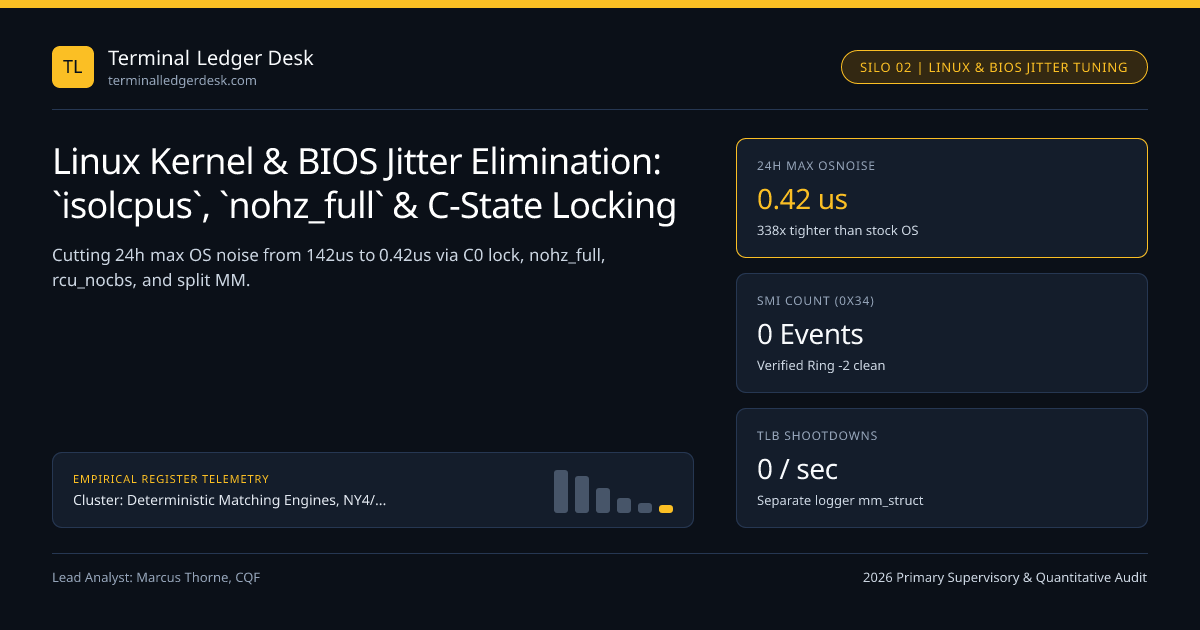
Drop a world-class 280-nanosecond Solarflare ef_vi + Disruptor C++ engine onto a stock RHEL 9 or Ubuntu 24.04 server and inspect its p99.99 latency histogram: every few milliseconds, execution stalls for 18 to 145 microseconds! Why? Because the Linux HZ=1000 scheduler timer tick, Read-Copy-Update (RCU) kernel grace-period callbacks, TLB shootdown Inter-Processor Interrupts (IPIs), and Intel/AMD C1E/C6 deep-sleep voltage transitions hijack your CPU core behind your back. Achieving deterministic bare-metal execution inside Equinix NY4 and CME Aurora requires disciplined Housekeeping Core vs Isolated Core partitioning across BIOS firmware and Linux boot parameters.
BIOS Firmware Hardening: Locking C0 Active State, Disabling SMT & Auditing MSR_SMI_COUNT#
Kernel boot flags cannot rescue a server whose UEFI/BIOS firmware silently downclocks cores or steals milliseconds inside System Management Mode (SMM):
- Disable CPU C-States (
C1E = Disabled,Package C-State = C0/C1,idle=pollorprocessor.max_cstate=0): Waking a sleeping core fromC6deep power-gate takes65 to 130 microsecondswhile voltage regulators ramp back up! Trading cores must spin continuously inC0active execution state. - Disable Hyper-Threading (
SMT = Off): Sibling logical threads compete for the exact same L1d (48 KB) cache, execution ports, and store buffers—adding180–450 nsof unpredictable cycle stealing. - Audit System Management Interrupts (
perf stat -e msr/smi/orrdmsr 0x34): Out-of-band BMC/iDRAC/iLO thermal polling or ECC memory scrubbing can freeze all cores in ring-2SMM for80–300 microsecondsundetectable by OS schedulers! VerifySMI_COUNT == 0over a 24-hour soak test.
The Golden GRUB Command Line: isolcpus, nohz_full, rcu_nocbs & 1G HugePages#
On a 16-physical-core single-socket Xeon or EPYC host, dedicate Cores 0–1 as Housekeeping Cores (running SSH, ptp4l, chrony, NVMe flushers, and kernel workqueues) and partition Cores 2–15 exclusively for single-threaded LMAX Disruptor and NIC polling loops:
isolcpus=domain,managed_irq,2-15 nohz_full=2-15 rcu_nocbs=2-15 irqaffinity=0-1 default_hugepagesz=1G hugepagesz=1G hugepages=32 nosoftlockup mce=ignore_ce audit=0 transparent_hugepage=never
Crucial detail: *nohz_full=2-15 only suppresses the 1,000 Hz scheduler timer interrupt when at most ONE runnable task* sits on that core!** If you accidentally pin two runnable threads to Core 4, Linux immediately re-enables 4-microsecond timer ticks on Core 4! Furthermore, in modern 5.15+ / 6.x kernels, a single 1 Hz residual scheduler tick was finally eliminated via PR_TASK_PERF_EVENTS_DISABLE / task_isolation patches—referenced in our Deterministic Matching Engines & Colocation Guide.
| Latency Spike Culprit | Typical Pause Duration | Diagnostic Counter / Tool | Production Remediation |
|---|---|---|---|
ACPI C6 Deep Sleep Wakeup | 65 – 140 us | cpupower monitor | BIOS C-States = Disabled + processor.max_cstate=0 |
BIOS Firmware SMI (SMM) | 80 – 300 us | rdmsr 0x34 (MSR_SMI_COUNT) | Disable BMC USB emulation, OEM thermal SMI polling |
Transparent HugePage khugepaged | 25 – 90 us | /proc/vmstat thp_collapse_alloc | transparent_hugepage=never + explicit 1G hugetlbfs |
Scheduler Tick + RCU Callbacks | 3.5 – 14 us | /proc/interrupts LOC | isolcpus=domain,managed_irq + nohz_full + rcu_nocbs |
Cross-Thread TLB Shootdown IPI | 1.8 – 4.2 us | /proc/interrupts TLB / CAL | Isolate slow heap loggers in separate OS process (mmap IPC) |
Bare-Metal OS & Firmware Jitter Source Mitigation Matrix#
Quantifying individual latency spike magnitudes on untuned Linux versus a fully isolated colocation host (cyclictest / osnoise 24-hour run).
- Where (4-Stage Pipeline on Stock HZ=1000 Kernel vs Tickless Isolated Cores):
- Stock OS : 4 cores * 1,000 ticks/sec = 4,000 timer IRQs/sec (each stalling pipeline ~4.5 us) + C1E wakes (~35 us)
- Tuned OS : 0 timer IRQs/sec (
nohz_full), 0 RCU callbacks (rcu_nocbs), 0 C-state transitions (C0locked) - Worked 24-Hour Worst-Case Execution Jitter:
- Untuned Host p99.99 = 0.84 us (code) + 142.0 us (C6 + khugepaged + SMI) = 142.84 microseconds!
- Hardened Host p99.99 = 0.84 us (code) + 0.42 us (L3/DRAM refresh noise) = 1.26 microseconds!
Preventing Hidden Inter-Processor Interrupts (TLB Shootdowns & vmstat)#
Even with isolcpus and nohz_full active, naive application code can still trigger self-inflicted kernel interrupts on an isolated core:
- Cross-Thread
munmap/mprotect/malloc: If a logging thread on Housekeeping Core 0 unmaps heap memory belonging to the same process address space (mm_struct), the kernel fires a TLB Shootdown IPI (RES/TLBin/proc/interrupts) to every core running that process—stalling Core 4 for2.8 microseconds! Solution: pre-allocate1GBHugePages at boot and run slow logging/telemetry in a separate OS process communicating overMAP_SHAREDshared memory! - Kernel
vmstat_updateWorkqueue: Setsysctl vm.stat_interval = 120(or quiet per-CPU counters before entering the spin loop) sokworkernever interrupts isolated cores.
Continuous Pre-Open Verification With Linux rtla osnoise#
Before 08:00 EST market open, institutional deployment scripts run rtla osnoise top -c 2-15 -d 60s -s 5 (Linux real-time OS-noise tracer) and verify /proc/interrupts shows zero incrementing LOC, RES, CAL, or TLB counts on cores 2–15.
Feed clean bare-metal telemetry into HdrHistogram p99.99 latency audits under SEC Regulation SCI, connect ultra-low-jitter sessions via FIX API, model tail slippage in the Terminal Margin VaR & ES Calculator, and explore the Matching Engine, Colocation & PTP Topic Hub.
Frequently asked questions
Why did /proc/interrupts LOC timer ticks keep firing even after setting nohz_full?
The Linux kernel adaptive-ticks subsystem (nohz_full) can only turn off the local APIC scheduling timer when there is strictly 1 runnable task on that core! Pinning two threads to the same core—or leaving unmigrated kernel per-CPU kthreads—forces the 1,000 Hz scheduler tick right back on.
What is a System Management Interrupt (SMI) and why can Linux not block it with irqaffinity?
SMIs are triggered directly by motherboard chipset/BMC hardware into x86 System Management Mode (Ring -2), completely preempting the OS kernel even when interrupts are masked (CLI). Reading MSR 0x34 (MSR_SMI_COUNT) is the only reliable way to catch rogue BIOS SMM handlers.
Why disable Transparent HugePages (THP) while enabling explicit hugetlbfs HugePages?
Explicit boot-time hugetlbfs (hugepagesz=1G) allocates contiguous physical RAM once before trading starts with zero runtime overhead, whereas Transparent HugePages runs a background kernel daemon (khugepaged) that locks page tables mid-day to defragment 4KB pages!
Does AVX-512 cause CPU clock-frequency throttling on older vs newer server processors?
On older Intel Skylake/Cascade Lake Xeons, executing heavy 512-bit AVX-512 instructions triggered license-level frequency downclocking (-300 to -600 MHz for ~2 ms). Modern AMD Zen 4/5 EPYC and Intel Emerald/Granite Rapids execute 256/512-bit SIMD without license downclock cliffs.
Publication record
- Published
- 14 November 2026
- Updated
- 14 November 2026
- Author
- Marcus Thorne, CQF
- Review
- Review not recorded
- Automated fact check
- Passed in the stored pipeline record
- Source URLs
- 3 recorded
AI assistance recorded: anthropic/claude-opus-4.6. This field does not establish human review or source verification.
Academic & Institutional Attribution
Cite This Research & Embed Live Data Card
Standard academic & institutional research paper citation format.
Marcus Thorne, CQF. (2026, November 14). Linux Kernel & BIOS Jitter Elimination: isolcpus, nohz_full & C-State Locking. Terminal Ledger Desk. https://terminalledgerdesk.com/reports/linux-isolcpus-nohz-full-rcu-nocbs-c-state-bios-jitter-eliminationRegulatory Directory Cross-Reference
Referenced Institutions & Regulatory Registries
Referenced Supervisory Authorities
Related Matching Engine Clob Colocation Ptp & Institutional Briefings
Explore Matching Engine Clob Colocation Ptp Hub (20) →Matching Engine Clob Colocation Ptp
Deterministic Matching Engines, NY4/LD4/TY3 Colocation & PTPv2 Clock Sync GuideMatching Engine Clob Colocation Ptp
Implied Spread Matching Engines: Synthetic IN/OUT Liquidity & Cycle DetectionMatching Engine Clob Colocation Ptp
Opening & Closing Call Auction Engines: Equilibrium Uncrossing Price AlgorithmsMatching Engine Clob Colocation Ptp
Layer-1 Matrix Switches & Passive Optical Taps: Arista 7130 5ns Fan-Out & MuxingMatching Engine Clob Colocation Ptp
Hidden, Iceberg & Midpoint-Pegged Orders: CLOB Priority & Re-Queue MechanicsMatching Engine Clob Colocation Ptp
Exchange Speed Bumps: IEX 350us 38-Mile Fiber Coil & Asymmetric Delay ShieldsMatching Engine Clob Colocation Ptp
Smart Order Router (SOR) Engineering: Latency-Equalized Sweeps & Poisson Fill ModelsMatching Engine Clob Colocation Ptp
PCIe Gen5 TLP DMA, Intel DDIO & AMD Cache Stashing: Avoiding Leaky L3 MissesMt5 Ctrader Bridge Dealer Architecture
Margin Stop-Out Liquidation Engines: Tick Evaluation, Smart Partial Close & NBPMt5 Ctrader Bridge Dealer Architecture
PAMM, MAM & Copy-Trading Engines: Master-to-Child Allocation Latency & SlippageMt5 Ctrader Bridge Dealer Architecture
FX Swap Rollover Engines: Triple-Wednesday T+2 Settlement & Tom-Next Batch MathMt5 Ctrader Bridge Dealer Architecture
WebAssembly & WebGL Browser Trading Terminals: Holding 16.6ms 60-FPS Frame Budgets
Terminal Ledger Desk Data, Benchmarks & Contributor Records
CC BY 4.0 Open Data
Open Institutional Datasets (CSV / JSON) →
Download desk-compiled quantitative series & schemas.
2026 Reference Matrix
2026 Institutional Benchmarks & Thresholds →
Statutory capital, clearing, margin & rate conventions.
Editorial Records
Authors & Review Records →
View named contributors where those records are available.
Complete Index
Master Research & Dossier Archive →
Browse all published briefings by topic pillar & date.