
Matching Engine Clob Colocation Ptp
Hidden, Iceberg & Midpoint-Pegged Orders: CLOB Priority & Re-Queue Mechanics
Institutional parent orders hide footprint using Reserve Iceberg slices and Midpoint-Pegged dark orders—yet losing display priority on replenishment leaks unmistakable ITCH/MDP signatures to predatory queue-detection models.
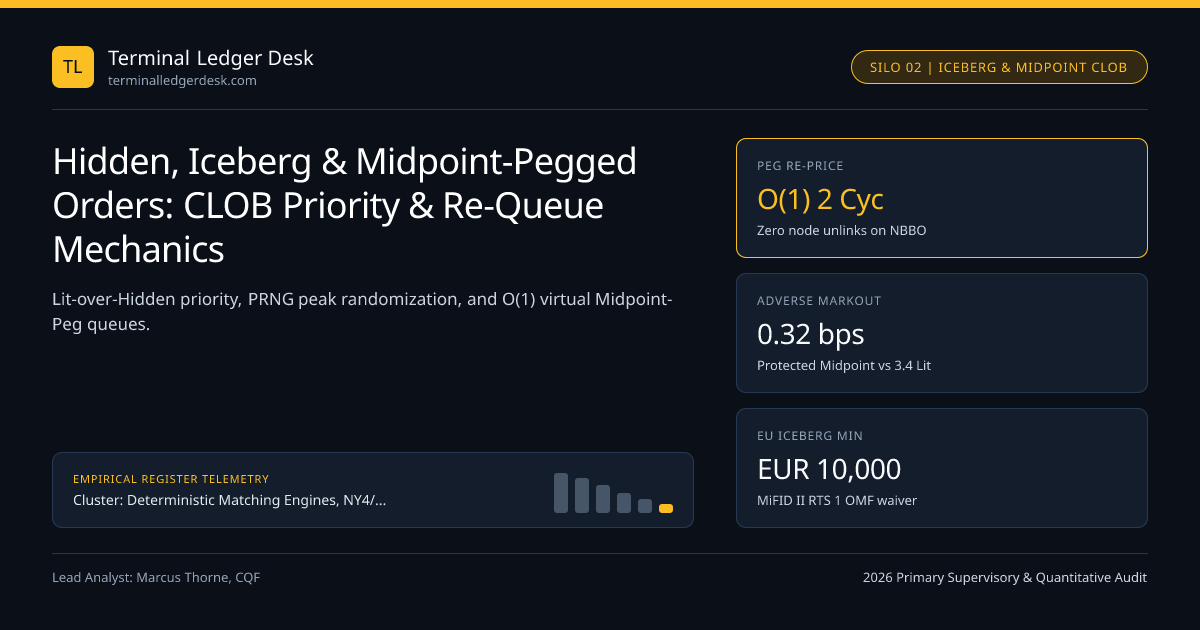
Display a 50,000-share Bid on AAPL or 500-lot Bid on E-mini S&P (ES) openly on the lit book, and cross-venue alpha models immediately skew fair value higher within 150 microseconds! Institutional execution desks conceal size behind three native matching-engine order types: Reserve (Iceberg) orders, Fully Non-Displayed (Hidden) orders, and Primary/Midpoint-Pegged (M-ELO / D-Peg) orders. Inside the matching core, however, strict Display-Before-Non-Display priority and tranche replenishment timestamp resets create complex execution dynamics.
Display Priority vs Hidden Queue & Iceberg Replenishment Re-Queuing#
Across virtually every lit exchange governed by SEC Reg NMS and European MiFID II pre-trade transparency waivers (Large-in-Scale / Order Management Facility Iceberg waiver), Displayed shares strictly outrank Non-Displayed shares at the identical price tick, regardless of arrival timestamp! If Hidden Order H arrived at 09:31:00 at $100.00 and Lit Order L arrives five minutes later at 09:36:00 at $100.00, Lit Order L fills first!
Now trace an Iceberg (MaxFloor Tag 111 / DisplayQty) order for 1,000 shares (Display = 100, Reserve = 900):
- Initial
100displayed shares enter the Lit FIFO queue (t_1). - When an incoming
250-share Seller sweeps$100.00, the matching engine first drains all displayed shares across all participants at$100.00(filling our100lit tip), and only after exhausting 100% of lit depth at$100.00dips into the Hidden/Reserve queue—or, upon partial sweep (100shares), replenishes a fresh100-share slice assigned a brand-newOrderRefNumand tail timestampt_2at the back of the Lit queue!
How HFT ITCH/MDP Parsers Detect Icebergs—and Randomized Peak Defenses#
Because replenishing a depleted Iceberg tip emits a new AddOrder immediately after OrderExecuted inside the same atomic packet or nanosecond timestamp delta (Δt == 0 ns on CME MDP MatchEventIndicator / Nasdaq ITCH) with identical fixed 100-share DisplayQty, naive fixed-peak Icebergs announce themselves like a neon sign to colocated intrusive MBO book trackers!
Modern exchange engines (Nasdaq Random Reserve, LSEG/Xetra Peak Size Randomization, Cboe Reserve) counter iceberg-sniffing by drawing each replenished peak deterministically (via a PRNG seeded in the LMAX Disruptor matching loop so standby replicas stay bit-identical!) from [DisplayQty - Variance, DisplayQty + Variance]—masking statistical size clustering.
| Order Type | FIX / OUCH Encoding | Queue Priority at Price P | NBBO Move Behavior | Primary Footprint Risk |
|---|---|---|---|---|
| Displayed Limit | 40=2 (No 111) | Rank 1 (Lit FIFO) | Static resting price | Immediate visible book imbalance |
Reserve (Iceberg) (CME / Eq) | MaxFloor (111) < Qty (38) | Tip in Rank 1; Reserve in Rank 2 | Static; reload resets to Lit tail | Δt = 0 refill leak unless randomized |
| Fully Hidden Limit | DisplayQty = 0 (18=M/H) | Rank 2 (Hidden FIFO) | Static resting price | Misses fills when Lit refills ahead |
Midpoint Peg / M-ELO (NY4) | 40=P, 18=M + Limit Cap | Rank 0 (Inside Spread Mid) | O(1) virtual shift w/ preserved t_0 | Picked off if NBBO about to crumble |
CLOB Non-Displayed & Pegged Order Mechanics Matrix#
Comparing priority rank, NBBO re-pricing latency, and information-leakage defenses across Iceberg, Hidden, Midpoint Peg, and Crumbling-Quote Peg (D-Peg / C-Peg) orders.
- PeakNextReload = min( ReserveRem, BaseDisplay + (PRNG_xorshift64(State) mod (2*Var + 1)) - Var )
- Worked Iceberg Execution & Replenishment Trace (Order = 1,000 sh, Base_Display = 200, Var = 50):
- t_0 : Lit Tip = 200 sh @ $50.00 (Hidden Reserve = 800 sh). Another trader places 300 Lit sh behind us.
- t_1 : Seller hits 200 sh -> Our 200 Lit tip fills 100%. Remaining 300 Lit sh of other trader now sit at Head!
- t1 : Engine draws PRNG reload = 235 sh (Reserve = 565 sh) -> Appended BEHIND the 300 Lit sh with new timestamp t1.
Midpoint-Pegged Re-Indexing: Avoiding O(N) Re-Price Stalls on NBBO Ticks#
Consider 2,500 resting Midpoint-Pegged (OrdType=P, ExecInst=M) orders tracking 0.5 * (NBBO_Bid + NBBO_Ask) inside Nasdaq Carteret or Equinix NY4. Every time NBBO_Bid ticks up $0.01, the effective execution price of all 2,500 midpoint orders shifts simultaneously by +$0.005! If the matching engine unlinked and re-inserted 2,500 nodes across price levels on every NBBO tick, continuous matching would stall for 80 microseconds!
Instead, deterministic CLOBs store Midpoint-Pegged orders in a dedicated Pegged FIFO Queue indexed by relative offset (Offset = 0), preserving original entry timestamps (t_0) across NBBO movements! During matching, the engine simply computes EffectiveMidPx = (nbboBid + nbboAsk) >> 1 in 2 instructions and checks whether the incoming aggressor limit price crosses EffectiveMidPx (subject to optional Limit Cap price)! Compare how IEX 350us speed bumps shield pegged orders and review our Deterministic Matching Engines & Colocation Guide.
Locked / Crossed NBBO Halts & Sub-Penny Reg NMS Rule 612 Compliance#
Under SEC Reg NMS Rule 612 (Sub-Penny Rule), exchanges cannot accept or rank explicitly priced orders in $0.005 half-penny increments for stocks >= $1.00—yet Midpoint-Pegged executions at $100.005 on a $100.00 x $100.01 spread are explicitly permitted because the order itself was submitted unpriced (pegged) or penny-capped! Furthermore, if the away SIP/Direct NBBO becomes Locked (Bid == Ask) or Crossed (Bid > Ask), compliant matching cores immediately suspend Midpoint-Peg matching to prevent anomalous cross-through prints.
Optimize lit-vs-midpoint child allocation inside the Algorithmic Kelly Allocation Calculator, pass MaxFloor (111) via FIX API, and explore more order-book mechanics in the Matching Engine, Colocation & PTP Topic Hub.
Frequently asked questions
If an aggressive sweep exceeds the entire displayed size at $50.00, how do Iceberg reserves fill?
Once 100% of displayed shares across all orders at $50.00 fill, the matching engine immediately executes remaining aggressor shares against Hidden orders and full Iceberg reserve balances at $50.00 before sweeping down to $49.99—avoiding unnecessary penny-worse slippage!
How can a matching engine use random numbers for Iceberg peaks without breaking HA determinism?
Hardware entropy (RDRAND) is forbidden inside the matching core! Instead, the engine uses a pure mathematical PRNG (such as xorshift128+) seeded deterministically at session start via the replicated Startup Event, ensuring Primary and Backup produce identical random peaks.
Why does MiFID II require a €10,000 minimum initial size for Iceberg orders in Europe?
Under ESMA RTS 1 Article 8 (Order Management Facility waiver), regulators prohibit tiny micro-icebergs from draining lit book transparency by enforcing a minimum €10,000 initial notional size at entry on EEA/UK equity and derivatives venues.
What is Nasdaq M-ELO (Midpoint Extended Life Order) and why does it wait 10 milliseconds?
M-ELO requires both sides of a midpoint order to rest un-canceled for a continuous 10-millisecond holding timer before becoming eligible to match—filtering out sub-millisecond latency-arbitrage snipers racing crumbling NBBO transitions.
Publication record
- Published
- 14 November 2026
- Updated
- 15 November 2026
- Author
- Marcus Thorne, CQF
- Review
- Review not recorded
- Automated fact check
- Passed in the stored pipeline record
- Source URLs
- 3 recorded
AI assistance recorded: anthropic/claude-opus-4.6. This field does not establish human review or source verification.
Academic & Institutional Attribution
Cite This Research & Embed Live Data Card
Standard academic & institutional research paper citation format.
Marcus Thorne, CQF. (2026, November 15). Hidden, Iceberg & Midpoint-Pegged Orders: CLOB Priority & Re-Queue Mechanics. Terminal Ledger Desk. https://terminalledgerdesk.com/reports/hidden-iceberg-midpoint-pegged-order-types-clob-priority-re-queueRelated Matching Engine Clob Colocation Ptp & Institutional Briefings
Explore Matching Engine Clob Colocation Ptp Hub (20) →Matching Engine Clob Colocation Ptp
Deterministic Matching Engines, NY4/LD4/TY3 Colocation & PTPv2 Clock Sync GuideMatching Engine Clob Colocation Ptp
Exchange Speed Bumps: IEX 350us 38-Mile Fiber Coil & Asymmetric Delay ShieldsMatching Engine Clob Colocation Ptp
Smart Order Router (SOR) Engineering: Latency-Equalized Sweeps & Poisson Fill ModelsMatching Engine Clob Colocation Ptp
PCIe Gen5 TLP DMA, Intel DDIO & AMD Cache Stashing: Avoiding Leaky L3 MissesMatching Engine Clob Colocation Ptp
Wire-to-Wire Latency Telemetry: HdrHistogram, Coordinated Omission & Optical TapsMatching Engine Clob Colocation Ptp
LMAX Disruptor Ring Buffers: Mechanical Sympathy in Matching Engine CoresMatching Engine Clob Colocation Ptp
Intrusive O(1) Limit Order Books: Slab Pools, Doubly-Linked Queues & Price ArraysMatching Engine Clob Colocation Ptp
FIFO Price-Time vs Pro-Rata Matching Algorithms: CME Split, LMM & TOP MechanicsMt5 Ctrader Bridge Dealer Architecture
Prime-of-Prime Net Open Position (NOP) Gates: Credit Throttling in FX BridgesMt5 Ctrader Bridge Dealer Architecture
MQL5 High-Speed EA Architecture: OnTick Drop Behavior & OrderSendAsync PipesMt5 Ctrader Bridge Dealer Architecture
Mobile Trading Terminals: iOS/Android Socket Suspension, QUIC & Push ExecutionMt5 Ctrader Bridge Dealer Architecture
Trading Terminal Binary Hardening: Certificate Pinning, DPAPI/Keychain & Anti-Tamper
Terminal Ledger Desk Data, Benchmarks & Contributor Records
CC BY 4.0 Open Data
Open Institutional Datasets (CSV / JSON) →
Download desk-compiled quantitative series & schemas.
2026 Reference Matrix
2026 Institutional Benchmarks & Thresholds →
Statutory capital, clearing, margin & rate conventions.
Editorial Records
Authors & Review Records →
View named contributors where those records are available.
Complete Index
Master Research & Dossier Archive →
Browse all published briefings by topic pillar & date.