
Matching Engine Clob Colocation Ptp
Intrusive O(1) Limit Order Books: Slab Pools, Doubly-Linked Queues & Price Arrays
Cancel messages account for 90% to 96% of all HFT exchange traffic; replacing std::map red-black trees with flat price-tick arrays and intrusive doubly-linked slab pointers drops cancel latency from 420 ns to 28 ns.
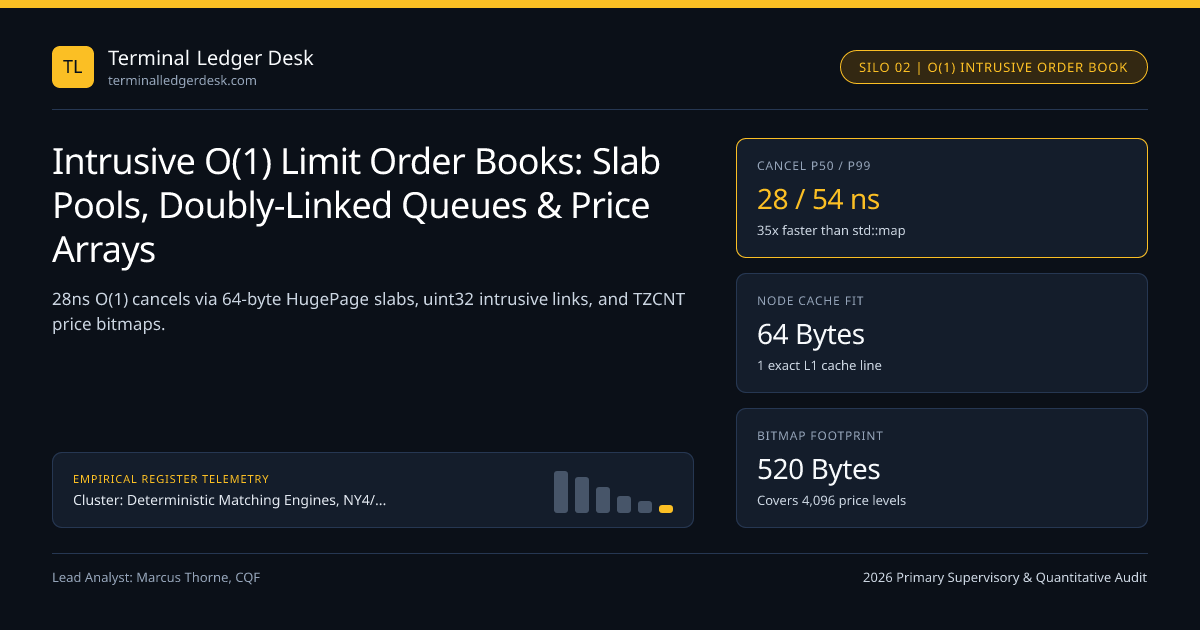
Across Nasdaq, CME Globex, and Eurex T7, 91% to 96% of all inbound messages are order cancellations or price/size modifications, while actual trades represent fewer than 4% of book mutations. Textbook order books built out of std::map<Price, std::list<Order>> fail catastrophically in production because every std::map lookup chases 12 to 18 heap-scattered red-black tree pointers—incurring 6+ L3/DRAM cache misses (~65 ns each)—before scanning a non-intrusive linked list! Institutional engines achieve 28-nanosecond O(1) cancels via three tight data structures: a flat tick-indexed PriceLevel array, an open-addressed OrderId -> SlabIdx hash table, and intrusive doubly-linked uint32_t index pointers embedded directly inside a 64-byte OrderNode slab.
Why std::map Red-Black Trees Lose to Dense Tick-Offset Price Arrays#
Every exchange instrument trades on a discrete MinPriceIncrement (tickSize, e.g., $0.01 for US equities >= $1.00, 0.25 index points for CME E-mini S&P 500 ES). Within any single trading day—especially bounded by LULD or exchange circuit-breaker bands (±10% to ±20%)—active resting orders span at most 8,192 to 65,536 discrete price ticks around the opening reference price!
Instead of maintaining a balanced binary search tree (O(log P) with random heap addresses), production CLOBs allocate a contiguous flat ring/band array of PriceLevel structs indexed directly by idx = (priceTicks - baseTickOffset) & BAND_MASK (O(1) in 1 CPU instruction!). Even better, maintaining a hierarchical 64-bit occupancy bitset (uint64_t l1Summary, uint64_t l2Bitmaps[64] covering 4,096 price ticks in 520 bytes of L1 cache!) lets the engine find the next non-empty Best Bid or Best Offer after a multi-level sweep using a single hardware TZCNT / LZCNT instruction (3 cycles)!
Intrusive Doubly-Linked uint32_t Slab Indices vs 64-Bit Raw Pointers#
Inside each PriceLevel ({ int64_t totalVisibleQty; uint32_t headIdx; uint32_t tailIdx; uint32_t orderCount; }), orders resting at that price form a strict FIFO queue. Rather than wrapping Order inside an external std::list node (doubling heap allocations) or storing 8-byte raw pointers (Order* prev, *next = 16 bytes), institutional C++/Rust books pre-allocate a contiguous OrderNode slab[MAX_RESTING_ORDERS] on 2MB HugePages and store 4-byte uint32_t array indices (prevIdx, nextIdx, levelIdx) right inside the 64-byte OrderNode!
Compressing prev, next, and level links from 24 bytes down to 12 bytes lets the entire resting order (orderId, qty, leavesQty, ownerFirmId, smpId, timestamp, prevIdx, nextIdx, levelIdx) pack inside one exact 64-byte L1 cache line! When OrderCancel (35=F / OUCH U) arrives, unlinking node from the middle of a 5,000-order price queue touches at most its immediate neighbor slots (slab[node.prevIdx].nextIdx = node.nextIdx) and decrements level.totalVisibleQty -= node.leavesQty in O(1) constant time—detailed alongside our LMAX Disruptor matching core guide.
| Book Operation | Textbook std::map + std::list | boost::flat_map + std::vector | Tick Array + Bitmap + Intrusive Slab |
|---|---|---|---|
| Add Resting Limit Order | O(log P) + 2x malloc (~480 ns) | O(P) shift on new price (~310 ns) | O(1) array + LIFO pop (~32 ns) |
Cancel Order by OrderID | Hash + pointer chase (~420 ns) | O(N_level) vector erase (~580 ns) | O(1) uint32 neighbor splice (~28 ns) |
| Read Best Bid / Best Offer | Tree leftmost node (~18 ns) | Array index 0 (~4 ns) | Cached register / TZCNT (~2 ns) |
| Aggressor Multi-Level Sweep | Tree iterator hops (L3 misses) | Contiguous level stride | Contiguous array + TZCNT jump (~45 ns/fill) |
TLB Misses (2M Active Orders) | Severe (4KB fragmented pages) | Moderate | Near Zero (64 x 2MB HugePages) |
CLOB Data Structure Complexity & Hardware Cache Telemetry Matrix#
Benchmarked on an AMD EPYC / Intel Xeon pinned core replaying 50 million real Nasdaq ITCH 5.0 / CME MDP 3.0 Market-By-Order mutations.
- WordIdx = PriceIdx >> 6 ; BitPos = PriceIdx & 63
- NextAskTick = (l2Bitmap[w] != 0) ? (w << 6) + tzcnt64(l2Bitmap[w]) : (tzcnt64(l1Summary_masked) << 6) + tzcnt64(...)
- Worked Memory Sizing for 4,000,000 Active Orders across 500 Symbols:
- Order Slab = 4,000,000 * 64 bytes = 256,000,000 bytes (244.1 MiB = 123 HugePages)
- Bitmap Band = 500 symbols * 520 bytes (4,096 ticks/side) = 260.0 KB (fits entirely inside 1 MB L2 cache!).
Sweep Execution & Partial-Fill Queue Walk Mechanics#
When an aggressive Buy IOC order crosses the spread (limitPx >= bestAskPx), the matching engine walks slab[askLevel.headIdx] sequentially:
- Compute
fillQty = min(aggressorLeaves, restingNode.leavesQty). - Emit a deterministic
MatchEventinto the outbound ring buffer (restingOrderId,aggressorOrderId,matchPx = askLevel.price,fillQty). - If
restingNode.leavesQty == 0, popheadIdx = restingNode.nextIdx, returnrestingIdxto the LIFO free-list head (keeping hot recently-freed cache lines in L1/L2!), and ifaskLevel.headIdx == NULL_IDX, clear its occupancy bit inl2BitmapssoTZCNTjumps instantaneously to the next ask tick!
Compare how FIFO queue walks differ from size-weighted splits in our FIFO vs Pro-Rata matching mechanics audit and our Deterministic Matching Engines & Colocation Guide.
Dual-Use Architecture: Venue Matching Core vs Client ITCH/MDP Shadow Book#
This exact O(1) slab-and-bitmap architecture powers both sides of the fiber inside Equinix NY4 and CME Aurora: exchanges run it as the authoritative matching engine, while buy-side/prop desks connected via FIX API and binary gateways run a read-optimized clone to reconstruct local Market-By-Order (MBO) shadow books from Nasdaq ITCH 5.0 and CME MDP 3.0!
Quantify queue-position fill odds and adverse-selection costs in the Algorithmic Kelly Allocation Calculator under SEC market-structure rules, and browse more engine blueprints in the Matching Engine, Colocation & PTP Topic Hub.
Frequently asked questions
How does a flat tick-array order book handle stub quotes 50% away from the current market price?
Production engines use a hybrid two-tier structure: 99.99% of active orders within ±15% of reference price hit the ultra-fast O(1) dense tick array, while rare deep-out-of-the-money GTC stub quotes spill cleanly into a cold secondary B-tree outside the hot path.
Why recycle freed OrderNode slots using a LIFO stack instead of a FIFO free list?
A slot freed 200 nanoseconds ago by a canceled quote is still sitting hot inside the CPU core L1 or L2 cache! Popping that exact slot from a LIFO free-list head avoids fetching a cold DRAM cache line that has not been touched for 20 minutes.
What happens to intrusive FIFO pointers when a resting order reduces vs increases its quantity?
Decreasing LeavesQty mutates restingNode.leavesQty and priceLevel.totalVisibleQty in place without touching prevIdx or nextIdx (preserving time priority). Increasing quantity unlinks the node and appends it to priceLevel.tailIdx (losing priority per venue rules).
Can Rust implement intrusive doubly-linked order slabs safely without raw C pointers?
Yes! Using uint32_t array indices (u32 with u32::MAX as sentinel NULL) inside a pre-allocated Vec<OrderNode> satisfies the Rust borrow checker cleanly with 100% safe indexing (or audited get_unchecked) and zero unsafe self-referential pointer lifetimes.
Publication record
- Published
- 14 November 2026
- Updated
- 14 November 2026
- Author
- Marcus Thorne, CQF
- Review
- Review not recorded
- Automated fact check
- Passed in the stored pipeline record
- Source URLs
- 3 recorded
AI assistance recorded: anthropic/claude-opus-4.6. This field does not establish human review or source verification.
Academic & Institutional Attribution
Cite This Research & Embed Live Data Card
Standard academic & institutional research paper citation format.
Marcus Thorne, CQF. (2026, November 14). Intrusive O(1) Limit Order Books: Slab Pools, Doubly-Linked Queues & Price Arrays. Terminal Ledger Desk. https://terminalledgerdesk.com/reports/intrusive-doubly-linked-order-book-o1-cancel-radix-price-indexingRegulatory Directory Cross-Reference
Referenced Institutions & Regulatory Registries
Referenced Supervisory Authorities
Related Matching Engine Clob Colocation Ptp & Institutional Briefings
Explore Matching Engine Clob Colocation Ptp Hub (20) →Matching Engine Clob Colocation Ptp
Deterministic Matching Engines, NY4/LD4/TY3 Colocation & PTPv2 Clock Sync GuideMatching Engine Clob Colocation Ptp
FIFO Price-Time vs Pro-Rata Matching Algorithms: CME Split, LMM & TOP MechanicsMatching Engine Clob Colocation Ptp
US Equities Liquidity Triangle: Equinix NY4, ICE Mahwah & Nasdaq Carteret SLAsMatching Engine Clob Colocation Ptp
Equinix LD4 Slough FX Colocation Topology: LMAX, EBS, Currenex & Prime BridgesMatching Engine Clob Colocation Ptp
Multi-Region Colocation Architecture: CME Aurora, Equinix FR2 Frankfurt & TY3 TokyoMatching Engine Clob Colocation Ptp
Solarflare Onload / ef_vi vs DPDK Kernel Bypass: NIC RX/TX Ring & PIO TuningMatching Engine Clob Colocation Ptp
FPGA Tick-to-Trade Pipelines: Cut-Through PCS/MAC & Sub-200ns Order TriggeringMatching Engine Clob Colocation Ptp
IEEE 1588v2 PTP Clock Synchronization: GNSS Grandmasters, Boundary Clocks & NIC PHCMt5 Ctrader Bridge Dealer Architecture
Liquidity Bridge Architecture: oneZero Hub, PrimeXM XCore & Centroid DatapathsMt5 Ctrader Bridge Dealer Architecture
A-Book STP, B-Book Internalization & C-Book Hybrid Dealing Desk ClassifiersMt5 Ctrader Bridge Dealer Architecture
Virtual Dealer Plugins vs True Market Execution: Auditing Asymmetric SlippageMt5 Ctrader Bridge Dealer Architecture
MT5 Execution Modes & Fill Policies: Instant, Request, Market, Exchange & IOC/FOK
Terminal Ledger Desk Data, Benchmarks & Contributor Records
CC BY 4.0 Open Data
Open Institutional Datasets (CSV / JSON) →
Download desk-compiled quantitative series & schemas.
2026 Reference Matrix
2026 Institutional Benchmarks & Thresholds →
Statutory capital, clearing, margin & rate conventions.
Editorial Records
Authors & Review Records →
View named contributors where those records are available.
Complete Index
Master Research & Dossier Archive →
Browse all published briefings by topic pillar & date.