
Mt5 Ctrader Bridge Dealer Architecture
A-Book STP, B-Book Internalization & C-Book Hybrid Dealing Desk Classifiers
Modern institutional brokerages rarely operate pure 100% A-Book or blind 100% B-Book silos; real-time quantitative risk engines score account Sharpe, markout toxicity, and aggregate net exposure to dynamically hedge tail risk.
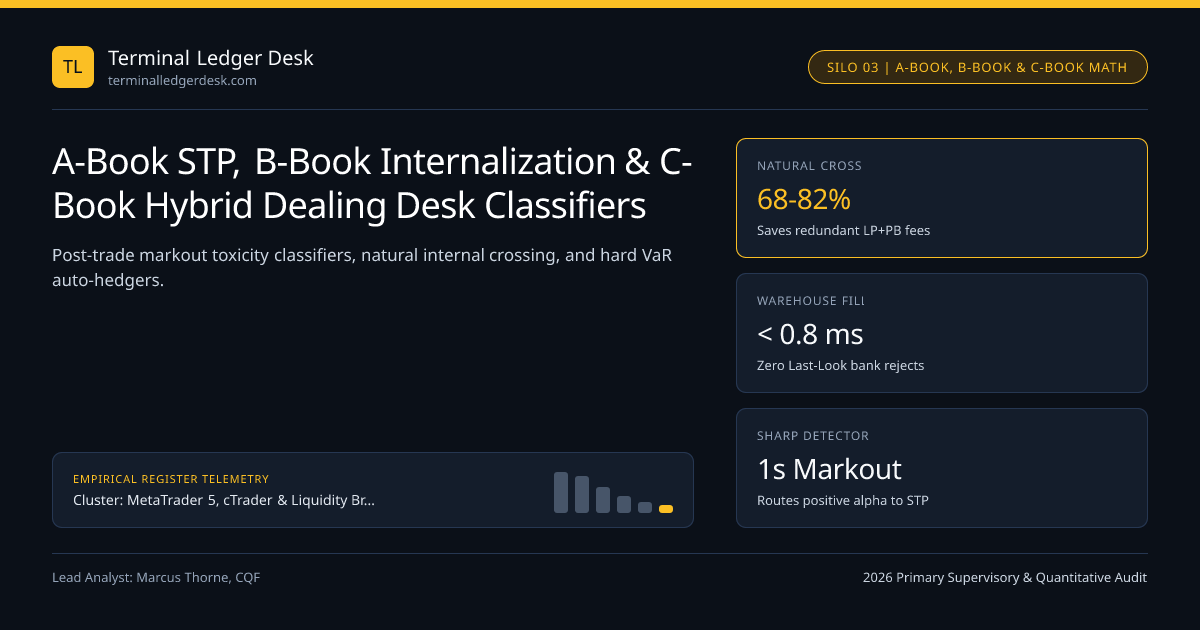
Retail forums reduce broker execution to a cartoon binary—"A-Book good, B-Book bad"—yet Tier-1 publicly listed brokerages (IG Group, Plus500, CMC Markets, Saxo Bank, and institutional FX banks like JPMorgan and XTX) run sophisticated Internalization + Dynamic Portfolio Hedging (Hybrid / C-Book) engines identical in math to Wall Street equity wholesalers! Understanding how quantitative liquidity aggregation bridges score post-trade markouts (1s, 10s, 60s), match opposing internal client flow at 0.0 ms LP cost, and hedge net residual Greeks externally demystifies modern broker microstructure.
Pure A-Book (Agency STP), Pure B-Book (Principal) & Internal Crossing Mechanics#
Trace what happens inside the bridge when two clients on IG, SaxoTraderGO, or MT5 trade EUR/USD simultaneously:
- 1-to-1 Agency
A-Book(Straight-Through Processing): Every individual client ticket triggers an immediate external35=Dhedge on an LD4 Liquidity Provider; the broker earns strictly commission/markup (~$15–$35 per $1M) regardless of client PnL, while paying LP spread + Prime Broker (PB) clearing ticket fees ($2–$6 per $1M) on every leg. - Natural Internalization (
Principal Crossing— 70%+ of Large Broker Flow!): When4,200clients are buyingEUR/USD(185 Lots) and3,900clients are sellingEUR/USD(172 Lots) in the same minute, routing all357 Lotsexternally to LPs would pay357 Lotsof LP spread + PB clearing fees just to buy and sell back the exact same asset! Instead, an internalizing book crosses172 Lotsinternally with zero Last-Look rejections and sends only the+13 Lotnet residual exposure to the street once portfolio VaR thresholds breach!
Quantitative Toxicity Classifiers: VPIN, Short-Horizon Markouts & C-Book Ratios#
How does a modern quantitative risk desk decide which individual accounts bypass the internal warehouse and route 100% (or 150%!) straight to external Firm LPs (C-Book)? Never by manually eyeballing account balances—by streaming real-time *Post-Trade Markout Curves (`Delta_Mid(t + tau) Direction)** across tau in {100ms, 1s, 5s, 30s, 300s}`:
- Latency / News Sniper Signature (
+1.8 pips@tau = 500ms): Price consistently moves in the client favor within500 millisecondsof entry ->100% A-Bookonto Firm No-Last-Look CLOBs (since Last-Look banks will reject toxic flow too!). - Sustained Directional Alpha (
Sharpe > 2.0, positive60s–1hmarkout): Routed via ProportionalC-BookHedging (HedgeRatio = 0.50to1.00, or even>1.0parallel alpha capture where prohibited/permitted disclosures allow—note UK FCA and MiFID II strict client-information barriers!). - Mean-Reverting / Noise Flow (
Zero1smarkout, negative net expectancy after spread/financing): Warehoused inside the Portfolio Netting Book bounded by strict symbolVaR/NOPauto-hedge ceilings!
| Execution Book Model | Fill Speed & Last-Look Risk | External PB / LP Cost | Broker PnL Variance | Regulatory Capital (IFPR) |
|---|---|---|---|---|
1-to-1 Ticket A-Book (STP) | 2 – 25 ms (Exposed to LP LL) | High (100% of gross volume) | Very Low (Pure fee margin) | Minimal K-NPR (K-DTF applies) |
Unhedged B-Book | < 1 ms (Internal fill) | $0 External | Extreme (Blowup risk on trends!) | High K-NPR (8%–15%+ net) |
| Internalizing Warehouse + Cap (IG / Saxo) | < 1 ms (0% LP Rejects) | Low (15–25% residual) | Controlled (Bounded by MaxNOP) | Moderate (Capped at Delta limit) |
Dynamic C-Book (Bridge) (Bridge) | 0.8 – 4 ms (Blended) | Medium (Targeted on sharp flow) | Low-Moderate | Optimized capital efficiency |
Broker Execution Book Model Comparison Matrix (A, B, Warehouse & C-Book)#
Comparing execution latency, LP rejection exposure, revenue volatility, and regulatory capital (IFPR / Basel K-Factor K-NPR) requirements.
- NetResidualHedge = sign(PosNetWarehouse) * max( 0, |PosNetWarehouse| - LimitDeltaSymbol )
- Worked Markout Classification & Warehouse Spillover:
- Account #88412 (500 trades) : Markout(1s) = +0.65 pips, Markout(60s) = +1.40 pips -> Toxic/Sharp! Set STP_Ratio = 100%.
- Warehouse XAU/USD Net Long = +$4,250,000 ; LimitDeltaXAU = $2,500,000
- > Auto-Hedger immediately fires Buy +$1,750,000 XAU/USD IOC on LD4 LMAX/Bullion Banks (capping warehouse at $2.50M!).
Portfolio Auto-Hedger Ceilings (Delta / VaR Limits) vs Toxic Unhedged B-Book Failures#
Why did under-capitalized offshore B-Book brokers blow up on 15 January 2015 (SNB EUR/CHF peg removal) or Gold / Cocoa parabolic trends, while disciplined listed market makers thrived? Because reckless B-Books warehouse unbounded directional inventory without automated delta ceilings!
Institutional unified margin & risk engines enforce two hard automatic triggers in C++ (< 1 ms):
- Per-Symbol Net Delta Collar (
MaxWarehouseUSD, e.g.,$3.0Mper FX major,$1.0MXAU/USD): The instant aggregate unhedged client net position crosses+$3.0Mlong XAU/USD, an Automated Portfolio TWAP/IOC Hedger sweeps excess delta straight intoLD4LPs—turning unhedged gambling into bounded market-making inventory! Compare execution fairness in our Virtual Dealer plugin vs Market Execution audit and MT5, cTrader & Liquidity Bridge Architecture Guide.
Regulatory Capital (MIFIDPRU K-NPR) & Conflict-of-Interest Firewalls#
Under UK FCA MIFIDPRU (IFPR), EU IFR/IFD, and CFTC/NFA RFED net-capital rules, every dollar of unhedged B-Book/Warehouse exposure incurs a mandatory Net Position Risk (K-NPR — typically 8% on FX, 15%+ on commodities/equities) regulatory capital charge! Furthermore, execution quality (fill speed, slippage symmetry, zero artificial delay) MUST remain 100% identical regardless of whether the back-end warehouse nets or hedges the position.
Calculate exact portfolio VaR and K-NPR warehouse capital cushions inside the Terminal Margin VaR & ES Calculator and explore more dealing topology reports in the MT5, cTrader & Bridge Topic Hub.
Frequently asked questions
Does B-Book or Warehouse internalization mean a broker wants me to lose or manipulates my fills?
At Tier-1 publicly traded FCA/CFTC/MAS-regulated firms (like IG, CMC, Saxo, Plus500), internalizing retail flow is pure statistical portfolio netting—identical to Citadel or Virtu internalizing US equities! Strict best-execution audits forbid artificial delays or off-market fills.
What exactly is C-Book routing inside oneZero Hub or PrimeXM XCore?
C-Book encompasses partial/hybrid routing rules—such as hedging 40% or 75% of an account orders externally while warehousing the remainder, or grouping hundreds of retail accounts into an aggregated portfolio bucket hedged dynamically via TWAP/delta thresholds.
Why does sending toxic latency-arbitrage flow to a Last-Look bank A-Book backfire on a broker?
If a sniper exploits a 15-ms stale price feed, a Last-Look bank holds the broker A-Book hedge for 20 ms, sees the market already moved against it, and rejects the hedge—or worse, widens spreads/terminates the broker Prime-of-Prime feed entirely!
How does EU/UK IFPR (MIFIDPRU) penalize unhedged B-Book exposure with capital requirements?
Under MIFIDPRU K-NPR (Net Position Risk), every unhedged net position held on the broker balance sheet at end-of-day/intraday consumes hard Tier-1 regulatory equity (8% on spot FX, 2% on gold/rates, 15%+ on commodities and single equities).
Publication record
- Published
- 14 November 2026
- Updated
- 15 November 2026
- Author
- Marcus Thorne, CQF
- Review
- Review not recorded
- Automated fact check
- Passed in the stored pipeline record
- Source URLs
- 3 recorded
AI assistance recorded: anthropic/claude-opus-4.6. This field does not establish human review or source verification.
Academic & Institutional Attribution
Cite This Research & Embed Live Data Card
Standard academic & institutional research paper citation format.
Marcus Thorne, CQF. (2026, November 15). A-Book STP, B-Book Internalization & C-Book Hybrid Dealing Desk Classifiers. Terminal Ledger Desk. https://terminalledgerdesk.com/reports/a-book-stp-b-book-internalization-c-book-hybrid-routing-classifiersRelated Mt5 Ctrader Bridge Dealer Architecture & Institutional Briefings
Explore Mt5 Ctrader Bridge Dealer Architecture Hub (20) →Mt5 Ctrader Bridge Dealer Architecture
MetaTrader 5, cTrader & Liquidity Bridge Server Topology & Execution Logs GuideMt5 Ctrader Bridge Dealer Architecture
Virtual Dealer Plugins vs True Market Execution: Auditing Asymmetric SlippageMt5 Ctrader Bridge Dealer Architecture
MT5 Execution Modes & Fill Policies: Instant, Request, Market, Exchange & IOC/FOKMt5 Ctrader Bridge Dealer Architecture
Decoding MT5 & cTrader Client Journal Logs: Millisecond TCA, Requotes & Off QuotesMt5 Ctrader Bridge Dealer Architecture
Tick-Filtering Gateways: Off-Market Spike Suppression & Quote Aggregation ThrottlesMt5 Ctrader Bridge Dealer Architecture
Spotware cTrader Open API (Protobuf) vs cTrader FIX 4.4: Quotas, Auth & LatencyMt5 Ctrader Bridge Dealer Architecture
MT5 Netting vs Hedging Position Ledgers: Orders, Deals, CloseBy & Margin MathMt5 Ctrader Bridge Dealer Architecture
OTC FX Last-Look Hold Windows: FX Global Code Principle 17 & Firm Liquidity TCAMifid Rts6 Pretrade Kill Switch Controls
Gross vs Net Intraday Pre-Trade Credit Accounting: Open-Order Exposure & Cancel-Replace InflationMifid Rts6 Pretrade Kill Switch Controls
Exchange Cancel-On-Disconnect (COD): Heartbeat Grace Windows Across CME, Nasdaq & EurexMifid Rts6 Pretrade Kill Switch Controls
FIX Tag 35=q OrderMassActionRequest & Venue Firm-Level Kill-Switch APIs BenchmarkedMifid Rts6 Pretrade Kill Switch Controls
Self-Match Prevention (SMP): Cancel-Oldest, Cancel-Newest & Decrement-and-Cancel Mechanics
Terminal Ledger Desk Data, Benchmarks & Contributor Records
CC BY 4.0 Open Data
Open Institutional Datasets (CSV / JSON) →
Download desk-compiled quantitative series & schemas.
2026 Reference Matrix
2026 Institutional Benchmarks & Thresholds →
Statutory capital, clearing, margin & rate conventions.
Editorial Records
Authors & Review Records →
View named contributors where those records are available.
Complete Index
Master Research & Dossier Archive →
Browse all published briefings by topic pillar & date.