
Mifid Rts6 Pretrade Kill Switch Controls
Gross vs Net Intraday Pre-Trade Credit Accounting: Open-Order Exposure & Cancel-Replace Inflation
Counting only filled trades toward intraday credit limits invites clearing insolvency; counting naive sums of bids and offers starves market makers. Learn exact worst-case directional and in-flight 35=G credit accounting.
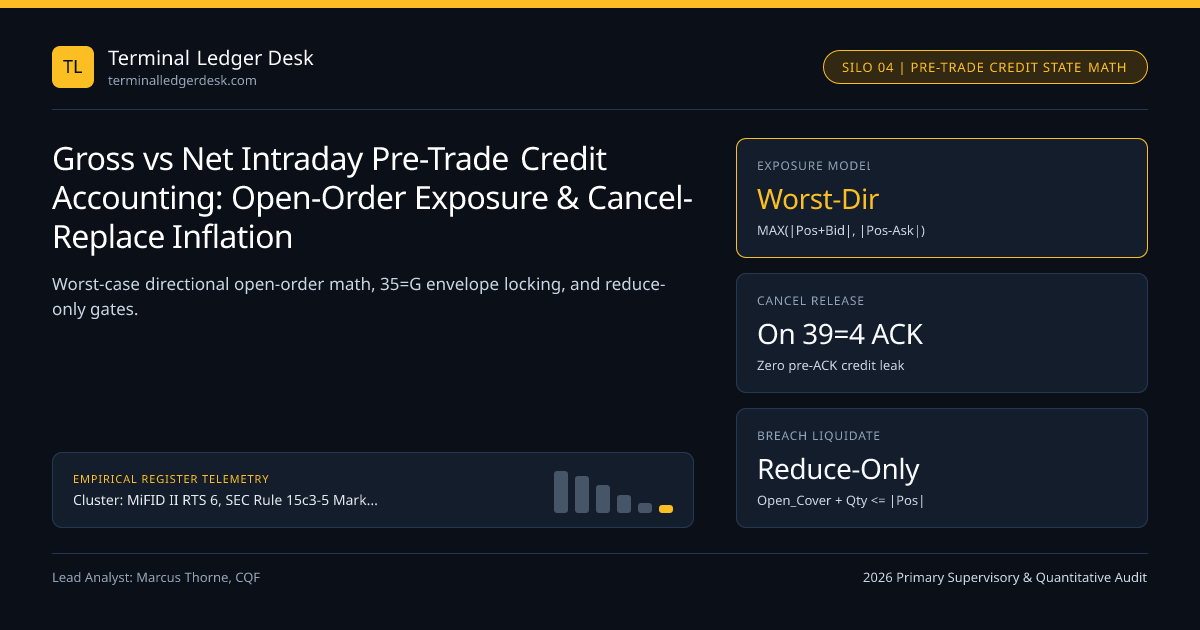
Getting intraday pre-trade credit arithmetic wrong destroys a brokerage in one of two opposite ways: under-counting open unexecuted orders allows a market maker quoting $40 million across 50 instruments to get swept on every bid simultaneously during an FOMC shock (10x posted margin!), whereas over-counting two-sided quotes and in-flight OrderCancelReplaceRequest (35=G) updates falsely locks out profitable clients every afternoon. Mastering exact state-machine credit accounting is core to SEC Rule 15c3-5 and CFTC Reg 1.73.
Three Credit Aggregation Formulas: Pure Gross, Net-Position-Only & Worst-Case Directional#
Within our MiFID II RTS 6 & SEC 15c3-5 Architecture Hub and Unified Margin Clearing Engine, pre-trade gateways evaluate exposure at two hierarchy levels (Per-Symbol and Portfolio Aggregate):
- Flawed Model A — Executed-Only (
|Filled_Pos|): IgnoresLeavesQty (Tag 151)on resting limit orders completely. Illegal under FINRA15c3-5examinations because500resting buy orders can fill in200 microsecondsbefore any post-trade monitor reacts! - Ultra-Conservative Model B — Naive Two-Sided Gross (
|Filled| + Open_Buys + Open_Sells): Adds resting Bids AND resting Offers together on the same symbol. Safe for directional hedge funds, but punitive for a two-sided market maker quoting$5M Bid / $5M AskonES(a single market move cannot fill both+5Mand-5Minto a$10Mdirectional position simultaneously!). - Institutional Standard Model C — Per-Symbol Worst-Case Directional Sum: For each symbol
i, computesE_i = MAX( |Pos_i + OpenBuy_i|, |Pos_i - OpenSell_i| ), then sumsSum_i(E_i * Haircut_i)across all symbols! Notice how offsetting reduce-only orders (Pos = +$5M,OpenSell = $3M) properly do not inflate worst-case long risk (MAX(|+5|, |+5 - 3|) = $5M), while an over-hedgingOpenSell = $12Mflips risk to|+5 - 12| = $7M!
The In-Flight 35=G (Cancel/Replace) Reservation Trap#
Suppose an algorithmic desk rests a 100-lot Buy limit (ClOrdID = A1) and sends OrderCancelReplaceRequest (35=G, OrigClOrdID = A1, ClOrdID = A2, OrderQty = 120, Price = +1 tick). During the 350 microseconds while A2 is Pending Replace (39=E) in flight to the exchange:
- What if
A1(100 lots) was already filled at the matching engine 10 microseconds ago, and the exchange rejects or appliesA2depending onOrderQtysemantics? - Under FIX Protocol Messaging Standard rules,
Tag 38 (OrderQty)in35=Gspecifies the new total chain quantity (CumQty + NewLeavesQty), so exposure duringPending Replacemust reserve *`MAX(Old_Price OldRemaining, NewPrice * MAX(0, NewOrderQty - KnownCumQty))**—neverOld + New(220 lotsdouble-count), and never droppingOldbefore39=5 (Replaced)` arrives!
| FIX Lifecycle Event | Naive (Buggy) Gateway Action | Institutional State-Machine Action | Failure Prevented | ||
|---|---|---|---|---|---|
Client sends Cancel (35=F) | Immediately frees resting order credit on outbound wire | Hold 100% of reservation until exchange returns 39=4 (Canceled) or 39=2 (Filled) | Prevents client sending Cancel + New 10x in flight when cancels lose race! | ||
Client sends Replace (35=G) | Adds full New_Qty on top of Old_Qty (200% usage) | Reserve MAX(Old_Remaining_Notional, New_Remaining_Notional) until 39=5 or 434=2 (35=9) | Eliminates false credit starvation during rapid quote-price sliding | ||
Account hits 102% Credit Cap | Blanket-rejects all outbound 35=D messages | Blocks risk-increasing orders; allows verified Reduce-Only covers where `Open_Cover + Qty <= | Pos | ` | Prevents trapping bleeding positions unable to flatten during volatility! |
| Exchange TCP Disconnects | Clears open-order table immediately on socket EOF | Keep open-order credit locked until COD verified via Drop-Copy / Out-of-Band check | Protects against fills occurring inside COD grace window |
Pre-Trade Credit State-Machine Transition Reference Table#
Exact credit reservation deltas across every outbound client request and inbound exchange ExecutionReport (35=8) state transition.
- TotalPortfolioCreditUsed = Sum{i = 1..N}( Esymboli ) + MAX( 0, -IntradayTotalPnL_USD )
- Worked Reduce-Only Liquidation Gate Verification (Symbol = NVDA, Executed Pos = -4,000 Shares Short):
- Resting Open Buy Limit Orders Already on Venue = 2,500 Shares
- Trader Submits Emergency Buy Order = 2,000 Shares
- Check: 2,500 + 2,000 = 4,500 > |-4,000| -> REJECT! (Would flip +500 shares Net Long!)
- Max Allowed Reduce-Only Clip = |-4,000| - 2,500 = 1,500 Shares -> PASS!
Allowing Risk-Reducing Liquidation Orders When Credit Is 100% Breached#
One of the deadliest coding bugs in homegrown risk gateways occurs when an intraday market rally pushes a short portfolio past 100% of its $20M gross mark-to-market limit—and the risk gateway blocks the trader Buy-to-Cover orders because Current_Exposure > Limit!
Compliant Pre-Trade Risk Control Standard engines implement a dedicated Reduce-Only Liquidation Bypass invariant: an inbound order on symbol i is permitted even during a credit freeze if and only if:
- Its side strictly opposes
Executed_Position_i(BuywhenPos_i < 0,SellwhenPos_i > 0), AND Existing_Same_Side_Open_Orders_i + New_Order_Qty_i <= |Executed_Position_i|! (Checking existing open reduce orders prevents submitting ten100-lotBuy-to-Cover orders against a-100-lotshort and flipping+900 lotsnet long!).
Multi-Currency FX Haircuts & SPAN / VaR Margin Approximation in Hardware#
Because full Monte Carlo or CME SPAN array convolutions take milliseconds, inline cut-through FPGAs store pre-scaled Per-Unit Risk Weights (w_i in USD) inside BRAM—updated every 30 seconds by an asynchronous risk server running full portfolio covariance and FX spot cross-rates (EURUSD, USDJPY plus a 2% FX volatility buffer).
Compute exact parametric and historical Expected Shortfall weights for w_i in our Terminal Margin VaR & ES Calculator and size multi-strategy capital envelopes in the Algorithmic Kelly Allocation Calculator.
Frequently asked questions
Why must credit reservation never be released when the client sends OrderCancelRequest (35=F)?
In fast markets, 40% to 70% of cancel requests aimed at near-touch quotes arrive Too Late To Cancel (returning OrderCancelReject 35=9 because the resting order already filled). Releasing credit on outbound 35=F would allow an algorithm to cycle New -> Cancel -> New ten times in 1 millisecond and accumulate 10x its capital limit!
Can portfolio-level cross-margining (e.g., Long ES vs Short SPY) be used inside a 310ns FPGA gate?
Pure hardware Layer-1/2 FPGAs typically enforce fast additive worst-case symbol weights (conservatively ignoring fragile cross-asset correlations during tail breaks), while a companion microsecond C++ / Drop-Copy risk server periodically recalculates SPAN/TIMS correlation offsets and refreshes the FPGA net headroom register.
How does intraday realized and unrealized PnL interact with pre-trade gross credit caps?
Best-practice gateways pair Exposure Caps with an Intraday Max Drawdown ("Stop-Loss") Gate: any net mark-to-market loss (Realized + Unrealized < -$500k) directly reduces available credit dollar-for-dollar and triggers an automatic Soft Freeze + Risk Alert once 80% and 100% of daily loss limits breach.
How are multi-leg futures calendar spreads or options iron condors credited pre-trade?
When submitted as native exchange-recognized spread instruments (e.g., CME Globex ES Calendar Spread or Cboe Complex Order Book), the venue guarantees atomic legged execution (zero leg risk), allowing the gateway to apply the spread-specific margin weight rather than summing outright notional legs.
Publication record
- Published
- 13 November 2026
- Updated
- 14 November 2026
- Author
- Marcus Thorne, CQF
- Review
- Review not recorded
- Automated fact check
- Passed in the stored pipeline record
- Source URLs
- 3 recorded
AI assistance recorded: anthropic/claude-opus-4.6. This field does not establish human review or source verification.
Academic & Institutional Attribution
Cite This Research & Embed Live Data Card
Standard academic & institutional research paper citation format.
Marcus Thorne, CQF. (2026, November 14). Gross vs Net Intraday Pre-Trade Credit Accounting: Open-Order Exposure & Cancel-Replace Inflation. Terminal Ledger Desk. https://terminalledgerdesk.com/reports/gross-vs-net-intraday-credit-exposure-accounting-pending-order-varRegulatory Directory Cross-Reference
Referenced Institutions & Regulatory Registries
Related Mifid Rts6 Pretrade Kill Switch Controls & Institutional Briefings
Explore Mifid Rts6 Pretrade Kill Switch Controls Hub (20) →Mifid Rts6 Pretrade Kill Switch Controls
MiFID II RTS 6, SEC Rule 15c3-5 Market Access & Inline Pre-Trade Kill-Switch Architecture GuideMifid Rts6 Pretrade Kill Switch Controls
Exchange Cancel-On-Disconnect (COD): Heartbeat Grace Windows Across CME, Nasdaq & EurexMifid Rts6 Pretrade Kill Switch Controls
FIX Tag 35=q OrderMassActionRequest & Venue Firm-Level Kill-Switch APIs BenchmarkedMifid Rts6 Pretrade Kill Switch Controls
Self-Match Prevention (SMP): Cancel-Oldest, Cancel-Newest & Decrement-and-Cancel MechanicsMifid Rts6 Pretrade Kill Switch Controls
Order-to-Trade Ratio (OTR) & MiFID II RTS 9: Token-Bucket Message Throttling EngineeringMifid Rts6 Pretrade Kill Switch Controls
NMS Limit Up-Limit Down (LULD) Plan: Reference Price Bands, Limit States & 5-Minute PausesMifid Rts6 Pretrade Kill Switch Controls
CME Globex Velocity Logic & Dynamic Circuit Breakers: Sub-Second Futures Volatility GuardsMifid Rts6 Pretrade Kill Switch Controls
CFTC Regulation 1.73: FCM Automated Pre-Execution Clearing Credit Screens & Give-Up LimitsReg Sci Disaster Recovery Outage Rca
Exchange Outage Post-Mortem Anatomy: 32-Bit Sequence Wraparounds & Timestamp Epoch OverflowsReg Sci Disaster Recovery Outage Rca
Exchange Outage Post-Mortem: Opening-Auction Reference-Price Errors & LULD Halt CascadesReg Sci Disaster Recovery Outage Rca
Exchange Outage Post-Mortem: WAN BGP Route Leaks, Extranet Partitions & Asymmetric HaltsReg Sci Disaster Recovery Outage Rca
CTA & UTP SIP Market-Data Processor Failover: NBBO Staleness, Reg NMS Rule 611 & Direct Feeds
Terminal Ledger Desk Data, Benchmarks & Contributor Records
CC BY 4.0 Open Data
Open Institutional Datasets (CSV / JSON) →
Download desk-compiled quantitative series & schemas.
2026 Reference Matrix
2026 Institutional Benchmarks & Thresholds →
Statutory capital, clearing, margin & rate conventions.
Editorial Records
Authors & Review Records →
View named contributors where those records are available.
Complete Index
Master Research & Dossier Archive →
Browse all published briefings by topic pillar & date.