
Mifid Rts6 Pretrade Kill Switch Controls
SEC Rule 15c3-5 Market Access Control: Ban on Unfiltered Sponsored Access & Annual CEO Attestation
Adopted after the May 2010 Flash Crash, SEC Rule 15c3-5 eliminated unfiltered sponsored access across US equities and options—mandating pre-trade credit, erroneous-order, and regulatory gates under exclusive broker-dealer control.
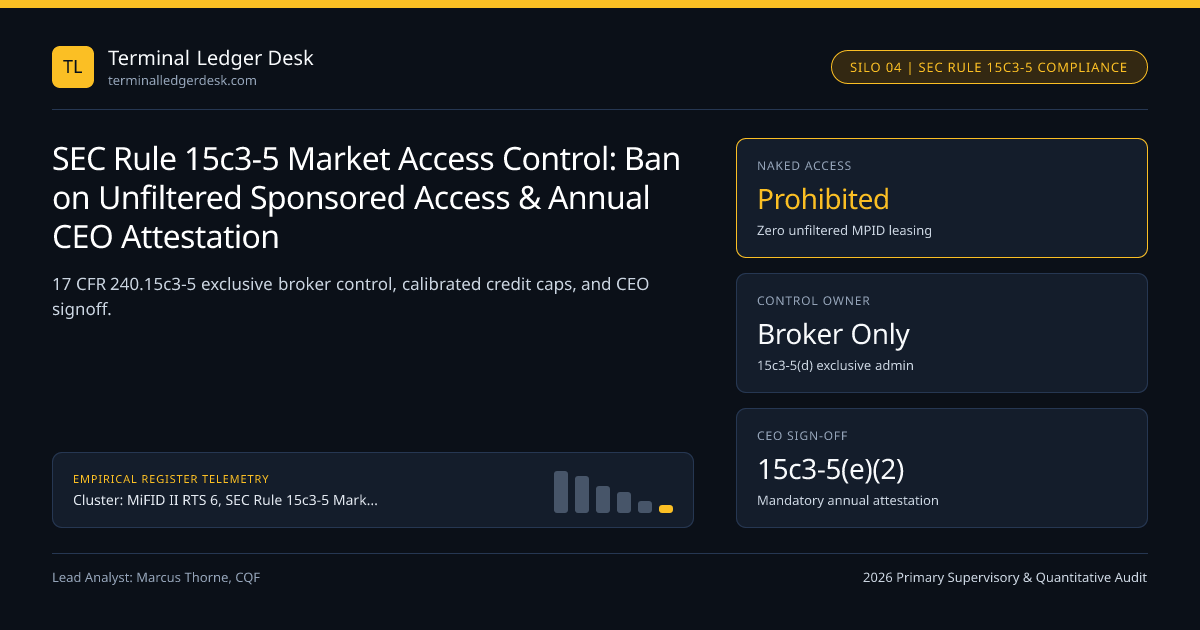
Before November 2011, roughly 38% of average daily US equity volume flowed through Sponsored Access arrangements in which high-frequency trading firms transmitted orders directly to Nasdaq, NYSE, and BATS using a clearing broker MPID with zero pre-trade inspection. SEC Rule 15c3-5 (17 CFR 240.15c3-5, the Market Access Rule) ended unfiltered ("naked") access permanently—requiring every broker-dealer with market access to enforce automated, pre-trade financial and regulatory controls under its direct and exclusive control.
Direct Market Access (DMA) vs Filtered Sponsored Access Under 15c3-5#
Understanding SEC and FINRA enforcement starts with distinguishing the three historical connectivity topologies detailed in our MiFID II RTS 6 & SEC 15c3-5 Risk Hub:
- Traditional DMA: Client orders traverse the broker own
OMS/EMSand smart order router (SOR) infrastructure before hitting the venue. - Unfiltered ("Naked") Sponsored Access (ILLEGAL): Client servers connect straight to exchange matching ports using the broker
MPID; the broker sees fills only post-trade via clearing drop-copies. - Filtered Sponsored Access (COMPLIANT): Client colocated servers inside Equinix NY4/NY5 pass through a broker-owned, broker-administered inline FPGA or exchange-hosted risk appliance (
Nasdaq Pre-Trade Risk Management/NYSE Pillar Risk Controls) prior to matching.
The Two Mandatory Control Pillars: 15c3-5(c)(1) Financial & 15c3-5(c)(2) Regulatory#
Rule 15c3-5(c) splits automated pre-trade enforcement into two non-negotiable categories under the Pre-Trade Risk Control Standard:
- Financial Risk Management Controls (
15c3-5(c)(1)): Must systematically prevent entry of orders exceeding pre-set credit or capital thresholds in the aggregate for each customer and the broker-dealer (including unexecuted open orders—see gross vs net intraday credit exposure accounting) AND block erroneous orders exceeding price/size parameters (dynamic fat-finger price collars) or duplicative message bursts. - Regulatory Risk Management Controls (
15c3-5(c)(2)): Must verify pre-trade compliance with all federal securities laws—including Reg SHO locate/short-sale restrictions (Reg SHO Rule 203(b) & 201 gates), trading halts, restricted-security lists, and post-trade wash-sale/manipulation surveillance.
| FINRA / SEC Audit Failure | Flawed Broker Implementation | Why Regulators Sanction It | Compliant 15c3-5 Engineering Fix |
|---|---|---|---|
| "Dummy" $999M Credit Limit | Setting absurdly high static ceilings so active funds never hit rejects | Violates 15c3-5(c)(1)(i) requirement for reasonably designed customer-specific thresholds | Tie per-MPID caps quantitatively to daily Net Capital / Margin VaR |
| Filled-Only Credit Tracking | Counting only executed trades (35=8 fills) toward intraday credit | Client can stack $200M of resting buy limits 1 tick below bid and get swept simultaneously | Track Executed + Worst-Case Open Buy/Sell in hardware registers |
| "Soft Block" Override Button | Letting DMA traders click "Confirm Override" on fat-finger warnings | Customer overrides bypass broker exclusive pre-trade gate | Hard block on breach; require logged Broker Risk Desk 2-person approval |
| Missing Fixed-Income / Options | Applying 15c3-5 checks to NMS equities while leaving options or Treasury ATS unfiltered | Rule covers all securities exchanges and ATSs where BD has access | Unify equity, OPRA options, and ATS gateways under single risk bus |
Common FINRA 15c3-5 Examination Violations & Fine Patterns#
Reviewing real-world architectural failures cited in SEC and FINRA Market Access Rule disciplinary actions ($500K to $12M+ settlements).
- Worked FINRA-Defensible Threshold Calibration:
- Sponsoring Clearing BD Excess Net Capital = $120,000,000 (k_concentration = 0.20 max single-client)
- Hedge Fund Customer Posted Margin Equity = $4,500,000
- Approved Intraday Portfolio Leverage = 4.0x
- Broker Concentration Ceiling = $120,000,000 * 0.20 = $24,000,000
- Customer Margin Ceiling = $4,500,000 * 4.00 = $18,000,000
- Assigned 15c3-5 Hard Gate = MIN($24.0M, $18.0M) = $18,000,000 (with 80% warning alert at $14.4M)
Rule 15c3-5(d) "Direct and Exclusive Control" & Third-Party Vendor Safe Harbor#
Subparagraph 15c3-5(d)(1) permits a sponsoring broker-dealer to allocate specific risk-management functions to another registered broker-dealer that has better visibility into an omnibus sub-account—provided a written contract specifies the exact division and the sponsoring broker performs rigorous ongoing due diligence.
What about commercial FPGA/software vendors or exchange-hosted pre-trade tools? The SEC permits third-party technology only if the vendor is strictly independent of the trading customer and ONLY broker-dealer risk personnel possess administrative credentials (SSH, GUI, API keys) to raise credit caps or widen fat-finger collars! Any architecture where a quantitative hedge fund can SSH into the risk box or modify an .ini file fails 15c3-5(d) immediately.
Rule 15c3-5(e) Annual Review & Personal CEO Certification Mechanics#
Unlike routine compliance policies delegated to mid-level managers, 15c3-5(e)(2) requires the Chief Executive Officer (or equivalent officer) of the broker-dealer to sign an annual written certification attesting that risk controls and supervisory procedures comply with the rule and have been tested across every active venue, MPID, and asset class (equities, options, fixed-income ATS).
Prime brokers align their customer 15c3-5 credit caps with portfolio tail risk using our Terminal Margin VaR & ES Calculator and verify FIX session boundaries on FIX API.
Frequently asked questions
Does SEC Rule 15c3-5 apply to futures markets like CME Globex or ICE Futures US?
SEC Rule 15c3-5 governs securities exchanges (NYSE, Nasdaq, Cboe Equities/Options) and ATS dark pools. Futures and swaps fall under CFTC Regulation 1.73 (for Futures Commission Merchants) and CFTC Regulation 38.255 (for Designated Contract Markets), which enforce parallel pre-trade credit and kill-switch mandates.
Can a broker temporarily raise a client 15c3-5 credit limit during a high-volume index rebalance day?
Yes, provided the broker follows a written intraday limit-change procedure: independent Risk/Credit officers (not sales traders alone) must verify sufficient collateral/net capital, log the exact rationale and timestamp, and set an automatic end-of-day expiration reverting the cap back to baseline.
Are exchange-provided pre-trade risk tools (such as Nasdaq PRM) acceptable under Rule 15c3-5(d)?
Yes! Because the national securities exchange is independent of the sponsored trading customer, a broker-dealer may utilize exchange-hosted pre-trade risk controls so long as the broker-dealer exclusively configures, monitors, and locks the parameter values.
Do routing brokers who forward orders to another executing broker still need 15c3-5 controls?
Rule 15c3-5 applies specifically to the broker-dealer WITH "market access" (the member whose MPID/port connects to the exchange or ATS), unless functions are formally allocated via written 15c3-5(d)(1) contract to a registered customer broker-dealer.
Publication record
- Published
- 13 November 2026
- Updated
- 16 November 2026
- Author
- Marcus Thorne, CQF
- Review
- Review not recorded
- Automated fact check
- Passed in the stored pipeline record
- Source URLs
- 3 recorded
AI assistance recorded: anthropic/claude-opus-4.6. This field does not establish human review or source verification.
Academic & Institutional Attribution
Cite This Research & Embed Live Data Card
Standard academic & institutional research paper citation format.
Marcus Thorne, CQF. (2026, November 16). SEC Rule 15c3-5 Market Access Control: Ban on Unfiltered Sponsored Access & Annual CEO Attestation. Terminal Ledger Desk. https://terminalledgerdesk.com/reports/sec-rule-15c3-5-ban-on-unfiltered-naked-sponsored-market-access-dmaRegulatory Directory Cross-Reference
Referenced Institutions & Regulatory Registries
Related Mifid Rts6 Pretrade Kill Switch Controls & Institutional Briefings
Explore Mifid Rts6 Pretrade Kill Switch Controls Hub (20) →Mifid Rts6 Pretrade Kill Switch Controls
MiFID II RTS 6, SEC Rule 15c3-5 Market Access & Inline Pre-Trade Kill-Switch Architecture GuideMifid Rts6 Pretrade Kill Switch Controls
MiFID II RTS 6 Compliance: Annual Self-Assessment, 2x Stress Testing & DEA GovernanceMifid Rts6 Pretrade Kill Switch Controls
Inline FPGA Pre-Trade Risk Gateways: Cut-Through FCS Stomping & Sub-Microsecond Credit CollarsMifid Rts6 Pretrade Kill Switch Controls
Dynamic Pre-Trade Price Collars & Fat-Finger Guards: NBBO Reference Anchoring vs Static TicksMifid Rts6 Pretrade Kill Switch Controls
Gross vs Net Intraday Pre-Trade Credit Accounting: Open-Order Exposure & Cancel-Replace InflationMifid Rts6 Pretrade Kill Switch Controls
Exchange Cancel-On-Disconnect (COD): Heartbeat Grace Windows Across CME, Nasdaq & EurexMifid Rts6 Pretrade Kill Switch Controls
FIX Tag 35=q OrderMassActionRequest & Venue Firm-Level Kill-Switch APIs BenchmarkedMifid Rts6 Pretrade Kill Switch Controls
Self-Match Prevention (SMP): Cancel-Oldest, Cancel-Newest & Decrement-and-Cancel MechanicsReg Sci Disaster Recovery Outage Rca
Annual SIFMA & FIA Industry-Wide Disaster Recovery Test: End-to-End Member RunbookReg Sci Disaster Recovery Outage Rca
Raft & Paxos Replicated State Machines in Matching Engines: Zero-Loss Sub-Millisecond FailoverReg Sci Disaster Recovery Outage Rca
Deterministic Event-Log Replay: Cold vs Warm vs Hot Standby Order-Book ReconstructionReg Sci Disaster Recovery Outage Rca
Multicast A/B Market-Data Feed Arbitration: Air-Gapped Switch Fabrics & Microburst Recovery
Terminal Ledger Desk Data, Benchmarks & Contributor Records
CC BY 4.0 Open Data
Open Institutional Datasets (CSV / JSON) →
Download desk-compiled quantitative series & schemas.
2026 Reference Matrix
2026 Institutional Benchmarks & Thresholds →
Statutory capital, clearing, margin & rate conventions.
Editorial Records
Authors & Review Records →
View named contributors where those records are available.
Complete Index
Master Research & Dossier Archive →
Browse all published briefings by topic pillar & date.