
Mifid Rts6 Pretrade Kill Switch Controls
Order-to-Trade Ratio (OTR) & MiFID II RTS 9: Token-Bucket Message Throttling Engineering
Exceeding exchange Order-to-Trade Ratios triggers six-figure monthly messaging surcharges, mandatory TCP throttling delays, and MiFID II RTS 9 regulatory breaches—unless governed by dual count-and-volume token buckets.
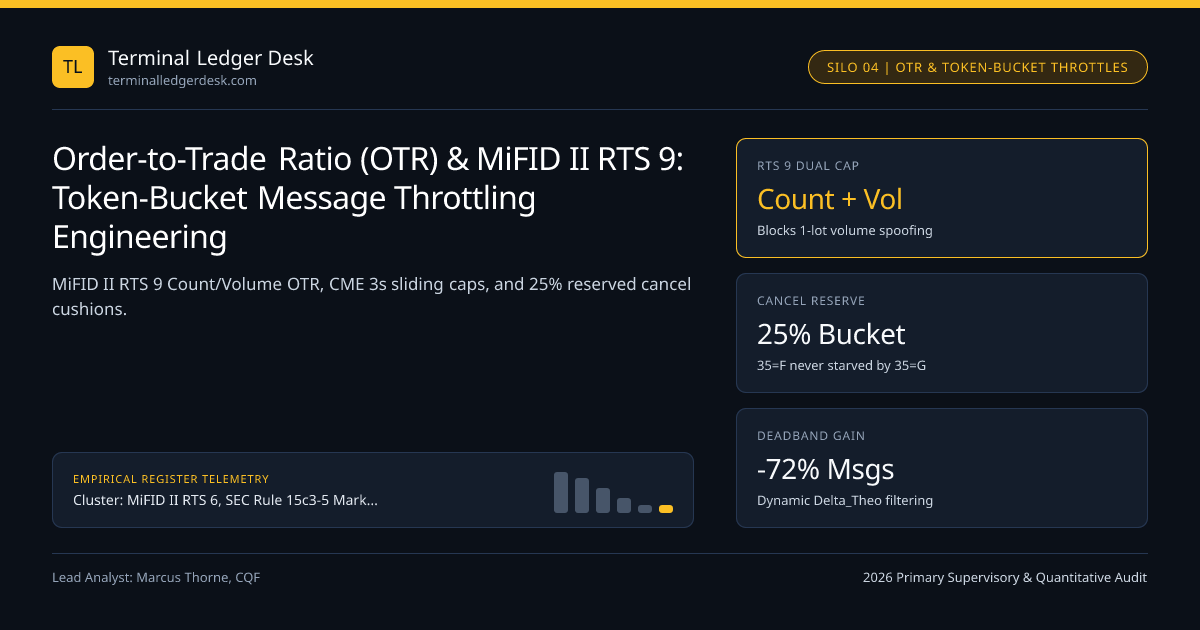
High-frequency quoting is never free of capacity constraints: every European trading venue enforces MiFID II RTS 9 (Commission Delegated Regulation (EU) 2017/566) daily Order-to-Trade Ratios (OTR) in both number and volume terms, while CME Group imposes steep Messaging Efficiency Program (MEP) surcharges ($1,000 to $10,000+ per benchmark breach) and Eurex T7 / Nasdaq / Cboe enforce sub-second sliding-window port throttles. Engineering deterministic two-tier token-bucket throttlers protects both venue stability and desk PnL.
MiFID II RTS 9 Dual OTR Formulas: Count Ratio vs Volume Ratio#
Supplementing our MiFID II RTS 6 & SEC 15c3-5 Architecture Hub, MiFID II RTS 9 mandates that every EU Regulated Market, MTF, and OTF calculate two separate OTR metrics per instrument (or asset class) per trading day for every member—with a separate higher ceiling for registered Market Makers (RTS 8):
- Count OTR:
(Total Order Events / Total Executed Trades) - 1, where everyNew,Modify, andCancelcounts as an event (and aCancel/Replacecounts as 2 events under RTS 9 Annex table weights!). - Volume OTR:
(Total Submitted Order Volume / Total Executed Volume) - 1!
Why both? Without Volume OTR, a manipulative spoofer could execute a single 1-share fill to "unlock" 5,000 count credits, then flash and cancel 5,000 massive 100,000-share orders! Volume OTR catches size-weighted quote churn immediately.
Sub-Second Port Rate Throttles vs Daily Messaging Efficiency Benchmarks#
An outbound Pre-Trade Risk Control Standard gateway must simultaneously satisfy two orthogonal time horizons:
- Microsecond / Millisecond Port Caps (
Hard Reject / Delay): E.g.,CME iLink 3enforces a rolling500 to 1,500 messages per 3-second sliding windowper session (Throttle Reject SBE 513on breach!), whileEurex T7deliberately inserts artificial millisecond penalty delays onto sessions exceeding sliding-window limits! - Daily Venue Surcharge Ratios (
CME MEP/Eurex Excessive System Usage/Nasdaq Equity Quote Meter): Evaluated at 17:00 settlement using product-group benchmarks (Volume-Weighted Score / Executed Volume), exemptions for new-product incubation, and volatility-adjusted multipliers when VIX or range expands.
| Venue / Regime | Sub-Second Burst Limit | Daily OTR / Efficiency Formula | Cancel (35=F) Counted? | Consequence of Breach |
|---|---|---|---|---|
EU MiFID II RTS 9 (Eurex, Euronext) | Venue port sliding window (50–1,000/s) | Both (Orders/Trades)-1 & (OrderVol/TradeVol)-1 | Yes (35=G = 2 events) | Penalty delay injection, ESU fees, NCA referral |
CME Globex (iLink 3) | Rolling 3-second sliding window (e.g. 1,500 msgs) | Product-group MEP Score / Executed Volume | 35=q MassAction exempt | BusinessMessageReject (513) + $1k–$10k MEP fine |
| Nasdaq / Cboe US Options | Per-port msg/sec rate limit | Monthly Quote-to-Trade / Bandwidth tiers | Purge Ports exempt | Excess quote fees + port packet drop/throttle |
| Direct FX ECN (FIX API) | 50 – 250 msg/sec per LP session | LP Fill-Ratio (Min 5% – 15% on sweep streams) | IOC misses penalize fill % | LP widens spread tier or revokes Tier-1 liquidity! |
Global Exchange OTR & Messaging Throttle Rules Comparison Matrix#
Comparing sub-second burst windows, daily OTR formulas, cancel exemptions, and breach penalties across CME, Eurex, Nasdaq, and Euronext.
- OTRvolumeRTS9 = ( Vsubmittedtotal ) / MAX( 1, Vexecutedtotal ) - 1
- Worked Priority Token Bucket Invariant (Window W = 3.0s, MaxPortMsgs = 1,500, Cancel_Reserve = 0.25):
- AvailableTokens(t) = MIN( 1500, AvailableTokens(t - dt) + 500 * dt )
- Allow NewOrderSingle / Replace IFF Available_Tokens(t) > (1500 * 0.25 = 375 tokens)!
- Allow OrderCancelRequest (35=F) IFF Available_Tokens(t) >= 1 token (375 emergency cancel slots guaranteed!)
Priority-Aware Hierarchical Token Buckets: Never Starve Cancels!#
The worst rookie mistake in outbound gateway coding is putting NewOrderSingle (35=D), Cancel/Replace (35=G), and OrderCancelRequest (35=F) behind one undifferentiated FIFO token bucket!
- Imagine market volatility spikes: the strategy exhausts
100%of its500-token1-second bucket repricing quotes (35=G), and 10 milliseconds later needs to cancel toxic bids before getting run over—only for its own local throttler to block35=F!
Institutional Disruptor execution gateways partition token capacity into three strict priority tiers:
- Tier 0 (
100% Unthrottled):OrderMassActionRequest (35=q)(FIX 35=q kill switches)—never touches token counters. - Tier 1 (
Reserved 25% Safety Cushion): Risk-reducingOrderCancelRequest (35=F)andReduce-Onlycovers. - Tier 2 (
Capped at 75% Bucket): Risk-increasingNewOrderSingle (35=D)and passive35=Gmicro-repricing (Minimum Quote Life / Tick-Move Filtersuppresses sub-0.2-tick theoretical reprices when bucket drops< 30%!).
Minimum Quote Life & Theoretical Edge Gating to Cut OTR by 70%#
Quantitative market makers cut daily OTR surcharges by 65% to 80% without sacrificing Sharpe ratio by enforcing a Dynamic Reprice Deadband (Delta_Theo_Min): as remaining daily OTR budget shrinks below 40%, the quoting engine widens its reprice trigger from 0.15 ticks of theoretical fair-value change to 0.45 ticks, eliminating zero-EV flicker.
Model expected fill rates vs fee drag in our Algorithmic Kelly Allocation Calculator, size intraday buffers in the Terminal Margin VaR & ES Calculator, and review loop hazards in stateful runaway-loop & quote-stuffing detection.
Frequently asked questions
What happens to the MiFID II RTS 9 denominator if an algorithm submits 8,000 quotes in an illiquid stock and gets ZERO trades all day?
To prevent division-by-zero errors, RTS 9 explicitly specifies that when Total_Trades == 0, the formula substitutes 1 in the denominator (yielding OTR = 8,000 - 1 = 7,999), compared against the venue published zero-trade floor ceiling for that liquidity band!
How does Eurex T7 "Speed Bump / Throttle Delay" punish sessions that breach sliding-window limits?
Rather than immediately disconnecting the session, Eurex T7 can dynamically penalize excessive message bursts by queuing offending inbound frames before matching-engine release—destroying colocation edge until the sliding-window message count decays below threshold.
Why do OTC FX liquidity providers care so deeply about Fill Ratio alongside message per second?
Every IOC sweep order sent to a Tier-1 FX bank triggers internal pricing and hedging risk checks; if an aggregator sprays 12 banks simultaneously with latency-arbitrage IOCs resulting in a <2% fill ratio (high reject/miss rate), the LP classifies the flow as toxic and moves the client to a wider-spread stream.
Are CME Globex Messaging Efficiency Program (MEP) benchmarks relaxed during FOMC or CPI crashes?
Yes—CME Group applies dynamic market-condition waivers and benchmark adjustments on extreme high-volatility days (and grants explicit waivers for newly launched contracts), recognizing that wider intraday ranges naturally require higher quote refresh counts.
Publication record
- Published
- 13 November 2026
- Updated
- 14 November 2026
- Author
- Marcus Thorne, CQF
- Review
- Review not recorded
- Automated fact check
- Passed in the stored pipeline record
- Source URLs
- 3 recorded
AI assistance recorded: anthropic/claude-opus-4.6. This field does not establish human review or source verification.
Academic & Institutional Attribution
Cite This Research & Embed Live Data Card
Standard academic & institutional research paper citation format.
Marcus Thorne, CQF. (2026, November 14). Order-to-Trade Ratio (OTR) & MiFID II RTS 9: Token-Bucket Message Throttling Engineering. Terminal Ledger Desk. https://terminalledgerdesk.com/reports/order-to-trade-ratio-otr-mifid-ii-rts-9-message-throttling-bucketsRegulatory Directory Cross-Reference
Referenced Institutions & Regulatory Registries
Referenced Supervisory Authorities
Related Mifid Rts6 Pretrade Kill Switch Controls & Institutional Briefings
Explore Mifid Rts6 Pretrade Kill Switch Controls Hub (20) →Mifid Rts6 Pretrade Kill Switch Controls
MiFID II RTS 6, SEC Rule 15c3-5 Market Access & Inline Pre-Trade Kill-Switch Architecture GuideMifid Rts6 Pretrade Kill Switch Controls
NMS Limit Up-Limit Down (LULD) Plan: Reference Price Bands, Limit States & 5-Minute PausesMifid Rts6 Pretrade Kill Switch Controls
CME Globex Velocity Logic & Dynamic Circuit Breakers: Sub-Second Futures Volatility GuardsMifid Rts6 Pretrade Kill Switch Controls
CFTC Regulation 1.73: FCM Automated Pre-Execution Clearing Credit Screens & Give-Up LimitsMifid Rts6 Pretrade Kill Switch Controls
Options Market-Maker Mass Quote Risk (MMR): Rolling Delta, Vega & Percentage-Swept Purge TriggersMifid Rts6 Pretrade Kill Switch Controls
Runaway Loop & Quote-Stuffing Detection: Stateful Duplicate-Order & Reject-Storm GatesMifid Rts6 Pretrade Kill Switch Controls
SEC Regulation SHO Pre-Trade Gates: Rule 203(b) Locate Accounting & Rule 201 Short-Sale Circuit BreakersMifid Rts6 Pretrade Kill Switch Controls
Drop-Copy Shadow Kill Switches: Out-of-Band Clearing Risk Monitors & Session Disconnect ArchitectureReg Sci Disaster Recovery Outage Rca
SEC Regulation SCI Rule 1002: Incident Triage Trees, Immediate SEC Notification & De Minimis Safe HarborReg Sci Disaster Recovery Outage Rca
Clearly Erroneous Executions (CEE) & Trade Bust Bands: Post-Outage Unwind & Hedge Risk MathReg Sci Disaster Recovery Outage Rca
Capacity Stress Testing & Microburst Telemetry Under SEC Regulation SCI Rule 1001(a)Reg Sci Disaster Recovery Outage Rca
Hybrid-Cloud Exchange Migration: AWS Outposts, Google Cloud & the Microsecond Determinism Gap
Terminal Ledger Desk Data, Benchmarks & Contributor Records
CC BY 4.0 Open Data
Open Institutional Datasets (CSV / JSON) →
Download desk-compiled quantitative series & schemas.
2026 Reference Matrix
2026 Institutional Benchmarks & Thresholds →
Statutory capital, clearing, margin & rate conventions.
Editorial Records
Authors & Review Records →
View named contributors where those records are available.
Complete Index
Master Research & Dossier Archive →
Browse all published briefings by topic pillar & date.