
Reg Sci Disaster Recovery Outage Rca
Hybrid-Cloud Exchange Migration: AWS Outposts, Google Cloud & the Microsecond Determinism Gap
Nasdaq partnered with AWS Outposts, CME Group partnered with Google Cloud, and LSEG partnered with Microsoft Azure—yet physics, hypervisor jitter, and deterministic L2 multicast still anchor ultra-low-latency CLOBs to bare metal.
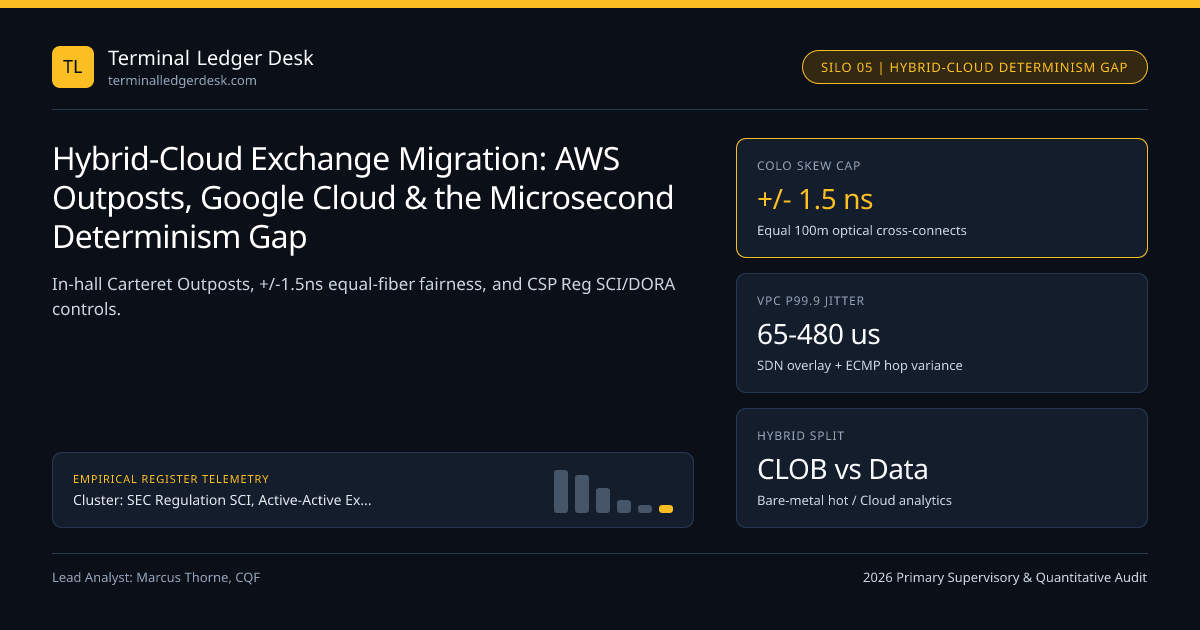
Billions of dollars in multi-year strategic partnerships—Nasdaq + AWS (Local Zones / Outposts inside Carteret NJ), CME Group + Google Cloud (Chicago Private Cloud Region), and London Stock Exchange Group + Microsoft Azure—promised to migrate global capital markets to the cloud. Five years into execution, a crisp architectural split has emerged: analytics, surveillance, clearing risk, and historical replay thrive in elastic public cloud, whereas deterministic sub-10-microsecond Central Limit Order Books (CLOBs) demand custom bare-metal Nitro/Outposts silicon, optical equal-cable fairness, and hardware PTPv2!
Four Physical Barriers Blocking Vanilla Public Cloud VMs From HFT Matching#
Examining exchange migrations through our SEC Reg SCI & Outage Post-Mortem Hub reveals four hard physics laws that break standard multi-tenant public cloud (EC2 / GCE / Azure VMs) for latency-sensitive matching:
- Equal-Cable-Length Fairness (
Spatial Equidistance): Inside Equinix NY4/Carteret and CME Aurora DC3, every customer rack connects to the matching switch via coiled100-meterequal-delay optical fiber (+/- 1 nsparity!). In a standard hyperscale cloud region spanning 6 buildings4 kmapart with opaque ECMP Clos spine routing, VM A randomly lands80 microsecondscloser to the matching VM than VM B—violating Exchange Act fair-access parity! - Lack of True Native Layer-2/3 Hardware UDP Multicast: Public cloud SDN overlays (
VPC) emulate multicast via unicast replication trees (Transit Gateway Multicast), adding tens of microseconds of fan-out skew across2,000subscribers compared to a320-nanosecondphysicalAristaoptical splitter/switch (Multicast A/B feed arbitration)! - Hypervisor / Nitro / Noisy-Neighbor Tail Jitter: Even
SR-IOVvirtual functions suffer50 to 800 microsecondp99.9 spikes unless running on 100% single-tenant Bare Metal with custom BIOS C-state locks. - Sub-Microsecond
IEEE 1588v2 PTPHardware Clocks: Standard cloud NTP/TimeSync (10–100 us) is tightening via AWS Time Sync hardware PHC, but colocation demands< 50 nsgrandmaster optical distribution.
How Nasdaq (AWS Outposts in Carteret) Solved the Hybrid Architecture#
Look at how Nasdaq (MRX, GEMX, Nasdaq Bond Exchange) actually engineered cloud-enabled matching without breaking fairness or SEC Regulation SCI:
- Rather than moving matching engines
500 kmaway tous-east-1(Ashburn, VA) over public VPCs, Nasdaq co-designed custom ultra-low-latencyAWS Outpostsracks physically installed INSIDE Nasdaq Carteret NJ (NY11) data center, preserving existing member equal-length physical cross-connects, hardware multicast switches, and10%-fasterAWS Nitrocustom silicon! - Meanwhile, non-matching workloads—CAT reporting, market surveillance, clearing margin simulation, and historical tick lakes—burst elastically across standard public cloud!
| Financial Workload | Latency / Jitter Budget | Optimal Infrastructure Tier | Why Public Cloud VMs Succeed or Fail |
|---|---|---|---|
| CLOB Matching & HFT Quoting | < 15 us (+/- 1 us jitter) | Colocated Bare Metal / In-Hall Outpost | Public VPC lacks equal-length fiber & zero-skew L2 multicast |
| Inline Pre-Trade Risk Gate | < 0.5 – 5 us | Colocated Cut-Through FPGA / SmartNIC | Requires physical SFP28 optical wire insertion |
Intraday Clearing VaR (CORE) | 1 – 10 seconds | Private Cloud / Dedicated VPC Cluster | Ideal fit: massive parallel matrix compute off hot path |
| Market Surveillance & Quant Research | Minutes – Hours | Elastic Public Cloud (AWS/GCP/Azure) | Ideal fit: petabyte Parquet tick lakes + burst GPU clusters |
Exchange Workload Placement Matrix: Colocated Bare Metal vs Public Cloud#
Mapping exchange and broker subsystems to their optimal infrastructure tier based on jitter tolerance and Reg SCI control.
- Colocation Equal-Cable Standard (100.0m +/- 0.3m optical fiber): Skew <= 1.5 nanoseconds!
- Multi-AZ Public Cloud VPC (50m intra-rack vs 3,500m cross-hall + SDN): Skew = 17,500+ nanoseconds (11,600x unfairness!)
Regulatory Third-Party Concentration Risk (SEC Reg SCI & EU DORA CSP Rules)#
Migrating exchange subsystems onto AWS, Google Cloud, or Azure triggers intense regulatory scrutiny on Cloud Service Provider (CSP) Systemic Concentration Risk (explored further in EU DORA vs SEC Regulation SCI):
- Under SEC Regulation SCI, hiring a hyperscaler never transfers statutory liability: the exchange must retain full audit rights, control change-management windows (
no surprise Tuesday afternoon hypervisor reboots during 15:55 ET Closing Cross!), and guarantee<= 2-hourrecovery even if an entire cloud region control plane (IAM / DNS / S3inus-east-1) locks up! - Under EU DORA (
Articles 28–44), AWS/GCP/Azure are directly designated as Critical ICT Third-Party Providers (CTPPs) subject to direct European Supervisory Authority (ESMA/EBA) inspections and mandatory exit/portability plans!
Practical Strategy for Quant & Broker Infrastructure Teams#
Adopt the exact same Hybrid Split used by Tier-1 exchanges: run backtesting, ML alpha training (H100 clusters), CAT/RTS 24 overnight ETL, and Monte Carlo risk in elastic cloud—while keeping live order books, inline FPGA risk collars, and FIX API execution engines on pinned bare metal inside NY4, Carteret, Aurora DC3, and LD4! Model latency-induced alpha decay in our Algorithmic Kelly Allocation Calculator.
Frequently asked questions
Did CME Group move its Aurora DC3 matching engine into public multi-tenant Google Cloud VMs?
CME Group migrated clearing, data/analytics, corporate workloads, and engineering environments to Google Cloud first while purpose-building a dedicated private Google Cloud facility + colocation campus adjacent to Chicago expressly engineered to preserve sub-microsecond determinism and fair-access parity before touching core Globex matching!
Why do crypto exchanges (Binance, Coinbase, Bybit, OKX) run inside AWS Tokyo (ap-northeast-1) or Dublin (eu-west-1) despite VPC jitter?
Unregulated/digital-asset exchanges grew up cloud-native without legacy SEC Exchange Act equal-cable colocation mandates—which immediately triggered an HFT "AWS Placement-Group Lottery" where crypto market makers spin up and terminate hundreds of EC2 instances daily hunting the exact subnet/AZ physically closest to the exchange gateway IP!
What is the "Cloud Control-Plane vs Data-Plane Trap" under SEC Regulation SCI?
Hyperscale cloud outages (like famous us-east-1 incidents) frequently break Control-Plane APIs (IAM token refresh, EC2 Autoscaling, S3 bucket reads, Route53 updates) while existing TCP sockets stay up. Any SCI system running on hybrid cloud MUST run statically provisioned with cached credentials so zero control-plane calls occur during trading hours!
Can AWS Nitro or GCP Bare Metal eliminate hypervisor jitter?
Dedicated Bare-Metal instances (.metal) offload virtualization onto dedicated Nitro/Titanium PCIe cards, eliminating guest hypervisor CPU stealing—leaving the VPC software-defined network (SDN) overlay and physical rack placement as the remaining sources of microsecond variance.
Publication record
- Published
- 13 November 2026
- Updated
- 15 November 2026
- Author
- Marcus Thorne, CQF
- Review
- Review not recorded
- Automated fact check
- Passed in the stored pipeline record
- Source URLs
- 3 recorded
AI assistance recorded: anthropic/claude-opus-4.6. This field does not establish human review or source verification.
Academic & Institutional Attribution
Cite This Research & Embed Live Data Card
Standard academic & institutional research paper citation format.
Marcus Thorne, CQF. (2026, November 15). Hybrid-Cloud Exchange Migration: AWS Outposts, Google Cloud & the Microsecond Determinism Gap. Terminal Ledger Desk. https://terminalledgerdesk.com/reports/hybrid-cloud-exchange-migration-aws-google-outposts-determinism-gapRelated Reg Sci Disaster Recovery Outage Rca & Institutional Briefings
Explore Reg Sci Disaster Recovery Outage Rca Hub (20) →Reg Sci Disaster Recovery Outage Rca
SEC Regulation SCI, Active-Active Exchange Failover & Outage Post-Mortem Engineering GuideReg Sci Disaster Recovery Outage Rca
Graceful Market-Halt Reopening Architecture: Cancel-Only Purge Windows & Call-Auction UncrossReg Sci Disaster Recovery Outage Rca
EU DORA (Regulation 2022/2554) vs US SEC Regulation SCI: Global ICT Operational Resilience ComparedReg Sci Disaster Recovery Outage Rca
Clearing House (CCP) FIXML Trade-Capture Backlog Recovery: Post-Spike Compression & NettingReg Sci Disaster Recovery Outage Rca
BGP Anycast & DNS TTL Pitfalls During Broker & Exchange Gateway Disaster-Recovery CutoversReg Sci Disaster Recovery Outage Rca
Chaos Engineering & Deterministic Fault Injection in Staging Matching & Gateway ClustersReg Sci Disaster Recovery Outage Rca
Immutable WORM Incident Forensics: SEC Rule 17a-4(f), Optical PCAPs & Cryptographic Hash ChainsReg Sci Disaster Recovery Outage Rca
SEC Regulation SCI Rule 1001(a): 2-Hour RTO & Geographically Diverse Backup Site ArchitectureMarket Insights
Nvidia Stock Slides After Chip Maker Opens ProbeBlockchain and Cryptocurrency
NYSE to Settle Tokenized Stocks on Avalanche BlockchainMarket Insights
Stock Market Today: Nvidia Stock Slides After Chip Maker Opens ProbeMarket Insights
Robinhood opens access to US IPOs for UK retail investors
Terminal Ledger Desk Data, Benchmarks & Contributor Records
CC BY 4.0 Open Data
Open Institutional Datasets (CSV / JSON) →
Download desk-compiled quantitative series & schemas.
2026 Reference Matrix
2026 Institutional Benchmarks & Thresholds →
Statutory capital, clearing, margin & rate conventions.
Editorial Records
Authors & Review Records →
View named contributors where those records are available.
Complete Index
Master Research & Dossier Archive →
Browse all published briefings by topic pillar & date.