
Mt5 Ctrader Bridge Dealer Architecture
OTC FX Last-Look Hold Windows: FX Global Code Principle 17 & Firm Liquidity TCA
Disclosed OTC FX streams quote razor-thin 0.1-pip spreads guarded by 2 to 35 millisecond Last-Look latency shields—forcing institutional bridges to weigh headline tightness against rejection information leakage.
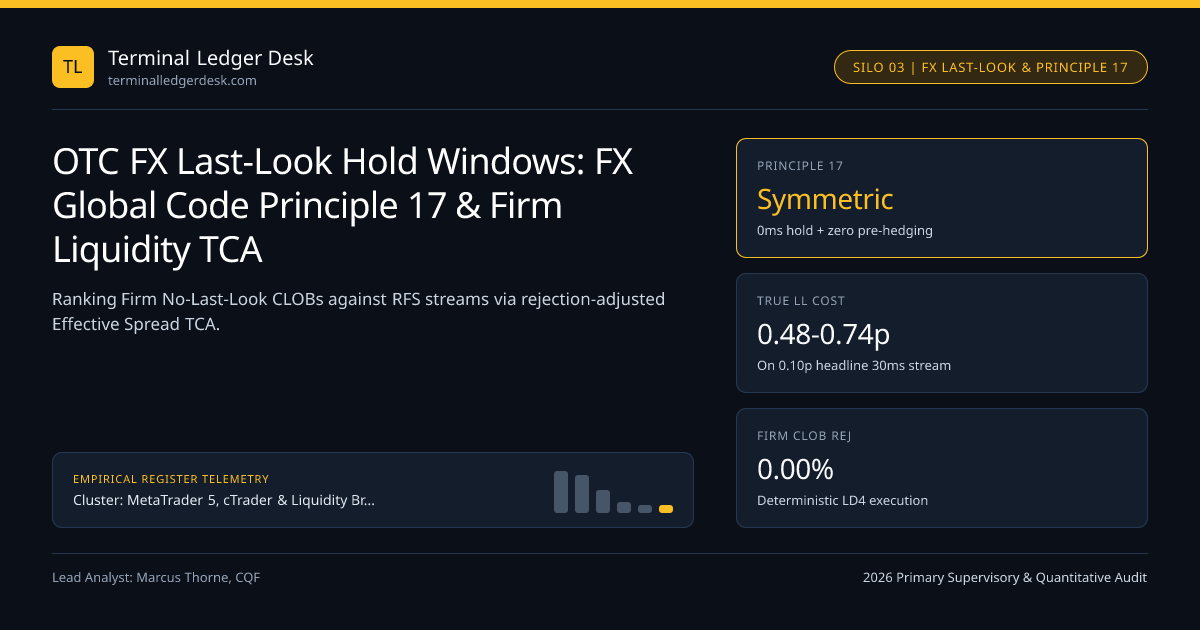
Why does a Tier-1 bank single-dealer stream inside Equinix LD4 quote EUR/USD at a dazzling 0.1-pip spread, whereas a firm Central Limit Order Book (LMAX, EBS Market) quotes 0.3–0.4 pips at the exact same millisecond? Because the 0.1-pip stream carries Last Look—the contractual right of the Liquidity Provider (LP) to inspect an incoming NewOrderSingle (35=D) for 0 to 35 milliseconds and return ExecutionReport (39=8 Rejected) if spot prices ticked beyond a tolerance threshold! Following multi-hundred-million-dollar regulatory fines (2015–2017) and BIS FX Global Code Principle 17 (2021 revision), Last-Look mechanics underwent strict institutional reform.
Why Last Look Exists Economically: Defending Multi-Venue Quote Duplication#
Unlike an equity market maker on Nasdaq who posts 100,000 shares on one book, an OTC FX market maker streams $5,000,000 executable prices simultaneously across 25 separate ECNs and client bridges (Currenex, FXall, 360T, oneZero, XCore)! Without either credit-check + latency-arbitrage Last Look or speed bumps, an HFT firm seeing CME 6E futures jump in Chicago could simultaneously sweep $5M x 25 = $125,000,000 off a bank intended $5M risk appetite before cancellation packets reach Slough!
Legitimate modern Last-Look engines run two microsecond-to-millisecond checks:
- Prime-Broker Credit & Validity Check (
< 1 ms): Verifies the counterpartyNOPcredit limit has remaining capacity. - Price Tolerance Check (
Zero-Additional-HoldvsHold Window tau_LL): Compares client order price against current live mid-price. If market moved further than-Toleranceagainst the LP (stale quote hit!), the LP rejects.
FX Global Code Principle 17: Symmetric Thresholds & Ban on Last-Look Pre-Hedging#
Before the Global Foreign Exchange Committee (GFXC) Principle 17 overhaul endorsed by central banks, UK FCA, MAS, and NYDFS, two abusive Last-Look practices plagued OTC FX:
- Asymmetric Last Look: Rejecting trades when price moved
+0.3 pipsin the client favor while filling 100% of trades at the stale worse price when price moved-0.8 pipsagainst the client! Today, compliant LPs publish Last-Look Disclosure Cover Sheets committing either to Symmetric Last Look (rejecting or price-improving both> +Toland< -Tolmoves equally!) or Zero-Additional-Hold-Time (0 mstimer)! - Trading on Last-Look Information (
Pre-Hedging Rejects— Strictly Forbidden!): Principle 17 strictly prohibits an LP from using knowledge of a client in-flight order during the Last-Look window to trade in the market and then rejecting the client if the LP hedge failed!
| Liquidity Stream Tier | Typical Headline Spread | Hold Time (tau_LL) | Rejection Behavior | Best Bridge Routing Assignment |
|---|---|---|---|---|
Firm CLOB (LMAX, EBS, LSEG) (LD4) | 0.25 – 0.45 pips | 0.0 ms (Firm) | 0% (Fills if qty still resting) | News breakouts, Multi-LP sweeps, HFT |
| 0ms-Hold Symmetric Bank/NBLP | 0.10 – 0.25 pips | 0.0 ms Additional | < 1.5% (Pure in-flight latency check) | Clean natural retail/institutional STP |
| Windowed Symmetric Last-Look | 0.08 – 0.20 pips | 5 – 25 ms | Rejects both >+Tol and <-Tol | Secondary passive / low-urgency flow |
| Legacy Asymmetric Hold (Avoid!) | 0.05 – 0.15 pips | 25 – 100 ms | Rejects client wins; fills client losses! | Quarantine / Remove from Bridge! |
Firm CLOB vs Symmetric Last-Look vs Legacy Asymmetric Stream TCA Matrix#
Institutional Transaction Cost Analysis (Effective Cost = Quoted Spread + Reject Re-Route Cost + Footprint Decay) across LD4 liquidity classes.
- CostDrift(tau) = Sigma1spips * sqrt( tauseconds ) * sqrt( 2 / pi )
- Worked SOR Ranking Proof (Active Volatility Sigma_1s = 4.0 pips/s):
- Stream A (30ms LL, Quote = 0.10p, P_rej = 0.25) : Drift = 4.0 * sqrt(0.030) * 0.798 = 0.553p
- > SpreadEffectiveA = 0.10 + 2 * 0.25 * (0.553 + 0.20) = 0.10 + 0.377 = 0.48 pips!
- Stream B (Firm CLOB, Quote = 0.30p, Prej = 0.00) -> SpreadEffective_B = 0.30 pips (Beats 0.10p LL by 0.18p!).
Measuring Post-Rejection Market Impact (Information Leakage Cost)#
Even when an LP obeys Principle 17 (zero intentional pre-hedging), a rejected 25-millisecond Last-Look order still costs you serious money! Why? Because during those 25 milliseconds while you waited for LP #1 to decide, the broader market kept moving away—and by the time your LD4 liquidity bridge receives 39=8 and fires a backup retry order at LP #2, composite VWAP has already drifted 0.6 to 1.8 pips worse!
Quantitative EMS routers inside MT5 / cTrader bridges dynamically penalize every LP quoted price by its real-time *Effective Rejection Penalty (`Penaltyi = Prej_i E[Drift | Rej_i])**: an LP quoting 0.1 pips with a 22% rejection rate and 30 ms hold ranks *behind* a Firm No-Last-Look CLOB ([LD4 topology](/reports/equinix-ld4-slough-fx-ecn-colocation-topology-optical-hop-telemetry)) quoting 0.3 pips with 0.0%` rejections!
Stream Curation: Segregating Sweep Flow From Resting Passive Flow#
How do top Prime-of-Prime desks earn sub-2% rejection rates from Tier-1 banks? Flow Hygiene & Stream Segregation! Never mix multi-venue simultaneous IOC news-sniping sweeps onto relationship tight-spread RFS bank streams (which immediately gets your tag widened or moved to a 35-ms defensive tier!). Route toxic sweep flow exclusively to Firm No-Last-Look CLOBs, keeping disclosed relationship streams clean (low 1-second markout) for natural two-way institutional tickets.
Evaluate rejection-adjusted execution alpha inside the Algorithmic Kelly Allocation Calculator, connect direct FIX API execution, and explore all 20 guides in the MT5, cTrader & Bridge Topic Hub.
Frequently asked questions
What does "Zero Additional Hold Time" mean on an FX Liquidity Provider disclosure sheet?
Zero Additional Hold Time means the LP adds 0 milliseconds of deliberate waiting timer: upon order arrival, the LP performs an instantaneous microsecond credit check and compares the order price against its current live mid-price, filling or rejecting immediately.
How does Symmetric Last Look differ from Asymmetric Last Look?
If tolerance is ±0.3 pips, an Asymmetric LP rejects when the market moved +0.4 pips in your favor yet fills you at the old price when the market moved -0.4 pips against you! A Symmetric LP rejects (or passes price improvement) identically on both +0.4 and -0.4 pip moves.
Why did regulators fine major FX banks over Last Look practices between 2015 and 2017?
Regulators including NYDFS and the Fed fined institutions where legacy algorithms applied undisclosed asymmetric Last-Look filters against electronic clients or leaked rejected order signals, leading directly to GFXC Principle 17 transparency templates.
Can a retail trader on cTrader or MT5 tell if an upstream LP rejected their Market order via Last Look?
If your bridge Retry Waterfall succeeds on LP #2, you see a normal fill with a slightly longer Delta_2 (~25–55 ms instead of 3 ms) and minor VWAP slippage; if all LPs reject during an extreme spike, MT5 logs 10021 (No Prices / Off Quotes).
Publication record
- Published
- 13 November 2026
- Updated
- 16 November 2026
- Author
- Marcus Thorne, CQF
- Review
- Review not recorded
- Automated fact check
- Passed in the stored pipeline record
- Source URLs
- 3 recorded
AI assistance recorded: anthropic/claude-opus-4.6. This field does not establish human review or source verification.
Academic & Institutional Attribution
Cite This Research & Embed Live Data Card
Standard academic & institutional research paper citation format.
Marcus Thorne, CQF. (2026, November 16). OTC FX Last-Look Hold Windows: FX Global Code Principle 17 & Firm Liquidity TCA. Terminal Ledger Desk. https://terminalledgerdesk.com/reports/otc-fx-last-look-hold-windows-symmetric-vs-asymmetric-lp-rejectionsRegulatory Directory Cross-Reference
Referenced Institutions & Regulatory Registries
Related Mt5 Ctrader Bridge Dealer Architecture & Institutional Briefings
Explore Mt5 Ctrader Bridge Dealer Architecture Hub (20) →Mt5 Ctrader Bridge Dealer Architecture
MetaTrader 5, cTrader & Liquidity Bridge Server Topology & Execution Logs GuideMt5 Ctrader Bridge Dealer Architecture
Margin Stop-Out Liquidation Engines: Tick Evaluation, Smart Partial Close & NBPMt5 Ctrader Bridge Dealer Architecture
PAMM, MAM & Copy-Trading Engines: Master-to-Child Allocation Latency & SlippageMt5 Ctrader Bridge Dealer Architecture
FX Swap Rollover Engines: Triple-Wednesday T+2 Settlement & Tom-Next Batch MathMt5 Ctrader Bridge Dealer Architecture
WebAssembly & WebGL Browser Trading Terminals: Holding 16.6ms 60-FPS Frame BudgetsMt5 Ctrader Bridge Dealer Architecture
Prime-of-Prime Net Open Position (NOP) Gates: Credit Throttling in FX BridgesMt5 Ctrader Bridge Dealer Architecture
MQL5 High-Speed EA Architecture: OnTick Drop Behavior & OrderSendAsync PipesMt5 Ctrader Bridge Dealer Architecture
Mobile Trading Terminals: iOS/Android Socket Suspension, QUIC & Push ExecutionMifid Rts6 Pretrade Kill Switch Controls
CFTC Regulation 1.73: FCM Automated Pre-Execution Clearing Credit Screens & Give-Up LimitsMifid Rts6 Pretrade Kill Switch Controls
Options Market-Maker Mass Quote Risk (MMR): Rolling Delta, Vega & Percentage-Swept Purge TriggersMifid Rts6 Pretrade Kill Switch Controls
Runaway Loop & Quote-Stuffing Detection: Stateful Duplicate-Order & Reject-Storm GatesMifid Rts6 Pretrade Kill Switch Controls
SEC Regulation SHO Pre-Trade Gates: Rule 203(b) Locate Accounting & Rule 201 Short-Sale Circuit Breakers
Terminal Ledger Desk Data, Benchmarks & Contributor Records
CC BY 4.0 Open Data
Open Institutional Datasets (CSV / JSON) →
Download desk-compiled quantitative series & schemas.
2026 Reference Matrix
2026 Institutional Benchmarks & Thresholds →
Statutory capital, clearing, margin & rate conventions.
Editorial Records
Authors & Review Records →
View named contributors where those records are available.
Complete Index
Master Research & Dossier Archive →
Browse all published briefings by topic pillar & date.