
Mt5 Ctrader Bridge Dealer Architecture
PAMM, MAM & Copy-Trading Engines: Master-to-Child Allocation Latency & Slippage
Executing 1,500 separate follower Market orders sequentially when a Master signal fires sweeps every LP rung and leaves Follower #1,500 4.5 pips behind; institutional PAMM and Block-MAM engines aggregate pre-trade into one LP sweep.
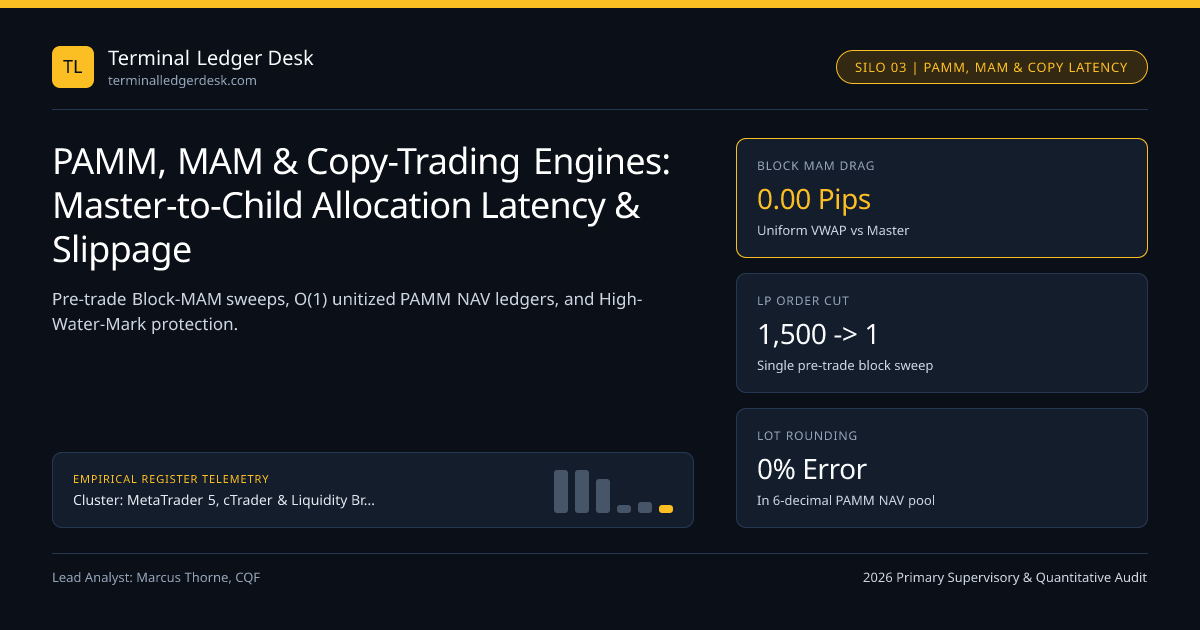
Suppose a popular Signal Master with 1,500 subscribed followers ($18,000,000 combined equity) clicks Buy EUR/USD at 14:30:05.000! If your copy-trading server naively loops for (follower : 1..1500) sendMarketOrder, disaster strikes immediately: Followers #1..#50 consume top-of-book LD4 liquidity at 1.08501, triggering LP Last-Look defensive widening while Followers #800..#1,500 queue 350 milliseconds behind and fill at 1.08546 (-4.5 pips structural follower slippage!)! Understanding the fundamental architectural divide between Sequential Signal Copy (MQL5 Signals / API Copiers), Block-Aggregated MAM (Multi-Account Manager), and Unitized PAMM / cTrader Copy Pool Accounting determines whether managed portfolios scale past $5M!
Three Multi-Account Execution Topologies Compared: Copy vs MAM vs PAMM#
Trace how $18M (180.0 Lots total across 1,500 investors) actually hits the Equinix LD4 liquidity bridge under each architecture:
- Sequential / Parallel Trade Copier (
Client-Side or Cross-Broker API): Master fills1.0 Lotfirst (t = 0); copier detects fill viaOnTradeTransactionor Open API (t = +15 ms) and blasts1,500separateNewOrderSinglemessages! Worst latency, severe LP message-rate throttling, and wide dispersion between Master and Follower PnL. - Server-Side Block
MAM(Pre-Trade Aggregation + Post-Trade Split): Followers allow flexible per-account leverage/stop overrides. Before touching the bridge, theMAMGateway sums all active follower ratios (Total = 180.00 Lots), fires ONE consolidated180.00-Lotmulti-LP VWAP sweep (filled @ 1.08506), and stamps exact uniform1.08506price onto all1,500sub-account deals (FIX 35=J AllocationInstructionmodel) in8 milliseconds! - Unitized
PAMM(Percent Allocation Management Module— Zero Sub-Deals!): Only ONE real trading account (Master Pool = $18M) trades on the MT5 or cTrader core! Investors own Net Asset Value (NAV) shares settled cleanly at rollover—O(1)zero per-trade fan-out overhead regardless of whether10or50,000investors join!
Solving the 0.01-Lot Minimum Rounding Remainder Problem (Cash-Drag vs Over-Leverage)#
In MAM and Copy-Trading where sub-accounts hold individual tickets (min lot step = 0.01 Lots = 1,000 units), suppose Master ($100,000) opens 0.25 Lots (25,000), and Small Follower #412 has $1,800 equity: Exact Proportional Lot = 0.25 * ($1,800 / $100,000) = 0.0045 Lots!
- Rounding
0.0045 -> 0.00starves the follower of the trade (tracking error!); rounding0.0045 -> 0.01more than doubles (2.22x) the follower risk! - Institutional
MAMResidual Accumulator: Rounds each sub-account viafloor_0.01(or stochastic unbiased rounding) while parking the fractional aggregate remainder (Sum_exact - Sum_sub = +1.34 Lots) inside a dedicated Master Residual Sub-Account—whereasPAMMNAV share accounting eliminates lot-rounding errors 100% because investors own6-decimalpool fractions!
| Multi-Account Architecture | Upstream LP Orders (1,500 Users) | Master-vs-Follower Price Gap | Min Account Size (0.01 Lot) | Individual Follower Stop/Withdraw? |
|---|---|---|---|---|
| External EA / REST Copier | 1,501 sequential orders (Flood!) | 1.5 – 6.0 pips worse! | $2,500+ (Rounding drag) | Yes (Immediate independent account) |
| Spotware cTrader Copy | Server-native synchronized batch | Low (Sub-second cServer) | $100 – $500 | Yes (Isolated copy sub-account) |
Institutional Block MAM (Bridge) | 1 Consolidated Block Sweep | 0.00 pips (Exact Uniform VWAP) | $5,000+ (Sub-ticket floor) | Yes (Pro-rata slice unwind) |
Unitized PAMM NAV Pool (MT5) | 1 Single Master Account Order | 0.00 pips (Identical Pool) | $50+ (Zero lot rounding!) | Scheduled rollover / NAV cutoffs |
Copy-Trading vs Block MAM vs Unitized PAMM Engineering Matrix#
Architectural, latency, and regulatory licensing comparison (MiFID II Portfolio Management vs Execution-Only).
- NAVPerShare(t) = EquityPoolNetBeforeFlows(t) / TotalSharesOutstanding(t - 1)
- PerfFeeHWMi = RatePerf * max( 0.0, (NAVPerShare(t) - HWMPerSharei) * Sharesi )
- Worked PAMM High-Water-Mark Protection (Investor buys 1,000 shares @ $100.00 NAV = $100k; 20% Perf Fee):
- Month 1 : NAV hits $110.00 -> Fee = 20% * ($10.00 * 1,000) = $2,000 ; HWM locks at $110.00.
- Month 2 : NAV drops to $102.00 -> Fee = $0 ; Month 3 : NAV rebounds to $109.00 -> Fee STILL $0 (< $110.00 HWM!).
Handling Mid-Trade Investor Deposits & Withdrawals (cTrader Copy Sub-Accounts)#
What happens in a PAMM pool if Investor #88 withdraws $250,000 at 11:15 UTC while the Master holds -40 pips floating drawdown across 6 open positions? Naive PAMMs lock withdrawals until weekend or daily rollover (illiquid!).
Spotware cTrader Copy engineered an elegant hybrid: each investor funds a segregated dedicated Copy Sub-Account synced server-side inside cServer. If Investor #88 withdraws $50k or clicks Stop Copying at 11:15 UTC, cServer proportionally trims only Investor #88 sub-account slice at live market prices without disturbing the Master or the other 1,499 followers! Review upstream bridge mechanics in our LD4 liquidity bridge datapaths guide and MT5, cTrader & Liquidity Bridge Architecture Guide.
Regulatory Guardrails: ESMA / FCA Copy-Trading as Automated Portfolio Management#
Crucial compliance alert under ESMA Supervisory Briefing ESMA35-43-3495 (2023) and UK FCA PERG: whenever client trades execute automatically without manual click-per-trade confirmation, regulators classify the service as Discretionary Portfolio Management (MiFID II Investment Service A4)—requiring Suitability Assessments (COBS 9A), High-Water-Mark (HWM) fee disclosures, and automated maximum-drawdown circuit breakers!
Calibrate strategy allocation weights and drawdown caps inside the Algorithmic Kelly Allocation Calculator and Terminal Margin VaR & ES Calculator, and explore the MT5, cTrader & Bridge Topic Hub.
Frequently asked questions
Why did my follower account lose 8% this month when the Signal Master account showed +12% profit?
Two culprits explain Master-vs-Follower divergence on external copiers: (1) high-frequency scalping strategies earning +0.8 pips/trade on the Master get flipped to -0.7 pips/trade after 1.5 pips of follower copy delay, and (2) 0.01-lot minimum rounding distorts small-account sizing!
How does Block MAM allocate exact identical fill prices without violating LP rules?
Operating identically to institutional FIX AllocationInstruction (35=J) prime brokerage workflows, the MAM engine executes one aggregated block order on the broker street bridge, computes exact multi-LP VWAP, and books proportional sub-deals internally at that audited VWAP.
What happens in a Block MAM if one follower runs out of free margin right before the Master fires?
Pre-trade validation inside the MAM Gateway checks every active sub-account margin headroom in RAM (~0.4 ms) *before* summing the block order—automatically excluding under-margined sub-accounts so the block LP sweep exactly equals valid allocatable volume!
What is a High-Water Mark (HWM) in PAMM and cTrader Copy performance fees?
A High-Water Mark tracks the highest historical net-of-fee equity peak achieved for each individual investor; if the strategy suffers a -$5,000 drawdown, the manager collects 0% performance fee on subsequent recovery profits until the investor surpasses their prior peak.
Publication record
- Published
- 13 November 2026
- Updated
- 14 November 2026
- Author
- Marcus Thorne, CQF
- Review
- Review not recorded
- Automated fact check
- Passed in the stored pipeline record
- Source URLs
- 3 recorded
AI assistance recorded: anthropic/claude-opus-4.6. This field does not establish human review or source verification.
Academic & Institutional Attribution
Cite This Research & Embed Live Data Card
Standard academic & institutional research paper citation format.
Marcus Thorne, CQF. (2026, November 14). PAMM, MAM & Copy-Trading Engines: Master-to-Child Allocation Latency & Slippage. Terminal Ledger Desk. https://terminalledgerdesk.com/reports/copy-trading-pamm-mam-master-child-proportional-allocation-latencyRegulatory Directory Cross-Reference
Referenced Institutions & Regulatory Registries
Primary Tier-1 Supervisory Registries
Related Mt5 Ctrader Bridge Dealer Architecture & Institutional Briefings
Explore Mt5 Ctrader Bridge Dealer Architecture Hub (20) →Mt5 Ctrader Bridge Dealer Architecture
MetaTrader 5, cTrader & Liquidity Bridge Server Topology & Execution Logs GuideMt5 Ctrader Bridge Dealer Architecture
FX Swap Rollover Engines: Triple-Wednesday T+2 Settlement & Tom-Next Batch MathMt5 Ctrader Bridge Dealer Architecture
WebAssembly & WebGL Browser Trading Terminals: Holding 16.6ms 60-FPS Frame BudgetsMt5 Ctrader Bridge Dealer Architecture
Prime-of-Prime Net Open Position (NOP) Gates: Credit Throttling in FX BridgesMt5 Ctrader Bridge Dealer Architecture
MQL5 High-Speed EA Architecture: OnTick Drop Behavior & OrderSendAsync PipesMt5 Ctrader Bridge Dealer Architecture
Mobile Trading Terminals: iOS/Android Socket Suspension, QUIC & Push ExecutionMt5 Ctrader Bridge Dealer Architecture
Trading Terminal Binary Hardening: Certificate Pinning, DPAPI/Keychain & Anti-TamperMt5 Ctrader Bridge Dealer Architecture
MT4 Single-Process Lock Contention vs MT5 Distributed Server Cluster ScalingMifid Rts6 Pretrade Kill Switch Controls
Runaway Loop & Quote-Stuffing Detection: Stateful Duplicate-Order & Reject-Storm GatesMifid Rts6 Pretrade Kill Switch Controls
SEC Regulation SHO Pre-Trade Gates: Rule 203(b) Locate Accounting & Rule 201 Short-Sale Circuit BreakersMifid Rts6 Pretrade Kill Switch Controls
Drop-Copy Shadow Kill Switches: Out-of-Band Clearing Risk Monitors & Session Disconnect ArchitectureMifid Rts6 Pretrade Kill Switch Controls
Algorithmic Trading Software Deployment Gates: Canary Releases, SHA-256 Attestation & Config Diffs
Terminal Ledger Desk Data, Benchmarks & Contributor Records
CC BY 4.0 Open Data
Open Institutional Datasets (CSV / JSON) →
Download desk-compiled quantitative series & schemas.
2026 Reference Matrix
2026 Institutional Benchmarks & Thresholds →
Statutory capital, clearing, margin & rate conventions.
Editorial Records
Authors & Review Records →
View named contributors where those records are available.
Complete Index
Master Research & Dossier Archive →
Browse all published briefings by topic pillar & date.