
Matching Engine Clob Colocation Ptp
Equinix LD4 Slough FX Colocation Topology: LMAX, EBS, Currenex & Prime Bridges
Over 40% of global institutional spot FX volume clears inside Equinix LD4/LD5 in Slough, UK—where non-equalized commercial cross-connects, Prime-of-Prime aggregation bridges, and sub-30ms transatlantic cables shape execution quality.
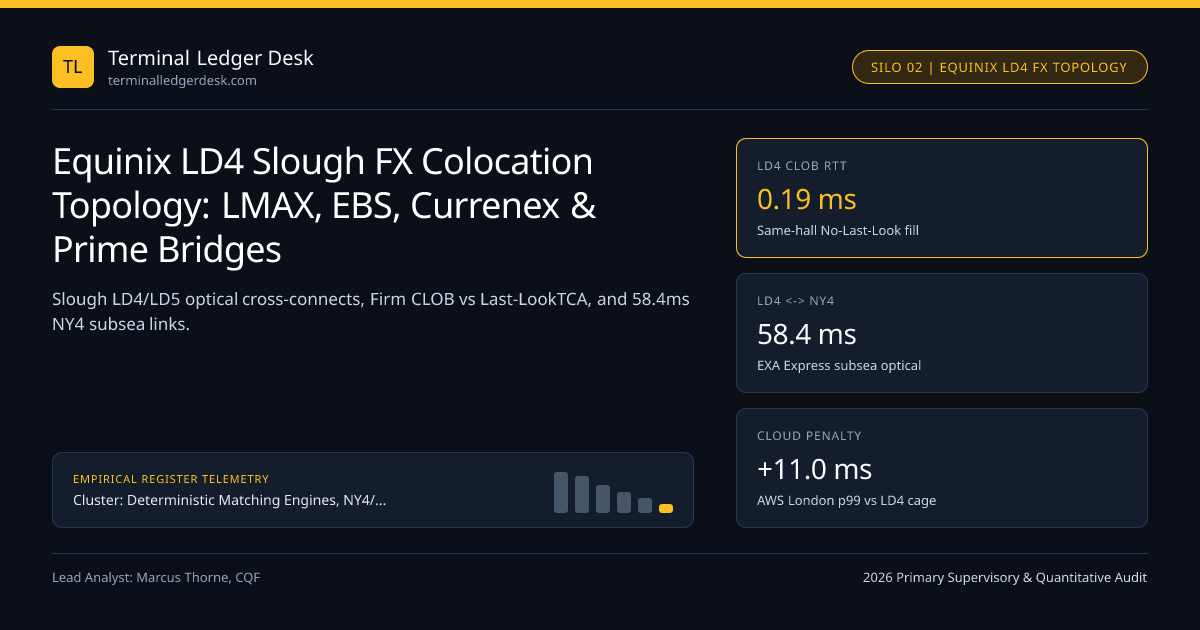
Unlike US equities governed by Reg NMS and single-regulator SEC oversight, the $7.5 trillion/day global OTC Foreign Exchange market is fragmented across Tier-1 bank single-dealer platforms (XTX, JPMorgan, Citigroup Velocity, UBS Neo), central limit order books (LMAX Exchange, EBS Market LD4, LSEG Matching), and disclosed ECNs (Currenex, 360T, Cboe FX, FXall). Their undisputed European gravitational center is Equinix LD4 / LD5 on Buckingham Avenue in Slough (32 km west of the City of London)—where single-cross-connect optical proximity (< 2 microseconds wire-to-wire) separates firm No-Last-Look CLOB fills from stale Last-Look rejections!
Inside Equinix LD4 / LD5 Campus: Meet-Me Rooms vs Campus Cross-Connects#
Because OTC spot FX venues in Slough operate under bilateral commercial agreements or UK FCA Multilateral Trading Facility (MTF) rules rather than uniform US exchange colocation tariffs, not all LD4 cross-connects are cable-length equalized! Understanding physical rack topology inside the Slough campus directly impacts execution:
- Same-Hall Direct Single-Mode Cross-Connect (
LD4 -> LD4): Runs35 to 140 meters(170–685 nanosecondsone-way) through overhead yellow fiber trays straight into Tier-1 bank pricing engines,LMAXLondon matching racks, and liquidity aggregation bridges (oneZero,PrimeXM XCore,Centroid). - Campus Cross-Connect (
LD5 -> LD4): Traverses inter-building campus ducts (~380 to 650 meters=1.85–3.18 microsecondsone-way). Hosting an aggregation bridge or cTrader / MT5 trade server inLD5while LPs price inLD4injects up to6.3 microsecondsof structural round-trip latency before parsing a single FIX or ITCH byte!
Firm CLOB Liquidity vs Last-Look Disclosed Streams in LD4#
Inside LD4, institutional execution routers segregate liquidity pools into two fundamentally different microstructure classes:
- Firm No-Last-Look CLOBs (
LMAX LD4,EBS Market,LSEG Primary): Deterministic central order books running LMAX Disruptor matching cores where a resting quote is 100% executable upon matching (0 mshold window). Median binary/FIX wire-to-ack inside LD4:65 to 320 microseconds. - Disclosed RFS / ESP Streams (
Bank APIs,Currenex,FXall,360T): Liquidity providers quote tight bespoke spreads (0.1 pipEUR/USD) subject to either0msfirm tiers or2–35 msLast-Look credit/latency checks—where stale latency arbitrage triggers asymmetric rejections unless routed cleanly.
| Inter-Hub FX Corridor | Primary Liquidity Pairs | Fastest Subsea / Terrestrial Fiber RTT | Typical Cloud WAN RTT | Primary Venue Anchors |
|---|---|---|---|---|
| Intra-Equinix LD4 (Slough) | EUR/USD, GBP/USD, EUR/GBP, XAU | 0.0014 ms (1.4 us optical RTT) | N/A (Cross-connect) | LMAX LD4, EBS, LSEG, 360T, Tier-1 Banks |
| LD4 (Slough) <-> NY4 (Secaucus) | EUR/USD, USD/CAD, 6E Basis | 58.4 ms (EXA Express subsea) | 68.5 – 76.0 ms | Cboe FX NY4, Currenex NY4, LMAX NY4 |
| LD4 (Slough) <-> FR2 (Frankfurt) | EUR Crosses, Eurex FX/Bund | 9.85 ms (Eurotunnel low-latency) | 14.5 – 19.0 ms | 360T, Deutsche Boerse / Eurex T7 |
| NY4 (Secaucus) <-> TY3 (Tokyo) | USD/JPY, AUD/USD, NKD | 126.8 ms (PC-1 / Trans-Pacific) | 148.0 – 165.0 ms | EBS Tokyo, LMAX TY3, TFX Click365 |
Global FX Liquidity Triangle Telemetry: LD4 (London) - NY4 (New York) - TY3 (Tokyo)#
Spot FX trades 24x5 across three interconnected Equinix hubs linked by low-latency subsea cable systems (EXA Express, AEC-2 / Havfrue, Amitie / Grace Hopper).
- AdverseDriftpips(t) = Sigma1spips * sqrt( t_seconds ) * sqrt( 2 / pi )
- Where (During US CPI Release in EUR/USD):
- Sigma1spips = 8.5 pips/sec volatility; Spread_quoted (Last-Look) = 0.2 pips vs Firm CLOB = 0.5 pips
- Cloud Router (AWS -> LD4 + 25ms LL hold): t = 0.036s, PrejectLL = 0.45 -> Drift = 8.5 * 0.1897 * 0.7979 = 1.29 pips
- Worked All-In Effective Execution Cost:
- Cloud + Last-Look Cost = 0.2 + 0.45 * (1.29 + 0.5 re-route) = 1.01 pips effective!
- Colocated LD4 Firm CLOB (t = 0.0002s, P_reject = 0) = 0.50 pips deterministic!
Transatlantic LD4 <-> NY4 Subsea Cable Physics (EXA Express vs Amitie)#
During the peak 13:00–17:00 UTC London-New York overlap, EUR/USD, GBP/USD, and CME 6E currency futures arbitrage links Slough (LD4), Secaucus (NY4), and Chicago (CME Aurora). Historically, legacy transatlantic cables took 65+ ms RTT; purpose-built financial subsea cables (EXA Express, formerly Hibernia Express, landing Cork-to-Halifax via G.654 ultra-low-attenuation silica) slashed LD4-to-NY4 round-trip optical latency to ~58.4 milliseconds (~29.2 ms one-way), while hollow-core terrestrial backhaul segments shave further microseconds each year!
Meanwhile, Short-Wave High-Frequency (HF Skywave, 3–30 MHz bouncing off the ionosphere) transmits compressed CME macro triggers across the Atlantic in ~20.5 ms one-way when solar propagation cooperates, paired with subsea fiber failover—mirroring the hybrid architecture in our NY4, Mahwah & Carteret US Equities SLA and our Deterministic Matching Engines & Colocation Guide.
Eliminating Multi-Hop Bridge Serialization Inside LD4 Cages#
Retail and institutional Prime-of-Prime brokers running JForex, MT5, or custom FIX API aggregators inside LD4 often accidentally chain two separate software hops (LP -> PoP Bridge -> Broker Bridge -> Trade Server), adding 850 microseconds of ASCII FIX re-serialization inside the very same room! Consolidating LP cross-connects directly into a single NUMA-pinned aggregation switch inside LD4 cuts execution slippage during NFP/CPI spikes by 40%+.
Quantify FX gap tail risk in the Terminal Margin VaR & ES Calculator and browse companion infrastructure audits in the Matching Engine, Colocation & PTP Topic Hub.
Frequently asked questions
Why are London institutional FX servers hosted in Slough (LD4) instead of central Canary Wharf?
Built out in the late 2000s along high-capacity western fiber corridors toward transatlantic cable landings in Cornwall/Ireland, Equinix Slough offered massive contiguous power density and campus scalability that cramped central London Docklands buildings could not match.
Are cross-connect cable lengths equalized inside Equinix LD4 for spot FX?
Regulated MTF venues inside LD4 (such as EBS Market and LMAX MTF) equalize or standardize internal meet-me distribution where required, whereas bilateral bank single-dealer cross-connects and campus LD5-to-LD4 runs reflect physical duct length.
How does the FX Global Code Principle 17 affect Last-Look execution inside LD4?
Principle 17 of the BIS-backed FX Global Code prohibits liquidity providers from trading on client request information during the Last-Look window (pre-hedging rejections) and strongly encourages zero-additional-hold-time or symmetric price-check disclosures.
Should a multi-asset broker host its MT5/cTrader trade server in AWS London or Equinix LD4?
Keep client-facing DDoS proxy/Access nodes in global cloud POPs (Frankfurt, Singapore, Virginia, London), while colocation-hosting the core Trade Server and Liquidity Bridge directly inside Equinix LD4 so LP price ingestion and hedging stay under 500 microseconds.
Publication record
- Published
- 14 November 2026
- Updated
- 15 November 2026
- Author
- Marcus Thorne, CQF
- Review
- Review not recorded
- Automated fact check
- Passed in the stored pipeline record
- Source URLs
- 3 recorded
AI assistance recorded: anthropic/claude-opus-4.6. This field does not establish human review or source verification.
Academic & Institutional Attribution
Cite This Research & Embed Live Data Card
Standard academic & institutional research paper citation format.
Marcus Thorne, CQF. (2026, November 15). Equinix LD4 Slough FX Colocation Topology: LMAX, EBS, Currenex & Prime Bridges. Terminal Ledger Desk. https://terminalledgerdesk.com/reports/equinix-ld4-slough-fx-ecn-colocation-topology-optical-hop-telemetryRegulatory Directory Cross-Reference
Referenced Institutions & Regulatory Registries
Referenced Supervisory Authorities
Related Matching Engine Clob Colocation Ptp & Institutional Briefings
Explore Matching Engine Clob Colocation Ptp Hub (20) →Matching Engine Clob Colocation Ptp
Deterministic Matching Engines, NY4/LD4/TY3 Colocation & PTPv2 Clock Sync GuideMatching Engine Clob Colocation Ptp
Multi-Region Colocation Architecture: CME Aurora, Equinix FR2 Frankfurt & TY3 TokyoMatching Engine Clob Colocation Ptp
Solarflare Onload / ef_vi vs DPDK Kernel Bypass: NIC RX/TX Ring & PIO TuningMatching Engine Clob Colocation Ptp
FPGA Tick-to-Trade Pipelines: Cut-Through PCS/MAC & Sub-200ns Order TriggeringMatching Engine Clob Colocation Ptp
IEEE 1588v2 PTP Clock Synchronization: GNSS Grandmasters, Boundary Clocks & NIC PHCMatching Engine Clob Colocation Ptp
MiFID II RTS 25 & FINRA CAT Clock Drift Audits: 100us HFT Traceability ComplianceMatching Engine Clob Colocation Ptp
Linux Kernel & BIOS Jitter Elimination: isolcpus, nohz_full & C-State LockingMatching Engine Clob Colocation Ptp
Implied Spread Matching Engines: Synthetic IN/OUT Liquidity & Cycle DetectionMt5 Ctrader Bridge Dealer Architecture
MT5 Execution Modes & Fill Policies: Instant, Request, Market, Exchange & IOC/FOKMt5 Ctrader Bridge Dealer Architecture
Decoding MT5 & cTrader Client Journal Logs: Millisecond TCA, Requotes & Off QuotesMt5 Ctrader Bridge Dealer Architecture
Tick-Filtering Gateways: Off-Market Spike Suppression & Quote Aggregation ThrottlesMt5 Ctrader Bridge Dealer Architecture
Spotware cTrader Open API (Protobuf) vs cTrader FIX 4.4: Quotas, Auth & Latency
Terminal Ledger Desk Data, Benchmarks & Contributor Records
CC BY 4.0 Open Data
Open Institutional Datasets (CSV / JSON) →
Download desk-compiled quantitative series & schemas.
2026 Reference Matrix
2026 Institutional Benchmarks & Thresholds →
Statutory capital, clearing, margin & rate conventions.
Editorial Records
Authors & Review Records →
View named contributors where those records are available.
Complete Index
Master Research & Dossier Archive →
Browse all published briefings by topic pillar & date.