
Matching Engine Clob Colocation Ptp
Multi-Region Colocation Architecture: CME Aurora, Equinix FR2 Frankfurt & TY3 Tokyo
Global futures and macro prop desks orchestrate synchronized bare-metal execution islands across CME Aurora (DC3), Equinix FR2 (Eurex T7), and Equinix TY3/CC2 (Tokyo)—bridging intercontinental basis spreads across 4ms to 127ms corridors.
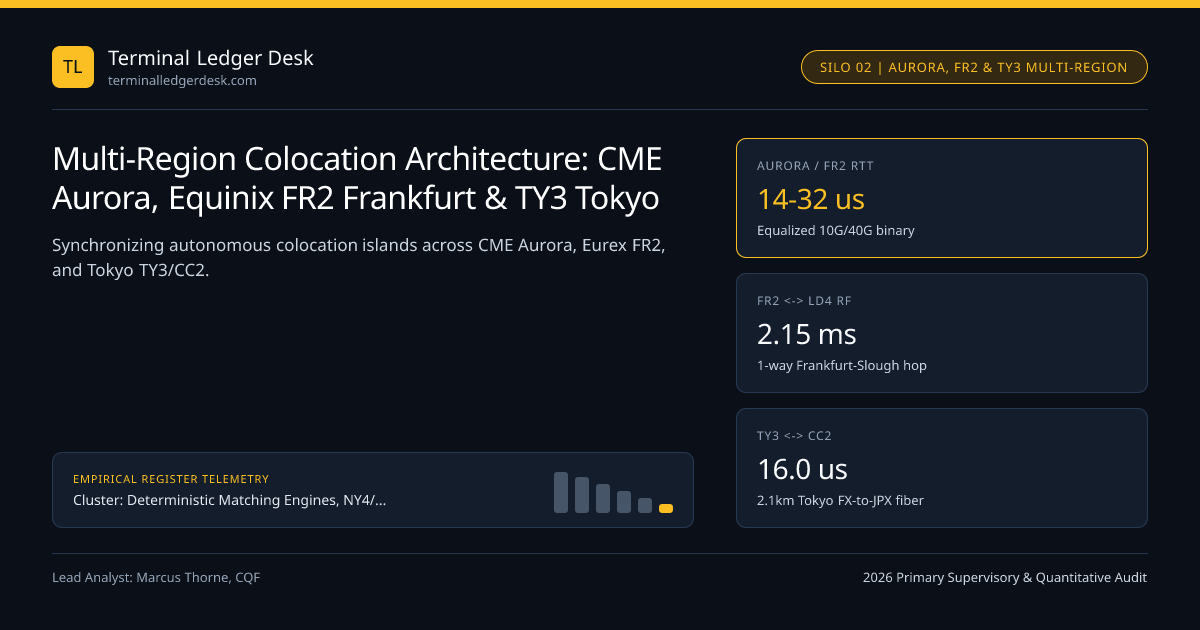
Cross-border futures, sovereign rates, and equity-index basis desks cannot run from a single continent: CME Globex matches ES, NQ, SOFR, WTI, and GC inside the 428,000-sq-ft Aurora Data Center (DC3, Illinois); Eurex T7 matches Euro-Bund (FGBL), DAX, and Euro STOXX 50 inside Equinix FR2 (Frankfurt-Kruifteler Strasse); and JPX (OSE Nikkei 225 / JGBs) + APAC FX anchor Tokyo (TY3 Koto-ku & @Tokyo CC2). Architecting a unified multi-region execution fabric requires respecting each hall unique equal-cable tariff, Layer-1 multicast topology, and intercontinental basis-hedge budgets.
CME Aurora (DC3, Illinois): 10GbE Equalized G-Link & Cloud Migration Reality#
Located 35 miles west of downtown Chicago at 2905 Diehl Road, the CME Aurora colocation facility enforces one of the strictest physical-equality regimes in global finance: every CME G-Link (10GbE) cross-connect from a customer cabinet to the Globex matching switch fabric traverses an exact-length calibrated single-mode optical path, delivering CME iLink 3 SBE acknowledgements in ~14 to 29 microseconds median wire-to-wire and MDP 3.0 A/B multicast feeds simultaneously across all racks.
Even as CME expands its long-term Google Cloud partnership (Chicago Cloud Region for clearing, analytics, and non-latency data), ultra-low-latency CLOB price discovery remains physically anchored by sub-microsecond deterministic hardware symmetry—detailed in our Deterministic Matching Engines & Colocation Guide.
Equinix FR2 (Frankfurt): Eurex T7 Co-Location 2.0 & 10GbE / 40GbE EMDI#
In continental Europe, Deutsche Boerse hosts Eurex T7 and Xetra inside Equinix FR2 under BaFin and ESMA MiFID II RTS 10 fair-access tariffs. Eurex provides two distinct market-data multicast tiers inside FR2:
- EMDI (
Enhanced Market Data Interface) & EOBI (Enhanced Order Book Interface): Unthrottled binary SBE-like order-by-order (EOBI) multicast over dual10GbE(and40GbE) equalized intra-hall fibers, paired with ETI (Enhanced Trading Interface) low-latency binary TCP sessions. FR2 <-> LD4Microwave & Fiber Corridor (~635 kmgeodesic): High-speed Euro-rates andDAX / FTSE / S&Pindex desks link Frankfurt (FR2) to Slough (LD4) in~2.15 msone-way via microwave (~4.92 msone-way via Eurotunnel low-latency fiber)—analyzed alongside our Equinix LD4 Slough FX topology guide.
| Colocation Facility | Anchor Venue(s) | Cross-Connect Equalization | Order Entry & MBO Feed | Typical Intra-Hall RTT |
|---|---|---|---|---|
| CME Aurora (`DC3`) (Illinois) | CME, CBOT, NYMEX, COMEX | Strict Equalized 10GbE G-Link | iLink 3 SBE + MDP 3.0 MBO | 14 – 29 us |
| Equinix FR2 (Frankfurt) | Eurex T7, Xetra Cash | Equalized Co-Location 10G / 40G | T7 ETI Binary + EOBI MBO | 15 – 32 us |
@Tokyo CC2 (Toyosu, Tokyo) | JPX (TSE Arrowhead / OSE J-GATE) | Equalized JPX Arrownet Co-Lo | Arrowhead / J-GATE OUCH-ITCH | 22 – 48 us |
| Equinix TY3 (Edagawa, Tokyo) | EBS Tokyo, LMAX TY3, TFX | Commercial OS2 Metro/Intra-Hall | ITCH / Binary / FIX 4.4 | 45 – 190 us |
Global Tier-1 Futures & APAC Colocation Facility Specification Matrix#
Comparing physical cross-connect equalization, native binary protocols, and inter-hall corridors across Aurora, FR2, and Tokyo (TY3 / @Tokyo CC2).
- Where (CME Nikkei NKD in Aurora vs OSE Nikkei 225 Mini in @Tokyo CC2):
- Tcorridor1way_ms = 58.4 ms (Aurora -> Seattle -> Trans-Pacific Subsea -> Toyosu CC2)
- Vol1msbps = 0.18 bps/sqrt(ms) during BOJ rate announcement; Z_adverse = 1.65 (95% guard)
- Fee_maker + taker = 0.35 bps + 0.55 bps = 0.90 bps exchange + clearing cost
- Worked Trans-Pacific Basis Capture Threshold:
- Latency Slippage Guard = 0.18 * sqrt(58.4) * 1.65 = 0.18 * 7.642 * 1.65 = 2.27 bps!
- Minimum Profitable Trigger Spread = 0.90 bps (fees) + 2.27 bps (58.4ms flight risk) = 3.17 bps.
Tokyo Dual-Site Reality: Equinix TY3 (FX) vs @Tokyo CC2 (JPX Arrowhead / J-GATE)#
Newcomers entering Japan often assume placing one rack in Equinix TY3 (Edagawa, Koto-ku) puts them inside both FX and Tokyo Stock Exchange / Osaka Exchange (JPX). Look closer at Tokyo campus geography:
Equinix TY3: HostsEBS Tokyo,LMAX TY3,TFX, and regional APAC FX bridges (cTrader / MT5 Asian trade nodes).@Tokyo CC2(Toyosu, Koto-ku —~2.1 kmaway): HostsJPX Co-Location(TSE Arrowhead v4.0cash equities andOSE J-GATE 3.0Nikkei 225 / TOPIX / 10-Yr JGB derivatives running Nasdaq Genium INET / OUCH-ITCH variants)!
Trading CME NKD (Aurora) or USD/JPY (TY3) against OSE Nikkei 225 Mini (CC2) requires a ~14–22 microsecond Toyosu-to-Edagawa metro dark-fiber cross-connect linking a local CC2 J-GATE execution box directly to your TY3 FX engine!
Autonomous Island Architecture for Transoceanic Basis Hedging#
Never deploy a centralized strategy brain in Chicago that sends orders over 67 ms WAN links to Frankfurt or 63 ms links to Tokyo! Instead, run autonomous local high-availability execution islands inside each data center (Aurora, FR2, TY3/CC2). Each island maintains local resting quotes, local CFTC / BaFin / JFSA pre-trade kill switches, and exchanges compact fair-value basis vectors (8-byte sequence + 8-byte theoretical mid) over redundant subsea/RF carriers.
Stress-test cross-margin currency/futures basis decouplings inside the Terminal Margin VaR & ES Calculator and explore hardware NIC tuning in the Matching Engine, Colocation & PTP Topic Hub.
Frequently asked questions
Has CME Globex moved its ultra-low-latency matching engine out of Aurora into public cloud?
While CME migrated clearing, margin analytics, and select data services onto Google Cloud, core sub-millisecond Globex futures and options CLOB matching requires deterministic equal-cable hardware physics anchored by dedicated colocation standards.
What is the difference between Eurex EMDI and Eurex EOBI inside Equinix FR2?
EMDI publishes aggregated depth-of-book price levels (suitable for standard derivatives quoting), whereas EOBI (Enhanced Order Book Interface) broadcasts full unthrottled order-by-order (MBO) SBE messages on liquid benchmarks like Euro-Bund, DAX, and Euro STOXX 50.
Why do firms connect Equinix TY3 and @Tokyo CC2 with dedicated dark fiber?
USD/JPY spot liquidity aggregates inside Equinix TY3, whereas Nikkei 225 and TOPIX futures match inside JPX @Tokyo CC2 2.1 km away. Since USD/JPY and Nikkei futures are tightly correlated millisecond-by-millisecond, a 16-us dark fiber link unlocks instant cross-asset hedging.
How do global trading desks synchronize timestamps across Aurora, FR2, and TY3?
Each regional colocation cage ingests an independent roof-mounted multi-constellation GNSS (GPS + Galileo + QZSS) Grandmaster Clock distributed via IEEE 1588v2 PTPv2 into NIC hardware clocks, keeping Chicago, Frankfurt, and Tokyo logs aligned within < 50 ns of UTC.
Publication record
- Published
- 14 November 2026
- Updated
- 14 November 2026
- Author
- Marcus Thorne, CQF
- Review
- Review not recorded
- Automated fact check
- Passed in the stored pipeline record
- Source URLs
- 3 recorded
AI assistance recorded: anthropic/claude-opus-4.6. This field does not establish human review or source verification.
Academic & Institutional Attribution
Cite This Research & Embed Live Data Card
Standard academic & institutional research paper citation format.
Marcus Thorne, CQF. (2026, November 14). Multi-Region Colocation Architecture: CME Aurora, Equinix FR2 Frankfurt & TY3 Tokyo. Terminal Ledger Desk. https://terminalledgerdesk.com/reports/equinix-ty3-tokyo-fr2-frankfurt-cme-aurora-multi-region-colocationRegulatory Directory Cross-Reference
Referenced Institutions & Regulatory Registries
Referenced Supervisory Authorities
Related Matching Engine Clob Colocation Ptp & Institutional Briefings
Explore Matching Engine Clob Colocation Ptp Hub (20) →Matching Engine Clob Colocation Ptp
Deterministic Matching Engines, NY4/LD4/TY3 Colocation & PTPv2 Clock Sync GuideMatching Engine Clob Colocation Ptp
Solarflare Onload / ef_vi vs DPDK Kernel Bypass: NIC RX/TX Ring & PIO TuningMatching Engine Clob Colocation Ptp
FPGA Tick-to-Trade Pipelines: Cut-Through PCS/MAC & Sub-200ns Order TriggeringMatching Engine Clob Colocation Ptp
IEEE 1588v2 PTP Clock Synchronization: GNSS Grandmasters, Boundary Clocks & NIC PHCMatching Engine Clob Colocation Ptp
MiFID II RTS 25 & FINRA CAT Clock Drift Audits: 100us HFT Traceability ComplianceMatching Engine Clob Colocation Ptp
Linux Kernel & BIOS Jitter Elimination: isolcpus, nohz_full & C-State LockingMatching Engine Clob Colocation Ptp
Implied Spread Matching Engines: Synthetic IN/OUT Liquidity & Cycle DetectionMatching Engine Clob Colocation Ptp
Opening & Closing Call Auction Engines: Equilibrium Uncrossing Price AlgorithmsMt5 Ctrader Bridge Dealer Architecture
Decoding MT5 & cTrader Client Journal Logs: Millisecond TCA, Requotes & Off QuotesMt5 Ctrader Bridge Dealer Architecture
Tick-Filtering Gateways: Off-Market Spike Suppression & Quote Aggregation ThrottlesMt5 Ctrader Bridge Dealer Architecture
Spotware cTrader Open API (Protobuf) vs cTrader FIX 4.4: Quotas, Auth & LatencyMt5 Ctrader Bridge Dealer Architecture
MT5 Netting vs Hedging Position Ledgers: Orders, Deals, CloseBy & Margin Math
Terminal Ledger Desk Data, Benchmarks & Contributor Records
CC BY 4.0 Open Data
Open Institutional Datasets (CSV / JSON) →
Download desk-compiled quantitative series & schemas.
2026 Reference Matrix
2026 Institutional Benchmarks & Thresholds →
Statutory capital, clearing, margin & rate conventions.
Editorial Records
Authors & Review Records →
View named contributors where those records are available.
Complete Index
Master Research & Dossier Archive →
Browse all published briefings by topic pillar & date.