
Matching Engine Clob Colocation Ptp
Exchange Speed Bumps: IEX 350us 38-Mile Fiber Coil & Asymmetric Delay Shields
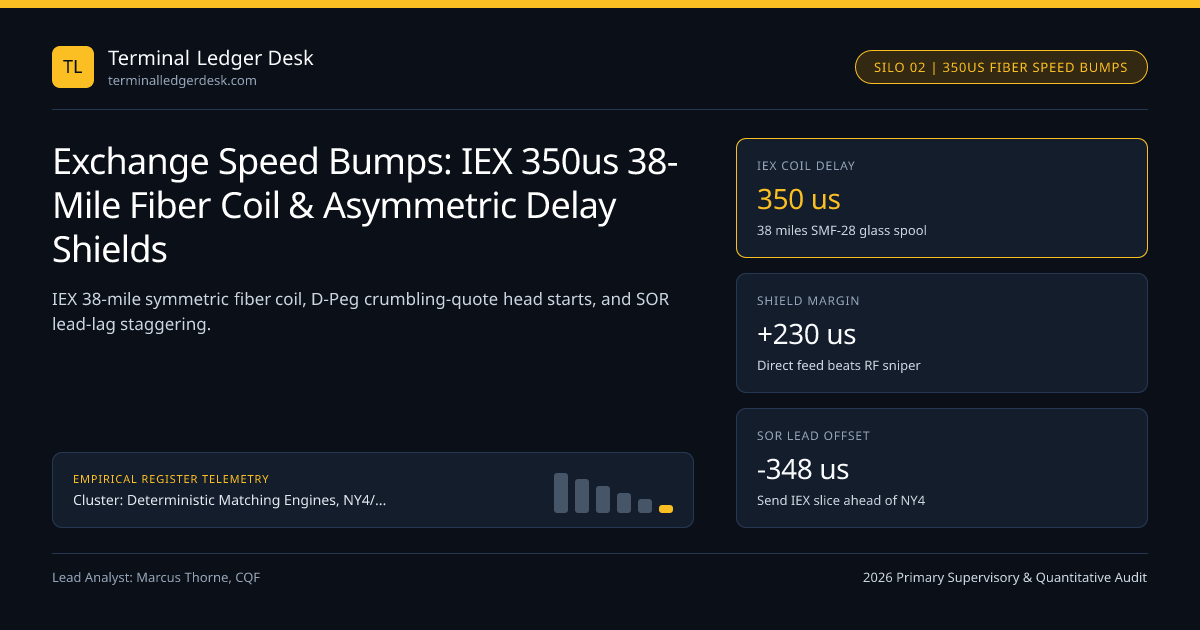
Intentional microsecond speed bumps reshape exchange microstructure: IEX routes orders through 38 miles of coiled fiber (350 us) so its internal engine reprices pegged dark orders before cross-venue snipers arrive.
After spending decades shaving nanoseconds off cross-connects, a wave of equity and FX venues deliberately inserted hundreds of microseconds to several milliseconds of artificial delay right in front of their matching engines! Yet Symmetric Speed Bumps (IEX 350-microsecond Magic Shoebox) and Asymmetric Speed Bumps (TSX Alpha 1–3ms, EBS Market / Refinitiv FX, LME, and Cboe EDGA proposals) operate on completely different physical and regulatory principles—determining whether passive market makers get protected from latency arbitrage or whether Smart Order Routers suffer phantom fill fade.
Physics of the IEX 350-Microsecond (38-Mile) Coiled Fiber POP#
Recall from our Equinix NY4, Mahwah & Carteret triangle audit that when NBBO support starts crumbling on Nasdaq (Carteret) and NYSE (Mahwah), a microwave-equipped sniper in NY4 can fire IOC sweep orders across venues in 103–187 microseconds—faster than a standard resting midpoint order can cancel! How did Investors Exchange (IEX) win SEC national exchange approval in 2016 (Release 34-78101) to neutralize that sniper?
IEX placed its Point-of-Presence (POP) inside Equinix NY5 (Secaucus), routing 100% of participant inbound orders AND outbound market-data/execution feeds through a physical spool containing *38 miles (~61.15 km) of single-mode optical fiber (`61.15 km 4.90 ns/km + switch hops ≈ 350 microseconds each way, 700 us RTT)**! Crucially, IEX own matching engine ingests direct Nasdaq/NYSE/Cboe market data *without* passing through the 350-us coil—giving IEX internal **D-Peg (Discretionary Peg) / C-Peg crumbling-quote logistic regression signal** a **230+ microsecond` head start** to step resting dark orders back 1 tick before the sniper order emerges from the coil!
Symmetric (IEX) vs Asymmetric (Maker Cancel Bypasses Delay) Speed Bumps#
Why did the SEC approve IEX 350-us symmetric coil yet reject Cboe EDGA 4-millisecond asymmetric speed bump (2020), while IIROC/OSC in Canada (TSX Alpha), UK FCA FX MTFs (Refinitiv Matching, Cboe FX), and ICE Futures (Gold/Silver trials) permitted asymmetric delays?
- Symmetric Delay (
IEX): Delays both liquidity takers (NewOrder) and external liquidity makers (CancelOrder) equally (350 us), delegating protection exclusively to exchange-calculated pegged order types (D-Peg,Midpoint Peg). - Asymmetric / Selective Delay (
TSX Alpha,FX ECNs, OptionsM-L3): Delays aggressive liquidity-taking orders (IOC / Market / Crossing Limit) by1 to 4 milliseconds, while letting passive Market MakerCancelorMass-Quote Updatemessages bypass the delay completely (0 ms)! Result: market makers quote narrower lit spreads because they can pull quotes across correlated venues before delayed takers hit them!
| Venue & Asset Class | Delay Magnitude | Symmetry Type | Physical / Software Mechanism | Regulatory Protected-Quote Status |
|---|---|---|---|---|
IEX (US Equities, NY5) | 350 us (1-way) | Symmetric (Pegs internal) | 38-mile (61.15 km) passive fiber coil | Protected NBBO (SEC de minimis <1ms) |
TSX Alpha (Canadian Equities) | 1 – 3 ms (Random) | Asymmetric (Post-Only 0ms) | Software/FPGA randomized timer queue | Unprotected under IIROC OPR! |
Cboe EDGA LP2 Proposal (US) | 4.0 ms | Asymmetric (Cancels 0ms) | Software timer wheel | Rejected by SEC (Feb 2020) as unfair |
FX ECNs (EBS / Cboe FX / Bridges) | 0.5 – 5.0 ms | Batch Floor or Taker Delay | Micro-batch auction / Taker timer | Permitted under UK FCA / FX Global Code |
Global Venue Speed-Bump Architecture & Regulatory Status Matrix#
Comparing physical coil hardware vs software timer rings, symmetry rules, and SEC Protected Quote (Reg NMS Rule 611) eligibility.
- Tsorstaggeroffset(v) = max{u in Venues}( Tonewaytotal(u) ) - Tonewaytotal(v)
- Worked IEX Crumbling-Quote Shield Margin (Carteret Nasdaq Crumble -> Secaucus IEX):
- Left Side (IEX Direct Fiber + Crumble Eval) = 211 us + 12 us = 223 microseconds
- Right Side (Sniper RF 103us + FPGA 0.2us + 350us Coil) = 453.2 microseconds -> Shield wins by +230.2 us!
- SOR Staggering (NY4 Router -> IEX 350us vs Cboe BZX 2us): Fire IEX slice 348 us BEFORE firing Cboe BZX slice!
Hardware Coiled Fiber vs Software Timer Wheel Implementation#
Why wind 38 miles of physical glass inside a chassis when a uint64_t releaseTimestamp = now_ns + 350_000 software timer ring inside an LMAX Disruptor costs zero rack units? Two reasons:
- Physical Immutability & Microburst Line-Rate Capacity: A passive 38-mile fiber spool holds
~3.5 Megabitsof light in flight simultaneously at10GbEwith zero RAM queuing jitter, zero clock drift, and zero possibility of software bug bypass! - Deterministic Randomized Windows (
TSX Alpha 1–3ms/EBS Ultra): Where venues intentionally randomize delay (e.g., uniform 1.0–3.0 msor batch frequent micro-auctions every3–5 msas onEBS Market), software/FPGA hierarchical timing wheels (Hashed Timing Wheel+ PTP hardware clock) become mandatory so orders reorder or batch cleanly per rulebook.
Smart Order Router (SOR) Adaptation: Opportunity Cost & Fade Penalties#
Routing a multi-venue sweep naively to IEX (+350 us) or TSX Alpha (+1–3 ms) at the same microsecond you hit Nasdaq (0 us coil) leaks your sweep footprint on Nasdaq 350 microseconds before your IEX child order exits the shoebox! Sophisticated Poisson-calibrated Smart Order Routers stagger departure timestamps (Lead-Lag Staggering) so child slices arrive at every matching core simultaneously!
Evaluate speed-bump fill rates vs adverse-selection savings in the Algorithmic Kelly Allocation Calculator, connect multi-venue execution via FIX API, and read our Deterministic Matching Engines & Colocation Guide and Matching Engine, Colocation & PTP Topic Hub.
Frequently asked questions
Why did IEX choose exactly 350 microseconds instead of 5 milliseconds for its speed bump?
Under the SEC 2016 Commission Interpretation on Automated Quotations (Rule 611 Order Protection Rule), only intentional delays below a de minimis sub-millisecond (< 1,000 us) threshold qualify as "immediate" Protected Quotes included in the national NBBO; 350 us cleared NJ transit physics while staying well under 1 ms.
Why did Canada IIROC exclude TSX Alpha from the Order Protection Rule when approving its speed bump?
Because TSX Alpha implemented a 1-to-3 millisecond asymmetric speed bump where resting quotes can fade while taker orders sit delayed, Canadian regulators ruled brokers cannot be legally forced to route to quotes that are not immediately accessible.
How does the IEX Crumbling Quote Indicator (CQI) predict imminent NBBO changes?
Running continuously inside the matching engine on sub-microsecond NY4/Carteret/Mahwah direct feeds, the published CQI formula evaluates best-bid/ask venue count contractions and E-mini/ETF cross-asset book imbalances—firing a 2-millisecond defensive state when adverse tick probability spikes.
Do asymmetric speed bumps widen or narrow consolidated market spreads?
Empirical microstructure studies on TSX Alpha and FX latency floors show a split effect: spreads narrow slightly on the speed-bumped venue itself due to lower market-maker adverse selection, but quote depth and spreads on competing non-bumped lit venues can widen slightly as uninformed flow segments away.
Publication record
- Published
- 14 November 2026
- Updated
- 15 November 2026
- Author
- Marcus Thorne, CQF
- Review
- Review not recorded
- Automated fact check
- Passed in the stored pipeline record
- Source URLs
- 3 recorded
AI assistance recorded: anthropic/claude-opus-4.6. This field does not establish human review or source verification.
Academic & Institutional Attribution
Cite This Research & Embed Live Data Card
Standard academic & institutional research paper citation format.
Marcus Thorne, CQF. (2026, November 15). Exchange Speed Bumps: IEX 350us 38-Mile Fiber Coil & Asymmetric Delay Shields. Terminal Ledger Desk. https://terminalledgerdesk.com/reports/speed-bumps-iex-350us-coiled-fiber-asymmetric-fx-ecn-delay-shieldsRegulatory Directory Cross-Reference
Referenced Institutions & Regulatory Registries
Related Matching Engine Clob Colocation Ptp & Institutional Briefings
Explore Matching Engine Clob Colocation Ptp Hub (20) →Matching Engine Clob Colocation Ptp
Deterministic Matching Engines, NY4/LD4/TY3 Colocation & PTPv2 Clock Sync GuideMatching Engine Clob Colocation Ptp
Smart Order Router (SOR) Engineering: Latency-Equalized Sweeps & Poisson Fill ModelsMatching Engine Clob Colocation Ptp
PCIe Gen5 TLP DMA, Intel DDIO & AMD Cache Stashing: Avoiding Leaky L3 MissesMatching Engine Clob Colocation Ptp
Wire-to-Wire Latency Telemetry: HdrHistogram, Coordinated Omission & Optical TapsMatching Engine Clob Colocation Ptp
LMAX Disruptor Ring Buffers: Mechanical Sympathy in Matching Engine CoresMatching Engine Clob Colocation Ptp
Intrusive O(1) Limit Order Books: Slab Pools, Doubly-Linked Queues & Price ArraysMatching Engine Clob Colocation Ptp
FIFO Price-Time vs Pro-Rata Matching Algorithms: CME Split, LMM & TOP MechanicsMatching Engine Clob Colocation Ptp
US Equities Liquidity Triangle: Equinix NY4, ICE Mahwah & Nasdaq Carteret SLAsMt5 Ctrader Bridge Dealer Architecture
MQL5 High-Speed EA Architecture: OnTick Drop Behavior & OrderSendAsync PipesMt5 Ctrader Bridge Dealer Architecture
Mobile Trading Terminals: iOS/Android Socket Suspension, QUIC & Push ExecutionMt5 Ctrader Bridge Dealer Architecture
Trading Terminal Binary Hardening: Certificate Pinning, DPAPI/Keychain & Anti-TamperMifid Rts6 Pretrade Kill Switch Controls
SEC Rule 15c3-5 Market Access Control: Ban on Unfiltered Sponsored Access & Annual CEO Attestation
Terminal Ledger Desk Data, Benchmarks & Contributor Records
CC BY 4.0 Open Data
Open Institutional Datasets (CSV / JSON) →
Download desk-compiled quantitative series & schemas.
2026 Reference Matrix
2026 Institutional Benchmarks & Thresholds →
Statutory capital, clearing, margin & rate conventions.
Editorial Records
Authors & Review Records →
View named contributors where those records are available.
Complete Index
Master Research & Dossier Archive →
Browse all published briefings by topic pillar & date.