
Fix Protocol Sbe Ouch Session Latency
Nasdaq TotalView-ITCH 5.0 & MoldUDP64: L3 Multicast Order Book Reconstruction
Nasdaq TotalView-ITCH 5.0 broadcasts over 500 million daily order-by-order events inside MoldUDP64 multicast datagrams, enabling colocated trading engines to rebuild exact L3 queue priority in sub-microsecond latency.
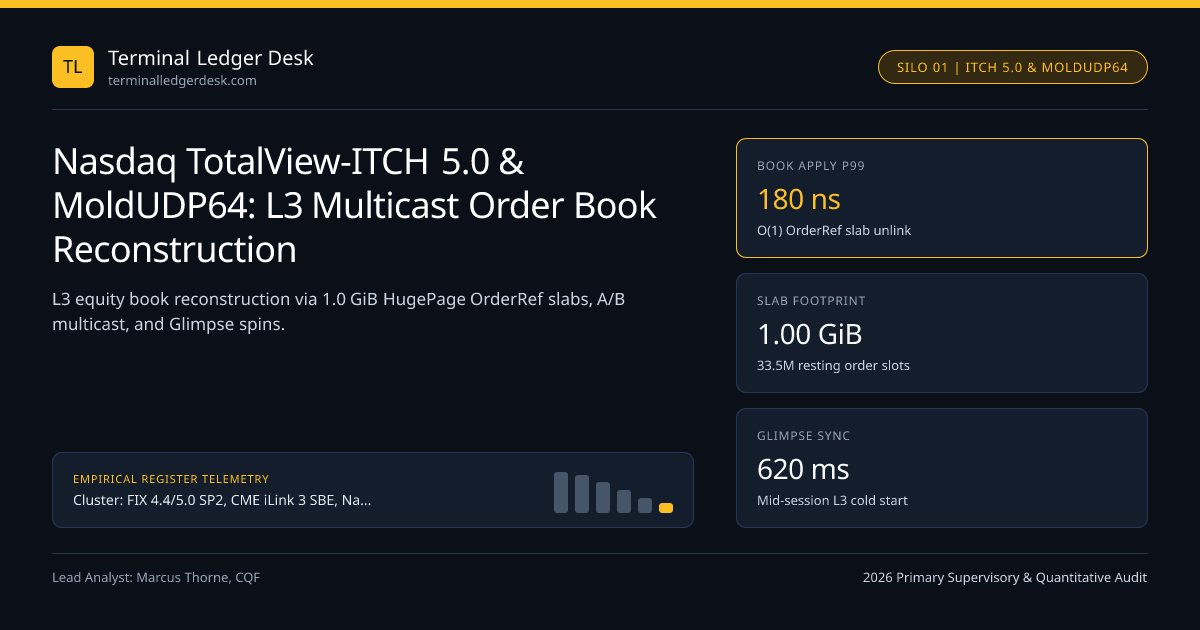
Building an institutional US equities Smart Order Router or market-making engine requires consuming order-by-order (Level 3) depth rather than aggregated SIP top-of-book quotes. Nasdaq TotalView-ITCH 5.0 delivers every individual resting order addition (A/F), partial execution (E/C), cancellation (X), deletion (D), and replacement (U) encapsulated inside MoldUDP64 IP multicast packets, allowing engines inside Carteret and Equinix NY4 to compute exact queue-ahead share volume in under 190 nanoseconds per tick.
MoldUDP64 Datagram Coalescing and 64-Bit Sequence Tracking#
At peak 09:30:00 and 16:00:00 auction bursts, transmitting one Ethernet/IP/UDP header per 36-byte ITCH message would overwhelm switch packet-per-second budgets. MoldUDP64 solves packet overhead by packing multiple length-prefixed ITCH messages into a single MTU-sized (<= 1,400 byte) UDP payload preceded by a 20-byte header: 10-byte Session, 8-byte big-endian SequenceNumber of the first contained message, and 2-byte MessageCount.
If a datagram carries SequenceNumber = 10,500,001 and MessageCount = 18, the next datagram on that multicast group MUST begin at 10,500,019. Setting MessageCount = 0 denotes an end-of-millisecond heartbeat carrying the next expected sequence number so idle subscribers detect silent drops within 1 millisecond—far tighter than TCP FIX Heartbeat and TestRequest timers.
Two-Table L3 Book Reconstruction: OrderID Map + Price-Level Tree#
Observe a critical bandwidth optimization in ITCH 5.0: while Add Order (Type A) provides OrderReferenceNumber (8B), BuySellIndicator, Shares (4B), StockLocate (2B), and Price (4B), subsequent Order Cancel (X) and Order Delete (D) messages transmit only OrderReferenceNumber, omitting Stock, Side, and Price! Consequently, an L3 book builder cannot route ticks by symbol alone.
High-speed engines maintain a flat global open-addressed hash table (or segmented slab indexed by OrderReferenceNumber) storing { stockLocate, side, priceNodePtr, remainingShares } alongside per-symbol price-level doubly-linked lists. When Delete (D) arrives, a single pointer dereference decrements the price level in O(1) time without tree traversal—mirroring the zero-copy ethos of our FIX, SBE & OUCH Session Architecture Guide.
| ITCH 5.0 Message Type | Code | Payload Bytes | Key Wire Fields | L3 Order Book Mutation |
|---|---|---|---|---|
| Stock Directory | R | 39 bytes | StockLocate (2B), Stock (8B), LotSize | Initializes Locate -> SymbolBook slot at 04:00 EST |
| Add Order (No MPID / MPID) | A / F | 36 / 40 bytes | OrderRefNum (8B), Side, Shares, Price | Inserts slab node + appends tail of price FIFO |
| Order Executed | E | 31 bytes | OrderRefNum (8B), ExecutedShares, MatchNum | Decrements resting head; removes node if Qty == 0 |
| Order Cancel / Delete | X / D | 23 / 19 bytes | OrderRefNum (8B) (+ CanceledShares on X) | O(1) slab lookup -> unlinks doubly-linked node |
| Order Replace | U | 35 bytes | OrigOrderRefNum, NewOrderRefNum, Shares, Price | Deletes OrigRef + inserts NewRef at tail priority |
MoldUDP64 Gap Recovery vs Nasdaq Glimpse Mid-Day Spin Synchronization#
Recovering from UDP buffer drops or restarting a strategy process at 11:15 EST requires coordinating live multicast buffering with unicast recovery services.
- BWmold = Ritchpeak * (Litchavg + 2 + (Lethipudp + 20) / K_coalesce) * 8
- Where:
- Nmaxlive_orders = 33,554,432 slots (2^25 pre-allocated slab nodes)
- sizeof(OrderNode) = 32 bytes (nextIdx 4B, prevIdx 4B, price 4B, shares 4B, refNum 8B, locate 2B, flags 6B)
- Ritchpeak = 6,800,000 messages/second (microburst rate)
- Litchavg = 27 bytes; Kcoalesce = 28 messages/MoldUDP64 packet; Lethipudp = 46 bytes
- Worked Memory & Microburst Bandwidth Sizing:
- Mslabram = 33,554,432 * 32 bytes = 1,073,741,824 bytes (1.00 GiB pinned in 512 x 2MB HugePages)
- Bytes/msg = 27 + 2 + (66 / 28) = 31.36 bytes/message
- BW_mold = 6,800,000 * 31.36 * 8 = 1.706 Gbps per multicast feed (3.41 Gbps dual A+B).
Why Unicast UDP Retransmission Requests Must Never Run on the Hot Path#
MoldUDP64 provides a unicast UDP Retransmission Server where subscribers send a 20-byte request specifying missed SequenceNumber and MessageCount. However, exchange retransmission servers intentionally throttle and deprioritize unicast repair traffic during market spikes to protect primary multicast fans. Relying on unicast repair inside Equinix NY4/Carteret racks stalls book validity for 5 to 45 milliseconds.
Instead, Tier-1 desks subscribe simultaneously to dual physically diverse multicast fabrics (Feed A and Feed B) and perform first-arrival sequence arbitration in NIC/FPGA memory—identical in principle to CME MDP 3.0 SBE A/B channel arbitration. Only if both A and B drop the identical sequence simultaneously—or when cold-starting an engine mid-session—does the process connect to Nasdaq Glimpse over SoupBinTCP to download a point-in-time L3 book spin aligned to a specific ITCH sequence number before draining buffered multicast ticks into Nasdaq OUCH 5.0 order entry.
Memory Sizing & Kernel Socket Buffer Engineering for 500M+ Daily Ticks#
Preventing kernel RcvbufErrors (netstat -su) during FOMC volatility spikes requires tuning three Linux and application layers audited against SEC market-data integrity rules:
- Socket Receive Ring (
rmem_max): Raisenet.core.rmem_max = 134217728(128 MB) or bypass the kernel completely onto Solarflareef_vi/ Mellanox VMA user-space RX rings. - 2-Byte StockLocate Indexing: Never key symbol books by 8-byte ASCII tickers (
"AAPL "); ingestStock Directory (Type R)at 04:00 EST and index a contiguous16,384-element C++ array directly by 16-bitStockLocate (1..N). - Queue-Depletion Signal Validation: Feed real-time L3 queue-imbalance alpha metrics into the Algorithmic Kelly Allocation Calculator and compare multi-asset terminal architectures in our FIX, SBE & OUCH Topic Hub and proprietary terminal directory.
Frequently asked questions
Why does ITCH Order Replace (Type U) change the OrderReferenceNumber instead of editing in place?
On Nasdaq, modifying price or increasing share size forfeits time priority and places the new order at the back of the price queue. Assigning a brand-new monotonic OrderReferenceNumber preserves strict chronological ordering across all resting liquidity.
How does Nasdaq Glimpse align its point-in-time snapshot with live MoldUDP64 multicast traffic?
An engine first starts recording live MoldUDP64 packets into a memory ring buffer, then logs into Glimpse to receive all currently resting orders followed by an End-of-Snapshot message citing sequence S_snap. The engine discards buffered multicast messages <= S_snap and applies S_snap + 1 onward.
What is the difference between ITCH Add Order Type A and Type F?
Type A (36 bytes) represents an anonymous non-attributed resting order displayed under the NSDQ generic market participant code, whereas Type F (40 bytes) appends a 4-character Market Participant Identifier (MPID) for attributed market-maker quotes.
How does TotalView-ITCH 5.0 latency compare against the consolidated UTP SIP Level-1 feed?
Colocated Carteret consumers decode ITCH 5.0 directly off the matching engine multicast fan in ~12–18 microseconds, beating the consolidated UTP SIP top-of-book quote feed by an additional geographic and aggregation margin during cross-market sweeps.
Publication record
- Published
- 14 November 2026
- Updated
- 14 November 2026
- Author
- Marcus Thorne, CQF
- Review
- Review not recorded
- Automated fact check
- Passed in the stored pipeline record
- Source URLs
- 3 recorded
AI assistance recorded: anthropic/claude-opus-4.6. This field does not establish human review or source verification.
Academic & Institutional Attribution
Cite This Research & Embed Live Data Card
Standard academic & institutional research paper citation format.
Marcus Thorne, CQF. (2026, November 14). Nasdaq TotalView-ITCH 5.0 & MoldUDP64: L3 Multicast Order Book Reconstruction. Terminal Ledger Desk. https://terminalledgerdesk.com/reports/nasdaq-totalview-itch-5-0-moldudp64-multicast-book-reconstructionRegulatory Directory Cross-Reference
Referenced Institutions & Regulatory Registries
Referenced Supervisory Authorities
Related Fix Protocol Sbe Ouch Session Latency & Institutional Briefings
Explore Fix Protocol Sbe Ouch Session Latency Hub (20) →Fix Protocol Sbe Ouch Session Latency
FIX 4.4/5.0 SP2, CME iLink 3 SBE & Nasdaq OUCH 5.0 Session Latency Architecture GuideFix Protocol Sbe Ouch Session Latency
CME MDP 3.0 SBE Market Data: A/B Multicast Arbitration & Snapshot SynchronizationFix Protocol Sbe Ouch Session Latency
Cboe BOE v3 Bitfields vs NYSE Pillar Binary Gateway: Wire Efficiency & LatencyFix Protocol Sbe Ouch Session Latency
FIX/FAST Protocol PMAP & Stop-Bit Decoding: Why Exchanges Migrated to SBEFix Protocol Sbe Ouch Session Latency
Zero-Malloc FIX Repeating Groups: Parsing NoMDEntries (268) & NoPartyIDs (453)Fix Protocol Sbe Ouch Session Latency
FIX Heartbeat (35=0), TestRequest (35=1) & Linux TCP_USER_TIMEOUT Dead-Peer DetectionFix Protocol Sbe Ouch Session Latency
EOD vs Weekly FIX Sequence Reset (Tag 141=Y): Cross-Timezone Rollover EngineeringFix Protocol Sbe Ouch Session Latency
SBE Schema Evolution: Forward & Backward Wire Compatibility via actingBlockLengthMatching Engine Clob Colocation Ptp
IEEE 1588v2 PTP Clock Synchronization: GNSS Grandmasters, Boundary Clocks & NIC PHCMatching Engine Clob Colocation Ptp
MiFID II RTS 25 & FINRA CAT Clock Drift Audits: 100us HFT Traceability ComplianceMatching Engine Clob Colocation Ptp
Linux Kernel & BIOS Jitter Elimination: isolcpus, nohz_full & C-State LockingMatching Engine Clob Colocation Ptp
Implied Spread Matching Engines: Synthetic IN/OUT Liquidity & Cycle Detection
Terminal Ledger Desk Data, Benchmarks & Contributor Records
CC BY 4.0 Open Data
Open Institutional Datasets (CSV / JSON) →
Download desk-compiled quantitative series & schemas.
2026 Reference Matrix
2026 Institutional Benchmarks & Thresholds →
Statutory capital, clearing, margin & rate conventions.
Editorial Records
Authors & Review Records →
View named contributors where those records are available.
Complete Index
Master Research & Dossier Archive →
Browse all published briefings by topic pillar & date.