
Fix Protocol Sbe Ouch Session Latency
Zero-Malloc FIX Repeating Groups: Parsing NoMDEntries (268) & NoPartyIDs (453)
Nested FIX repeating groups inside MarketDataSnapshotFullRefresh (35=W) and multi-leg ExecutionReports trigger up to 120 heap allocations per frame in naive parsers, causing 45-microsecond p99.9 latency spikes.
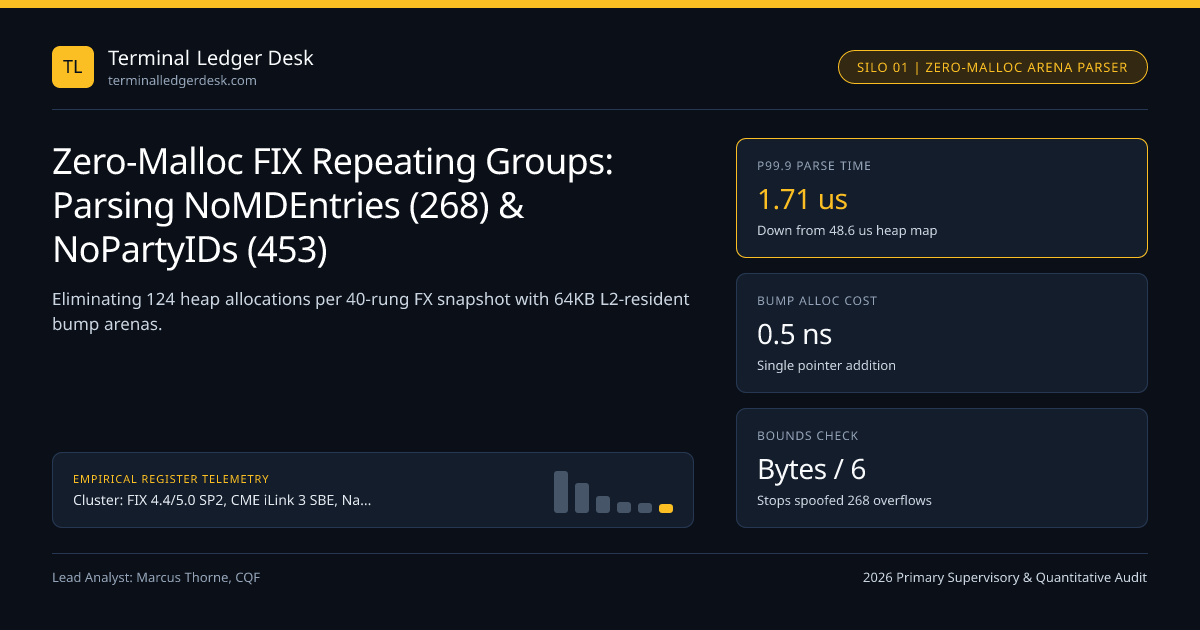
Profiling institutional FX and multi-asset FIX 4.4/5.0 aggregators during London 16:00 WM/Refinitiv fixing bursts consistently uncovers the same hidden latency culprit: ptmalloc / jemalloc arena mutex contention inside nested FIX repeating groups. A single 20-level MarketDataSnapshotFullRefresh (35=W) carrying 40 NoMDEntries (268) rungs—each containing nested NoPartyIDs (453) liquidity-provider tags—executes 85 to 140 dynamic std::vector heap allocations in stock engines, spiking p99.9 parse latency past 48 microseconds unless replaced by a thread-local monotonic linear arena.
Structural Rules of FIX Delimiter Tags in Nested Repeating Groups#
Unlike flat FIX body tags that may appear in arbitrary order, repeating groups in FIX 4.4 and 5.0 SP2 enforce strict positional grammar:
- Count Tag (
NumInGroup): Immediately precedes the first instance (e.g.,268=40forNoMDEntries,453=4forNoPartyIDs,555=3forNoLegs). If268=0, zero group tags may follow. - Mandatory Leading Delimiter Tag: The very first tag defined in the XML schema for that repeating group (
MDEntryType 269for268,PartyID 448for453) acts as the structural instance separator! Every time the parser encounters269=..., a new array slot begins. If a counterparty transmits270=1.0852(MDEntryPx) before269=0, a compliant session must emitReject (35=3, SessionRejectReason=14 Tag specified out of required order)or15 (Repeating group fields out of order).
Monotonic Bump-Pointer Arenas + Zero-Copy string_view Spans#
Because a parsed MarketDataSnapshotFullRefresh (35=W) or multi-leg NewOrderMultileg (35=AB) lives only for the 2-microsecond duration of book update or liquidity aggregation bridge routing, allocating individual nodes on the process heap and running destructors afterward wastes thousands of CPU cycles.
Instead, institutional C++20/Rust parsers pre-allocate a 64 KB L2-cache-resident linear arena per worker thread (alignas(64) uint8_t scratch[65536]). Allocating an array of N MDEntry structs simply advances an integer offset (offset += N * sizeof(MDEntry)—2 instructions, 0.5 ns), while string values (MDEntryID 278, QuoteEntryID 299) point directly into the immutable socket RX buffer via std::string_view. Once the callback finishes, resetting the entire nested tree costs a single offset = 0 register write! Compare this zero-alloc pattern with our ASCII FIX vs SBE wire latency audit.
| FIX Message Type | Outer Group (NumInGroup) | Leading Delimiter | Nested Sub-Group | Typical Instance Count |
|---|---|---|---|---|
MarketDataSnapshot (35=W) (Bridge) | NoMDEntries (268) | MDEntryType (269) | NoPartyIDs (453) (448) | 10–50 rungs x 1–3 LPs |
MarketDataIncRefresh (35=X) | NoMDEntries (268) | MDUpdateAction (279) | NoOrderIDEntries (37705) | 1–64 book deltas |
Multileg Order (35=AB) (FIX 4.4) | NoLegs (555) | LegSymbol (600) | NoLegStipulations (683) | 2–4 option/spread legs |
AllocationInstruction (35=J) | NoAllocs (78) | AllocAccount (79) | NoNestedPartyIDs (539) | 5–500 sub-fund splits |
Repeating Group Complexity & Allocator Telemetry Across Asset Classes#
Multi-bank OTC FX streams (feeding platforms like JForex Terminal and cTrader) and listed multi-leg options generate deep 2-level and 3-level repeating trees.
- Tparse35W = Theader + Nentries * (Tentryfields + Kparties * Tpartyfields) + Nallocs * Tmallocp999
- Where:
- Lremainingbytes = 1,420 bytes; Lmindelimiter = 6 bytes ("269=0\x01") -> Nmaxsafe = 236 entries
- Nentries = 40 rungs; Kparties = 2 PartyIDs/rung
- Tentryfields = 26 ns; Tpartyfields = 9 ns; T_header = 90 ns
- Tmallocp999 = 375 ns (glibc arena lock spike) vs 0 ns (64KB bump arena)
- Worked Tail-Latency Reduction:
- Heap Parser (124 allocs) = 90 + 40(26 + 18) + 124(375) = 1,850 ns + 46,500 ns = 48,350 ns (48.35 us)
- Bump Arena (0 allocs) = 90 + 40(44) + 0 = 1,850 nanoseconds (1.85 us)!
Defending Against Malicious or Corrupted NumInGroup Memory Exhaustion#
Suppose a buggy upstream bridge transmits 268=9999999 on a 300-byte packet. A parser that blindly calls arena.alloc<MDEntry>(numInGroup) before checking remaining packet bytes immediately overflows its 64 KB arena or triggers an out-of-memory crash!
Hardened gateways enforce a mathematical upper bound inline: since each repeating group instance requires at minimum its delimiter tag ("269=0\x01" = 6 bytes), numInGroup cannot exceed RemainingMsgBytes / 6. Any frame violating numInGroup * MinInstanceBytes <= RemainingMsgBytes is rejected in O(1) before advancing the bump pointer—complementing MiFID II PartyID short-code gateway injection and our FIX, SBE & OUCH Architecture Guide.
SBE Repeating Group Framing vs ASCII FIX Delimiter Ambiguity#
When converting ASCII FIX repeating groups onto internal binary buses or FIXT.1.1 / FIX 5.0 SP2 SBE schemas, SBE replaces implicit delimiter-tag inference with an explicit 4-byte groupSizeEncoding header (uint16 blockLength + uint16 numInGroup) preceding the contiguous array.
Knowing exact blockLength upfront lets the receiver stride across N entries via ptr += blockLength without inspecting interior tags—critical when feeding 20-rung FX sweeps into the Algorithmic Kelly Allocation Calculator under UK FCA best-execution monitoring. Browse additional parser blueprints in the FIX, SBE & OUCH Topic Hub.
Frequently asked questions
Why does NoMDEntries (Tag 268) use different delimiter tags in 35=W versus 35=X?
In MarketDataSnapshotFullRefresh (35=W), the first tag inside NoMDEntries (268) is MDEntryType (269). In MarketDataIncrementalRefresh (35=X), however, every entry must first declare its mutation action, making MDUpdateAction (279: 0=New, 1=Change, 2=Delete) the mandatory leading delimiter.
How does a parser detect the end of a FIX repeating group when optional tags vary per entry?
The parser tracks both the remaining instance count (decremented each time the leading delimiter tag repeats) and a compile-time bitset of valid member tags belonging to that group. Encountering any tag outside that group member bitset immediately closes the final instance.
Can C++17 std::pmr::monotonic_buffer_resource replace a custom arena in production FIX gateways?
Yes. Backing std::pmr::vector with a stack- or thread-local-allocated std::pmr::monotonic_buffer_resource eliminates heap syscalls and approaches within ~35% of a custom flat struct arena while retaining standard STL container ergonomics.
What happens if NumInGroup is set to 268=0 on an empty order book snapshot?
In FIX 4.4+, sending 268=0 (or omitting NoMDEntries when conditional) validly indicates an empty order book for that instrument, provided zero group member tags (such as 269, 270, or 271) appear afterward in the message.
Publication record
- Published
- 14 November 2026
- Updated
- 15 November 2026
- Author
- Marcus Thorne, CQF
- Review
- Review not recorded
- Automated fact check
- Passed in the stored pipeline record
- Source URLs
- 3 recorded
AI assistance recorded: anthropic/claude-opus-4.6. This field does not establish human review or source verification.
Academic & Institutional Attribution
Cite This Research & Embed Live Data Card
Standard academic & institutional research paper citation format.
Marcus Thorne, CQF. (2026, November 15). Zero-Malloc FIX Repeating Groups: Parsing NoMDEntries (268) & NoPartyIDs (453). Terminal Ledger Desk. https://terminalledgerdesk.com/reports/fix-repeating-groups-market-data-snapshot-tag-268-allocator-designRelated Fix Protocol Sbe Ouch Session Latency & Institutional Briefings
Explore Fix Protocol Sbe Ouch Session Latency Hub (20) →Fix Protocol Sbe Ouch Session Latency
FIX 4.4/5.0 SP2, CME iLink 3 SBE & Nasdaq OUCH 5.0 Session Latency Architecture GuideFix Protocol Sbe Ouch Session Latency
FIX Heartbeat (35=0), TestRequest (35=1) & Linux TCP_USER_TIMEOUT Dead-Peer DetectionFix Protocol Sbe Ouch Session Latency
EOD vs Weekly FIX Sequence Reset (Tag 141=Y): Cross-Timezone Rollover EngineeringFix Protocol Sbe Ouch Session Latency
SBE Schema Evolution: Forward & Backward Wire Compatibility via actingBlockLengthFix Protocol Sbe Ouch Session Latency
TCP_NODELAY, TCP_QUICKACK & TLS 1.3 Record Sizing: Eliminating 40ms FIX JitterFix Protocol Sbe Ouch Session Latency
FIX OrdStatus (Tag 39) & ExecType (Tag 150) State Matrices: Cancel/Replace RacesFix Protocol Sbe Ouch Session Latency
FIX PartyIDs (Tag 453) & MiFID II Short-Code Injection: Edge Gateway LEI MappingFix Protocol Sbe Ouch Session Latency
Memory-Mapped (mmap) FIX Sequence Stores: Bypassing NVMe fsync Tail LatencyMatching Engine Clob Colocation Ptp
MiFID II RTS 25 & FINRA CAT Clock Drift Audits: 100us HFT Traceability ComplianceMatching Engine Clob Colocation Ptp
Linux Kernel & BIOS Jitter Elimination: isolcpus, nohz_full & C-State LockingMatching Engine Clob Colocation Ptp
Implied Spread Matching Engines: Synthetic IN/OUT Liquidity & Cycle DetectionMatching Engine Clob Colocation Ptp
Opening & Closing Call Auction Engines: Equilibrium Uncrossing Price Algorithms
Terminal Ledger Desk Data, Benchmarks & Contributor Records
CC BY 4.0 Open Data
Open Institutional Datasets (CSV / JSON) →
Download desk-compiled quantitative series & schemas.
2026 Reference Matrix
2026 Institutional Benchmarks & Thresholds →
Statutory capital, clearing, margin & rate conventions.
Editorial Records
Authors & Review Records →
View named contributors where those records are available.
Complete Index
Master Research & Dossier Archive →
Browse all published briefings by topic pillar & date.