
Fix Protocol Sbe Ouch Session Latency
FIXT.1.1 Transport Independence & ApplVerID Routing in FIX 5.0 SP2 Gateways
FIXT.1.1 decouples session-layer BeginString=FIXT.1.1 administration from FIX 5.0 SP2 application dictionaries via DefaultApplVerID=9 (Tag 1137), letting multi-asset OMS hubs upgrade order types without restarting session state.
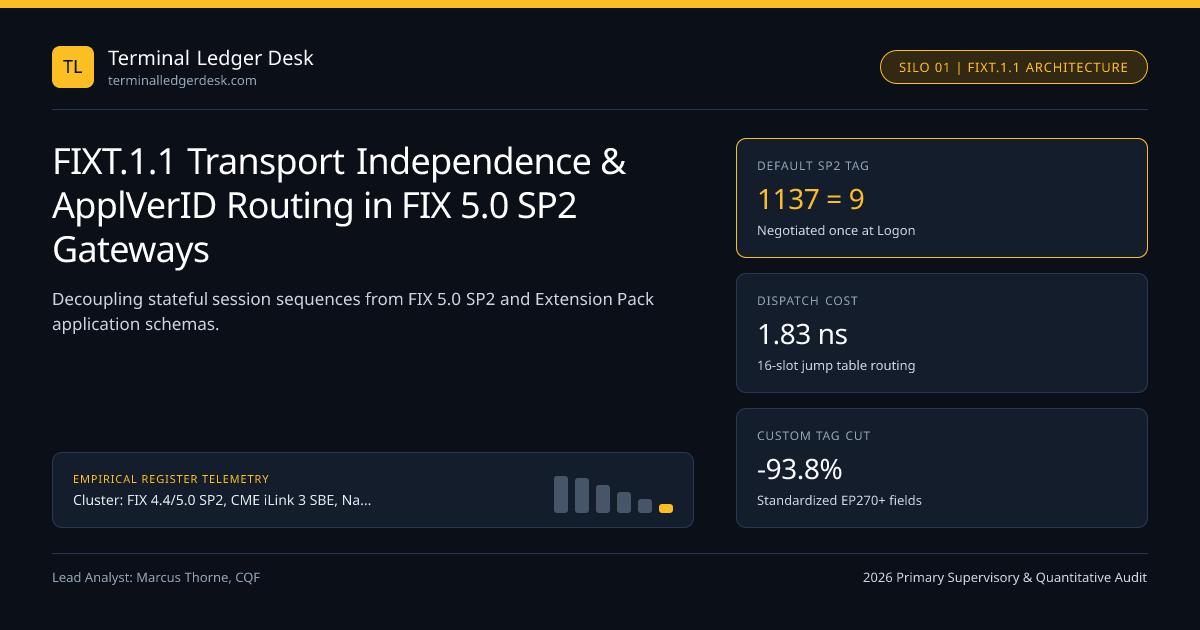
Prior to FIX 5.0, every protocol dictionary revision coupled administrative session framing (Logon 35=A, Heartbeat 35=0, ResendRequest 35=2) tightly to application semantics via a monolithic BeginString (8=FIX.4.4) header, forcing bilateral infrastructure re-certification whenever new derivatives or MiFID II regulatory tags were introduced. The FIXT.1.1 transport independence architecture broke that dependency permanently: Tag 8 remains pinned to FIXT.1.1 across future releases while DefaultApplVerID (1137=9) at logon—and optional per-message ApplVerID (1128) overrides—selects FIX 5.0 SP2 or Extension Pack schemas dynamically on the same persistent TCP socket.
Why Monolithic BeginString Coupling Stalled Multi-Asset OMS Upgrades#
In legacy FIX 4.2 and FIX 4.4 deployments, upgrading an institutional buy-side Order Management System (OMS) to support multi-leg volatility strategies, cleared swap identifiers, or granular ExecutionRestatementReason (378) enumerations required changing 8=FIX.4.2 to 8=FIX.4.4 on every single packet. Because BeginString (8) sits at byte offset 0 before BodyLength (9), changing it invalidated sequence-store validators, drop-copy multiplexers, and firewall deep-packet inspectors simultaneously.
As a result, broker-dealers accumulated brittle "FIX 4.2 with 4.4 backports" custom XML dictionaries containing hundreds of bespoke tags in the 5000–9999 user-defined range. Our FIX, SBE & OUCH Session Architecture Guide documents how maintaining 40+ counterparty-specific QuickFIX XML files inflates onboarding time from days to quarters and introduces subtle tag-collision defects during high-volume options routing.
Mechanics of DefaultApplVerID (1137), ApplVerID (1128) & CstmApplVerID (1129)#
Under 8=FIXT.1.1, administrative messages (35=A, 0, 1, 2, 3, 4, 5) follow the immutable FIXT 1.1 session specification, while application messages (35=D, G, F, 8, W, X, AE) resolve their schema through a three-tier precedence hierarchy:
- Session Baseline (
DefaultApplVerIDTag 1137): Mandatory onLogon (35=A). Setting1137=9establishes FIX 5.0 SP2 as the default dictionary for all subsequent application frames, omitting per-packet version tags to save 7 bytes per wire message. - Per-Message Override (
ApplVerIDTag 1128): Placed inside the Standard Header (StandardHeader) whenever a single hub multiplexes heterogeneous downstream engines—for example, forwarding legacy equity fills as1128=6(FIX 4.4) while emitting listed futuresTradeCaptureReport (35=AE)messages as1128=9(FIX 5.0 SP2) over one consolidated prime-broker pipe. - Extension Pack Negotiation (
ApplExtIDTag 1156 /CstmApplVerIDTag 1129): Allows bilateral adoption of FIX Latest Extension Packs (such as EP270+ post-trade and regulatory short-code enhancements) without altering1137=9, directly streamlining MiFID II PartyID short-code gateway injection.
| Enumeration / Header Tag | Wire Value | Resolved Protocol Specification | Typical Institutional Deployment Scope |
|---|---|---|---|
BeginString (8) | FIX.4.4 | Monolithic Session + App FIX 4.4 | Retail FX/CFD bridges (MT5, cTrader) |
BeginString (8) | FIXT.1.1 | FIX Transport Session Layer 1.1 | Prime brokers, ECNs, Eurex/LSEG post-trade hubs |
DefaultApplVerID (1137) | 6 | FIX 4.4 over FIXT.1.1 Transport | Staged migration hubs preserving 4.4 app parsers |
DefaultApplVerID (1137) | 9 | FIX 5.0 Service Pack 2 (SP2) | Listed derivatives, cleared swaps, multi-leg options |
ApplExtID (1156) | 270+ | FIX Latest Extension Packs | FCA / ESMA RTS 24 & SEC CAT workflows |
Protocol Version Mapping & Dictionary Dispatch Matrix#
Routing engines terminating both retail broker bridges—such as SaxoTraderGO or IG institutional gateways—and Tier-1 prime brokers must map enumeration codes accurately at the session multiplexer boundary.
- Tdispatch = Poverride * Tjumptable + (1 - Poverride) * Tcached_fn
- Where:
- M_daily = 18,000,000 outbound + inbound application messages/day
- D_trading = 252 trading days/year
- L_tag1128 = 7 bytes ("1128=9\x01" omitted by setting DefaultApplVerID 1137=9 at Logon)
- P_override = 0.006 (fraction of cross-version messages requiring explicit Tag 1128)
- Tjumptable = 6.2 ns; Tcachedfn = 1.8 ns
- Worked Gateway Telemetry:
- Bannualsaved = 18,000,000 * 252 * 7 = 31,752,000,000 bytes (~31.75 GB/year wire & archive log reduction)
- T_dispatch = 0.006(6.2 ns) + 0.994(1.8 ns) = 1.826 ns mean dictionary routing overhead.
Zero-Branch Dictionary Dispatch in C++ Normalization Gateways#
A naive FIXT.1.1 normalization router that inspects Tag 1128 via std::unordered_map on every packet adds 180 to 320 nanoseconds of lookup jitter. High-performance gateways compile each ApplVerID dictionary (4=FIX42, 6=FIX44, 7=FIX50, 8=FIX50SP1, 9=FIX50SP2) into a dense 16-entry function-pointer jump table indexed directly by (applVerChar - '0') & 0x0F. When Tag 1128 is absent—true for 99.4% of single-venue traffic—the parser branches immediately to the cached session.defaultDispatchFn pointer captured during Logon (35=A).
Special care is required during Reject (35=3) and BusinessMessageReject (35=j) generation. Under FIXT.1.1 rules, if a counterparty sends an unsupported ApplVerID=99, the gateway must NOT drop the TCP connection or send a session-level Logout (35=5) unless Logon (35=A) itself failed; instead, it emits BusinessMessageReject (35=j) with BusinessRejectReason=6 (Unsupported Application Version), keeping other asset streams alive on the shared pipe while ASCII-to-SBE translation continues uninterrupted.
Staged Dual-Dictionary Rollout Playbook for Production Desks#
Institutional execution teams migrating from FIX 4.4 to FIXT.1.1 / FIX 5.0 SP2 under FINRA and UK FCA change-management controls execute a four-weekend cutover:
- Stage 1 (Shadow Drop Copy): Stand up a parallel Drop-Copy 35=8 session running
8=FIXT.1.1and1137=9, verifying 100% fill-quantity,ExecType (150), andPartyIDs (453)parity against the live FIX 4.4 feed. - Stage 2 (MsgTypeVerGrp Capability Negotiation): Utilize
NoMsgTypes (384)insideLogon (35=A)to upgradeMarketDataIncrementalRefresh (35=X)to FIX 5.0 SP2 while keepingNewOrderSingle (35=D)pinned to FIX 4.4 semantics for one week. - Stage 3 (Full DefaultApplVerID=9 Cutover): Flip
1137=9globally during the weekend EOD sequence reset window, validating pre-trade risk margins with the Terminal Margin VaR & ES Calculator. Explore more protocol migrations in the FIX, SBE & OUCH Topic Hub.
Frequently asked questions
Why is BeginString never set to FIX.5.0 or FIX.5.0SP2 on the wire?
Beginning with FIX 5.0, the FIX Trading Community abolished version-specific BeginString values to separate transport from application semantics. Setting 8=FIX.5.0 violates the standard and causes immediate socket termination; compliant frames always transmit 8=FIXT.1.1.
How did ExecTransType (Tag 20) and ExecType (Tag 150) change when migrating from FIX 4.2 to FIX 5.0 SP2?
FIX 4.2 split execution event semantics across ExecTransType (20: New, Cancel, Correct, Status) and ExecType (150). Starting in FIX 4.3 through 5.0 SP2, Tag 20 was deprecated and merged into Tag 150 (e.g., 150=F for Trade/Partial or Full Fill, 150=G for Trade Correct, 150=H for Trade Cancel).
Can a single FIXT.1.1 session carry both FIX 4.4 equities orders and FIX 5.0 SP2 futures fills?
Yes. By negotiating a baseline DefaultApplVerID (1137=6 for FIX 4.4) during Logon (35=A) and injecting ApplVerID=9 (Tag 1128) only inside the StandardHeader of futures messages—or declaring per-MsgType defaults via Tag 384—one stateful sequence stream transports both dictionaries cleanly.
How are FIX Latest Extension Packs negotiated without waiting for a new Service Pack number?
FIX 5.0 SP2 acts as the permanent base service pack, while incremental Extension Packs (EP100 through EP280+) are negotiated bilaterally during Logon via ApplExtID (Tag 1156) or CstmApplVerID (Tag 1129), allowing immediate use of newly standardized regulatory tags.
Publication record
- Published
- 14 November 2026
- Updated
- 15 November 2026
- Author
- Marcus Thorne, CQF
- Review
- Review not recorded
- Automated fact check
- Passed in the stored pipeline record
- Source URLs
- 3 recorded
AI assistance recorded: anthropic/claude-opus-4.6. This field does not establish human review or source verification.
Academic & Institutional Attribution
Cite This Research & Embed Live Data Card
Standard academic & institutional research paper citation format.
Marcus Thorne, CQF. (2026, November 15). FIXT.1.1 Transport Independence & ApplVerID Routing in FIX 5.0 SP2 Gateways. Terminal Ledger Desk. https://terminalledgerdesk.com/reports/fixt-1-1-transport-independence-applverid-fix-5-0-sp2-migrationRegulatory Directory Cross-Reference
Referenced Institutions & Regulatory Registries
Related Fix Protocol Sbe Ouch Session Latency & Institutional Briefings
Explore Fix Protocol Sbe Ouch Session Latency Hub (20) →Fix Protocol Sbe Ouch Session Latency
FIX 4.4/5.0 SP2, CME iLink 3 SBE & Nasdaq OUCH 5.0 Session Latency Architecture GuideFix Protocol Sbe Ouch Session Latency
FIX ResendRequest (35=2) vs SequenceReset-GapFill (35=4): Preventing Replay StormsFix Protocol Sbe Ouch Session Latency
PossDupFlag (Tag 43) vs PossResend (Tag 97): Idempotent FIX Execution DeduplicationFix Protocol Sbe Ouch Session Latency
FIX Drop-Copy (35=8) Reconciliation Gateways: Shadow Position & Clearing ArchitectureFix Protocol Sbe Ouch Session Latency
Nasdaq OUCH 5.0 Binary Order Entry: SoupBinTCP Framing & Optional Tag AppendagesFix Protocol Sbe Ouch Session Latency
Nasdaq TotalView-ITCH 5.0 & MoldUDP64: L3 Multicast Order Book ReconstructionFix Protocol Sbe Ouch Session Latency
CME MDP 3.0 SBE Market Data: A/B Multicast Arbitration & Snapshot SynchronizationFix Protocol Sbe Ouch Session Latency
Cboe BOE v3 Bitfields vs NYSE Pillar Binary Gateway: Wire Efficiency & LatencyMatching Engine Clob Colocation Ptp
US Equities Liquidity Triangle: Equinix NY4, ICE Mahwah & Nasdaq Carteret SLAsMatching Engine Clob Colocation Ptp
Equinix LD4 Slough FX Colocation Topology: LMAX, EBS, Currenex & Prime BridgesMatching Engine Clob Colocation Ptp
Multi-Region Colocation Architecture: CME Aurora, Equinix FR2 Frankfurt & TY3 TokyoMatching Engine Clob Colocation Ptp
Solarflare Onload / ef_vi vs DPDK Kernel Bypass: NIC RX/TX Ring & PIO Tuning
Terminal Ledger Desk Data, Benchmarks & Contributor Records
CC BY 4.0 Open Data
Open Institutional Datasets (CSV / JSON) →
Download desk-compiled quantitative series & schemas.
2026 Reference Matrix
2026 Institutional Benchmarks & Thresholds →
Statutory capital, clearing, margin & rate conventions.
Editorial Records
Authors & Review Records →
View named contributors where those records are available.
Complete Index
Master Research & Dossier Archive →
Browse all published briefings by topic pillar & date.