
Fix Protocol Sbe Ouch Session Latency
Nasdaq OUCH 5.0 Binary Order Entry: SoupBinTCP Framing & Optional Tag Appendages
Nasdaq OUCH 5.0 replaces fixed-width OUCH 4.2 message bloat with a compact 49-byte Enter Order root block plus tagged binary appendages over SoupBinTCP, keeping Carteret round-trip acknowledgements below 14 microseconds.
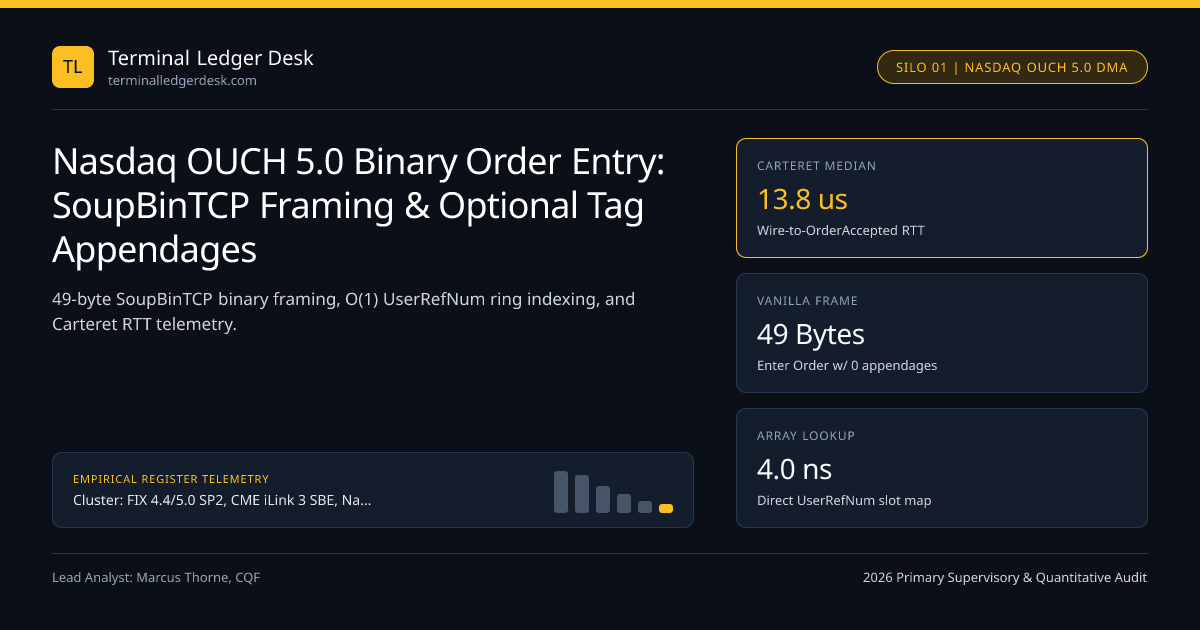
Direct Market Access gateways colocated inside the Nasdaq Carteret data center achieve sub-14-microsecond wire-to-acknowledgement round trips by routing orders over OUCH 5.0 rather than RASH or ASCII FIX. Introduced to modernize legacy OUCH 4.2 without sacrificing deterministic parsing, OUCH 5.0 couples a fixed 49-byte Enter Order (Type O) root structure with compact length-prefixed optional appendages framed inside SoupBinTCP, eliminating unused pegging and display-reserve bytes on plain vanilla limit sweeps.
SoupBinTCP Framing and Monotonic UserRefNum Identification#
Unlike stateful tag-value FIX 4.4 execution ports where alphanumeric ClOrdID (11) strings up to 20 characters are hashed at the gateway, Nasdaq OUCH 5.0 identifies outbound orders via a strictly increasing 4-byte unsigned big-endian integer UserRefNum. Every outbound packet is encapsulated inside a 3-byte SoupBinTCP header consisting of a 2-byte big-endian payload length and a 1-byte packet type (U for Unsequenced Data from client, S for Sequenced Data from Nasdaq).
Because SoupBinTCP treats client-to-exchange U packets as unsequenced fire-and-forget TCP frames while strictly sequencing exchange-to-client S acknowledgements (Accepted, Executed, Canceled), a reconnecting EMS never replays stale outbound orders after a link drop. Instead, the client supplies its last processed inbound sequence number inside the SoupBinTCP Login Request (L) packet and reconciles open inventory against out-of-band FIX Drop Copy (35=8).
OUCH 5.0 Tagged Binary Appendages vs Legacy OUCH 4.2 Fixed Padding#
In OUCH 4.2, adding specialized equity instructions—such as Minimum Quantity, Peg Offset, Customer Type, or Discretionary Price—forced every single Enter Order message across the entire market to carry unused zero-filled columns. OUCH 5.0 solves this wire expansion by appending a 2-byte AppendageLength counter followed by compact [1B Length][1B Tag][Value] tuples only when needed.
For latency-critical top-of-book taking strategies inside Equinix NY4 and Carteret infrastructure, setting AppendageLength = 0 keeps the entire Enter Order frame inside a single 64-byte CPU cache line. As shown in our FIX, SBE & OUCH Session Architecture Guide, big-endian BSWAP instructions on 4-byte Shares and 8-byte Price (10^-4 implied scale) cost less than 3 nanoseconds on modern x86-64 cores.
| Nasdaq Gateway Port | Framing & Encoding | Outbound Routing (ROUT) | Median Carteret RTT | Ideal Institutional Use Case |
|---|---|---|---|---|
| OUCH 5.0 Native (Equinix Carteret) | SoupBinTCP + Binary + Appendages | Direct book only (No away routing) | 13.8 us | Latency-sensitive HFT & SOR child sweeps |
| RASH Binary Port | SoupBinTCP + RASH Engine | Full away-market NMS routing & pegs | 48.0 us | Complex pegged orders & Reg NMS routing |
| Nasdaq FIX 4.2 / FIXT (FIX Standard) | ASCII SOH Tag-Value | Configurable RASH/Book | 69.5 us | Agency OMS & retail broker aggregators |
| Broker DMA Terminal (Colmex Pro 2.0) | Proprietary TCP -> Broker OUCH | Broker SOR managed | 450–1,800 us | Active equities desk execution |
Nasdaq Order Entry Protocol Comparison: OUCH 5.0 vs RASH vs FIX#
Selecting the wrong Nasdaq port type silently routes orders through secondary smart-routing hops inside Carteret, adding tens of microseconds of unnecessary internal queuing.
- Pricewire = round( Priceusd * 10,000 ) [uint64 Big-Endian]
- Where:
- Lethip_tcp = 14B Ethernet + 20B IPv4 + 20B TCP + 4B FCS = 58 bytes
- L_soupbin = 3 bytes (2B packet length + 1B packet type "U")
- Louchroot = 49 bytes (Type "O", UserRefNum, Side, Shares, Symbol[8], Price, TIF, Display...)
- m = Number of optional appendages (e.g., MinQty Tag=4B, CustomerType Tag=1B)
- Worked Wire Serialization Calculation (Vanilla IOC Sweep vs 2-Appendage Peg):
- 1) Vanilla IOC Limit Order (m = 0):
- L_total = 58 + 3 + 49 + 0 = 110 bytes -> 880 bits @ 10GbE = 88.0 ns serialization time.
- 2) Order with MinQty (4B) + CustomerType (1B) (m = 2):
- L_total = 110 + (2 + 4) + (2 + 1) = 119 bytes -> 95.2 ns serialization time.
Handling Modify/Replace UserRefNum Chaining Under Burst Contention#
Modifying order quantity or limit price in OUCH 5.0 (Replace Order Type U) requires passing both ExistingUserRefNum and a brand-new monotonically higher ReplacementUserRefNum. Engines feeding OUCH from LMAX Disruptor ring buffers pre-allocate an indexed ring array keyed by UserRefNum & 0x00FFFFFF so inbound Replaced (U) or Cancel Reject (I) callbacks resolve in O(1) array indexing (~4 ns) with zero hash collisions.
note that OUCH intentionally delegates away complex smart-routing (ROUT, SCAN) and pegged order re-pricing in several configurations; desks needing native exchange outbound routing fall back to RASH ports while keeping pure liquidity-taking sweeps on OUCH 5.0 paired with TotalView-ITCH 5.0 multicast book feeds.
Production Socket & Byte-Order Certification Checklist#
Before promoting an OUCH 5.0 gateway into live US cash equity trading under SEC and FINRA market-access controls, verify three low-level invariants:
- Network Byte Order (
htonl/__builtin_bswap64): Unlike little-endian CME SBE, Nasdaq OUCH 5.0 transmits all integers in big-endian network order; forgetting byte-swap intrinsics turns a 100-share order (0x00000064) into1,677,721,600shares, tripping inline fat-finger limits immediately. - 1-Second SoupBinTCP Heartbeats: Client
Rand ServerHheartbeats fire every 1 second; pair them withTCP_NODELAYas analyzed in TCP Nagle and delayed-ACK gateway jitter. - Pre-Trade Capital Sizing: Bound per-port maximum order notional using the Terminal Margin VaR & ES Calculator and explore more binary specs in the FIX, SBE & OUCH Topic Hub.
Frequently asked questions
Why does Nasdaq OUCH 5.0 require a new UserRefNum on every Replace Order (Type U) request?
Assigning a fresh monotonically increasing ReplacementUserRefNum alongside ExistingUserRefNum allows both the exchange and the client EMS to track multiple rapid in-flight cancel/replace chains unambiguously without race conditions between consecutive modifications.
Can a trading desk submit Reg NMS intermarket sweep or away-routed orders over OUCH 5.0?
OUCH 5.0 supports Intermarket Sweep Orders (ISO) directed strictly at the local Nasdaq book, but it deliberately bypasses the RASH smart-routing layer. Orders requiring Nasdaq itself to route unfilled shares to NYSE or Cboe must use RASH or FIX ports.
How does SoupBinTCP recover missed Execution messages after a brief TCP disconnect?
Every exchange-to-client Sequenced Data (Type S) packet increments the session sequence counter by 1. Upon reconnecting within the same trading day, the client sends its next expected sequence number in the SoupBinTCP Login packet, and Nasdaq streams all missed Type S fills immediately.
What integer byte order and price precision does Nasdaq OUCH 5.0 use on the wire?
All multi-byte numeric fields in SoupBinTCP and OUCH 5.0 use unsigned big-endian (network) byte order, and prices are encoded as 8-byte integers with 4 implied decimal places (e.g., $185.2500 is transmitted as integer 1,852,500).
Publication record
- Published
- 14 November 2026
- Updated
- 14 November 2026
- Author
- Marcus Thorne, CQF
- Review
- Review not recorded
- Automated fact check
- Passed in the stored pipeline record
- Source URLs
- 3 recorded
AI assistance recorded: anthropic/claude-opus-4.6. This field does not establish human review or source verification.
Academic & Institutional Attribution
Cite This Research & Embed Live Data Card
Standard academic & institutional research paper citation format.
Marcus Thorne, CQF. (2026, November 14). Nasdaq OUCH 5.0 Binary Order Entry: SoupBinTCP Framing & Optional Tag Appendages. Terminal Ledger Desk. https://terminalledgerdesk.com/reports/nasdaq-ouch-5-0-binary-order-entry-appendage-tags-tail-latencyRelated Fix Protocol Sbe Ouch Session Latency & Institutional Briefings
Explore Fix Protocol Sbe Ouch Session Latency Hub (20) →Fix Protocol Sbe Ouch Session Latency
FIX 4.4/5.0 SP2, CME iLink 3 SBE & Nasdaq OUCH 5.0 Session Latency Architecture GuideFix Protocol Sbe Ouch Session Latency
Nasdaq TotalView-ITCH 5.0 & MoldUDP64: L3 Multicast Order Book ReconstructionFix Protocol Sbe Ouch Session Latency
CME MDP 3.0 SBE Market Data: A/B Multicast Arbitration & Snapshot SynchronizationFix Protocol Sbe Ouch Session Latency
Cboe BOE v3 Bitfields vs NYSE Pillar Binary Gateway: Wire Efficiency & LatencyFix Protocol Sbe Ouch Session Latency
FIX/FAST Protocol PMAP & Stop-Bit Decoding: Why Exchanges Migrated to SBEFix Protocol Sbe Ouch Session Latency
Zero-Malloc FIX Repeating Groups: Parsing NoMDEntries (268) & NoPartyIDs (453)Fix Protocol Sbe Ouch Session Latency
FIX Heartbeat (35=0), TestRequest (35=1) & Linux TCP_USER_TIMEOUT Dead-Peer DetectionFix Protocol Sbe Ouch Session Latency
EOD vs Weekly FIX Sequence Reset (Tag 141=Y): Cross-Timezone Rollover EngineeringMatching Engine Clob Colocation Ptp
FIFO Price-Time vs Pro-Rata Matching Algorithms: CME Split, LMM & TOP MechanicsMatching Engine Clob Colocation Ptp
US Equities Liquidity Triangle: Equinix NY4, ICE Mahwah & Nasdaq Carteret SLAsMatching Engine Clob Colocation Ptp
Equinix LD4 Slough FX Colocation Topology: LMAX, EBS, Currenex & Prime BridgesMatching Engine Clob Colocation Ptp
Multi-Region Colocation Architecture: CME Aurora, Equinix FR2 Frankfurt & TY3 Tokyo
Terminal Ledger Desk Data, Benchmarks & Contributor Records
CC BY 4.0 Open Data
Open Institutional Datasets (CSV / JSON) →
Download desk-compiled quantitative series & schemas.
2026 Reference Matrix
2026 Institutional Benchmarks & Thresholds →
Statutory capital, clearing, margin & rate conventions.
Editorial Records
Authors & Review Records →
View named contributors where those records are available.
Complete Index
Master Research & Dossier Archive →
Browse all published briefings by topic pillar & date.