
Fix Protocol Sbe Ouch Session Latency
CME MDP 3.0 SBE Market Data: A/B Multicast Arbitration & Snapshot Synchronization
CME MDP 3.0 broadcasts SBE-encoded Multi-Depth and Order-by-Order updates across redundant UDP multicast Feed A and Feed B channels, using channel MsgSeqNum (34) and per-security RPTSeq (83) counters for lossless book recovery.
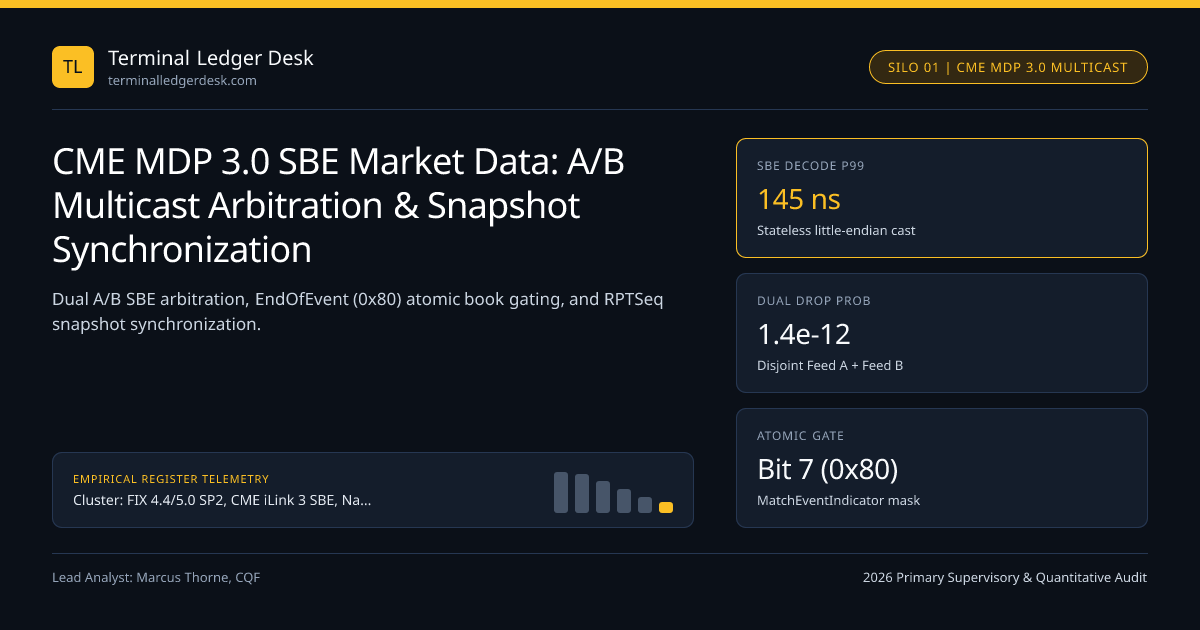
Derivative trading engines colocated inside CME Aurora DC3 reconstruct E-mini S&P 500 (ES), SOFR, and US Treasury futures books from Market Data Platform (MDP 3.0) UDP multicast feeds encoded in Simple Binary Encoding (SBE). Unlike legacy FIX/FAST streams where losing a single UDP datagram corrupted stateful stop-bit decoders across an entire channel, MDP 3.0 combines stateless little-endian SBE frames with dual-fabric Feed A/B sequence arbitration (MsgSeqNum Tag 34) and per-instrument repeat sequences (RPTSeq Tag 83) to keep Market-By-Order (MBO) and Market-By-Price (MBP) books continuously synchronized.
MDP 3.0 Packet Header Layout and Feed A / Feed B Sequence Arbitration#
Every CME MDP 3.0 UDP datagram begins with a 12-byte binary packet header (4-byte uint32 MsgSeqNum + 8-byte uint64 SendingTime in nanoseconds) followed by one or more length-prefixed SBE messages (MDIncrementalRefreshBook46, MDIncrementalRefreshOrderBook47, MDIncrementalRefreshTradeSummary48). Both Feed A and Feed B emit byte-for-byte identical payloads bearing the exact same MsgSeqNum across physically separate switch fabrics inside CME Aurora colocation.
In live Aurora packet captures, Feed A leads Feed B on roughly 54% of packets while Feed B leads by 40 to 900 nanoseconds on the remaining 46% depending on internal switch cross-traffic. A deterministic kernel-bypass receiver maintains a single uint32_t nextChannelSeq variable: whichever NIC port delivers MsgSeqNum == nextChannelSeq first immediately passes the SBE payload to the book builder and increments nextChannelSeq, causing the trailing duplicate from the opposite feed to be discarded in 3 CPU cycles.
Harmonizing Market-By-Order (MBO) and Implied Market-By-Price (MBP) Books#
CME futures channels publish both explicit resting orders (MBO keyed by 64-bit OrderID Tag 37 and MDOrderPriority Tag 37707) and synthetic implied liquidity generated by the Globex matching engine across calendar spreads and butterflies. Because implied orders lack individual participant OrderID tickets, CME delivers implied top-2-level quantities via MBP repeating groups (MDUpdateAction: 0=New, 1=Change, 2=Delete, MDPriceLevel 1023: 1..2).
Execution engines feeding CME iLink 3 SBE order entry maintain a unified composite price ladder per SecurityID (48) that sums explicit MBO queue quantities with implied MBP layer quantities, allowing strategies to compute exact fill probabilities before firing an aggressive sweep—as synthesized in our FIX, SBE & OUCH Session Architecture Guide.
| CME MDP 3.0 Feed Service | Transport Protocol | Primary SBE Templates | Sequence Key | Operational Role in Aurora EMS |
|---|---|---|---|---|
| Incremental Feed A & B (Aurora Standard) | Dual UDP Multicast | Book46, OrderBook47, Trade48 | Channel MsgSeqNum (34) + RPTSeq (83) | Primary sub-microsecond live book updates |
| Instrument Definition | Looped UDP Multicast | MDInstrumentDefinitionFuture54 | TotNumReports (911) loop | Pre-open SecurityID (48) & tick-size map |
| Market Recovery (MBO/MBP) | Looped UDP Multicast | SnapshotFullRefresh52 / OrderBook53 | LastMsgSeqNumProcessed (369) | Cold-start & large-gap point-in-time spin |
| Historical TCP Replay (FIX Messaging) | Unicast TCP Request | Logon + MsgSeqNum Range | Channel MsgSeqNum (<= 2,000 pkts) | Fast surgical fill-in when A & B drop <=2k pkts |
MDP 3.0 Recovery Feed Matrix: Incremental, Snapshot & Instrument Replay#
CME partitions market data recovery across four specialized multicast/TCP services per channel ID (e.g., Channel 310 for Equity Index Futures).
- ValidApply(SecurityID k) <=> (MsgRPTSeq[k] == Book_RPTSeq[k] + 1) AND ((MEI & 0x80) != 0 -> Publish)
- Where:
- PlossA = 1.2 * 10^-6 (1.2 dropped UDP datagrams per million during CPI microburst)
- PlossB = 1.2 * 10^-6 (independent redundant multicast switch plane)
- M_annual = 2.5 * 10^10 packets/year on Channel 310 (Equity Index Futures)
- Worked Dual-Fabric Reliability Calculation:
- Single-Feed Unrecovered Gaps/Year = 2.5 * 10^10 * (1.2 * 10^-6) = 30,000 book freezes/year (~119/day)
- Dual A/B Simultaneous Gaps/Year = 2.5 * 10^10 * (1.44 * 10^-12) = 0.036 events/year (1 every 27.7 years!).
Synchronizing SnapshotFullRefresh (W) Using LastMsgSeqNumProcessed (369)#
When an execution server cold-starts mid-session or experiences simultaneous A+B packet loss exceeding the 2,000-packet TCP Historical Replay window, it joins the Market Recovery (SnapshotFullRefresh52) multicast group while simultaneously queuing live Incremental A/B datagrams inside an LMAX Disruptor ring buffer.
Each SnapshotFullRefresh (35=W) frame carries LastMsgSeqNumProcessed (369) (the exact Incremental channel MsgSeqNum reflected in the snapshot) plus per-contract RPTSeq (83). Once every SecurityID on the channel has loaded a complete snapshot cycle, the engine drains its buffered Incremental ring: any incremental update for SecurityID K whose RPTSeq <= Snapshot.RPTSeq[K] is skipped as already baked into the snapshot, while RPTSeq == Snapshot.RPTSeq[K] + 1 transitions that contract seamlessly into real-time streaming.
Handling MatchEventIndicator (5799) Bitmasks to Prevent Crossed Books#
A subtle bug in naive MDP 3.0 parsers is firing trading signals mid-way through a multi-packet matching event, observing a momentarily crossed bid/ask spread! Suppose an aggressive 2,000-lot sweep clears 4 price levels across 85 resting orders, spanning three consecutive UDP datagrams.
CME stamps every incremental SBE message with an 8-bit MatchEventIndicator (Tag 5799) bitfield (Bit 0: LastTradeMsg, Bit 1: LastVolumeMsg, Bit 2: LastQuoteMsg, Bit 7: EndOfEvent). Compliant execution engines under CFTC and NFA risk supervision mutate internal book arrays on every frame but suppress alpha signal evaluation until Bit 7 (0x80 EndOfEvent) is set, ensuring strategies never trade on torn intermediate book states. Validate margin shock tolerances using the Terminal Margin VaR & ES Calculator and explore related codecs in ASCII FIX vs SBE zero-copy latency and the FIX, SBE & OUCH Topic Hub.
Frequently asked questions
Why does CME MDP 3.0 include both channel MsgSeqNum (34) and instrument RPTSeq (83)?
Channel MsgSeqNum (34) increments once per UDP packet across all ~200 instruments sharing a multicast channel, detecting wire drops immediately. Instrument RPTSeq (83) increments per individual SecurityID update, allowing clean per-contract alignment against looped SnapshotFullRefresh frames.
What happens if an execution engine evaluates trading signals before MatchEventIndicator EndOfEvent?
A single large aggressor order that sweeps multiple price levels often spans two or three UDP packets where trade summaries arrive before book-level deletions complete, making the best bid momentarily appear higher than the best ask until EndOfEvent=1 closes the atomic transaction.
How does Market-By-Order (MBO) priority work when a trader modifies order quantity on CME Globex?
Decreasing order quantity preserves the resting order MDOrderPriority (Tag 37707) queue position, whereas increasing quantity or changing limit price assigns a new higher MDOrderPriority integer, moving the order to the tail of that price level.
When should an MDP 3.0 engine use TCP Historical Replay instead of UDP Market Recovery snapshots?
Use TCP Historical Replay when both Feed A and Feed B miss a small contiguous burst of 1 to 2,000 packets, which repairs in ~3–5 ms. If the outage exceeds 2,000 packets or occurs on initial process boot, join the multicast SnapshotFullRefresh feed instead.
Publication record
- Published
- 14 November 2026
- Updated
- 14 November 2026
- Author
- Marcus Thorne, CQF
- Review
- Review not recorded
- Automated fact check
- Passed in the stored pipeline record
- Source URLs
- 3 recorded
AI assistance recorded: anthropic/claude-opus-4.6. This field does not establish human review or source verification.
Academic & Institutional Attribution
Cite This Research & Embed Live Data Card
Standard academic & institutional research paper citation format.
Marcus Thorne, CQF. (2026, November 14). CME MDP 3.0 SBE Market Data: A/B Multicast Arbitration & Snapshot Synchronization. Terminal Ledger Desk. https://terminalledgerdesk.com/reports/cme-mdp-3-0-sbe-incremental-refresh-channel-arbitration-recoveryRegulatory Directory Cross-Reference
Referenced Institutions & Regulatory Registries
Related Fix Protocol Sbe Ouch Session Latency & Institutional Briefings
Explore Fix Protocol Sbe Ouch Session Latency Hub (20) →Fix Protocol Sbe Ouch Session Latency
FIX 4.4/5.0 SP2, CME iLink 3 SBE & Nasdaq OUCH 5.0 Session Latency Architecture GuideFix Protocol Sbe Ouch Session Latency
Cboe BOE v3 Bitfields vs NYSE Pillar Binary Gateway: Wire Efficiency & LatencyFix Protocol Sbe Ouch Session Latency
FIX/FAST Protocol PMAP & Stop-Bit Decoding: Why Exchanges Migrated to SBEFix Protocol Sbe Ouch Session Latency
Zero-Malloc FIX Repeating Groups: Parsing NoMDEntries (268) & NoPartyIDs (453)Fix Protocol Sbe Ouch Session Latency
FIX Heartbeat (35=0), TestRequest (35=1) & Linux TCP_USER_TIMEOUT Dead-Peer DetectionFix Protocol Sbe Ouch Session Latency
EOD vs Weekly FIX Sequence Reset (Tag 141=Y): Cross-Timezone Rollover EngineeringFix Protocol Sbe Ouch Session Latency
SBE Schema Evolution: Forward & Backward Wire Compatibility via actingBlockLengthFix Protocol Sbe Ouch Session Latency
TCP_NODELAY, TCP_QUICKACK & TLS 1.3 Record Sizing: Eliminating 40ms FIX JitterMatching Engine Clob Colocation Ptp
MiFID II RTS 25 & FINRA CAT Clock Drift Audits: 100us HFT Traceability ComplianceMatching Engine Clob Colocation Ptp
Linux Kernel & BIOS Jitter Elimination: isolcpus, nohz_full & C-State LockingMatching Engine Clob Colocation Ptp
Implied Spread Matching Engines: Synthetic IN/OUT Liquidity & Cycle DetectionMatching Engine Clob Colocation Ptp
Opening & Closing Call Auction Engines: Equilibrium Uncrossing Price Algorithms
Terminal Ledger Desk Data, Benchmarks & Contributor Records
CC BY 4.0 Open Data
Open Institutional Datasets (CSV / JSON) →
Download desk-compiled quantitative series & schemas.
2026 Reference Matrix
2026 Institutional Benchmarks & Thresholds →
Statutory capital, clearing, margin & rate conventions.
Editorial Records
Authors & Review Records →
View named contributors where those records are available.
Complete Index
Master Research & Dossier Archive →
Browse all published briefings by topic pillar & date.