
Mt5 Ctrader Bridge Dealer Architecture
Trading Terminal Binary Hardening: Certificate Pinning, DPAPI/Keychain & Anti-Tamper
Commodity infostealer malware targets plaintext config files and unencrypted trading terminal credential stores; institutional client hardening enforces Secure Enclave/DPAPI hardware binding, SPKI TLS pinning, and scope-split API keys.
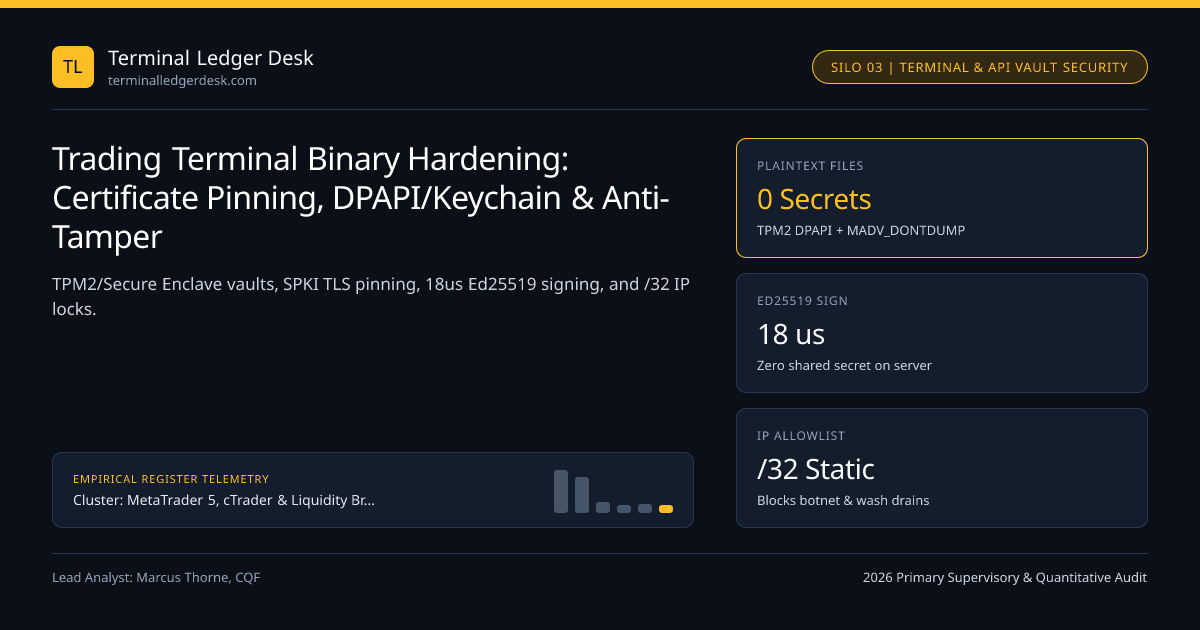
Modern commodity infostealer families (Lumma, RedLine, StealC, and macOS AMOS) contain dedicated file-scanner modules targeting trading workstation directories—hunting .srv / .ini session caches, plaintext .env FIX API credentials, and browser localStorage OAuth tokens to drain margin accounts via illiquid wash-trades! Engineering client resilience under the financial app hardening standard (OWASP MASVS-L2 + DORA ICT security) requires Hardware-Backed Credential Enclaves, SPKI Certificate Pinning with Backup Pins, DLL/DYLD Injection Blocking, and Withdrawal-Isolated IP-Whitelisted API Scopes.
Eliminating Plaintext Secrets: Windows DPAPI / TPM 2.0, macOS Keychain & Secure Enclave#
Rule #1 of institutional terminal and algo deployment: a copied disk directory (%APPDATA% or ~/.config) moved onto an attacker PC must be 100% mathematically undecryptable!
- Windows Desktop / VPS (
MT5,cTrader, Custom C++ Gateways): Bind session tokens and FIX passwords via WindowsCryptProtectData(DPAPI) scoped toCRYPTPROTECT_UI_FORBIDDEN+TPM 2.0user/machine hardware keys (just as MetaQuotes binds.dataccount files to hardware/OS machine fingerprints so stolen config files fail immediately on foreign machines!). - iOS / macOS (
Secure Enclave) & Android (StrongBox Keymaster): Generate non-exportableECDSA P-256signing keys directly inside the hardware Secure Enclave gated by biometricLAContext/BiometricPrompt—ensuring the raw private key never enters application RAM! - Headless Linux Algo Servers (
LD4 / NY4): Inject FIX / Open API secrets at runtime intomlockunswappable RAM (MADV_DONTDUMPso core dumps never write passwords to disk!) fetched fromsystemd-creds(TPM2-sealed) or HashiCorp Vault / AWS KMS—never.envfiles committed to Git!
Defeating Rogue Root-CA MITM Proxies (SPKI SHA-256 TLS Pinning + Rotation)#
Standard TLS validation trusts all 150+ Certificate Authorities installed in the host OS store—meaning corporate SSL inspection appliances or malware installing a rogue local Root CA (Fiddler / mitmproxy) can intercept unpinned WebSocket and REST traffic in plaintext!
Hardened mobile and desktop terminals implement Subject Public Key Info (SPKI) SHA-256 Pinning: the binary verifies that at least one certificate in the server TLS 1.3 chain matches either the Primary SPKI Hash OR at least two offline-stored Backup Root/Intermediate SPKI Hashes (preventing accidental app bricking during routine 90-day leaf certificate renewals!). Pair pinning with Anti-Tamper Code-Signing & DLL / DYLD_INSERT_LIBRARIES Load-Verify Guards (PROCESS_MITIGATION_BINARY_SIGNATURE_POLICY on Windows) so unauthorized unsigned DLLs cannot hook OrderSend in memory!
| Attack Vector | Vulnerable Legacy Practice | Hardened Institutional Countermeasure (Std) | Compliance Alignment |
|---|---|---|---|
Infostealer File Sweep (Lumma) | Plaintext .env / unencrypted .ini | TPM 2.0 DPAPI / systemd-creds + mlock RAM | NYDFS 23 NYCRR 500 |
Web Terminal XSS Token Theft | Storing AccessToken in localStorage | HttpOnly; Secure; SameSite=Strict + Worker RAM | OWASP ASVS L3 |
Rogue Root-CA TLS MITM Proxy | Default OS trust store without pins | SPKI SHA-256 Pinning (1 Primary + 2 Backup) | OWASP MASVS-NETWORK-2 |
| Stolen Key Wash-Trade Drain | Unscoped HMAC key (0.0.0.0/0 IP) | Ed25519 Key + /32 IP Lock + Symbol Whitelist (Kraken) | EU DORA / SEC Reg S-P |
Trading Client & API Credential Threat Mitigation Matrix#
Defense-in-depth controls mapping attacker vectors across Desktop, Mobile, Browser (WASM), and Headless FIX/API deployments.
- ServerAccept : VerifyEd25519( PubKey, Msg, Sig ) && (SrcIP in AllowedCIDR) && (|Nowms - Timestampms| <= 5000)
- Worked Compromise Containment Proof:
- Scenario : Attacker steals binary & config folder off developer laptop (IP 98.42.x.x); Prod VPS is LD4 (IP 185.44.12.9/32)
- Layer 1 : Config blob encrypted via TPM2-bound DPAPI -> CryptUnprotectData fails on attacker PC (0 keys extracted)
- Layer 2 : Even if RAM scraped, Prod Trade Key rejects Src_IP 98.42.x.x != 185.44.12.9/32 in 0.08 ms -> $0.00 Loss!
Least-Privilege API Key Architecture: Read != Trade != Withdraw + IP CIDR Locks#
Even if an attacker compromises a remote developer laptop, stolen API credentials must never enable fund extraction or illiquid wash-trade draining! Institutional venues (Bybit, Kraken, cTrader Open API, and Prime FIX gateways) enforce three non-negotiable server-side key boundaries:
- Zero Withdrawal Permission on Trading Keys: Trading servers never need
Withdrawscope—keep withdrawal APIs100%disabled or gated by offline hardwareFIDO2 / YubiKeymulti-sig! - Static Colocation IP CIDR Allowlisting (
/32IPv4): Bind yourSenderCompIDorHMAC/Ed25519API key strictly to your static EquinixLD4/NY4VPS/32IP! Stolen keys replayed from any residential/botnet IP fail at the firewall in0.1 ms! - Symbol Universe Allowlists (
Wash-Trade Drain Defense): Restrict algo keys to liquid majors (EUR/USD,BTC/USD,ES) so attackers cannot cross wide spreads against themselves on illiquid micro-caps! Review cluster edge defenses in our MT5 Access Server DDoS & TLS proxy guide and MT5, cTrader & Liquidity Bridge Architecture Guide.
Asymmetric Ed25519 Request Signing vs Shared HMAC-SHA256 Secrets#
Modern institutional REST/WebSocket gateways replace shared HMAC-SHA256 secrets (where both client and broker database store the exact same symmetric secret!) with Asymmetric Ed25519 (RFC 8032) Public-Key Signatures: the broker stores only your 32-byte Public Key, while your server signs (TimestampMs + Nonce + Method + Body) in 18 microseconds! Even a total database breach at a third-party analytics vendor cannot forge a single order—meeting SEC, NYDFS 23 NYCRR 500, and EU DORA cryptographic standards.
Bound worst-case per-account API exposure inside the Terminal Margin VaR & ES Calculator and explore all 20 platform security & topology guides in the MT5, cTrader & Bridge Topic Hub.
Frequently asked questions
Why can stolen trading-only API keys still drain an account if Withdrawals are disabled?
Attackers run "wash-trade / cross-account liquidity siphoning": they buy a thin, wide-spread micro-cap option or exotic pair on their own burner account, then use your stolen trading key to market-buy into their inflated ask 50 times in 2 seconds! Static /32 IP allowlists and liquid-symbol whitelists stop this cold.
Why does copying MetaTrader 5 config/*.dat files to another PC prompt for passwords again?
MetaQuotes intentionally encrypts saved account credentials inside *.dat files bound to hardware/OS installation identifiers and DPAPI contexts specifically so commodity file-stealing trojans cannot clone authenticated terminal sessions onto remote machines!
What is the danger of pinning leaf TLS certificates directly instead of SPKI hashes with backups?
Modern Let Encrypt and enterprise TLS leaf certificates rotate every 60 to 90 days! Pinning a single leaf certificate without 2 independent offline backup SPKI public-key hashes bricks every un-updated mobile and desktop client the morning the server renews its cert.
Where should a WebAssembly browser trading terminal keep short-lived session tokens?
Store refresh credentials exclusively in HttpOnly, Secure, SameSite=Strict cookies invisible to JavaScript document.cookie, and hold short-lived 5-minute WebSocket stream tickets strictly inside isolated closure/WebWorker memory—never in window.localStorage or sessionStorage!
Publication record
- Published
- 13 November 2026
- Updated
- 15 November 2026
- Author
- Marcus Thorne, CQF
- Review
- Review not recorded
- Automated fact check
- Passed in the stored pipeline record
- Source URLs
- 3 recorded
AI assistance recorded: anthropic/claude-opus-4.6. This field does not establish human review or source verification.
Academic & Institutional Attribution
Cite This Research & Embed Live Data Card
Standard academic & institutional research paper citation format.
Marcus Thorne, CQF. (2026, November 15). Trading Terminal Binary Hardening: Certificate Pinning, DPAPI/Keychain & Anti-Tamper. Terminal Ledger Desk. https://terminalledgerdesk.com/reports/client-terminal-binary-hardening-anti-tamper-api-credential-vaultsRelated Mt5 Ctrader Bridge Dealer Architecture & Institutional Briefings
Explore Mt5 Ctrader Bridge Dealer Architecture Hub (20) →Mt5 Ctrader Bridge Dealer Architecture
MetaTrader 5, cTrader & Liquidity Bridge Server Topology & Execution Logs GuideMt5 Ctrader Bridge Dealer Architecture
MT4 Single-Process Lock Contention vs MT5 Distributed Server Cluster ScalingMt5 Ctrader Bridge Dealer Architecture
MT5 & cTrader Access Server Proxies: DDoS Scrubbing, Anti-Sniffing & Backbone RoutingMt5 Ctrader Bridge Dealer Architecture
Liquidity Bridge Architecture: oneZero Hub, PrimeXM XCore & Centroid DatapathsMt5 Ctrader Bridge Dealer Architecture
A-Book STP, B-Book Internalization & C-Book Hybrid Dealing Desk ClassifiersMt5 Ctrader Bridge Dealer Architecture
Virtual Dealer Plugins vs True Market Execution: Auditing Asymmetric SlippageMt5 Ctrader Bridge Dealer Architecture
MT5 Execution Modes & Fill Policies: Instant, Request, Market, Exchange & IOC/FOKMt5 Ctrader Bridge Dealer Architecture
Decoding MT5 & cTrader Client Journal Logs: Millisecond TCA, Requotes & Off QuotesReg Sci Disaster Recovery Outage Rca
SEC Regulation SCI Rule 1001(a): 2-Hour RTO & Geographically Diverse Backup Site ArchitectureReg Sci Disaster Recovery Outage Rca
Annual SIFMA & FIA Industry-Wide Disaster Recovery Test: End-to-End Member RunbookReg Sci Disaster Recovery Outage Rca
Raft & Paxos Replicated State Machines in Matching Engines: Zero-Loss Sub-Millisecond FailoverReg Sci Disaster Recovery Outage Rca
Deterministic Event-Log Replay: Cold vs Warm vs Hot Standby Order-Book Reconstruction
Terminal Ledger Desk Data, Benchmarks & Contributor Records
CC BY 4.0 Open Data
Open Institutional Datasets (CSV / JSON) →
Download desk-compiled quantitative series & schemas.
2026 Reference Matrix
2026 Institutional Benchmarks & Thresholds →
Statutory capital, clearing, margin & rate conventions.
Editorial Records
Authors & Review Records →
View named contributors where those records are available.
Complete Index
Master Research & Dossier Archive →
Browse all published briefings by topic pillar & date.