
Reg Sci Disaster Recovery Outage Rca
Exchange Outage Post-Mortem Anatomy: 32-Bit Sequence Wraparounds & Timestamp Epoch Overflows
Why do battle-tested stock and options exchanges suddenly halt at 14:12 PM on high-volatility days? Signed 32-bit integer wraparounds at 2,147,483,647 messages and monotonic leap-second inversions remain silent time bombs.
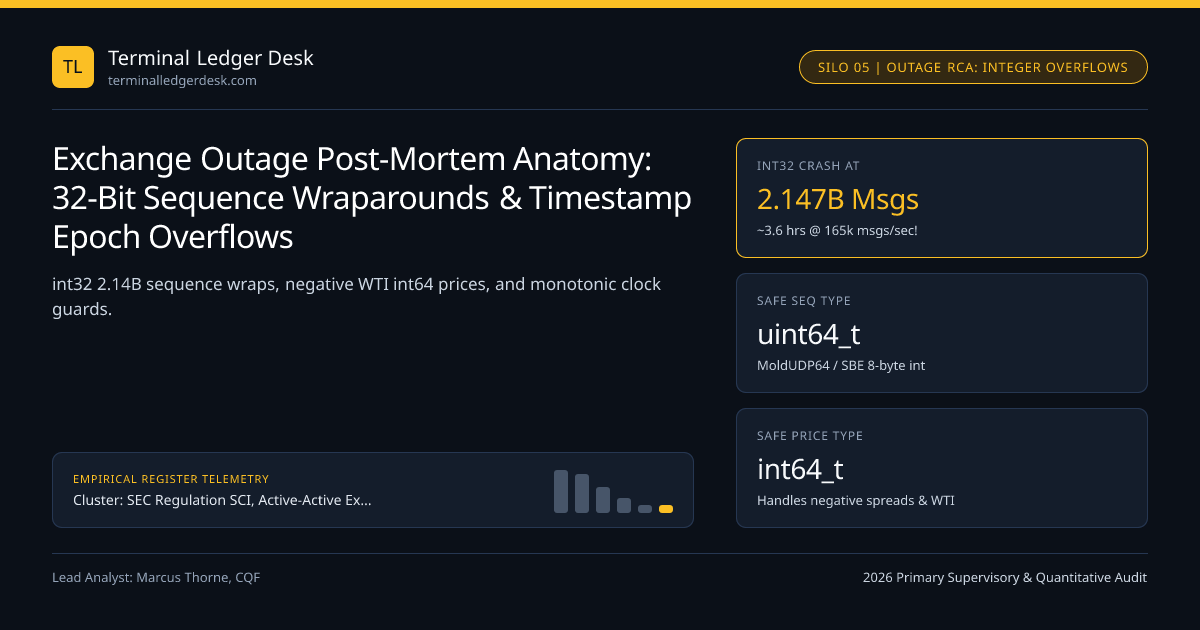
At 2,147,483,647 (2^31 - 1), a signed 32-bit C/Java integer (int32_t) silently increments to -2,147,483,648! Over the past decade, signed 32-bit sequence-number, trade-ID, and price-tick overflows have triggered full-market trading halts at Tier-1 exchanges and market-data feeds across North America, Europe, and Asia-Pacific whenever volatility doubled intraday message counts past 2.14 billion. Understanding exact integer-boundary failure modes is mandatory for SEC Regulation SCI engineering.
Why 2^31 - 1 (2,147,483,647) Strikes Precisely During Macro Crises#
During quiet summer sessions, a major options or equity multicast partition might emit 650 million messages across a 6.5-hour trading day (~30% of INT32_MAX)—passing every normal regression test for years! Then a pandemic crash (March 2020), meme-stock options frenzy (2021), or tariff shock (2025–2026) triples quote churn to 110,000 messages/second, crossing 2,147,483,647 at 14:54 PM!
Look at what breaks simultaneously across FIX Session Layer and binary parsers when an internal int32_t wraps negative (tracked in our Outages & Halts Ledger):
- Sequence Gap Detector Deadlock: Downstream Multicast A/B feed arbitrators evaluate
if (pkt_seq < expected_seq) drop_duplicate;! Because-2,147,483,648 < +2,147,483,647, every single market-data packet for the rest of the day is silently dropped as an "old duplicate"! - Negative Array Indexing (
SIGSEGV): Ring-buffer indexing written asring[seq % RING_SIZE]in C/C++ yields a negative remainder (-2147483648 % 65536or negative index on non-power-of-2 modulo!), Segfaulting every Raft matching replica simultaneously! - FIX
Tag 34 (MsgSeqNum)Serialization: Naive ASCII formatters emit34=-2147483648|, causing compliant FIX engines to disconnect immediately withValue is incorrect (out of range) for this tag!
Beyond int32: uint16 Partition IDs, Negative Oil Prices & Leap-Second Panics#
Integer boundary post-mortems under our Financial App Hardening Standard extend across four related binary fields:
- Unsigned 32-Bit (
uint32_t = 4,294,967,295) OPRA / Options Burst Exhaustion: Across 1.6 million listed US option strikes, aggregate OPRA traffic now exceeds tens of billions of messages per day—requiring strictly unsigned 64-bit (uint64_t) sequence counters (MoldUDP64,CME MDP 3.0 RptSeq / MsgSeqNum). - Unsigned Price Assumptions (
April 20, 2020 WTI Crude Oil = -$37.63): Risk gateways and broker terminals (Interactive Brokerssuffered$104Mcustomer loss!) that storedPriceasuint64_tunsigned integers could neither display negative futures prices nor compute Bachelier options Greeks until emergency schema patches shipped! - 32-Bit Nanoseconds-Since-Midnight Overflow:
86,400 seconds * 10^9 ns = 8.64 * 10^10—which exceedsuint32_t(4.29 * 10^9) after just4.294 seconds! Evenuint32_tmicroseconds since midnight (86.4 * 10^9us? Wait:86,400 * 10^6 = 8.64 * 10^10 > 4.29 * 10^9!) overflows after71.58 minutes! Onlyuint64_tnanoseconds since Unix Epoch (good until Year 2554) is safe! - UTC Leap-Second (
23:59:60) Backward Clock Jumps: Un-smeared NTP/PTP steps backward by1.000 second, causinguint64_t dt = t_now - t_prevto underflow to18,446,744,073,709,551,615and instantly trip every token-bucket and heartbeat timeout!
| Vulnerable Field | Flawed Data Type | Exact Failure Point | Real-World Market Symptom | Hardened Institutional Type |
|---|---|---|---|---|
Market-Data / Log SeqNum | int32_t / Java int | 2,147,483,648 (~4h @ 150k/s) | Feed handlers drop all ticks; FIX disconnects | uint64_t (MoldUDP64 / SBE u64) |
| Price / Spread Tick Value | uint32_t / uint64_t | Price <= 0 (WTI -$37.63 / Calendar spreads) | Underflow to $184 Trillion; collar/margin explosion | int64_t Signed Fixed-Point Mantissa |
Time-Since-Midnight (us) | uint32_t | 4,294,967,295 us (71 min 35 sec!) | Timestamps wrap backward every 71.6 minutes! | uint64_t Unix Epoch Nanoseconds |
Elapsed Timeout (t1 - t0) | CLOCK_REALTIME u64 | NTP/PTP backward step (-50 us or Leap Sec) | t1 - t0 wraps to 2^64 - 1 -> Instant COD disconnect! | CLOCK_MONOTONIC_RAW / Signed int64_t diff |
Historical Financial Integer & Timestamp Overflow Hall-of-Shame Matrix#
Canonical binary field sizing mistakes, exact wraparound thresholds, failure symptoms, and hardened 64-bit types.
- Worked High-Volatility Options Partition Audit (Peak Sustained Rate = 165,000 msgs/sec across 11-Hour Global Session):
- Total Daily Messages = 165,000 * 11 * 3,600 = 6,534,000,000 messages!
- Signed int32_t (2.147B) -> CRASHES after 3.61 hours!
- Unsigned uint32_t (4.295B) -> CRASHES after 7.23 hours!
- Unsigned uint64_t (1.844E19) -> Uses 0.000000035% of capacity (100% Immune)!
Testing INT32_MAX - 10,000 in Every CI & Reg SCI Capacity Harness!#
Why did QA teams miss 2^31 - 1 bugs for 8 years? Because every staging test initialized SeqNum = 1 every morning and only ran 50 million test messages! Under capacity stress testing & Reg SCI telemetry, enforce Boundary-Seeded Pre-Release Suites:
- Boot staging matching engines, FIX gateways, and market-data feed handlers initialized at
Start_Seq = 2,147,480,000(INT32_MAX - 3,647) and4,294,960,000(UINT32_MAX - 7,295)! - Inject negative and zero prices (
Price = -500 ticks,Price = 0) across futures/spreads in UAT. - Compile all C++/Rust execution binaries with
-fsanitize=signed-integer-overflow,undefined(UBSan) in nightly PCAP fuzzing!
Intraday Gauge Alerting: Page NOC at 50% of Any Counter Domain!#
Export Prometheus/telemetry gauges computing Current_Counter / Counter_Max_Type_Ceiling across every sequence, OrderID, ExecID, and slab-arena slot_id: if any counter crosses 50.0% of its wire/memory data type ceiling intraday, trigger a Severity-1 engineering page days or hours before truncation hits! Quantify halt exposure in our Terminal Margin VaR & ES Calculator.
Frequently asked questions
Why do Java trading applications fall victim to 2,147,483,647 bugs even when the exchange wire protocol specifies an unsigned 32-bit uint32?
Because the JVM historically lacked primitive unsigned types: if a developer reads 4 wire bytes into a Java int instead of masking into a 64-bit long (wireInt & 0xFFFFFFFFL), message #2,147,483,648 turns negative inside JVM business logic even though the C++ exchange sent a valid unsigned uint32!
How does Nasdaq ITCH 5.0 store nanosecond timestamps in 6 bytes without overflowing?
ITCH 5.0 uses a 48-bit unsigned integer counting nanoseconds since midnight Eastern Time: 2^48 - 1 = 281,474,976,710,655 ns = 281,474.9 seconds (~78.18 hours), safely covering a 24-hour trading day while saving 2 bytes per packet (always widen 6 wire bytes into a uint64_t in memory!).
What happened during the April 2020 WTI Crude Oil negative-price shock inside exchange and broker systems?
CME Clearing had proactively tested and enabled Bachelier pricing and signed negative prices ahead of May contract expiry after warning members, whereas several retail/institutional broker GUIs and risk gateways still enforced Price > 0 validation schemas—locking traders out of closing long contracts as May WTI plunged to -$37.63!
How did global exchanges eliminate the UTC Leap-Second crash hazard permanently?
First, exchanges switched from abrupt 1-second midnight step adjustments to linear 24-hour "Leap Smearing" outside market hours; second, the International Bureau of Weights and Measures (CGPM Resolution 4, 2022) voted to abolish/suspend UTC leap seconds by or before 2035!
Publication record
- Published
- 13 November 2026
- Updated
- 14 November 2026
- Author
- Marcus Thorne, CQF
- Review
- Review not recorded
- Automated fact check
- Passed in the stored pipeline record
- Source URLs
- 3 recorded
AI assistance recorded: anthropic/claude-opus-4.6. This field does not establish human review or source verification.
Academic & Institutional Attribution
Cite This Research & Embed Live Data Card
Standard academic & institutional research paper citation format.
Marcus Thorne, CQF. (2026, November 14). Exchange Outage Post-Mortem Anatomy: 32-Bit Sequence Wraparounds & Timestamp Epoch Overflows. Terminal Ledger Desk. https://terminalledgerdesk.com/reports/postmortem-anatomy-integer-sequence-wraparound-timestamp-overflowsRelated Reg Sci Disaster Recovery Outage Rca & Institutional Briefings
Explore Reg Sci Disaster Recovery Outage Rca Hub (20) →Reg Sci Disaster Recovery Outage Rca
SEC Regulation SCI, Active-Active Exchange Failover & Outage Post-Mortem Engineering GuideReg Sci Disaster Recovery Outage Rca
Exchange Outage Post-Mortem: Opening-Auction Reference-Price Errors & LULD Halt CascadesReg Sci Disaster Recovery Outage Rca
Exchange Outage Post-Mortem: WAN BGP Route Leaks, Extranet Partitions & Asymmetric HaltsReg Sci Disaster Recovery Outage Rca
CTA & UTP SIP Market-Data Processor Failover: NBBO Staleness, Reg NMS Rule 611 & Direct FeedsReg Sci Disaster Recovery Outage Rca
SEC Regulation SCI Rule 1002: Incident Triage Trees, Immediate SEC Notification & De Minimis Safe HarborReg Sci Disaster Recovery Outage Rca
Clearly Erroneous Executions (CEE) & Trade Bust Bands: Post-Outage Unwind & Hedge Risk MathReg Sci Disaster Recovery Outage Rca
Capacity Stress Testing & Microburst Telemetry Under SEC Regulation SCI Rule 1001(a)Reg Sci Disaster Recovery Outage Rca
Hybrid-Cloud Exchange Migration: AWS Outposts, Google Cloud & the Microsecond Determinism GapExecutive Moves
Ripple Prime brokerage head to step down at year-end - Tech in AsiaMarket Insights
Avalanche Won Over the NYSE. Now It Has to ‘Capture Value’ for AVAXMarket Insights
Nasdaq Jumps After CoreWeave EarningsMarket Insights
Nasdaq-Backed Payward Launches Tokenized Versions of European Stocks
Terminal Ledger Desk Data, Benchmarks & Contributor Records
CC BY 4.0 Open Data
Open Institutional Datasets (CSV / JSON) →
Download desk-compiled quantitative series & schemas.
2026 Reference Matrix
2026 Institutional Benchmarks & Thresholds →
Statutory capital, clearing, margin & rate conventions.
Editorial Records
Authors & Review Records →
View named contributors where those records are available.
Complete Index
Master Research & Dossier Archive →
Browse all published briefings by topic pillar & date.