
Reg Sci Disaster Recovery Outage Rca
CTA & UTP SIP Market-Data Processor Failover: NBBO Staleness, Reg NMS Rule 611 & Direct Feeds
When the Consolidated Tape (CTA) or UTP Securities Information Processor freezes, US equity venues invoke Reg NMS Rule 611 Self-Help or halt outright—requiring dual SIP+Direct NBBO synthesis in every SOR.
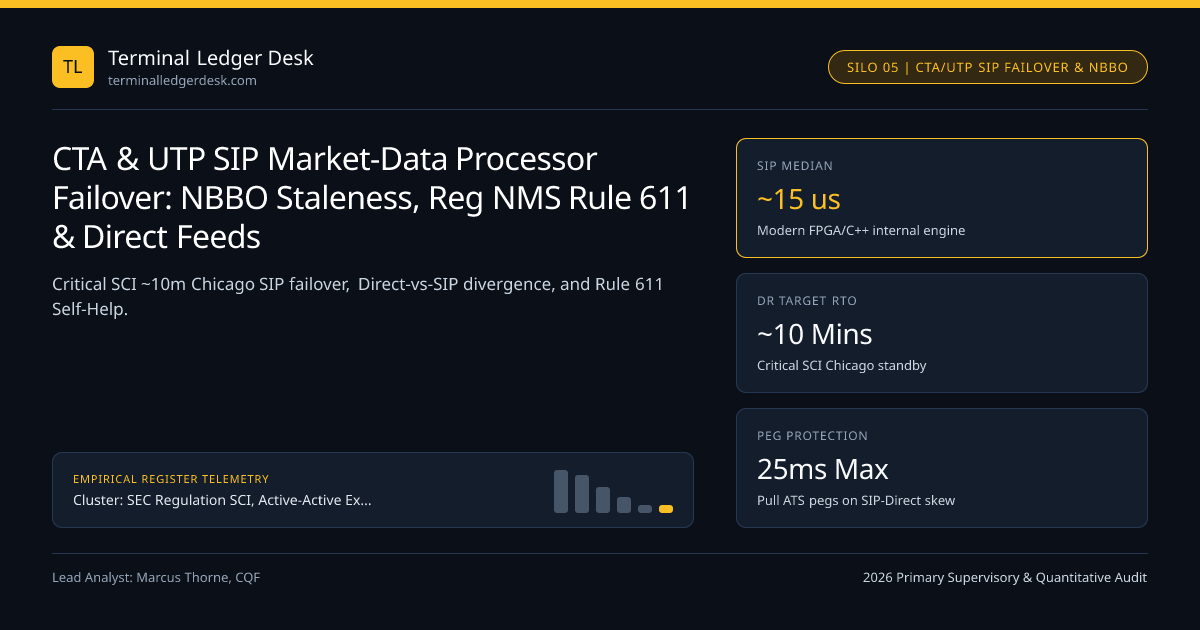
On August 22, 2013, a connectivity race condition inside the UTP Securities Information Processor (SIP) blinded the consolidated National Best Bid and Offer (NBBO) for every Tape C (Nasdaq-listed) stock—halting Apple, Microsoft, Google, and Amazon for 3 hours and 9 minutes across the entire United States! Under SEC Regulation SCI, the CTA/CQ Plan (NYSE SIAC — Tape A & B) and UTP Plan (Nasdaq — Tape C) processors are classified as Critical SCI Systems subject to the nation strictest hot-warm failover SLAs and Reg NMS Rule 611 (Order Protection Rule) routing invariants.
Why a Single-Point SIP Outage Paralyzes US Equities Without Direct-Feed Failover#
Connecting the regulatory architecture of our SEC Reg SCI & Outage Post-Mortem Hub, the SIP performs three legally indispensable functions across 16+ lit US equity exchanges and 30+ ATS dark pools:
- Disseminating Official Consolidated
NBBO& Last Sale: Retail brokers, dark-pool midpoint pegs (Midpoint = 0.5 * (NBB + NBO)), and wholesale internalizers price tens of millions of orders off the SIPNBBO! - Broadcasting National
LULDPrice Bands & Pause Flags: As detailed in NMS Limit Up-Limit Down (LULD) mechanics, the SIP calculates and distributes rolling 5-minuteUpper/Lower Price Bands! Without valid LULD bands or regulatory halt messages, exchanges risk executing illegal out-of-band trades. - Enforcing Reg NMS Rule 611 (
Trade-Through Ban): Exchanges cannot execute trades through a protected automated quotation displayed on an away venue unless a statutoryRule 611(b)exception applies.
Critical SCI Dual-Site Hot/Warm SIP Architecture (Mahwah/Carteret <-> Chicago)#
Following the 2013 Flash Freeze and Regulation SCI enactment, both SIAC (CTA/CQ) and Nasdaq (UTP) re-architected their SIP stacks under HA Trading Failover Architecture standards:
- In-Site Active/Hot-Standby Fault Tolerance: Sub-second automated switchover inside the primary New Jersey facility (
Mahwahfor SIAC;Carteretfor UTP) with hardware FPGA/C++ acceleration reducing median SIP aggregation latency below15 to 20 microseconds! - 10-Minute Cross-Region DR Target: Rather than taking the full
2-hourouter bound allowed for standard SCI systems (Reg SCI Rule 1001 2-hour RTO), Critical SCI SIP backup sites in Chicago target rapid~10-minutedisaster failover, exercised regularly during quarterly SIP weekend tests and the annual October SIFMA DR test!
| Consolidated Tape / Feed | Operating Processor | Securities Covered | Primary / DR Topology | SOR Outage Failure Mode |
|---|---|---|---|---|
CTA / CQ (Tape A & B) | SIAC (NYSE/ICE) | NYSE (Tape A) & Arca/Cboe/AMEX (Tape B) | Mahwah NJ <-> Chicago DR | Missing LULD bands; stale ATS midpoint pegs |
UTP (Tape C) | Nasdaq | All Nasdaq-listed NMS equities | Carteret NJ <-> Chicago DR | Aug 2013 3-hr freeze -> Harmonized multi-venue rules |
OPRA (Options) | SIAC | All 18 US listed equity/index options venues | Mahwah NJ <-> Chicago DR | Massive 96-multicast-line bandwidth saturation |
| Direct Proprietary Feeds | Individual Venues | Full depth-of-book (ITCH, XDP, PITCH) | Per-venue primary + Chicago DR | Fastest NBBO (<200us cross-NJ), but needs SIP LULD verify |
US Equity SIP vs Proprietary Direct-Feed NBBO Comparison Matrix#
Comparing latency, regulatory authority, dark-pool peg impact, and Reg NMS Rule 611 Self-Help rules.
- SOR Automated Dark-Peg Protection Rule:
- SUSPENDATSMIDPOINT_ORDERS(sym) IFF:
- (Nowns - LastSIPHeartbeatns > 100,000,000 ns [100 ms])
- OR ( |DirectNBBOMid(sym) - SIPNBBOMid(sym)| >= MAX($0.02, 0.0010 * Direct_Mid) FOR >= 25 ms )!
Reg NMS Rule 611(b)(1) "Self-Help" Declarations & Dual-Feed SOR Synthesis#
What happens inside an institutional Smart Order Router (SOR) when Exchange X suffers a gateway brownout (response latency > 1 second or stale stuck quote) while the rest of the market is healthy?
- Rule 611(b)(1) Self-Help: Broker-dealers and rival exchanges declare Self-Help against malfunctioning Exchange X (publishing standardized notifications and logging exact justification timestamps), legally excluding Exchange X broken quote from their Protected NBBO so orders stop routing into a black hole and stop getting locked by a phantom bid!
- Dual-Source NBBO Cross-Check (
Direct_NBBOvsSIP_NBBO): Institutional SORs inside Equinix NY4/Carteret construct both a syntheticDirect_NBBO(fromITCH + Pillar + Cboe PITCH + MEMX + IEX) AND ingestSIP_NBBO. If|Direct_Mid - SIP_Mid| > Threshold_Bpsfor> 50 ms(or SIP heartbeat stalls), the Pre-Trade Risk Control layer immediately pulls dark-pool Midpoint Peg orders so toxic latency arbitrageurs cannot pick off your pegged midpoint on a lagging SIP quote!
Preparing for Multi-SIP Competition ( SEC Market Data Infrastructure Rule — MDIR)#
Under the SEC Market Data Infrastructure (MDI) Rule, competing consolidators and expanded round-lot/odd-lot depth schemas emphasize deterministic multi-source feed arbitration (Multicast A/B feed arbitration). Size adverse midpoint-peg exposure during SIP lag spikes using our Terminal Margin VaR & ES Calculator.
Frequently asked questions
If our SOR already subscribes to every exchange ultra-fast Direct Feed (ITCH, XDP, PITCH), why do we still subscribe to the slower SIP?
Three critical reasons: (1) Official LULD Price Bands and Limit State indicators are authoritatively calculated and broadcast by the SIP; (2) Regulatory Short Sale Restriction (SSR) and Market-Wide Halt states coordinate via the SIP; and (3) comparing Direct NBBO against SIP NBBO reveals instantly whether dark pools (pegged to SIP) are running on stale prices!
How do US stock exchanges handle trading today if CTA or UTP suffers a total outage?
After the August 2013 UTP halt, NYSE, Nasdaq, and Cboe adopted harmonized SIP Outage Market-Wide Halt / Continuity rules: if a SIP fails to disseminate quotes/LULD bands across a broad threshold and cannot fail over cleanly within minutes, primary listing exchanges coordinate orderly halts and reopening auctions once backup SIP feeds stabilize.
What triggers a valid Reg NMS Rule 611(b)(1) Self-Help declaration against an exchange?
Under SEC Rule 611 FAQ guidance, a trading center/broker-dealer must apply objective, documented, automated latency/error thresholds (for example, repeated failure to respond to Immediate-Or-Cancel orders within 1 second) consistently, notify the malfunctioning venue and internal compliance immediately, and revoke Self-Help promptly once responsiveness recovers.
Why is OPRA (Options Price Reporting Authority) the heaviest multicast feed on Wall Street?
With 18 competing US options exchanges quoting over 1.5 million individual Call/Put strike series simultaneously, OPRA routinely bursts past tens of millions of messages per second across 96 multicast channels—requiring hardware FPGA/DPDK NIC filtering!
Publication record
- Published
- 13 November 2026
- Updated
- 14 November 2026
- Author
- Marcus Thorne, CQF
- Review
- Review not recorded
- Automated fact check
- Passed in the stored pipeline record
- Source URLs
- 3 recorded
AI assistance recorded: anthropic/claude-opus-4.6. This field does not establish human review or source verification.
Academic & Institutional Attribution
Cite This Research & Embed Live Data Card
Standard academic & institutional research paper citation format.
Marcus Thorne, CQF. (2026, November 14). CTA & UTP SIP Market-Data Processor Failover: NBBO Staleness, Reg NMS Rule 611 & Direct Feeds. Terminal Ledger Desk. https://terminalledgerdesk.com/reports/sip-ctaplan-utp-market-data-processor-failover-nbbo-staleness-rulesRelated Reg Sci Disaster Recovery Outage Rca & Institutional Briefings
Explore Reg Sci Disaster Recovery Outage Rca Hub (20) →Reg Sci Disaster Recovery Outage Rca
SEC Regulation SCI, Active-Active Exchange Failover & Outage Post-Mortem Engineering GuideReg Sci Disaster Recovery Outage Rca
SEC Regulation SCI Rule 1002: Incident Triage Trees, Immediate SEC Notification & De Minimis Safe HarborReg Sci Disaster Recovery Outage Rca
Clearly Erroneous Executions (CEE) & Trade Bust Bands: Post-Outage Unwind & Hedge Risk MathReg Sci Disaster Recovery Outage Rca
Capacity Stress Testing & Microburst Telemetry Under SEC Regulation SCI Rule 1001(a)Reg Sci Disaster Recovery Outage Rca
Hybrid-Cloud Exchange Migration: AWS Outposts, Google Cloud & the Microsecond Determinism GapReg Sci Disaster Recovery Outage Rca
Graceful Market-Halt Reopening Architecture: Cancel-Only Purge Windows & Call-Auction UncrossReg Sci Disaster Recovery Outage Rca
EU DORA (Regulation 2022/2554) vs US SEC Regulation SCI: Global ICT Operational Resilience ComparedReg Sci Disaster Recovery Outage Rca
Clearing House (CCP) FIXML Trade-Capture Backlog Recovery: Post-Spike Compression & NettingMarket Insights
Nasdaq-Backed Payward Launches Tokenized Versions of European StocksMarket Insights
After LMAX, Standard Chartered Scales Crypto Prime Brokerage Playbook to 24X - TradingViewBroker Fees and Calculators
Standard Chartered Expands Prime Brokerage Partnership With 24X to Cover BTC and ETH - TradingViewBroker Fees and Calculators
CNBC Daily Open: Tech falls to earth, Musk's fortunes diverge
Terminal Ledger Desk Data, Benchmarks & Contributor Records
CC BY 4.0 Open Data
Open Institutional Datasets (CSV / JSON) →
Download desk-compiled quantitative series & schemas.
2026 Reference Matrix
2026 Institutional Benchmarks & Thresholds →
Statutory capital, clearing, margin & rate conventions.
Editorial Records
Authors & Review Records →
View named contributors where those records are available.
Complete Index
Master Research & Dossier Archive →
Browse all published briefings by topic pillar & date.