
Fix Protocol Sbe Ouch Session Latency
FIX PartyIDs (Tag 453) & MiFID II Short-Code Injection: Edge Gateway LEI Mapping
Embedding full 20-character Legal Entity Identifiers (LEIs) and MiFID II RTS 24 trader strings inside internal strategy orders bloats packets by 90+ bytes; edge gateways map 4-byte numeric short codes inline in 12 nanoseconds.
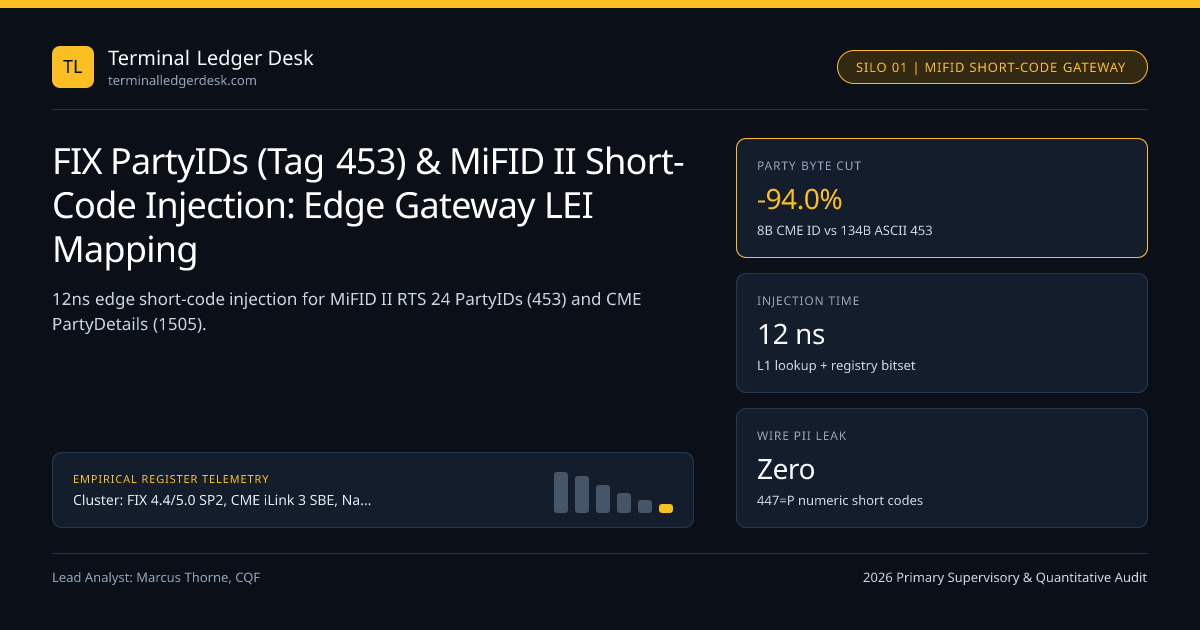
European MiFID II RTS 24 (Commission Delegated Regulation 2017/580) and UK FCA order record-keeping rules require every single outbound order, modification, and cancellation submitted to an EEA/UK venue (Eurex, Xetra, LSEG, Euronext) to identify the Client (LEI or CONCAT), the Investment Decision Within Firm (Algo ID or natural person), and the Execution Within Firm (Algo ID). Instead of dragging 110 bytes of ASCII NoPartyIDs (453) repeating groups across internal strategy ring buffers, institutional venues pre-register 4-byte unsigned integer Short Codes mapped at the edge gateway in 12 nanoseconds.
Anatomy of MiFID II PartyRole (452) & PartyRoleQualifier (2376) Blocks#
In FIX 5.0 SP2 with Extension Packs, regulatory attribution travels inside Parties (NoPartyIDs 453), combining PartyID (448), PartyIDSource (447=P for Short Code ), PartyRole (452), and PartyRoleQualifier (2376):
PartyRole = 3(Client ID):0(None/Prop), or 4-byte short code mapped to a 20-char ISO 17442LEI(2376=23Legal Entity) or national passportCONCAT(2376=24Natural Person).PartyRole = 122(Investment Decision Maker):4-byte Short Code+2376=22 (Algorithm)or2376=24 (Human Portfolio Manager)identifying what generated the signal.PartyRole = 12(Executing Trader / Algo):4-byte Short Code+2376=22 (Algorithm)identifying the child-slicing SOR or execution algorithm certified under MiFID II RTS 6.
Why Venues Mandate 4-Byte Short Codes Over Raw Wire PII / LEIs#
Transmitting raw 20-character LEIs or trader passport strings (CONCAT) on 500 million daily quotes creates two unacceptable hazards: first, it leaks sensitive PII (National ID + Date of Birth concatenations) onto internal gateway logs and packet captures; second, it adds 95+ bytes to every order frame!
Consequently, Eurex T7 ETI, Deutsche Boerse, LSEG Millennium, and Cboe Europe require firms to upload an encrypted overnight Short-Code-to-Long-Code XML/SFTP mapping file (T+1 deadline before 23:59 CET, or pre-trade registration). On the live trading wire inside Equinix LD4 / FR2, the strategy passes a compact 16-bit internal StrategyBookID which the edge gateway expands via an L1-cache array into three 32-bit integers (ClientShortCode, InvDecisionShortCode, ExecAlgoShortCode)—aligned with our FIX, SBE & OUCH Session Architecture Guide.
| Jurisdiction / Venue | Regulatory Rule | Wire Identification Fields | Long-Code Mapping Mechanism |
|---|---|---|---|
| EU / UK Venues (Eurex, LSEG, Cboe EU) | MiFID II RTS 24 / UK FCA | 452=3, 122, 12 + 447=P + 2376=22/24 | Venue SFTP Short-Code -> LEI / CONCAT XML |
| CME Globex Futures (CFTC Rule 536) | CME Rule 536.B.2 / 576 | PartyDetailsListReqID (1505) + 1028 | Pre-registered via Template 518 + EFS Portal |
| US Equities & Options (CAT) (SEC / FINRA) | SEC Rule 613 CAT NMS Plan | FDID (Firm Designated ID), DeptType, MPID | Nightly CAT Reporter Portal linkage submission |
| Canadian Equities (TSX / CIRO) (IIROC) | UMIR Rule 7.1 / 10.15 | Client ID / LEI + OrderExecutionAlgo | Encrypted regulatory marker registry |
Global Regulatory Attribution Tags: EU/UK MiFID II vs US CME & CAT#
Multi-jurisdiction EMS routers translate internal strategy metadata into distinct wire fields across Frankfurt/London, Chicago, and New York venues.
- Twiresavedns = (Lasciifullparties - Lbinaryshortref) * 8 / Rlink_gbps
- Where:
- Nordersday = 8,500,000 outbound orders + cancel/replaces across European & CME desks
- Lasciifull_parties = 134 bytes (3 PartyID groups carrying 20-char LEI + 16-char Algo strings)
- Lbinaryshort_ref = 8 bytes (CME iLink 3 PartyDetailsListReqID) or 16 bytes (Eurex ETI)
- Rlinkgbps = 10 Gbps (1.25 bytes/ns)
- Worked Wire & Storage Compression:
- Bytessaveddaily = 8,500,000 * (134 - 8) = 1,071,000,000 bytes (1.071 GB/day wire reduction)
- Twiresaved_ns = (126 * 8) / 10 = 100.8 nanoseconds faster NIC serialization per order.
Inline Unregistered-Short-Code Kill Gate (Pre-Trade Blocking)#
A recurring regulatory fine trigger audited by UK FCA, BaFin, and ESMA occurs when a quant team deploys a newly versioned execution model (v4.2 -> v4.3, generating a new AlgoShortCode = 804192) on Tuesday morning, forgetting to add 804192 to the T+1 Short-Code Reference Data registry! Over 200,000 orders execute with an orphaned integer that fails venue RTS 24 reconciliation.
Hardened pre-trade risk control gateways compile the approved registry into a memory-mapped bitset (RoaringBitmap or flat array) loaded at 06:00 UTC. Any outbound order referencing an unregistered (InvDecisionCode, ExecAlgoCode) pair is blocked inline prior to wire emission in 8 nanoseconds—alongside zero-malloc repeating-group validation.
CME Tag 1028 (ManualOrderIndicator) & Self-Match ID Alignment#
Crossing the Atlantic to CFTC and CME Globex Rule 536.B.2, automated gateways must similarly inject SenderSubID (50) (Operator ID registered in CME Exchange Fee System), ManualOrderIndicator (1028=N for automated, Y for manual clicks on terminals like MT5 or cTrader), and PartyDetailsListReqID (1505)` in iLink 3!
CME iLink 3 pushes short-code efficiency even further via PartyDetailsDefinitionRequest (518): the firm sends all clearing account, take-up firm, and operator strings once at Sunday session startup mapped to a single 8-byte PartyDetailsListReqID, omitting party repeating groups completely from every weekday NewOrderSingle (514)! Size per-operator position collars in the Terminal Margin VaR & ES Calculator and browse the FIX, SBE & OUCH Topic Hub.
Frequently asked questions
What is the difference between PartyRole=122 and PartyRole=12 in MiFID II FIX 5.0 SP2 orders?
PartyRole=122 (Investment Decision Maker) identifies the human portfolio manager or quantitative alpha model that decided to buy or sell the instrument, whereas PartyRole=12 (Executing Trader) identifies the execution algorithm (e.g., VWAP/SOR) or dealer executing child slices on the venue.
When must a trading firm assign a new MiFID II Algorithm Short Code after a code change?
Under MiFID II RTS 6 and RTS 24 governance, minor bug fixes or parameter tweaks retain the existing Algo ID, whereas material changes to execution logic, venue routing behavior, or risk thresholds require incrementing the registered Algo ID and re-running conformance tests.
How does CME Globex PartyDetailsDefinitionRequest (518) avoid sending PartyIDs on orders?
Before market open (or on demand), the gateway sends Template 518 defining clearing firm, account, customer capacity, and self-match ID tied to a unique 64-bit PartyDetailsListReqID. Every subsequent NewOrderSingle (514) passes only that 8-byte integer.
What happens if an algorithmic gateway sets ManualOrderIndicator (Tag 1028) incorrectly on CME?
CME Market Regulation routinely audits Tag 1028 against inter-order microsecond timing distributions; marking automated API flow as 1028=Y (Manual) or omitting registered Tag 50 Operator IDs violates CME Rule 536.B.2 and Rule 576, resulting in disciplinary fines.
Publication record
- Published
- 14 November 2026
- Updated
- 14 November 2026
- Author
- Marcus Thorne, CQF
- Review
- Review not recorded
- Automated fact check
- Passed in the stored pipeline record
- Source URLs
- 3 recorded
AI assistance recorded: anthropic/claude-opus-4.6. This field does not establish human review or source verification.
Academic & Institutional Attribution
Cite This Research & Embed Live Data Card
Standard academic & institutional research paper citation format.
Marcus Thorne, CQF. (2026, November 14). FIX PartyIDs (Tag 453) & MiFID II Short-Code Injection: Edge Gateway LEI Mapping. Terminal Ledger Desk. https://terminalledgerdesk.com/reports/fix-partyids-tag-453-mifid-short-code-lei-mapping-gateway-injectionRelated Fix Protocol Sbe Ouch Session Latency & Institutional Briefings
Explore Fix Protocol Sbe Ouch Session Latency Hub (20) →Fix Protocol Sbe Ouch Session Latency
FIX 4.4/5.0 SP2, CME iLink 3 SBE & Nasdaq OUCH 5.0 Session Latency Architecture GuideFix Protocol Sbe Ouch Session Latency
Memory-Mapped (mmap) FIX Sequence Stores: Bypassing NVMe fsync Tail LatencyFix Protocol Sbe Ouch Session Latency
FIX 4.4 ASCII Tag-Value Parsing Overhead vs SBE Zero-Copy Wire Struct LatencyFix Protocol Sbe Ouch Session Latency
CME iLink 3 SBE Session Architecture: UUID Negotiation, Establish & HMAC State MachineFix Protocol Sbe Ouch Session Latency
FIXT.1.1 Transport Independence & ApplVerID Routing in FIX 5.0 SP2 GatewaysFix Protocol Sbe Ouch Session Latency
FIX ResendRequest (35=2) vs SequenceReset-GapFill (35=4): Preventing Replay StormsFix Protocol Sbe Ouch Session Latency
PossDupFlag (Tag 43) vs PossResend (Tag 97): Idempotent FIX Execution DeduplicationFix Protocol Sbe Ouch Session Latency
FIX Drop-Copy (35=8) Reconciliation Gateways: Shadow Position & Clearing ArchitectureMatching Engine Clob Colocation Ptp
Wire-to-Wire Latency Telemetry: HdrHistogram, Coordinated Omission & Optical TapsMt5 Ctrader Bridge Dealer Architecture
MT4 Single-Process Lock Contention vs MT5 Distributed Server Cluster ScalingMt5 Ctrader Bridge Dealer Architecture
MT5 & cTrader Access Server Proxies: DDoS Scrubbing, Anti-Sniffing & Backbone RoutingMt5 Ctrader Bridge Dealer Architecture
Liquidity Bridge Architecture: oneZero Hub, PrimeXM XCore & Centroid Datapaths
Terminal Ledger Desk Data, Benchmarks & Contributor Records
CC BY 4.0 Open Data
Open Institutional Datasets (CSV / JSON) →
Download desk-compiled quantitative series & schemas.
2026 Reference Matrix
2026 Institutional Benchmarks & Thresholds →
Statutory capital, clearing, margin & rate conventions.
Editorial Records
Authors & Review Records →
View named contributors where those records are available.
Complete Index
Master Research & Dossier Archive →
Browse all published briefings by topic pillar & date.