
Reg Sci Disaster Recovery Outage Rca
Exchange Outage Post-Mortem: WAN BGP Route Leaks, Extranet Partitions & Asymmetric Halts
When a carrier BGP leak or cooling failure disconnects 40% of clearing members while 60% stay live in colocation, exchanges face the hardest Reg SCI decision in finance: stay open or halt for market fairness?
Complete 100% matching-engine crashes are ironically the easiest outages to adjudicate: nobody can trade, and everyone halts together. Far more treacherous are Partial / Asymmetric Gateway & Extranet Partitions—where a BGP route hijack, carrier fiber cut, cooling failure (Equinix CH4 Aurora/Chicago chiller incident of June 2024), or gateway software partition leaves 65% of colocated HFT pods trading normally while 35% of clearing banks and global hedgers are locked out while their resting quotes sit exposed!
Three Partial-Outage Archetypes: Gateway Slice Loss, Extranet BGP Leak & Chiller Shedding#
Cataloged across our SEC Reg SCI & Outage Post-Mortem Hub and Outages & Halts Ledger, partial market connectivity failures strike through three distinct mechanisms:
- Order-Gateway Shard Failure (
Euronext / Eurex / TSEPrecedents): The core matching engine stays100%healthy, but4 of 24front-end FIX/binary gateway processes lock up or lose internal multicast—disconnecting every member pinned to Gateways1..4while Gateways5..24sweep the book! - Financial Extranet BGP Route Leak / Optical Cut (
BT Radianz,ICE IGN,TNS,SFTI): A misconfiguredBGPannouncement or dual-conduit backhoe cut severs London-to-Chicago or Frankfurt-to-Slough leased wavelengths, blinding international liquidity providers simultaneously. - Data-Center Thermal / Chiller Excursion (
June 2024 CyrusOne Aurora Incident): Rising hall temperatures inside a primary colocation facility force sequential rack thermal shutdowns before matching engines formally halt.
The Fair-and-Orderly Market Threshold: When Must an Exchange Halt All Trading?#
Every Regulated Market (NYSE, Nasdaq, CME, Eurex, LSE) maintains a written Market Integrity Halt Threshold Policy balancing continuous liquidity against asymmetric unfairness:
- Quantitative Quorum Rule: Most Tier-1 exchanges define an objective Connected Liquidity / Member Quorum Floor—for example, if gateways representing
>= X%(commonly 20%–30%) of average market volume or registered Designated Market Makers become unreachable due to venue-side or venue-extranet infrastructure (not a single client own router!), the exchange halts the affected market segment completely rather than running a lopsided market! - Mandatory Auto-Purge of Disconnected Gateway Slice: Even if only
1of24exchange gateways crashes (4%of volume, below full-market halt threshold), the matching engine MUST immediately trigger server-side mass-cancel for100%of non-persistent orders owned by sessions on that dead gateway—never waiting for client TCP timeouts (COD grace-window mechanics)!
| Partial Outage Scenario | Who Stays Live vs Blinded? | Exchange Standard Action | Client Best-Practice Mitigation |
|---|---|---|---|
| 1 of 20 Venue Gateways Hangs | 95% live; 5% pinned to dead CGW blind | Purge dead-CGW non-persistent orders; keep market open | Stripe ports across >=3 CGWs + Cross-CGW 35=q purge |
35% of Gateways / DMMs Drop | Asymmetric lopsided order book | Declare Market Integrity Halt + Reopen Auction | Subscribe to venue status feeds; halt cross-hedging immediately |
| Single Carrier Fiber Cut | Colocated HFT live; single-homed WAN blind | Remains open (client/carrier domain) | Dual-carrier KMZ-verified paths + 30 ms hardware BFD |
| Colocation Hall Cooling Loss | Progressive thermal rack shutdowns | Halt affected venue once core/quorum threatened | IPMI >40°C hook auto-fires 35=q & shifts to DR |
Partial Connectivity Failure Modes & Institutional Defense Matrix#
Comparing failure domains, exchange halt policies, resting-order hazards, and multi-homing client mitigations.
- Default Carrier BGP (No BFD): (3 * 60,000 ms) + 150 ms = 180,150 ms (3 minutes of unhedged market drift!)
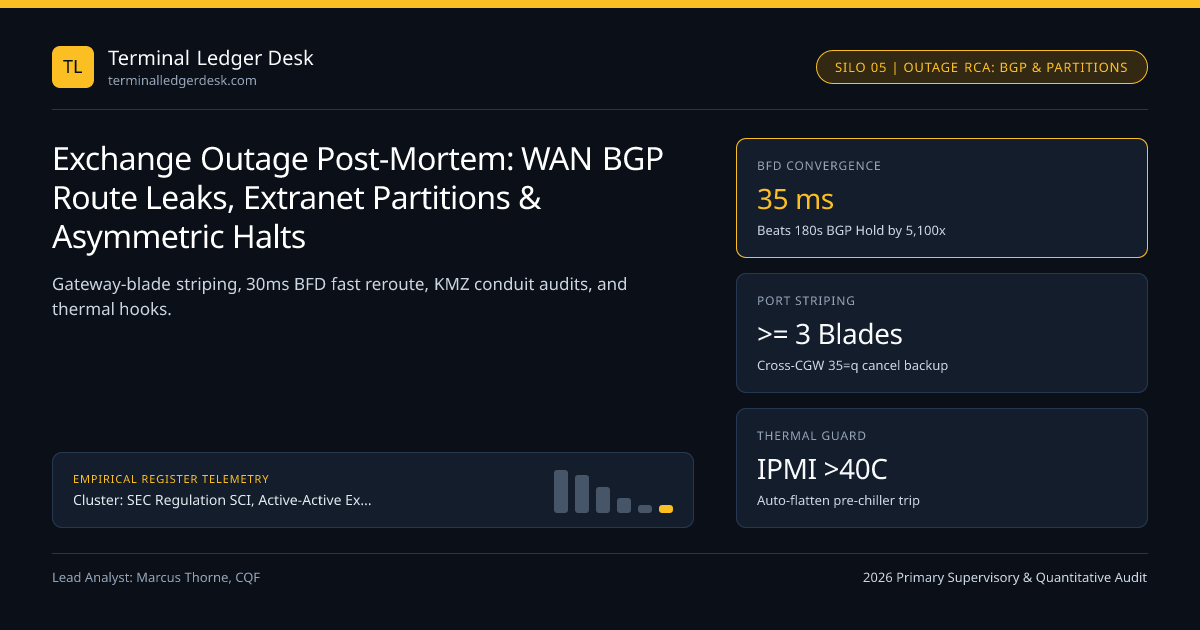
- Hardware BFD + PIC Edge FRR: (3 * 10 ms) + 5 ms = 35 ms (5,147x faster recovery!)
- Market Fairness Halt Predicate (Exchange Market Operations):
- HALTSEGMENT IFF (DisconnectedVenueGatewayVolumeShare >= 0.25) OR (ActiveRegisteredMarketMakers < Kminquorum)
Multi-Gateway Sharding & Carrier-Diverse Extranet Design for Trading Desks#
How do top proprietary desks and prime brokers survive a gateway-slice crash or extranet carrier outage inside Equinix NY4/LD4 and CME Aurora DC3 without interruption?
- Stripe Sessions Across Disjoint Exchange Gateway Pods: Never allocate all 8 of your
CME iLink 3orNasdaq OUCHports on the same gateway IP subnet/CGW! Request port assignments striped across at least 3 physically distinct Exchange Gateway Blades—and keep an idle `35=q` Purge Session on a fourth blade so you can cancel orders entered on a hung gateway! - True Layer-1 Path & Carrier Diversity (
Zero Shared Manholes): Pair your primary10GbEcolocation cross-connect or Dark Fiber (Carrier ANorthern route) with an independent secondary extranet (Carrier BSouthern route or microwave/cloud-direct backup) verified via KMZ physical fiber route maps! - RPKI Origin Validation & BFD (
Bidirectional Forwarding Detection): Run3-pkt x 10ms = 30mshardwareBFDacross WAN links (default BGPHoldTimer = 90–180 secondsis3,000xtoo slow during market hours!).
Thermal Telemetry & Automatic Rack Shutdown Hooks#
After the 2024 colocation chiller outage, leading colocated firms wired IPMI / BMC inlet-air temperature sensors (> 36°C warning, > 41°C critical) directly into their Drop-Copy shadow kill switches: if hall cooling fails, the trading box gracefully fires 35=q, verifies Open_Orders == 0, and migrates quoting to DR minutes before thermal trip! Model unhedged outage gap risk in our Terminal Margin VaR & ES Calculator.
Frequently asked questions
Can Session B cancel resting orders that were originally submitted on hung Session A?
Yes—if configured in advance! On CME iLink 3, Cboe Purge Ports, Eurex T7, and Nasdaq, granting Firm/Account-wide MassActionScope (or sharing a Trading Group / Executing Firm authorization) lets healthy Session B on Gateway #4 immediately purge every resting order submitted by hung Session A on Gateway #1!
How do two "redundant" telecom carriers accidentally go down from a single backhoe strike?
Carrier resale and last-mile conduit sharing! Carrier B frequently leases dark fiber from Carrier A across the final 2 km entering Equinix Secaucus or Slough, or crosses the exact same river bridge. Always demand physical Layer-1 KMZ path files and verify zero shared PoPs or trenches.
Why did the June 2024 Aurora data-center cooling incident become a global case study in exchange resilience?
When chilled-water cooling failed at the CyrusOne Aurora facility outside Chicago on June 3, 2024, rising server room temperatures disrupted CME Globex and EBS FX markets for hours—accelerating industry adoption of thermal pre-shutdown flatten hooks and hybrid/geographic multi-site readiness.
How does RPKI (Resource Public Key Infrastructure) protect financial extranets from BGP route leaks?
When a telecom ISP in Asia or Eastern Europe accidentally announces a /24 prefix belonging to a financial extranet or cloud provider, routers enforcing RPKI Route Origin Authorizations (ROAs) cryptographically reject the invalid AS-origin announcement instead of black-holing trading traffic halfway around the globe.
Publication record
- Published
- 13 November 2026
- Updated
- 14 November 2026
- Author
- Marcus Thorne, CQF
- Review
- Review not recorded
- Automated fact check
- Passed in the stored pipeline record
- Source URLs
- 3 recorded
AI assistance recorded: anthropic/claude-opus-4.6. This field does not establish human review or source verification.
Academic & Institutional Attribution
Cite This Research & Embed Live Data Card
Standard academic & institutional research paper citation format.
Marcus Thorne, CQF. (2026, November 14). Exchange Outage Post-Mortem: WAN BGP Route Leaks, Extranet Partitions & Asymmetric Halts. Terminal Ledger Desk. https://terminalledgerdesk.com/reports/postmortem-anatomy-cloud-wan-bgp-partition-in-derivative-gatewaysRelated Reg Sci Disaster Recovery Outage Rca & Institutional Briefings
Explore Reg Sci Disaster Recovery Outage Rca Hub (20) →Reg Sci Disaster Recovery Outage Rca
SEC Regulation SCI, Active-Active Exchange Failover & Outage Post-Mortem Engineering GuideReg Sci Disaster Recovery Outage Rca
CTA & UTP SIP Market-Data Processor Failover: NBBO Staleness, Reg NMS Rule 611 & Direct FeedsReg Sci Disaster Recovery Outage Rca
SEC Regulation SCI Rule 1002: Incident Triage Trees, Immediate SEC Notification & De Minimis Safe HarborReg Sci Disaster Recovery Outage Rca
Clearly Erroneous Executions (CEE) & Trade Bust Bands: Post-Outage Unwind & Hedge Risk MathReg Sci Disaster Recovery Outage Rca
Capacity Stress Testing & Microburst Telemetry Under SEC Regulation SCI Rule 1001(a)Reg Sci Disaster Recovery Outage Rca
Hybrid-Cloud Exchange Migration: AWS Outposts, Google Cloud & the Microsecond Determinism GapReg Sci Disaster Recovery Outage Rca
Graceful Market-Halt Reopening Architecture: Cancel-Only Purge Windows & Call-Auction UncrossReg Sci Disaster Recovery Outage Rca
EU DORA (Regulation 2022/2554) vs US SEC Regulation SCI: Global ICT Operational Resilience ComparedMarket Insights
Nasdaq Jumps After CoreWeave EarningsMarket Insights
Nasdaq-Backed Payward Launches Tokenized Versions of European StocksMarket Insights
After LMAX, Standard Chartered Scales Crypto Prime Brokerage Playbook to 24X - TradingViewBroker Fees and Calculators
Standard Chartered Expands Prime Brokerage Partnership With 24X to Cover BTC and ETH - TradingView
Terminal Ledger Desk Data, Benchmarks & Contributor Records
CC BY 4.0 Open Data
Open Institutional Datasets (CSV / JSON) →
Download desk-compiled quantitative series & schemas.
2026 Reference Matrix
2026 Institutional Benchmarks & Thresholds →
Statutory capital, clearing, margin & rate conventions.
Editorial Records
Authors & Review Records →
View named contributors where those records are available.
Complete Index
Master Research & Dossier Archive →
Browse all published briefings by topic pillar & date.