
Mifid Rts6 Pretrade Kill Switch Controls
NMS Limit Up-Limit Down (LULD) Plan: Reference Price Bands, Limit States & 5-Minute Pauses
Enacted to prevent a repeat of the May 2010 Flash Crash, the NMS Limit Up-Limit Down Plan dynamically walls off every US stock inside rolling 5-minute SIP price bands—triggering 15-second Limit State timers and 5-minute halts.
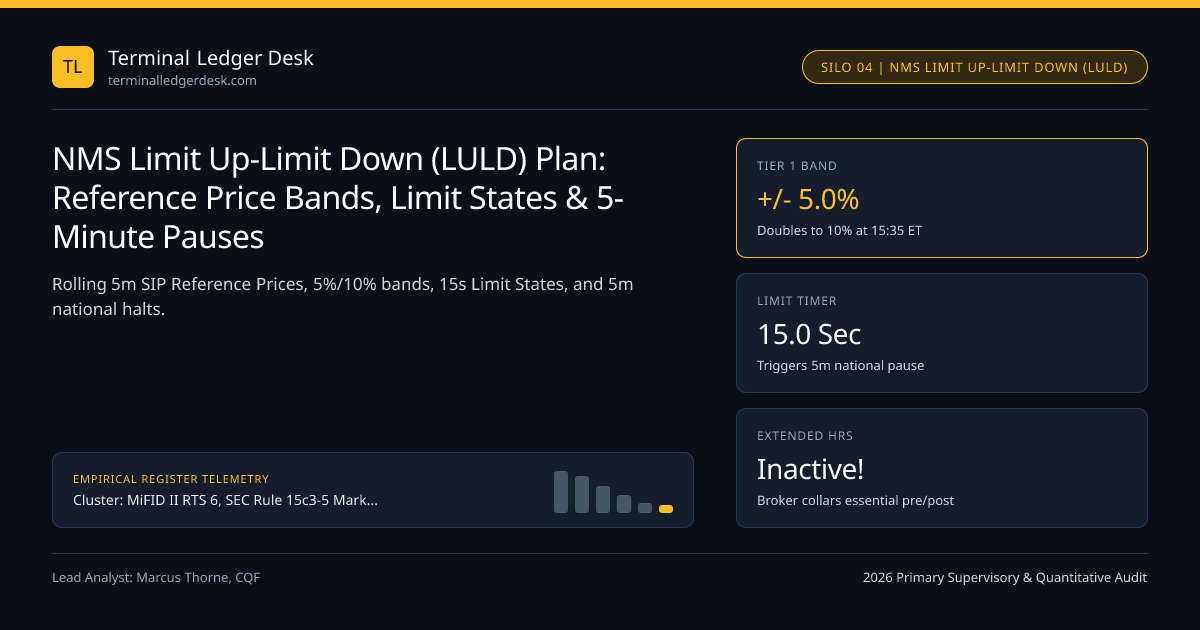
During the May 6, 2010 Flash Crash, blue-chip S&P 500 stocks like Procter & Gamble and Accenture traded down 35% to 99% in seconds while uncoordinated single-exchange halts routed panic market orders onto thin alternative venues. Today, the NMS Plan to Address Extraordinary Market Volatility (Limit Up-Limit Down / LULD Plan) binds every US equity exchange (NYSE, Nasdaq, Cboe, IEX, MEMX) and dark-pool ATS to identical SIP-broadcast Upper and Lower Price Bands: no trade may execute outside the LULD bands on any venue in America!
Rolling 5-Minute Reference Price (P_ref) & Tier 1 vs Tier 2 Band Percentages#
Coordinated by the Consolidated Tape Association (CTA/CQ) and UTP Securities Information Processors (SIPs) under SEC oversight (contextualized in our MiFID II RTS 6 & SEC 15c3-5 Architecture Hub), LULD recalculates each stock Reference Price continuously between 09:30 and 16:00 ET:
- Initial Reference Price: Primary Listing Exchange Opening Price (or Previous Close if opened on quotes).
- Rolling Update Rule: Every 30 seconds, the SIP computes the arithmetic mean (
Pro-Forma Reference Price) of eligible trades over the preceding 5 minutes. To avoid noisy band churn, the SIP publishes a new Reference Price only if the 5-minute mean moved by>= 1.0%from the currentP_ref! - Tier 1 NMS Stocks (S&P 500, Russell 1000, and flagship ETPs):
5.0%band for stocks> $3.00(20%for$0.75–$3.00;MIN($0.15, 75%)below$0.75). - Tier 2 NMS Stocks (All other NMS equities & leveraged ETPs):
10.0%band above$3.00! (Note: Bands double* during the final 25 minutes15:35–16:00 ETfor Tier 1> $3.00->10%, and Tier 2<= $3.00)*!
Straddle State vs Limit State vs 5-Minute LULD Trading Pause#
Algorithmic order routers must parse SIP LULD Indicator flags (A through P on CQS/UQDF) accurately because Straddle States and Limit States behave very differently:
- Straddle State: One side of the National Best Bid and Offer (
NBBO) rests at the price band while the contra side remains executable (e.g. NBB = Lower_Band $95.00, NBO = $95.12), OR one side has zero national quotes inside the bands. Trading continues normally inside the bands, though Primary Listing Exchanges may elect to pause. - Limit State (
15-Second Countdown): All national offers hit the Lower Price Band (NBO == Lower_Band, meaning nobody is willing to buy at or above$95.00while sellers queue at$95.00), OR all national bids hit the Upper Price Band (NBB == Upper_Band)! - 5-Minute Trading Pause: If the stock does not exit the Limit State naturally within
15.0 seconds, the Primary Listing Exchange (NYSE,Nasdaq,Cboe BZX) declares a mandatory 5-Minute LULD Trading Pause across all US exchanges, ATS dark pools, and wholesale internalizers simultaneously, reopening via a formal Call Auction!
| NMS Security Category | Previous Close Price Tier | 09:30 – 15:35 ET Band | 15:35 – 16:00 ET Close Band | Primary Reopen Mechanism |
|---|---|---|---|---|
Tier 1 (S&P 500, Russell 1000, Core ETPs) | > $3.00 | +/- 5.0% | +/- 10.0% (2x close!) | Primary Listing Exchange 5-min LULD Auction |
Tier 2 (Other NMS Stocks & 2x/3x ETPs) | > $3.00 | +/- 10.0% | +/- 10.0% (No doubling!) | Primary Listing Exchange 5-min LULD Auction |
| Tier 1 & Tier 2 Low-Priced | $0.75 to $3.00 | +/- 20.0% | 20% (Tier 1) / 40% (Tier 2) | Primary Listing Exchange 5-min LULD Auction |
Market-Wide Circuit Breaker (MWCB) | S&P 500 Index Decline | -7% (L1), -13% (L2) -> 15m Halt | -20% (L3 anytime) -> Day Halt | Coordinated Market-Wide Reopening Auctions |
NMS LULD Band Percentage Matrix by Security Tier & Price Level#
Exact SEC-approved LULD percentage bands across Tier 1 and Tier 2 NMS securities during regular hours and the 15:35–16:00 ET close.
- Update Prefnew = ProFormaRefPrice(t) IFF |ProFormaRefPrice(t) - Prefcurrent| / Prefcurrent >= 0.01 (1.0%)
- UpperBand = FLOORTOPENNY( Pref * (1 +Pct_Band) ) [or Half-Penny rounding rules per Plan]
- LowerBand = CEILTOPENNY( Pref * (1 - Pct_Band) )
- Worked Tier-1 Example (Pref = $184.50, PctBand = 5.0%):
- Raw Bands: $184.50 * 1.05 = $193.725 | $184.50 * 0.95 = $175.275 -> Band Envelope = [$175.28, $193.73]!
Order Re-Pricing ("Sliding") vs Immediate Cancel on LULD Band Collision#
What happens inside an exchange matching engine when an algo sends Buy Limit @ $106.00 while the SIP Upper_Band sits at $105.00? Under the Pre-Trade Risk Control Standard, exchanges execute order-specific handling:
- IOC / FOK Orders: Execute all resting liquidity up to
$105.00, then immediately cancel any unfilled remainder rather than trading at$105.01! - Day / Displayable Limit Orders (
Price-Sliding): Unless the trader explicitly flaggedCancel-on-LULD-Collar,Nasdaq,NYSE, andCboeslide/re-price the aggressive$106.00buy limit to display and execute no higher than$105.00(Upper_Band), automatically sliding it upward to$106.00if the rolling LULD band later rises! - Warning for Market Makers: Never forget a price-slid order sitting pinned at
$105.00—as soon as the 5-minute Reference Price shifts upward, your slid order leaps aggressively into the new band!
Market-Wide Circuit Breakers (MWCB Levels 1, 2 & 3) vs Single-Stock LULD#
Alongside single-stock LULD, every execution gateway must handle S&P 500 Index Market-Wide Circuit Breakers (MWCB, FINRA Rule 6121.02 / NYSE Rule 7.12): -7% (Level 1) and -13% (Level 2) declines from prior S&P 500 close before 15:25 ET halt every US stock and equity option for 15 minutes, while -20% (Level 3) at any time halts trading for the remainder of the day!
Set broker pre-trade fat-finger collars strictly inside LULD bands (dynamic NBBO price collars), review derivatives equivalents in CME Globex Velocity Logic, and model gap-reopen tail risk in our Terminal Margin VaR & ES Calculator.
Frequently asked questions
Does LULD operate during the 04:00–09:30 ET Pre-Market or 16:00–20:00 ET After-Hours sessions?
No! Under current NMS Plan rules, LULD Price Bands operate strictly during Regular Trading Hours (09:30 to 16:00 ET). During Extended Hours (04:00–09:30 and 16:00–20:00 ET), liquidity is much thinner and LULD bands are inactive—making tight broker-side dynamic NBBO/Last price collars doubly vital!
Why did Amendment 10/18 eliminate double-wide LULD bands at the 09:30 ET Market Open?
Originally, LULD doubled bands from 09:30 to 09:45 ET (10% for Tier 1, 20% for Tier 2), which inadvertently contributed to extreme ETF flash dislocations on August 24, 2015! Regulators eliminated opening double-wide bands while anchoring initial P_ref cleanly to the Primary Listing Exchange Opening Auction.
What happens to listed single-stock options on Cboe/ISE when the underlying stock enters an LULD Pause?
Every US options exchange immediately halts trading in all overlying equity options classes whenever the underlying NMS stock enters a 5-minute LULD Trading Pause, canceling or queuing option quotes according to venue Mass Quote Risk rules until the underlying stock reopens.
What if an illiquid stock still cannot clear imbalance after the initial 5-minute LULD Pause ends?
Under harmonized reopen rules adopted by NYSE, Nasdaq, and Cboe, if imbalance remains outside auction collars at the 5-minute mark, the Primary Listing Exchange automatically extends the LULD Auction in 5-minute increments while widening auction collars progressively until equilibrium clears.
Publication record
- Published
- 13 November 2026
- Updated
- 14 November 2026
- Author
- Marcus Thorne, CQF
- Review
- Review not recorded
- Automated fact check
- Passed in the stored pipeline record
- Source URLs
- 3 recorded
AI assistance recorded: anthropic/claude-opus-4.6. This field does not establish human review or source verification.
Academic & Institutional Attribution
Cite This Research & Embed Live Data Card
Standard academic & institutional research paper citation format.
Marcus Thorne, CQF. (2026, November 14). NMS Limit Up-Limit Down (LULD) Plan: Reference Price Bands, Limit States & 5-Minute Pauses. Terminal Ledger Desk. https://terminalledgerdesk.com/reports/luld-limit-up-limit-down-nms-price-bands-straddle-state-pause-logicRelated Mifid Rts6 Pretrade Kill Switch Controls & Institutional Briefings
Explore Mifid Rts6 Pretrade Kill Switch Controls Hub (20) →Mifid Rts6 Pretrade Kill Switch Controls
MiFID II RTS 6, SEC Rule 15c3-5 Market Access & Inline Pre-Trade Kill-Switch Architecture GuideMifid Rts6 Pretrade Kill Switch Controls
CME Globex Velocity Logic & Dynamic Circuit Breakers: Sub-Second Futures Volatility GuardsMifid Rts6 Pretrade Kill Switch Controls
CFTC Regulation 1.73: FCM Automated Pre-Execution Clearing Credit Screens & Give-Up LimitsMifid Rts6 Pretrade Kill Switch Controls
Options Market-Maker Mass Quote Risk (MMR): Rolling Delta, Vega & Percentage-Swept Purge TriggersMifid Rts6 Pretrade Kill Switch Controls
Runaway Loop & Quote-Stuffing Detection: Stateful Duplicate-Order & Reject-Storm GatesMifid Rts6 Pretrade Kill Switch Controls
SEC Regulation SHO Pre-Trade Gates: Rule 203(b) Locate Accounting & Rule 201 Short-Sale Circuit BreakersMifid Rts6 Pretrade Kill Switch Controls
Drop-Copy Shadow Kill Switches: Out-of-Band Clearing Risk Monitors & Session Disconnect ArchitectureMifid Rts6 Pretrade Kill Switch Controls
Algorithmic Trading Software Deployment Gates: Canary Releases, SHA-256 Attestation & Config DiffsReg Sci Disaster Recovery Outage Rca
Clearly Erroneous Executions (CEE) & Trade Bust Bands: Post-Outage Unwind & Hedge Risk MathReg Sci Disaster Recovery Outage Rca
Capacity Stress Testing & Microburst Telemetry Under SEC Regulation SCI Rule 1001(a)Reg Sci Disaster Recovery Outage Rca
Hybrid-Cloud Exchange Migration: AWS Outposts, Google Cloud & the Microsecond Determinism GapReg Sci Disaster Recovery Outage Rca
Graceful Market-Halt Reopening Architecture: Cancel-Only Purge Windows & Call-Auction Uncross
Terminal Ledger Desk Data, Benchmarks & Contributor Records
CC BY 4.0 Open Data
Open Institutional Datasets (CSV / JSON) →
Download desk-compiled quantitative series & schemas.
2026 Reference Matrix
2026 Institutional Benchmarks & Thresholds →
Statutory capital, clearing, margin & rate conventions.
Editorial Records
Authors & Review Records →
View named contributors where those records are available.
Complete Index
Master Research & Dossier Archive →
Browse all published briefings by topic pillar & date.