
Mt5 Ctrader Bridge Dealer Architecture
MT5 & cTrader Access Server Proxies: DDoS Scrubbing, Anti-Sniffing & Backbone Routing
Exposing a core Trade Server IP directly to the public internet invites 400 Gbps volumetric DDoS extortion; multi-region Access Server proxies cloak origin racks inside LD4/NY4 while accelerating TLS handshakes over private backbones.
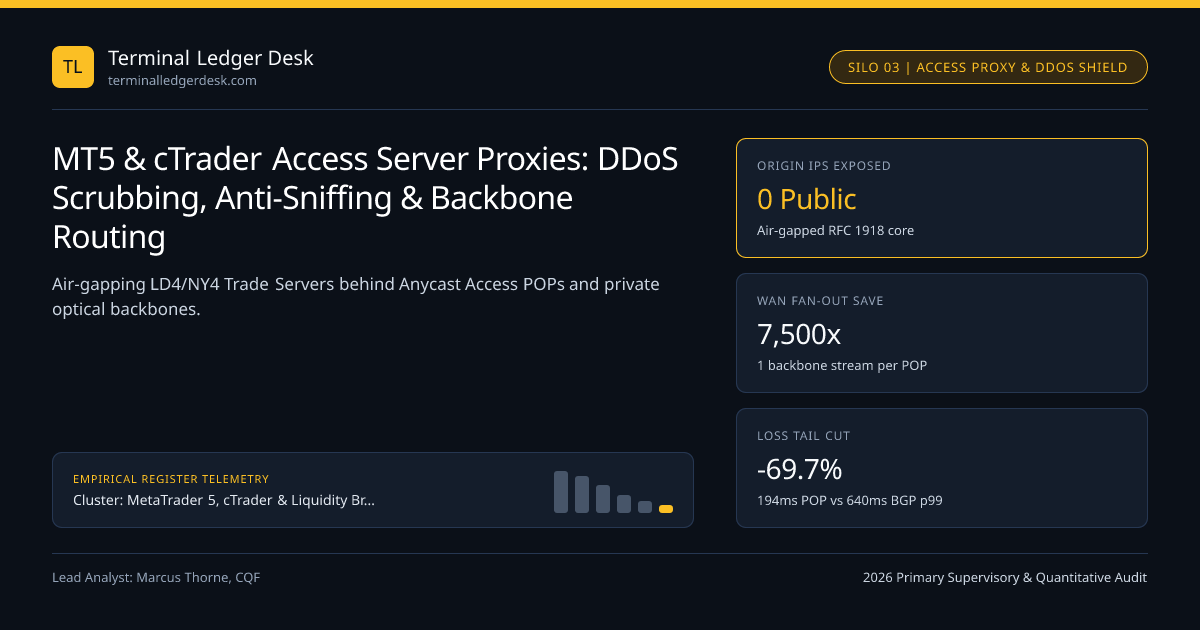
During peak volatile sessions, retail and institutional FX/CFD brokers are prime targets for ransom Layer-4 SYN/UDP floods (100–600 Gbps) and Layer-7 login-exhaustion botnets aimed at knocking traders offline during margin calls. If a broker ever exposed the real IPv4 address of its primary MetaTrader 5 Trade Server or Spotware cTrader core inside Equinix LD4, a single volumetric flood would saturate its cross-connects and sever Liquidity Provider FIX sessions! Production architectures enforce strict Zero-Origin-Exposure Air-Gapping via globally distributed Edge Access Server & Proxy Fleets.
Zero-Origin-Exposure Topology: Cloaking the Core Trade Server IP#
In a hardened MT5 or cTrader cluster, the Main Trade Server and Backup Server reside on RFC 1918 private VLANs inside Equinix LD4 (Slough) or NY4 (Secaucus) with zero public inbound internet routes (0.0.0.0/0 deny)! Only whitelisted IPsec / WireGuard / private Cloud Connect tunnels from 8 to 24 regional Access Servers (Frankfurt, London, New York, Tokyo, Singapore, Sydney, Sao Paulo, Hong Kong) can reach the Trade Server.
Suppose a botnet launches a 300 Gbps UDP flood against Access-Singapore-02: Cloudflare Spectrum / AWS Shield / Voxility BGP scrubbing absorbs volumetric junk at the edge, and even if Access-Singapore-02 degrades completely, client MT5 terminals automatically fail over within 800 milliseconds to Access-HongKong-01 or Access-Tokyo-01 while the London LD4 Trade Server and LP bridges continue matching stop-losses and limit orders at 0.4 ms uninterrupted!
Why Private Leased Backbones Beat Public Internet BGP by 35–90 ms#
Beyond security, edge Access Servers dramatically accelerate long-haul client connections! When a trader in Jakarta or Mumbai connects directly over consumer ISP BGP to London, packets suffer: (1) 3-RTT TCP + TLS/proprietary handshake (3 x 190 ms = 570 ms just to connect!), (2) congested public transit peering hops, and (3) aggressive TCP congestion window resets on Wi-Fi packet loss.
When that same trader terminates TCP locally at Access-Singapore (12 ms away):
- Local Wi-Fi packet loss retransmits across a
12 msloop instead of a190 msintercontinental loop (15.8x faster recovery!). - From
Access-SingaporetoLD4 Trade Core, orders ride a pre-established, warm, non-congested persistent multiplexed tunnel over AWS Global Accelerator, Cloudflare Argo, or Equinix Fabric private optical waves—analyzed alongside our MT5, cTrader & Liquidity Bridge Architecture Guide.
| Edge POP Region | Primary Cloud / Carrier Location | Typical Local User Ping | Private Backbone RTT to LD4 | Primary Protection Role |
|---|---|---|---|---|
Europe West (EMEA-1) | Frankfurt (FR2) / Amsterdam | 4 – 18 ms | 9.9 ms | DACH / EU retail + cTrader Web |
North America (US-East) | Secaucus (NY4) / Ashburn (IAD) | 5 – 28 ms | 58.5 ms (EXA Express) | Americas + LatAm north hub |
APAC South (SG-1) | Equinix SG1 / AWS ap-southeast-1 | 3 – 32 ms (SEA/IN) | 154.0 ms (Marseille/Low-lat) | High-growth SEA mobile Wi-Fi shield |
APAC East (TY-1 / HK-1) | Tokyo (TY3) / Hong Kong (HK1) | 3 – 22 ms | 158 – 182 ms | High-volume EA / FX retail edge |
Global Access Node Placement, DDoS Mitigation & Backbone Matrix#
Engineering specifications for global multi-POP broker edge fleets serving APAC, EMEA, and Americas client bases.
- BWwanwithaccess = 1tunnel * Rtickssec * Lcompressedbytes * 8
- Tlossrecoverysaved = Pwifiloss * (RTTintercontinental - RTTlocalpop)
- Worked Bandwidth & Packet-Loss Savings (5,000 Tokyo Clients, 200 ticks/sec across Market Watch, 48B/tick):
- Without Access POP = 5,000 * 200 * 48 * 8 = 384.0 Mbps continuous London-to-Tokyo transit!
- With Access POP = 1 * 200 * 32 * 8 = 0.051 Mbps (51.2 Kbps -> 7,500x backbone compression!).
Anti-Sniffing Protocol Encryption, ECDHE/RSA Keys & Brute-Force Bans#
Unlike plaintext ASCII protocols, both MT5 (AES-256 encrypted compressed frames + optional extended RSA-2048 client X.509 certificates) and cTrader (TLS 1.3 over Protobuf/WebSocket) implement Anti-Sniffing Port Obfuscation & Dynamic Rate Bans directly on the Access Server:
- Credential Stuffing Quarantine: Access nodes track failed login attempts per
/24IPv4 subnet and/48IPv6 prefix at the edge, dropping brute-force bots in RAM before a single authentication RPC ever touches the core Trade database! - Quote Fan-Out Coalescing (
1-to-5,000Edge Broadcast): Instead of sending5,000duplicate EUR/USD ticks from London to Tokyo over WAN (wasting 40 Mbps), the Trade Server sends 1 compressed tick across the backbone toAccess-Tokyo, which fans it out locally to all5,000Japanese terminals! Compare server role isolation in MT4 single-process vs MT5 distributed nodes.
Auditing Edge Failover Under DORA & SEC / FCA Operational Resilience#
European DORA (Regulation EU 2022/2554) and UK FCA PS21/3 operational resilience rules require brokers to conduct live quarterly chaos drills killing primary Access POPs during simulated load while verifying zero orphaned client orders.
Pair hardened server access with client-side security from our client terminal binary hardening & vault guide, size volatility shock buffers in the Terminal Margin VaR & ES Calculator, and explore the MT5, cTrader & Bridge Topic Hub.
Frequently asked questions
How do attackers try to discover a broker hidden Trade Server IP behind Access Servers?
Attackers probe misconfigured historical DNS records, outbound CRM webhook emails, MQL5 WebRequest callbacks, or unproxied Manager API ports. Hardened brokers route all outbound administrative webhooks through separate NAT gateways in a completely different Autonomous System (ASN).
If an Access Server crashes while my Market order is in flight, is my order executed twice?
Each client order frame carries a client-assigned request/ticket correlation ID; if the terminal fails over to a backup Access Server before receiving an acknowledgement, the Trade Server deduplicates or reports current order status rather than blindly double-executing.
Should I pick the Access Server closest to my home PC or closest to London LD4?
From a home PC or mobile phone, always pick the Access Server with the lowest ping to YOU (e.g., Singapore from Asia) so local TCP loss recovers quickly and rides the broker fast private backbone; for an automated EA, rent a VPS directly inside LD4/NY4 next to the Trade Server!
How does Spotware cTrader Proxy Cloud handle regional routing compared to MT5?
Spotware operates an automated global AWS/bare-metal Proxy Cloud mesh of 100+ edge nodes that dynamically steers cTrader Desktop, Web, Mobile, and Open API Protobuf clients to the healthiest lowest-RTT proxy path into the LD4/NY4 host.
Publication record
- Published
- 14 November 2026
- Updated
- 14 November 2026
- Author
- Marcus Thorne, CQF
- Review
- Review not recorded
- Automated fact check
- Passed in the stored pipeline record
- Source URLs
- 3 recorded
AI assistance recorded: anthropic/claude-opus-4.6. This field does not establish human review or source verification.
Academic & Institutional Attribution
Cite This Research & Embed Live Data Card
Standard academic & institutional research paper citation format.
Marcus Thorne, CQF. (2026, November 14). MT5 & cTrader Access Server Proxies: DDoS Scrubbing, Anti-Sniffing & Backbone Routing. Terminal Ledger Desk. https://terminalledgerdesk.com/reports/mt5-access-server-ddos-edge-proxy-anti-sniffing-tls-routing-designRelated Mt5 Ctrader Bridge Dealer Architecture & Institutional Briefings
Explore Mt5 Ctrader Bridge Dealer Architecture Hub (20) →Mt5 Ctrader Bridge Dealer Architecture
MetaTrader 5, cTrader & Liquidity Bridge Server Topology & Execution Logs GuideMt5 Ctrader Bridge Dealer Architecture
Liquidity Bridge Architecture: oneZero Hub, PrimeXM XCore & Centroid DatapathsMt5 Ctrader Bridge Dealer Architecture
A-Book STP, B-Book Internalization & C-Book Hybrid Dealing Desk ClassifiersMt5 Ctrader Bridge Dealer Architecture
Virtual Dealer Plugins vs True Market Execution: Auditing Asymmetric SlippageMt5 Ctrader Bridge Dealer Architecture
MT5 Execution Modes & Fill Policies: Instant, Request, Market, Exchange & IOC/FOKMt5 Ctrader Bridge Dealer Architecture
Decoding MT5 & cTrader Client Journal Logs: Millisecond TCA, Requotes & Off QuotesMt5 Ctrader Bridge Dealer Architecture
Tick-Filtering Gateways: Off-Market Spike Suppression & Quote Aggregation ThrottlesMt5 Ctrader Bridge Dealer Architecture
Spotware cTrader Open API (Protobuf) vs cTrader FIX 4.4: Quotas, Auth & LatencyMifid Rts6 Pretrade Kill Switch Controls
Inline FPGA Pre-Trade Risk Gateways: Cut-Through FCS Stomping & Sub-Microsecond Credit CollarsMifid Rts6 Pretrade Kill Switch Controls
Dynamic Pre-Trade Price Collars & Fat-Finger Guards: NBBO Reference Anchoring vs Static TicksMifid Rts6 Pretrade Kill Switch Controls
Gross vs Net Intraday Pre-Trade Credit Accounting: Open-Order Exposure & Cancel-Replace InflationMifid Rts6 Pretrade Kill Switch Controls
Exchange Cancel-On-Disconnect (COD): Heartbeat Grace Windows Across CME, Nasdaq & Eurex
Terminal Ledger Desk Data, Benchmarks & Contributor Records
CC BY 4.0 Open Data
Open Institutional Datasets (CSV / JSON) →
Download desk-compiled quantitative series & schemas.
2026 Reference Matrix
2026 Institutional Benchmarks & Thresholds →
Statutory capital, clearing, margin & rate conventions.
Editorial Records
Authors & Review Records →
View named contributors where those records are available.
Complete Index
Master Research & Dossier Archive →
Browse all published briefings by topic pillar & date.