
Reg Sci Disaster Recovery Outage Rca
SEC Regulation SCI, Active-Active Exchange Failover & Outage Post-Mortem Engineering Guide
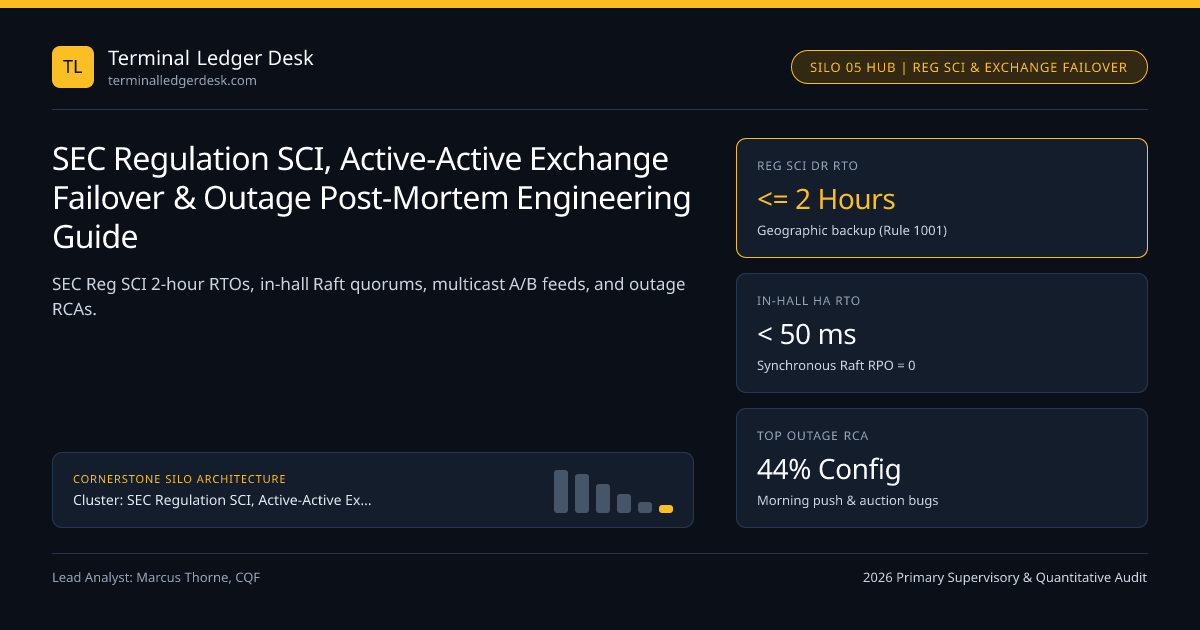
When a matching engine, SIP market-data processor, or clearing house halts, trillions in price discovery freeze; SEC Regulation SCI and EU DORA mandate 2-hour geographic failover, Raft determinism, and annual DR drills.
Between 2012 and 2014, a string of high-profile US market infrastructure failures—the Nasdaq Facebook IPO auction cross deadlock, the 3-hour Nasdaq UTP SIP "Flash Freeze" (August 22, 2013), and the BATS IPO matching-engine halt—proved that voluntary technology guidelines could no longer safeguard national securities markets. In response, the U.S. SEC enacted Regulation Systems Compliance and Integrity (Regulation SCI, 17 CFR 242.1000–1007), imposing binding federal engineering mandates on exchanges, SIPs, clearing agencies, FINRA, and high-volume ATS dark pools.
Statutory Scope of Regulation SCI (Rules 1000–1007) & EU DORA Convergence#
Under our HA Trading Failover Architecture, Regulation SCI divides mission-critical market infrastructure into SCI Systems (trading, clearance/settlement, order routing, market data, market regulation, and surveillance) and Critical SCI Systems (single points of failure such as consolidated SIPs and clearinghouses that face even tighter recovery SLAs):
- Geographic Backup & 2-Hour RTO: Analyzed in SEC Reg SCI Rule 1001 2-hour RTO & geographic DR mandates, annual SIFMA / FIA industry-wide October DR failover testing, and EU DORA (`2022/2554`) vs SEC Regulation SCI operational resilience.
- Capacity Stress, Notification & Forensics: Detailed in capacity stress testing & microburst telemetry under Reg SCI, Reg SCI Rule 1002 SEC incident notification & de minimis triage trees, and immutable WORM Rule 17a-4 PCAP incident forensics.
Inside Fault-Tolerant Matching Clusters: Raft Consensus, Event Replay & A/B Feeds#
How does an exchange matching 500,000 orders per second inside Equinix NY4/Carteret or CME Aurora DC3 survive a blade CPU crash in under 50 milliseconds with zero lost fills, AND survive a regional power grid collapse (Secaucus NJ -> Chicago Cermak) within 2 hours?
- In-Metro Microsecond High Availability: Contrasted in Raft & Paxos replicated state machines in matching clusters (LMAX Disruptor framework) and deterministic event-log replay: cold vs warm vs hot standby orderbooks.
- Network & Market-Data Redundancy: Covered in Multicast A/B feed arbitration & switch fault isolation, CTA & UTP SIP market-data processor failover & NBBO staleness rules, and BGP Anycast & DNS TTL pitfalls during broker DR IP cutovers.
| Failover Scope | Physical Distance | Replication Mechanism | Recovery Time (RTO) | Order-Book State Policy |
|---|---|---|---|---|
| In-Rack Blade Failover | < 30 meters (Same Hall) | Synchronous Aeron Raft / RDMA ring | 10 – 100 ms | 100% Bit-Exact State Preserved (RPO = 0) |
| Metro Campus Failover | 15 – 55 km (NJ Triangle) | Synchronous / Semi-sync DWDM optical log | 1 – 30 seconds | Matched fills preserved; in-flight unacked reconciled |
| Regional Reg SCI DR | > 400 – 1,200 km (NJ -> CHI) | Asynchronous WAN journal (~14 ms lag) | <= 2 Hours (Rule 1001) | Cancel open Day orders; confirm Last_Matched_Seq; Call Auction! |
Critical SCI (SIP / DTCC) | Geographically diverse | Dual hot-warm active processors | Substantially < 2 Hours | Deterministic sequence resume (CTA / UTP failover) |
Global Exchange Failover Tiers & Regulatory Recovery SLA Matrix#
Comparing metro HA failover, cross-region DR cutover, state-replication physics, and regulatory RTO/RPO ceilings.
- Why Cross-Country DR Cannot Run Synchronous Per-Order Quorum Without Destroying Colocation:
- In-Hall NY4/Carteret Raft (Distance = 0.05 km) -> RTT = 0.50 microseconds -> 500,000+ sequential commits/sec!
- Secaucus NJ <-> Chicago Cermak (Distance = 1,180 km fiber) -> RTT = ~13.95 milliseconds!
- Therefore: In-Hall runs Synchronous Raft (RPO = 0), while Chicago DR runs Asynchronous Pipelined Log Streaming
- paired with formal Open-Order Purge + Reconciled Trade Cutoff upon Regional Disaster Declaration!
Post-Mortem Root-Cause Anatomy of Famous Exchange Outages#
Every catastrophic exchange halt of the past decade taught systems engineers an unforgettable lesson in distributed state hazards (tracked live in our Outages & Halts Ledger):
- 32-Bit / 64-Bit Sequence & Epoch Overflows: Dissected in post-mortem anatomy of integer sequence wraparounds & timestamp overflows (
ASX CHESS,TSX,Euronextlessons). - Manual CSV & Opening-Cross Collar Bugs: Examined in post-mortem anatomy of opening-auction reference-collar cascade halts (
NYSE January 24, 2023disaster-recovery config table failure!). - Cloud WAN, BGP & Hybrid Determinism: Audited in post-mortem anatomy of cloud WAN & BGP partitions in derivative gateways and hybrid-cloud exchange migrations (`AWS Outposts` / `Google Cloud` determinism gaps).
Orderly Halt Unwinds: Reopening Auctions, Clearly Erroneous Busts & CCP Backlogs#
Recovering hardware is only half of an incident: venues and clearinghouses must cleanly reconcile broken executions via Clearly Erroneous Execution (`CEE`) bust bands, purge stale resting liquidity in graceful market-halt reopening call auctions, drain CCP FIXML trade-capture clearing backlogs, and proactively inject faults in staging chaos-engineering harnesses.
Quantify unhedged inventory VaR during a 2-hour exchange outage using our Terminal Margin VaR & ES Calculator, adjust strategy capital sizing in the Algorithmic Kelly Allocation Calculator, and explore all 20 resilience guides in the Reg SCI & Outage RCA Topic Hub.
Frequently asked questions
Which Alternative Trading Systems (ATS dark pools) are legally classified as "SCI ATSs" subject to Regulation SCI?
Under Rule 1000 of Regulation SCI, an NMS stock ATS crosses the SCI ATS threshold when during at least 4 of the preceding 6 calendar months it accounted for >= 5% in any single NMS stock (plus >= 0.25% total NMS market) OR >= 1% of aggregate average daily dollar volume across all NMS stocks.
Why can an exchange NOT preserve open resting Day orders seamlessly when failing over 1,200 km from New Jersey to Chicago?
During a sudden regional disaster destroying New Jersey power/telecoms, the asynchronous WAN stream to Chicago may lag by 5–20 milliseconds, and colocated NJ servers have died simultaneously. Leaving NJ market-maker quotes active in Chicago would expose blinded firms to catastrophic pick-off—so DR playbooks universally purge open Day orders and reopen via Call Auction!
Can a broker-dealer opt out of the annual SIFMA/FIA Reg SCI disaster-recovery test?
Not if designated! Rule 1004 requires every SCI entity to establish objective volume/clearing standards designating specific members/participants who are LEGALLY COMPELLED to connect to the backup DR site and execute test transactions during the annual coordinated test.
What is the difference between a standard "SCI System" and a "Critical SCI System"?
Critical SCI Systems (Rule 1000) are systems whose outage poses single-point systemic paralysis with no market substitute—specifically consolidated market-data SIPs (CTA/UTP/OPRA), clearing/settlement engines (NSCC/DTC/OCC), and primary listing reopeners—facing heightened SEC scrutiny and faster-than-2-hour recovery expectations.
Publication record
- Published
- 14 November 2026
- Updated
- 14 November 2026
- Author
- Marcus Thorne, CQF
- Review
- Review not recorded
- Automated fact check
- Passed in the stored pipeline record
- Source URLs
- 4 recorded
AI assistance recorded: anthropic/claude-opus-4.6. This field does not establish human review or source verification.
Academic & Institutional Attribution
Cite This Research & Embed Live Data Card
Standard academic & institutional research paper citation format.
Marcus Thorne, CQF. (2026, November 14). SEC Regulation SCI, Active-Active Exchange Failover & Outage Post-Mortem Engineering Guide. Terminal Ledger Desk. https://terminalledgerdesk.com/reports/sec-regulation-sci-exchange-disaster-recovery-outage-postmortem-hubRelated Reg Sci Disaster Recovery Outage Rca & Institutional Briefings
Explore Reg Sci Disaster Recovery Outage Rca Hub (20) →Reg Sci Disaster Recovery Outage Rca
SEC Regulation SCI Rule 1001(a): 2-Hour RTO & Geographically Diverse Backup Site ArchitectureReg Sci Disaster Recovery Outage Rca
Annual SIFMA & FIA Industry-Wide Disaster Recovery Test: End-to-End Member RunbookReg Sci Disaster Recovery Outage Rca
Raft & Paxos Replicated State Machines in Matching Engines: Zero-Loss Sub-Millisecond FailoverReg Sci Disaster Recovery Outage Rca
Deterministic Event-Log Replay: Cold vs Warm vs Hot Standby Order-Book ReconstructionReg Sci Disaster Recovery Outage Rca
Multicast A/B Market-Data Feed Arbitration: Air-Gapped Switch Fabrics & Microburst RecoveryReg Sci Disaster Recovery Outage Rca
Exchange Outage Post-Mortem Anatomy: 32-Bit Sequence Wraparounds & Timestamp Epoch OverflowsReg Sci Disaster Recovery Outage Rca
Exchange Outage Post-Mortem: Opening-Auction Reference-Price Errors & LULD Halt CascadesReg Sci Disaster Recovery Outage Rca
Exchange Outage Post-Mortem: WAN BGP Route Leaks, Extranet Partitions & Asymmetric HaltsFix Protocol Sbe Ouch Session Latency
FIX 4.4 ASCII Tag-Value Parsing Overhead vs SBE Zero-Copy Wire Struct LatencyFix Protocol Sbe Ouch Session Latency
CME iLink 3 SBE Session Architecture: UUID Negotiation, Establish & HMAC State MachineFix Protocol Sbe Ouch Session Latency
FIXT.1.1 Transport Independence & ApplVerID Routing in FIX 5.0 SP2 GatewaysFix Protocol Sbe Ouch Session Latency
FIX ResendRequest (35=2) vs SequenceReset-GapFill (35=4): Preventing Replay Storms
Terminal Ledger Desk Data, Benchmarks & Contributor Records
CC BY 4.0 Open Data
Open Institutional Datasets (CSV / JSON) →
Download desk-compiled quantitative series & schemas.
2026 Reference Matrix
2026 Institutional Benchmarks & Thresholds →
Statutory capital, clearing, margin & rate conventions.
Editorial Records
Authors & Review Records →
View named contributors where those records are available.
Complete Index
Master Research & Dossier Archive →
Browse all published briefings by topic pillar & date.