
Mt5 Ctrader Bridge Dealer Architecture
MetaTrader 5, cTrader & Liquidity Bridge Server Topology & Execution Logs Guide
Behind every retail and Prime-of-Prime trading terminal sits a multi-tier distributed server topology: edge DDoS Access nodes, core Trade/History ledgers, C++ Gateway API liquidity bridges, and Equinix LD4/NY4 FIX engines.
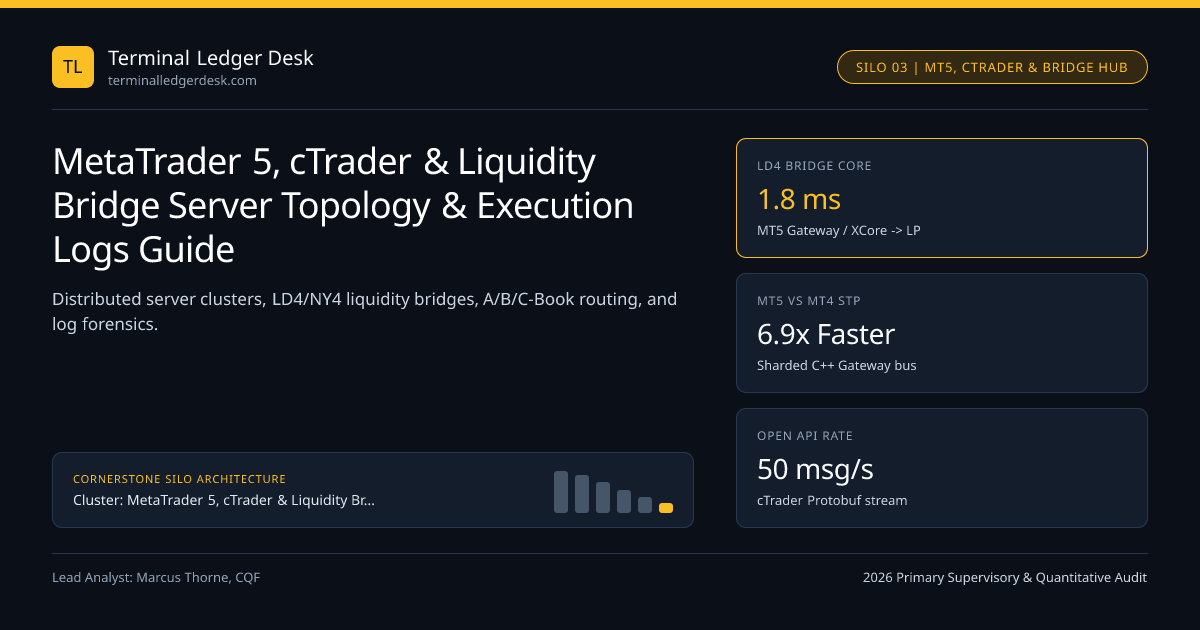
Clicking Buy Market inside a desktop or mobile trading terminal initiates a multi-hop distributed systems journey that few traders ever see: encrypted frames traverse geo-routed DDoS Access proxies, hit in-memory Trade Server margin engines, cross C++ Gateway/Manager memory buses into Prime-of-Prime liquidity bridges (oneZero Hub, PrimeXM XCore, Centroid), and convert into FIX 4.4 NewOrderSingle (35=D) sweeps inside Equinix LD4 or NY4. Understanding this full topology separates sub-15-millisecond institutional pass-through from lock-contended dealing plugins.
Monolithic MT4 vs Distributed MT5 & Cloud-Native cTrader Topologies#
Legacy MetaTrader 4 (mt4srv.exe released in 2005 for MT4 terminals) crammed tick distribution, client authentication, chart history, margin checking, and plugin hooks into a single monolithic Windows server process—forcing global brokers to spin up 15 disconnected Live-1..Live-15 silos once concurrent sockets crossed ~20,000.
By contrast, the MetaTrader 5 Server Cluster (MT5 software) and Spotware cTrader Architecture (cTrader software) decouple responsibilities across specialized bare-metal and cloud nodes:
- Cluster Scaling: Benchmarked in MT4 single-process lock contention vs MT5 distributed nodes and MT5 Access Server DDoS edge proxy & anti-sniffing TLS routing.
- Account & Fill Semantics: Audited across MT5 Instant, Request, Market & Exchange execution modes, MT5 Netting vs Hedging position ledgers, and Spotware cTrader Open API Protobuf vs FIX 4.4 rate limits.
Inside the Liquidity Bridge: oneZero, PrimeXM XCore, Centroid & C-Book Routing#
Neither MT5 nor cTrader speaks native multi-bank Tier-1 FX protocols out of the box without a Liquidity Aggregation Bridge (liquidity bridge engine) colocated inside LD4 (Slough), NY4 (Secaucus), or TY3 (Tokyo). Connecting to MT5 via the high-speed C++ Gateway API (IMTGatewaySink) rather than legacy polling Manager APIs shaves 4 to 18 milliseconds off every hedged ticket!
Inside the bridge, microsecond routing engines enforce:
- Tick Hygiene & Credit: Covered in oneZero, PrimeXM XCore & Centroid bridge datapaths, tick-filtering spike gateways & LP throttling, and Prime-of-Prime Net Open Position (NOP) credit gates.
- Dealing & Execution Integrity: Contrasted in A-Book STP, B-Book internalization & C-Book classifiers, Virtual Dealer plugin artificial delays vs true Market Execution, and OTC FX Last-Look symmetric vs asymmetric hold windows.
| Platform Architecture | Server Process Topology | Bridge Integration API | Position Accounting | Native Algo / API Stack |
|---|---|---|---|---|
| MetaTrader 4 (MT4 Terminal) | Single monolithic mt4srv | Legacy C++ Server / Manager Plugin | Ticket-based (Hedging only) | MQL4 (Single-threaded chart) |
| MetaTrader 5 (MT5 Terminal) | Distributed Access / Trade / History | High-Speed MT5 Gateway API | Both Netting & Hedging | MQL5 (OrderSendAsync) + Python |
| Spotware cTrader (cTrader) | Cloud Proxy Mesh + LD4 Core | Native Institutional Aggregator | Both Netting & Hedging | cBots (C# .NET) + Open API + FIX 4.4 |
| Proprietary ECN (JForex / FIX) | Microservice / Disruptor Cluster | Native Binary / FIX 4.4 Direct | Institutional Net / Sub-Account | Direct FIX 4.4 + Java/C++ SDK |
Multi-Asset Broker Platform & Bridge Architecture Comparison Matrix#
Comparing server concurrency, native protocol interfaces, and execution audit transparency across MT4, MT5, cTrader, and proprietary multi-asset stacks.
- Where (Asian Trader in Singapore -> Tokyo Access Proxy -> London LD4 Trade Core + LMAX Firm LP):
- Tclienttoaccesswan = 34.0 ms (Singapore fiber to Tokyo Access Node)
- Taccesstotradebackbone = 156.0 ms (Dedicated leased line / AWS Global Accelerator to Slough LD4)
- Tmarginbridge_core = 1.9 ms (MT5 Trade Server + PrimeXM XCore C++ Gateway)
- Tlpmatchandlastlook = 0.4 ms (Same-hall LMAX LD4 Firm No-Last-Look fill)
- Worked End-to-End Client Journal Ping vs Execution Time:
- Displayed Terminal Ping (Client <-> Tokyo Access Proxy ONLY!) = 34.0 ms
- Actual Order Journal Execution Time (
request -> accepted -> done) = 34.0 + 156.0 + 1.9 + 0.4 = 192.3 milliseconds!
Risk Engines, PAMM Allocation, Rollover Batches & Client Log Forensics#
When volatility explodes during US Non-Farm Payrolls or SNB/BOJ interventions, three internal broker subsystems face extreme concurrency load simultaneously:
- Tick-Driven Margin Liquidation: Analyzed in stop-out liquidation cascades & margin-level evaluation engines and swap rollover Triple-Wednesday tom-next batch settlement.
- Multi-Account Fan-Out: Detailed in PAMM / MAM / Copy-Trading proportional allocation latency and MQL5 Expert Advisor OnTick & OrderSendAsync queues.
- Forensic Journal Auditing: Every trader can verify exact millisecond round-trips and dealer rejection codes using our guide to decoding MT5 & cTrader client journal logs (`Requotes` vs `Off Quotes`).
WebAssembly Browser Rendering, Mobile Keepalives & Binary Hardening#
Modern multi-platform brokers must also deliver 60-FPS depth-of-market rendering and tamper-proof security outside Win32 desktops: explore WebAssembly / WebGL browser trading terminal frame budgets (WASM terminal standard), mobile background socket keepalive & APNs/FCM push execution, and client binary hardening & API credential vaults.
Regulated execution quality under UK FCA, NFA, and MAS requires pairing clean server topology with disciplined leverage sizing inside the Terminal Margin VaR & ES Calculator and Algorithmic Kelly Allocation Calculator. Browse all 20 architectural reports in the MT5, cTrader & Bridge Topic Hub.
Frequently asked questions
Why does my MT5 terminal show a 12ms ping on the status bar when orders take 165ms to execute?
The MT5/cTrader server selector displays ICMP/TCP RTT to the nearest geographic edge Access Server (e.g., Singapore or Frankfurt), whereas every trade request must still travel over the broker private backbone to the single authoritative Trade Server and Liquidity Bridge in London LD4 or New York NY4.
How can an algorithmic trader bypass edge Access Server hops completely?
Deploy your Expert Advisor, cBot, or FIX 4.4 engine on a Virtual Private Server (VPS) or bare-metal cross-connect physically inside the exact same Equinix data center (LD4 Slough or NY4 Secaucus) where your broker hosts its primary Trade Server and bridge—shrinking total execution RTT below 2–6 ms!
What is the architectural difference between Market Execution and Instant Execution in MT5?
In Instant Execution, the client terminal attaches a strict requested price and maximum deviation, allowing the server to return a Requote if prices moved. In true STP Market Execution, the order routes straight through the bridge to fill at live LP VWAP depth without requotes.
Why do liquidity providers prefer brokers running PrimeXM XCore or oneZero Hub in LD4?
Enterprise bridges enforce microsecond pre-trade Net Open Position (NOP) credit caps, filter corrupt LP price spikes, throttle excessive quote churn, and aggregate multi-venue depth into clean FIX 4.4 streams without leaking toxic unthrottled retail bursts.
Publication record
- Published
- 14 November 2026
- Updated
- 14 November 2026
- Author
- Marcus Thorne, CQF
- Review
- Review not recorded
- Automated fact check
- Passed in the stored pipeline record
- Source URLs
- 4 recorded
AI assistance recorded: anthropic/claude-opus-4.6. This field does not establish human review or source verification.
Academic & Institutional Attribution
Cite This Research & Embed Live Data Card
Standard academic & institutional research paper citation format.
Marcus Thorne, CQF. (2026, November 14). MetaTrader 5, cTrader & Liquidity Bridge Server Topology & Execution Logs Guide. Terminal Ledger Desk. https://terminalledgerdesk.com/reports/mt5-ctrader-liquidity-bridge-server-topology-execution-logs-guideRelated Mt5 Ctrader Bridge Dealer Architecture & Institutional Briefings
Explore Mt5 Ctrader Bridge Dealer Architecture Hub (20) →Mt5 Ctrader Bridge Dealer Architecture
MT4 Single-Process Lock Contention vs MT5 Distributed Server Cluster ScalingMt5 Ctrader Bridge Dealer Architecture
MT5 & cTrader Access Server Proxies: DDoS Scrubbing, Anti-Sniffing & Backbone RoutingMt5 Ctrader Bridge Dealer Architecture
Liquidity Bridge Architecture: oneZero Hub, PrimeXM XCore & Centroid DatapathsMt5 Ctrader Bridge Dealer Architecture
A-Book STP, B-Book Internalization & C-Book Hybrid Dealing Desk ClassifiersMt5 Ctrader Bridge Dealer Architecture
Virtual Dealer Plugins vs True Market Execution: Auditing Asymmetric SlippageMt5 Ctrader Bridge Dealer Architecture
MT5 Execution Modes & Fill Policies: Instant, Request, Market, Exchange & IOC/FOKMt5 Ctrader Bridge Dealer Architecture
Decoding MT5 & cTrader Client Journal Logs: Millisecond TCA, Requotes & Off QuotesMt5 Ctrader Bridge Dealer Architecture
Tick-Filtering Gateways: Off-Market Spike Suppression & Quote Aggregation ThrottlesMifid Rts6 Pretrade Kill Switch Controls
MiFID II RTS 6, SEC Rule 15c3-5 Market Access & Inline Pre-Trade Kill-Switch Architecture GuideReg Sci Disaster Recovery Outage Rca
SEC Regulation SCI, Active-Active Exchange Failover & Outage Post-Mortem Engineering GuideFix Protocol Sbe Ouch Session Latency
FIX 4.4 ASCII Tag-Value Parsing Overhead vs SBE Zero-Copy Wire Struct LatencyFix Protocol Sbe Ouch Session Latency
CME iLink 3 SBE Session Architecture: UUID Negotiation, Establish & HMAC State Machine
Terminal Ledger Desk Data, Benchmarks & Contributor Records
CC BY 4.0 Open Data
Open Institutional Datasets (CSV / JSON) →
Download desk-compiled quantitative series & schemas.
2026 Reference Matrix
2026 Institutional Benchmarks & Thresholds →
Statutory capital, clearing, margin & rate conventions.
Editorial Records
Authors & Review Records →
View named contributors where those records are available.
Complete Index
Master Research & Dossier Archive →
Browse all published briefings by topic pillar & date.