
Mifid Rts6 Pretrade Kill Switch Controls
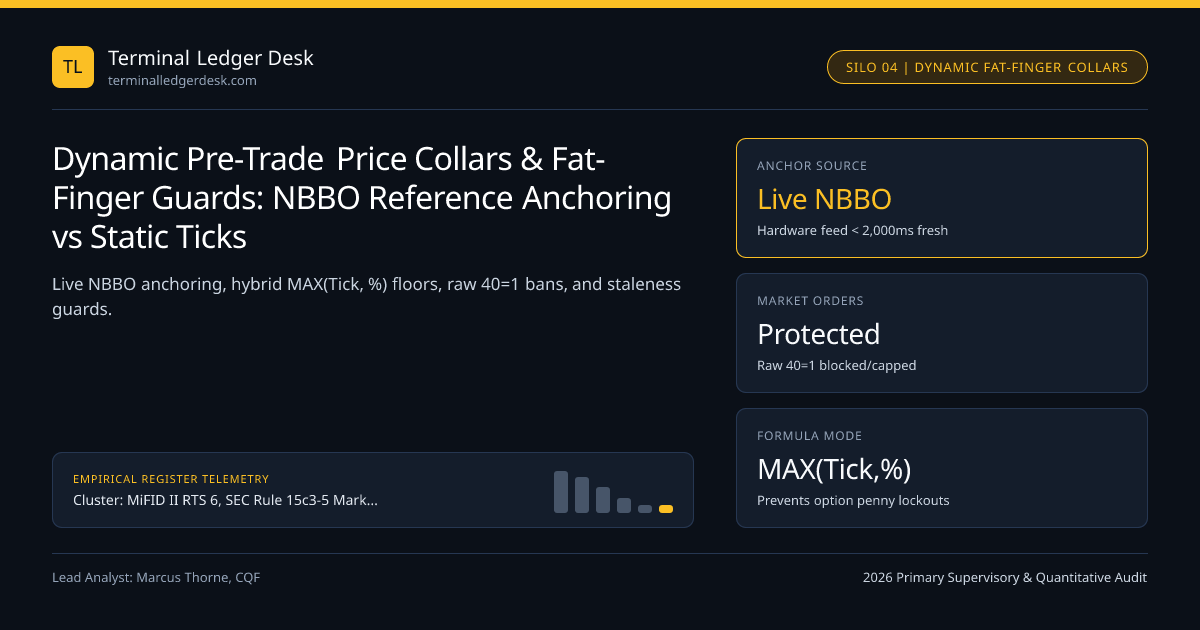
Dynamic Pre-Trade Price Collars & Fat-Finger Guards: NBBO Reference Anchoring vs Static Ticks
Static percentage price collars anchored to yesterday close fail catastrophically during earnings gaps and CPI releases; institutional gateways compute asymmetric bid/ask collars off live multicast NBBO.
In May 2022, a single desk trader in London typed total notional value into the quantity box of a European equity basket without an active dynamic collar—triggering the "Citigroup Flash Crash" across Nordic stock indices (OMX Stockholm 30 plunged -8% in 90 seconds, wiping out EUR 300 billion in transient market cap). Preventing catastrophic fat-finger sweeps under SEC Rule 15c3-5(c)(1)(ii) and MiFID II RTS 6 Article 15 requires asymmetric, live-reference-anchored Pre-Trade Price and Quantity Collars that distinguish aggressive liquidity-taking sweeps from passive resting quotes.
Why Static "Previous Close +/- 10%" Collars Fail in Live Markets#
Amateur risk gateways anchor fat-finger bands to a static morning CSV file containing Previous_Settlement_Price. That design fails in both directions—as analyzed in our MiFID II RTS 6 & SEC 15c3-5 Architecture Hub:
- False-Positive Paralysis on Legitimate Gaps: If an AI semiconductor stock reports blowout earnings overnight and opens
+14%higher in regular trading, a staticPrevClose + 10%buy collar blocks the desk from covering short hedges while prices run away! - Zero Protection Against Sweeping 300bps of Book Depth: Conversely, during calm midday trading when
SPYtrades at0.8 bpsspread, a+/- 10%static collar happily lets a buggy algorithm submit aBuy Limit @ +9.5%—instantly sweeping every resting offer on the order book and triggering an NMS Limit Up-Limit Down (LULD) trading pause!
Reference Price Hierarchy & Asymmetric Aggressive-vs-Passive Collar Math#
Institutional Pre-Trade Risk Control Standard engines (including inline cut-through FPGAs) maintain a strict fallback state machine for the Reference Price (P_ref) of every instrument:
- Tier 1 (Continuous Two-Sided Market): Anchor Buy orders against live
Best_Ask(NBO) and Sell orders against liveBest_Bid(NBB), providedBest_Ask > Best_Bid(non-crossed) and quote age< T_stale_max(e.g.2,000 ms). - Tier 2 (One-Sided or Wide-Spread Market): Fall back to
Last_Eligible_Trade_Price(SIP / Consolidated Last) within the last60 secondsif spread exceedsMax_Valid_Spread_Pct. - Tier 3 (Pre-Open / Halted Call Auction): Anchor to the exchange published
Indicative_Equilibrium_Price (IEP / NOII)orAdjusted_Prev_Closewith wider auction-specific collars.
Notice the asymmetry: a Buy Limit priced 1.2% above Best_Ask is an immediate marketable sweep (strictly collared at e.g. +0.50% or +15 ticks for liquid large-caps), whereas a passive Buy Limit resting 4.0% below Best_Bid poses zero immediate market-impact risk (collared only against extreme >20% stub-quote bans)!
| Asset Class / Instrument Tier | Reference Anchor (P_ref) | Aggressive Through-Book Collar | Max Single-Clip Notional | Venue Native Backstop |
|---|---|---|---|---|
| S&P 500 / Tier-1 NMS Equities | Live SIP / Direct NBB / NBO | MAX($0.10, 0.60% of NBO) | $2.5M – $5.0M | NMS LULD `5.0%` Band |
CME E-mini S&P (ES) / NQ | MDP 3.0 Implied Top-of-Book | 16 to 24 Ticks (4–6 pts ES) | 250 – 500 Contracts | CME Protection Points + Velocity Logic |
| G10 Spot FX (FIX API) | Aggregated Tier-1 Firm Mid | 15 to 25 Pips (0.15%–0.25%) | $10M – $25M Base | LP Last-Look / ECN Price Band |
Listed Equity Options (OPRA) | Live NBBO Mid / Theor Fair Value | MAX($0.15, 8.0% of Ask) | 500 – 2,000 Contracts | Cboe / ISE Drill-Through Protection |
Asset-Class Fat-Finger Collar Calibration Reference Table#
Standard institutional pre-trade aggressive price collar, max clip quantity, and max single-order notional guardrails across major liquid markets.
- Psellminallowed = Pbestbid - MAX( Nminticks * TickSize, Pbestbid * caggressivepct )
- Worked Hybrid Collar Check Across Two Contracts (Nminticks = 8, caggressivepct = 0.0075 [75 bps]):
- Case A — AAPL Stock @ Ask = $228.00 (Tick = $0.01):
- MAX(8 * $0.01, $228.00 * 0.0075) = MAX($0.08, $1.71) = $1.71 -> Max Buy Price = $229.71
- Case B — Weekly Option @ Ask = $0.12 (Tick = $0.01):
- MAX(8 * $0.01, $0.12 * 0.0075) = MAX($0.08, $0.0009) = $0.08 -> Max Buy Price = $0.20 (No false penny lock!)
Market Orders (40=1) & Deep-Out-of-the-Money Options Edge Cases#
Two notorious edge cases defeat naive percentage-based fat-finger formulas:
- Unpriced Market Orders (
OrdType 40=1): Because a rawMarketorder carries no limit price (Tag 44omitted), a percentage price collar cannot evaluate how deep it will sweep! Consequently, Tier-1 DMA gateways ban raw40=1Market orders outright on electronic books—automatically converting or requiring Marketable Limit ("Protection Limit") orders (Buy @ NBO + k_collar_ticks, matching CME Globex Market-with-Protection). - Low-Priced Pennies & Weekly Options: Applying a
2.0%percentage collar to an option trading at$0.08yields$0.0016—less than a single$0.01minimum tick! Compliant risk engines always use a *hybrid `MAX(Collar_Ticks TickSize, Pref * CollarPct)`** floor so low-premium strikes remain tradable without widening high-priced contracts.
Expected Market Impact Check: Comparing Order Clip Against Visible Depth#
Advanced execution gateways go one step beyond price-only collars by computing Simulated Book Sweep Depth: before releasing a 500-lot E-mini S&P (ES) IOC buy order, the gateway walks the top 10 levels of its local MDP 3.0 book; if cumulative visible ask liquidity across +6 ticks is only 140 lots, the gateway rejects or slices the order before triggering CME Velocity Logic.
Calibrate maximum single-clip notional caps against portfolio volatility in our Terminal Margin VaR & ES Calculator and Algorithmic Kelly Allocation Calculator.
Frequently asked questions
What happens if the market-data feed handler drops out—should the pre-trade collar use the last cached price from 10 minutes ago?
Never! Using a 10-minute-old cached NBBO during a macro shock guarantees either false blocks or dangerous sweeps. Every dynamic collar carries a strict Max_Quote_Age_Ms timer (typically 500ms to 2,000ms during continuous trading); if no valid tick refreshes the symbol, new aggressive orders fail closed until feed arbitration recovers.
Why must a broker set its pre-trade equity price collar tighter than the 5% NMS LULD band?
If a broker sets its fat-finger collar at 6% while LULD sits at 5%, a single erroneous client order will sweep every resting share across Nasdaq/NYSE right up to the 5% LULD band, trigger a 5-minute national trading pause across the entire US market, and draw immediate FINRA 15c3-5 enforcement!
Why do gateways enforce a minimum passive price floor (Stub-Quote Ban) far below the bid?
During the May 6, 2010 Flash Crash, once real liquidity evaporated, market orders executed against automated market-maker "stub quotes" resting at $0.01 (Accenture traded at 1 cent!) and $99,999. SEC Rule 15c3-5 and FINRA Market Maker quoting rules banned stub quotes permanently.
How should pre-trade collars handle 10-for-1 reverse stock splits on Ex-Date morning?
If corporate-action multipliers fail to load before the 04:00 ET pre-market open, any backup reference anchored to yesterday unadjusted close will be off by 900%! Gateways cross-check overnight corporate action files against exchange pre-open security status messages before enabling continuous trading.
Publication record
- Published
- 13 November 2026
- Updated
- 14 November 2026
- Author
- Marcus Thorne, CQF
- Review
- Review not recorded
- Automated fact check
- Passed in the stored pipeline record
- Source URLs
- 3 recorded
AI assistance recorded: anthropic/claude-opus-4.6. This field does not establish human review or source verification.
Academic & Institutional Attribution
Cite This Research & Embed Live Data Card
Standard academic & institutional research paper citation format.
Marcus Thorne, CQF. (2026, November 14). Dynamic Pre-Trade Price Collars & Fat-Finger Guards: NBBO Reference Anchoring vs Static Ticks. Terminal Ledger Desk. https://terminalledgerdesk.com/reports/dynamic-price-collar-fat-finger-thresholds-nbbo-reference-anchoringRelated Mifid Rts6 Pretrade Kill Switch Controls & Institutional Briefings
Explore Mifid Rts6 Pretrade Kill Switch Controls Hub (20) →Mifid Rts6 Pretrade Kill Switch Controls
MiFID II RTS 6, SEC Rule 15c3-5 Market Access & Inline Pre-Trade Kill-Switch Architecture GuideMifid Rts6 Pretrade Kill Switch Controls
Gross vs Net Intraday Pre-Trade Credit Accounting: Open-Order Exposure & Cancel-Replace InflationMifid Rts6 Pretrade Kill Switch Controls
Exchange Cancel-On-Disconnect (COD): Heartbeat Grace Windows Across CME, Nasdaq & EurexMifid Rts6 Pretrade Kill Switch Controls
FIX Tag 35=q OrderMassActionRequest & Venue Firm-Level Kill-Switch APIs BenchmarkedMifid Rts6 Pretrade Kill Switch Controls
Self-Match Prevention (SMP): Cancel-Oldest, Cancel-Newest & Decrement-and-Cancel MechanicsMifid Rts6 Pretrade Kill Switch Controls
Order-to-Trade Ratio (OTR) & MiFID II RTS 9: Token-Bucket Message Throttling EngineeringMifid Rts6 Pretrade Kill Switch Controls
NMS Limit Up-Limit Down (LULD) Plan: Reference Price Bands, Limit States & 5-Minute PausesMifid Rts6 Pretrade Kill Switch Controls
CME Globex Velocity Logic & Dynamic Circuit Breakers: Sub-Second Futures Volatility GuardsReg Sci Disaster Recovery Outage Rca
Multicast A/B Market-Data Feed Arbitration: Air-Gapped Switch Fabrics & Microburst RecoveryReg Sci Disaster Recovery Outage Rca
Exchange Outage Post-Mortem Anatomy: 32-Bit Sequence Wraparounds & Timestamp Epoch OverflowsReg Sci Disaster Recovery Outage Rca
Exchange Outage Post-Mortem: Opening-Auction Reference-Price Errors & LULD Halt CascadesReg Sci Disaster Recovery Outage Rca
Exchange Outage Post-Mortem: WAN BGP Route Leaks, Extranet Partitions & Asymmetric Halts
Terminal Ledger Desk Data, Benchmarks & Contributor Records
CC BY 4.0 Open Data
Open Institutional Datasets (CSV / JSON) →
Download desk-compiled quantitative series & schemas.
2026 Reference Matrix
2026 Institutional Benchmarks & Thresholds →
Statutory capital, clearing, margin & rate conventions.
Editorial Records
Authors & Review Records →
View named contributors where those records are available.
Complete Index
Master Research & Dossier Archive →
Browse all published briefings by topic pillar & date.