
Mifid Rts6 Pretrade Kill Switch Controls
Algorithmic Trading Software Deployment Gates: Canary Releases, SHA-256 Attestation & Config Diffs
Eight out of ten catastrophic algorithmic trading incidents trace directly to a flawed binary rollout or unvalidated parameter push; enforce reproducible SHA-256 builds, dead-flag stripping, and 1-symbol canary gates.
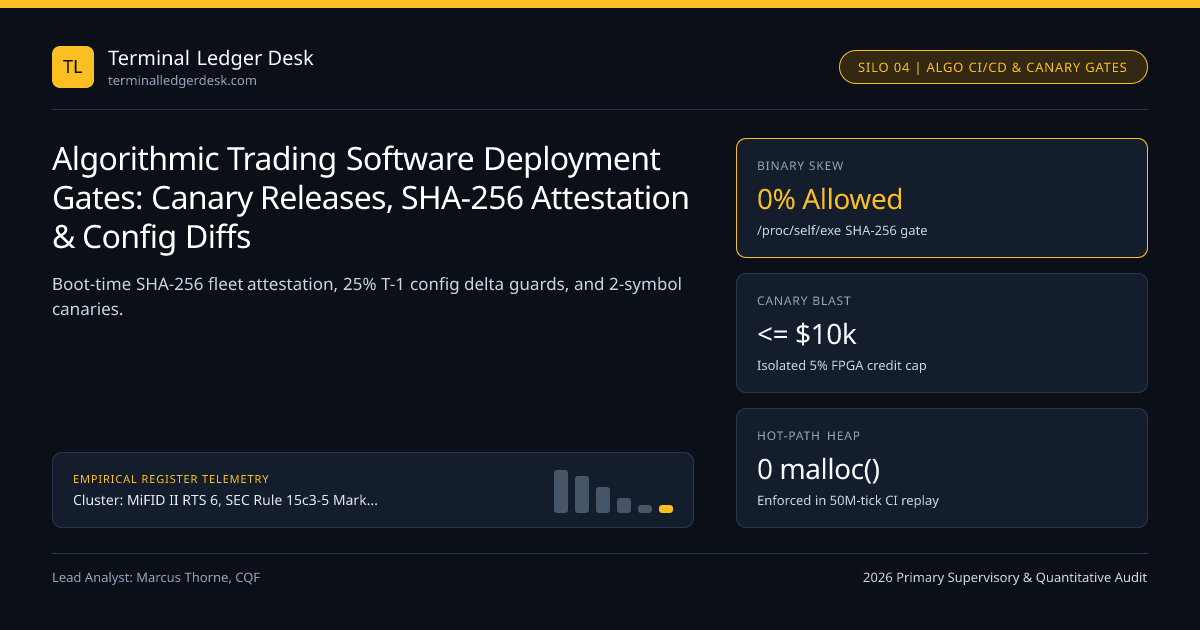
Every C++ engineer in electronic trading studies the two fatal software engineering sins behind Knight Capital August 1, 2012 collapse: (1) re-purposing an integer bit-flag (FIX Tag / feature toggle) that still pointed to 9-year-old dead PowerPeg code never deleted from the repository, and (2) manually copying the new SMARS binary onto 7 of 8 production servers while Server #8 booted the old binary! Under MiFID II RTS 6 Articles 5–8, SEC Reg SCI, and FINRA Notice 15-09, deterministic CI/CD Deployment Gates and Cryptographic Binary Attestation are mandatory regulatory controls.
Eliminating "Server #8 Skew": Immutable Artifacts & Pre-Logon SHA-256 Attestation#
Connected to our MiFID II RTS 6 & SEC 15c3-5 Architecture Hub and Financial App Hardening Standard, production colocation hosts must never receive ad-hoc scp / rsync binary copies:
- Reproducible Signed Artifacts (
SLSA/Cosign): Every release binary is compiled inside an isolated hermetic build pipeline from a tagged Git commit, signed by CI + Independent Risk Release Sign-Off (MiFID II RTS 6 Article 5dual control), and hashed (SHA-256). - Cluster Fleet Homogeneity Check (
Zero Partial Rollouts): Before the pre-open03:45 ET/07:30 CETboot window opens, an orchestration verifier queries every colocated host (Server_1 .. Server_N) for its running/proc/self/exeSHA-256digest. If any node mismatches the approved manifest—or if a live hotfix was attempted during market hours without Emergency CAB sign-off—the inline risk gateway refuses to unlock that server port!
Banning Dormant Feature Flags & Validating Schema-Typed Config Diffs#
Roughly half of production trading outages involve zero C++ code changes—they are triggered by a morning JSON/TOML/YAML configuration update (e.g. typing 0.05 [500 bps] instead of 0.0005 [5 bps])! Enforce three non-negotiable engineering rules:
- Strict Dead-Code Purge Policy: Never leave deprecated execution algorithms behind runtime boolean flags in production binaries! Delete retired order-routing paths at the source/compile level (
#ifdefstripped in prod builds) so no config flag reuse can resurrect legacy code. - Explicit Units in Schema Field Names (
_bps,_usd,_lots,_ns): Ban ambiguous float fields likethreshold: 0.5; enforce strongly typed schemas (aggressive_collar_bps: uint16 [1..150],max_clip_usd: uint64 [1000..2000000]). - Automated
T-1vsT+0Config Delta Bounds: Any daily parameter push changing more thanX%of symbols or shifting a risk/sizing parameter by> 25%from yesterday baseline fails CI validation automatically unless co-signed by Head of Risk!
| Deployment Hazard | Real-World Failure Mechanism | Deterministic Engineering Gate | Regulatory Mapping |
|---|---|---|---|
| Partial Server Rollout | 7/8 nodes updated; 1/8 runs stale binary (Knight 2012) | Boot-time /proc/self/exe SHA-256 attestation against Risk Manifest | FINRA Notice 15-09 / SEC 15c3-5 |
Unit Typo (0.05 vs 5 bps) | JSON float scaled 100x intended collar or size | Typed unit suffixes (_bps) + T-1 max 25% delta validator | MiFID II RTS 6 Article 5 & 15 |
| Dead-Code Flag Collision | Reused enum value triggers retired aggressive router | Compile-time dead-code elimination + AST static analysis | UK PRA SS5/18 & FCA MAR 7A |
| Full-Book Day-1 Blast Radius | New C++ build crashes or loops across all 500 symbols at 09:30 | 48-hour 2-symbol Canary Pod locked behind 5% FPGA credit cap | SEC Reg SCI Rule 1001(a) |
Production Algorithmic Deployment & Rollback Control Matrix#
Mapping the five-stage release pipeline from Replay Simulation to Canary Symbol Promotion and Instant Atomic Rollback.
- SchemaMin(p) <= ValueToday(p) <= Schema_Max(p)
- AND ( |ValueToday(p) - ValueYesterday(p)| / MAX(epsilon, |ValueYesterday(p)|) <= 0.25 OR HasDualRiskSignature == True )
- )
- CanaryWorstLossBound = MIN( CanaryFPGAGrossCapUSD * MaxCollarSlippagePct, CanaryDailyPnLHardStop_USD )
- Example: MIN( $1,000,000 * 0.01, $25,000 ) = $10,000 max blast radius (vs $440,000,000 full-fleet rollout!)
Deterministic PCAP Replay & 1-Symbol Canary Promotion#
Before any material algorithm revision (MiFID II RTS 6 conformance & 2x stress testing) touches full capital:
- Bit-Exact Historical PCAP Shadow Replay: Feed yesterday full
50-million-packetITCH / MDP 3.0capture through bothBinary_OldandBinary_Newside-by-side, diffing outbound order counts, OTR ratios, and peak memory (0heap allocations after warm-up!). - Constrained Canary Partition (
1%Capital / 2 Liquid Symbols): DeployBinary_Newon one isolated Canary Pod trading2liquid symbols under5%normal pre-trade credit caps (Pre-Trade Risk Control Standard) for 1–3 full sessions while comparing fill quality, reject rate (0.00%target), and cancel latency against control pods.
Never Hot-Swap Live Shared-Memory Layouts Mid-Session!#
Attempting an intraday binary upgrade on a live trading box whose orders are still resting on CME or Nasdaq risks struct-alignment corruption when reading /dev/shm memory-mapped sequence/position files! If an intraday rollback is required, flatten/cancel working orders via `35=q` Mass Action FIRST, verify Open_Orders == 0 on the Drop-Copy shadow monitor, and start the pinned prior release cleanly.
Size Canary pod maximum capital envelopes using our Algorithmic Kelly Allocation Calculator and Terminal Margin VaR & ES Calculator.
Frequently asked questions
What does FINRA Regulatory Notice 15-09 specifically expect regarding algorithmic change management?
FINRA Notice 15-09 outlines effective supervision practices for algorithmic strategies: cross-functional pre-deployment review (Legal, Compliance, Risk, Trading), strict separation between development and production access (developers cannot push binaries to prod unilaterally), code-repository audit trails, and staged/canary rollouts.
When a firm deploys a material change to an algorithm in Europe, must its MiFID II Algo ID change?
Under ESMA MiFID II RTS 6 / RTS 24 Q&A guidance, firms must maintain a complete version history mapping every deployed code version and parameter set to the unique Algorithm ID stamped on orders so regulators can reconstruct exact code behavior at any historical nanosecond.
How do high-frequency firms test that a new C++ build did not accidentally introduce a runtime malloc on the hot path?
In the CI PCAP replay harness, override global operator new / malloc with a thread-local hook armed right after post-boot warm-up completes: if a single heap allocation occurs while replaying 10 million ITCH/MDP3 packets, abort fails the CI build immediately!
What is the safest procedure if a severe bug is discovered in a Canary Pod at 10:15 AM?
Trigger the Canary Pod dedicated 35=q Kill Switch + FPGA TX Block immediately, confirm zero open orders on the Shadow Drop-Copy monitor, terminate the Canary process, and leave the remaining 99% production fleet untouched while post-mortem analysis runs offline.
Publication record
- Published
- 13 November 2026
- Updated
- 16 November 2026
- Author
- Marcus Thorne, CQF
- Review
- Review not recorded
- Automated fact check
- Passed in the stored pipeline record
- Source URLs
- 3 recorded
AI assistance recorded: anthropic/claude-opus-4.6. This field does not establish human review or source verification.
Academic & Institutional Attribution
Cite This Research & Embed Live Data Card
Standard academic & institutional research paper citation format.
Marcus Thorne, CQF. (2026, November 16). Algorithmic Trading Software Deployment Gates: Canary Releases, SHA-256 Attestation & Config Diffs. Terminal Ledger Desk. https://terminalledgerdesk.com/reports/algo-software-deployment-gates-canary-release-checksum-attestationRelated Mifid Rts6 Pretrade Kill Switch Controls & Institutional Briefings
Explore Mifid Rts6 Pretrade Kill Switch Controls Hub (20) →Mifid Rts6 Pretrade Kill Switch Controls
MiFID II RTS 6, SEC Rule 15c3-5 Market Access & Inline Pre-Trade Kill-Switch Architecture GuideMifid Rts6 Pretrade Kill Switch Controls
UK FCA MAR 7A & PRA SS5/18 Algorithmic Trading Governance: SM&CR Accountability & MaterialityMifid Rts6 Pretrade Kill Switch Controls
Consolidated Audit Trail (CAT) & MiFID II RTS 24: Nanosecond Order-Lifecycle Telemetry EngineeringMifid Rts6 Pretrade Kill Switch Controls
SEC Rule 15c3-5 Market Access Control: Ban on Unfiltered Sponsored Access & Annual CEO AttestationMifid Rts6 Pretrade Kill Switch Controls
MiFID II RTS 6 Compliance: Annual Self-Assessment, 2x Stress Testing & DEA GovernanceMifid Rts6 Pretrade Kill Switch Controls
Inline FPGA Pre-Trade Risk Gateways: Cut-Through FCS Stomping & Sub-Microsecond Credit CollarsMifid Rts6 Pretrade Kill Switch Controls
Dynamic Pre-Trade Price Collars & Fat-Finger Guards: NBBO Reference Anchoring vs Static TicksMifid Rts6 Pretrade Kill Switch Controls
Gross vs Net Intraday Pre-Trade Credit Accounting: Open-Order Exposure & Cancel-Replace InflationReg Sci Disaster Recovery Outage Rca
Chaos Engineering & Deterministic Fault Injection in Staging Matching & Gateway ClustersReg Sci Disaster Recovery Outage Rca
Immutable WORM Incident Forensics: SEC Rule 17a-4(f), Optical PCAPs & Cryptographic Hash ChainsDigital Assets
Standard Chartered, 24X Expand Digital Assets Prime Brokerage - Markets MediaBroker Fees and Calculators
Stock market outlook today, 12 Nov: Sensex, Nifty prediction - DJIA, S&P, NASDAQ, GIFT Nifty, Kospi, Nikkei, Taiwan cues - TradingView
Terminal Ledger Desk Data, Benchmarks & Contributor Records
CC BY 4.0 Open Data
Open Institutional Datasets (CSV / JSON) →
Download desk-compiled quantitative series & schemas.
2026 Reference Matrix
2026 Institutional Benchmarks & Thresholds →
Statutory capital, clearing, margin & rate conventions.
Editorial Records
Authors & Review Records →
View named contributors where those records are available.
Complete Index
Master Research & Dossier Archive →
Browse all published briefings by topic pillar & date.