
Fix Protocol Sbe Ouch Session Latency
Cboe BOE v3 Bitfields vs NYSE Pillar Binary Gateway: Wire Efficiency & Latency
Cboe BOE v3 uses caller-defined return bitfields to strip unneeded acknowledgement columns on the wire, whereas NYSE Pillar unifies equities and options gateways around sequenced binary streams.
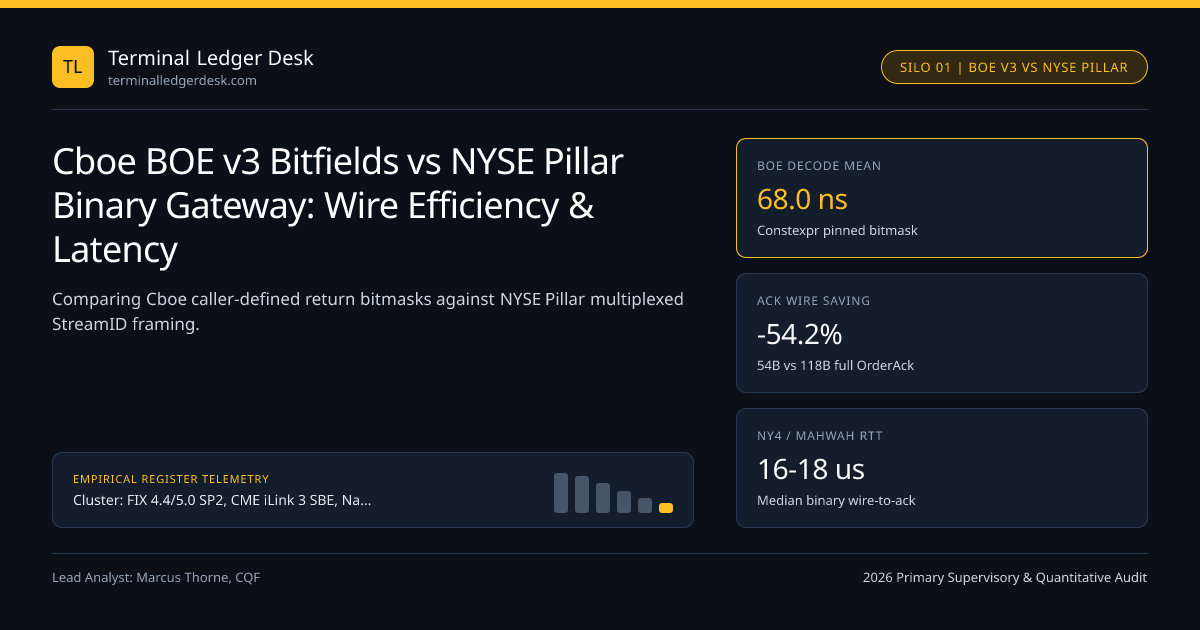
Multi-venue US equities and options Smart Order Routers operating across Secaucus (NY4 for Cboe BYX/BZX/EDGX/EDGA) and Mahwah (NYSE/Arca/American) must maintain native binary adapters alongside Nasdaq OUCH. While Cboe Binary Order Entry (BOE) pioneered caller-requested optionality bitfields that let trading firms customize exact inbound acknowledgement byte layouts, NYSE Pillar consolidated five legacy NYSE matching silos onto a deterministic binary stream architecture featuring unified StreamID sequence domains and nanosecond hardware timestamps.
Cboe BOE Optional Bitfields: Caller-Controlled Wire Trimming#
Cboe engineered BOE (v2 / v3) around a clever observation: an options market maker firing 50,000 NewOrder / ModifyOrder updates per second across C1, BZX Options, and EDGX rarely needs clearing-account strings, fee codes, or display indicators echoed back on every single OrderAcknowledgement! Following a 2-byte StartOfMessage (0xBABA) little-endian marker, BOE frames carry an array of 1-byte Bitfields where each set bit (1) indicates the presence of a corresponding optional field in deterministic order.
Even better, during LoginRequest, the client specifies Return Bitfields for each inbound message type (OrderAck, OrderExecution, OrderCancelled). Consequently, Cboe strips unrequested attributes before transmitting acknowledgements over the cross-connect inside Equinix NY4/NY5, shrinking average inbound OrderAck packets from 118 bytes down to 54 bytes while preserving little-endian integer alignment.
NYSE Pillar Binary Gateway: Unified StreamIDs and SeqMsg Framing#
Historically, routing across NYSE Tape A floor-hybrid markets, NYSE Arca, and NYSE American required maintaining completely incompatible gateway stacks (CCG, UTP Direct). NYSE Pillar replaced those fragmented adapters with a single binary protocol built around SeqMsg stream envelopes (2B MsgType, 2B MsgSize, 4B StreamID, 4B Seq, 8B TimestampNs).
Unlike Nasdaq OUCH 5.0 unsequenced client frames, NYSE Pillar enforces explicit sequence tracking across multiple logical StreamID channels multiplexed onto a single TCP session (separating outbound order entry, inbound execution reports, and reference-data state). Fixed-size Pillar message bodies avoid dynamic bit-counting instructions (POPCNT), trading slightly larger wire frames (68–96 bytes) for pure compile-time struct offsets akin to SBE zero-copy wire structs.
| Protocol Dimension | Cboe BOE (v2 / v3) | NYSE Pillar Binary | Nasdaq OUCH 5.0 |
|---|---|---|---|
| Primary Colocation Facility | Equinix NY4 / NY5 (Secaucus) | ICE Mahwah Data Center (NJ) | Nasdaq Carteret Data Center (NJ) |
| Integer Endianness | Little-Endian (0xBABA start) | Little-Endian | Big-Endian (Network Byte Order) |
| Optional Field Mechanism | Bitfield bitmasks + Return Bitfields | Fixed-offset versioned structs | 2B Length + [Len][Tag][Val] tail |
| Inbound Sequence Topology | Vector of MatchingUnit sequences | Multiplexed 4-byte StreamID + Seq | Single SoupBinTCP session sequence |
| Fixed-Point Price Scale | 10^-4 or 10^-8 (int64) | 10^-8 (int64 Pillar Price) | 10^-4 (uint64 Price) |
US Equities & Options Binary Order Entry Comparison Matrix#
Institutional EMS architects building unified North American routers balance byte-order, bitfield branches, and colocation site physics across the Big Three US exchange groups.
- Tboedecode = Ppinned * Tdirectcast + (1 - Ppinned) * (Nbitbytes * Tpopcnt_lut)
- Where:
- P_pinned = 0.9998 (fraction of OrderAck frames matching exact Login ReturnBitfield)
- Tdirectcast = 68 ns (single constexpr struct pointer overlay)
- Nbitbytes = 6 bitfield bytes; Tpopcnt_lut = 22 ns per byte LUT offset resolution
- Worked Inbound BOE Decoder Performance:
- Tboedecode = 0.9998(68 ns) + 0.0002(6 * 22 ns) = 67.986 ns + 0.026 ns = 68.01 nanoseconds!
- Bandwidth Saved on 5M Daily OrderAcks = 5,000,000 * (118 - 54) bytes = 320.0 MB/day per port.
Optimizing Bitfield Decoding With x86 BMI2 PEXT / POPCNT Intrinsics#
In naive C++ BOE parsers, testing 40 individual optional bitfield flags (if (bf0 & 0x01) ... if (bf0 & 0x02) ...) introduces 40 conditional branches that pollute the Branch Target Buffer (BTB) whenever rare administrative fields (ContraBroker, SubLiquidityIndicator) toggle on fills. High-speed execution teams eliminate those branches using two techniques:
- Pinned Return Bitfield Profiles: Because the client itself dictates the Return Bitfields at
LoginRequest, the inbound BOE decoder compiles a single static struct cast matching that exact bitmask! Only if the incoming header bitmask differs from the pinnedconstexprmask does execution fall back to dynamicPOPCNToffset calculation. - Pre-Baked Outbound Bitmasks: Outbound
NewOrdertemplates pre-bake fixed bitfield bytes (bf[0..5]) per order archetype (Lit IOC,Post-Only Slide,Midpoint Peg), matching the speed documented in our FIX, SBE & OUCH Session Architecture Guide.
Cross-Venue Risk Normalization & Price-Scale Harmonization#
A notorious multi-venue bug lies in inconsistent fixed-point binary price scales across US equities ports: Nasdaq OUCH 5.0 scales prices by 10^4 ($1.00 = 10,000), whereas Cboe BOE binary BinaryPrice and NYSE Pillar Price use 10^4 or 10^8 ($1.00 = 100,000,000 for sub-penny and options decimals)! Mixing up 10^4 and 10^8 scales in a Smart Order Router produces a 10,000x price error.
Production gateways normalize all internal EMS prices to int64_t scaled by 10^8 inside LMAX Disruptor ring buffers, applying compile-time strong typedef wrappers (Price1e4, Price1e8) tested against SEC Rule 15c3-5 price collars and the Terminal Margin VaR & ES Calculator. Explore more binary comparisons in the FIX, SBE & OUCH Topic Hub.
Frequently asked questions
Why does Cboe BOE track a vector of MatchingUnit sequence numbers instead of a single counter?
Cboe partitions symbol ranges across independent parallel Matching Units (e.g., Unit 1 for A–C, Unit 2 for D–G). Tracking a separate sequence counter per MatchingUnit ensures that a failover or gap on one partition never halts or invalidates fill recovery on healthy symbol partitions.
How does NYSE Pillar handle session replay compared to SoupBinTCP on Nasdaq OUCH?
NYSE Pillar assigns explicit 32-bit StreamIDs for client write streams and venue read streams. Upon reconnecting with OpenStream, both client and gateway exchange their last committed sequence per StreamID, replaying exact missed binary frames deterministically.
Do Cboe BOE and NYSE Pillar eliminate the need for FIX Drop Copy ports?
No. Prime brokers, clearing risk monitors, and firm-wide compliance engines still subscribe to Cboe and NYSE FIX Drop Copy feeds on physically separate circuits to maintain independent Rule 15c3-5 gross-exposure accounting across all binary trading ports.
Which US exchange binary protocol has the lowest CPU byte-swapping overhead on x86 servers?
Cboe BOE, NYSE Pillar, and CME iLink 3 all transmit multi-byte integers in little-endian byte order matching native x86-64 registers (zero BSWAP overhead), whereas Nasdaq OUCH 5.0 and ITCH 5.0 use big-endian network order requiring fast hardware BSWAP instructions.
Publication record
- Published
- 14 November 2026
- Updated
- 14 November 2026
- Author
- Marcus Thorne, CQF
- Review
- Review not recorded
- Automated fact check
- Passed in the stored pipeline record
- Source URLs
- 3 recorded
AI assistance recorded: anthropic/claude-opus-4.6. This field does not establish human review or source verification.
Academic & Institutional Attribution
Cite This Research & Embed Live Data Card
Standard academic & institutional research paper citation format.
Marcus Thorne, CQF. (2026, November 14). Cboe BOE v3 Bitfields vs NYSE Pillar Binary Gateway: Wire Efficiency & Latency. Terminal Ledger Desk. https://terminalledgerdesk.com/reports/cboe-boe-v3-vs-nyse-pillar-binary-gateway-protocol-wire-efficiencyRelated Fix Protocol Sbe Ouch Session Latency & Institutional Briefings
Explore Fix Protocol Sbe Ouch Session Latency Hub (20) →Fix Protocol Sbe Ouch Session Latency
FIX 4.4/5.0 SP2, CME iLink 3 SBE & Nasdaq OUCH 5.0 Session Latency Architecture GuideFix Protocol Sbe Ouch Session Latency
FIX/FAST Protocol PMAP & Stop-Bit Decoding: Why Exchanges Migrated to SBEFix Protocol Sbe Ouch Session Latency
Zero-Malloc FIX Repeating Groups: Parsing NoMDEntries (268) & NoPartyIDs (453)Fix Protocol Sbe Ouch Session Latency
FIX Heartbeat (35=0), TestRequest (35=1) & Linux TCP_USER_TIMEOUT Dead-Peer DetectionFix Protocol Sbe Ouch Session Latency
EOD vs Weekly FIX Sequence Reset (Tag 141=Y): Cross-Timezone Rollover EngineeringFix Protocol Sbe Ouch Session Latency
SBE Schema Evolution: Forward & Backward Wire Compatibility via actingBlockLengthFix Protocol Sbe Ouch Session Latency
TCP_NODELAY, TCP_QUICKACK & TLS 1.3 Record Sizing: Eliminating 40ms FIX JitterFix Protocol Sbe Ouch Session Latency
FIX OrdStatus (Tag 39) & ExecType (Tag 150) State Matrices: Cancel/Replace RacesMatching Engine Clob Colocation Ptp
Multi-Region Colocation Architecture: CME Aurora, Equinix FR2 Frankfurt & TY3 TokyoMatching Engine Clob Colocation Ptp
Solarflare Onload / ef_vi vs DPDK Kernel Bypass: NIC RX/TX Ring & PIO TuningMatching Engine Clob Colocation Ptp
FPGA Tick-to-Trade Pipelines: Cut-Through PCS/MAC & Sub-200ns Order TriggeringMatching Engine Clob Colocation Ptp
IEEE 1588v2 PTP Clock Synchronization: GNSS Grandmasters, Boundary Clocks & NIC PHC
Terminal Ledger Desk Data, Benchmarks & Contributor Records
CC BY 4.0 Open Data
Open Institutional Datasets (CSV / JSON) →
Download desk-compiled quantitative series & schemas.
2026 Reference Matrix
2026 Institutional Benchmarks & Thresholds →
Statutory capital, clearing, margin & rate conventions.
Editorial Records
Authors & Review Records →
View named contributors where those records are available.
Complete Index
Master Research & Dossier Archive →
Browse all published briefings by topic pillar & date.