
Fix Protocol Sbe Ouch Session Latency
SBE Schema Evolution: Forward & Backward Wire Compatibility via actingBlockLength
FIX Simple Binary Encoding (SBE) achieves zero-downtime forward and backward wire compatibility by transmitting actingBlockLength and version in every 8-byte message header.
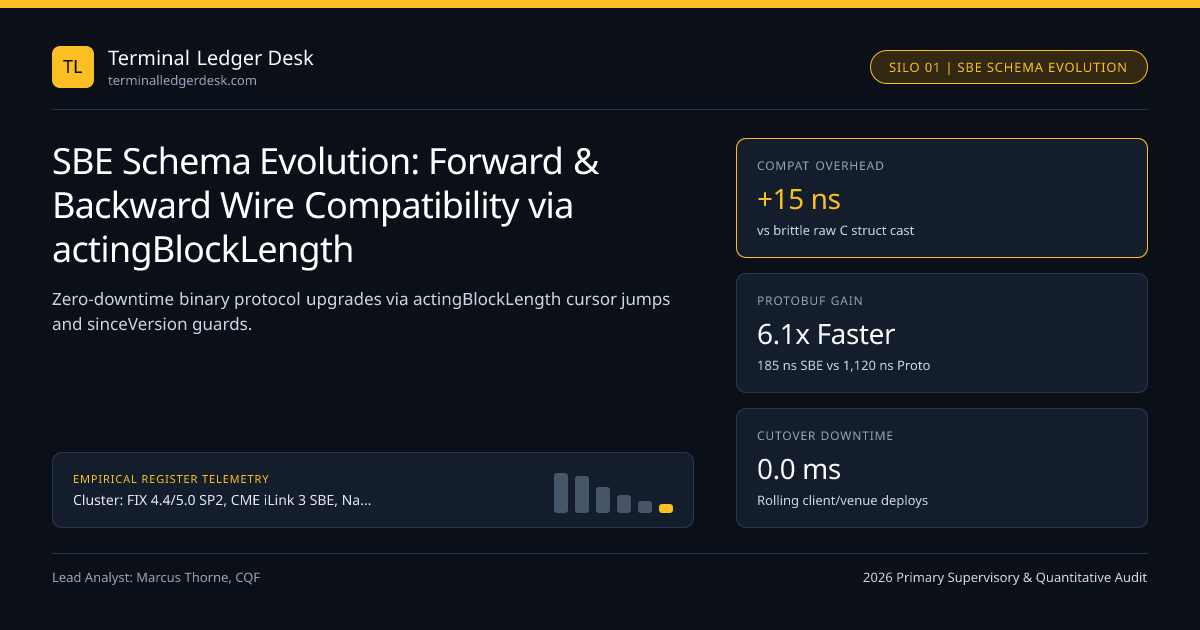
Hardcoding raw C reinterpret_cast<const NewOrderAck*>(buf) pointers against binary exchange packets works right up until an exchange appends an 8-byte regulatory timestamp to the root block during a quarterly release—instantly shifting every trailing repeating group by 8 bytes and corrupting production parsers! FIX Simple Binary Encoding (SBE) solves binary schema evolution cleanly without version-negotiation handshakes by embedding two dynamic framing integers—blockLength (actingBlockLength) and version (actingVersion)—inside every 8-byte wire header.
Three-Rule Invariant of Non-Breaking SBE XML Schema Extensions#
Under the FIX SBE standard used by CME Globex (iLink 3 and MDP 3.0), Eurex, and institutional internal buses, a schema publisher can increment version (e.g., v8 -> v9) without forcing clients to recompile on Day 1 provided three strict XML layout laws hold:
- Immutable Existing Offsets: Existing fields in the root block or inside a repeating group NEVER change byte offset, width, or primitive type.
- Tail-Only Extension (
sinceVersion): New fields are appended strictly at the end of the root fixed block (or at the end of a repeating group block) tagged withsinceVersion="9", increasing the schemablockLengthfrom e.g.88to96bytes. - Stable Ordering of Groups & VarData: Repeating groups and variable-length strings follow the root block in unchanged declaration order.
How actingBlockLength Enables Both Forward and Backward Compatibility#
Generated C++ / Rust SBE flyweight decoders (Real Logic sbe-tool) never advance past the root block using their compile-time SCHEMA_BLOCK_LENGTH! Instead, they read the wire packet header actingBlockLength (uint16_t at byte 0) and actingVersion (uint16_t at byte 6):
- Forward Compatibility (v8 Client Receiving Newer v9 Exchange Packet): The wire header reports
actingBlockLength = 96,actingVersion = 9. The v8 client reads its known fields at offsets0..87, then jumps directly toheader + 96(actingBlockLength) to parseNoFillsrepeating groups—cleanly skipping the unknown 8-byte v9 extension field with zero corruption! - Backward Compatibility (v9 Client Receiving Older v8 Packet / PCAP Replay): The wire header reports
actingBlockLength = 88,actingVersion = 8. When the v9 client callsmsg.newRegTimestamp, the generated accessor checksif (actingVersion < 9) return NULL_VALUE;instead of reading out-of-bounds into the repeating group! Compare this zero-copy elegance with ASCII FIX vs SBE wire latency and our FIX, SBE & OUCH Architecture Guide.
| Schema Change Type | XML Attribute / Mechanism | Wire version / schemaId | v8 Old Client Behavior | Compatibility Verdict |
|---|---|---|---|---|
| Append Field to Root Tail | sinceVersion="9" + explicit offset | version 8 -> 9 (Same schemaId) | Skips tail via actingBlockLength | 100% Non-Breaking |
| Append Field to Group Tail | sinceVersion="9" inside <group> | version 8 -> 9 (Same schemaId) | Skips via group.blockLength stride | 100% Non-Breaking |
| Add New Enum Bit / Constant | New <validValue sinceVersion="9"> | version 8 -> 9 | Must handle UNKNOWN default arm | Safe w/ Default Switch |
Change int32 to int64 in Place | Modifies interior field offsets | Increment schemaId! | Would misread every subsequent byte | Breaking (Hard Cutover) |
SBE Wire Compatibility Matrix Across Client & Venue Schema Versions#
Understanding exactly which schema edits preserve wire compatibility versus requiring a new schemaId or mandatory weekend cutover prevents Aurora and NY4 Monday-open parser crashes.
- Ptrgroupelem(i) = Ptrgroupbody + i * GroupHeader.actingGroupBlockLength
- Valextfield = (Header.actingVersion >= FieldsinceVersion) ? (T)(Ptrrootstart + Offset) : TNULL
- Where:
- Ptrrootstart = Wire buffer byte 8 (immediately following 8-byte SBE messageHeader)
- Header.actingBlockLength = 96 bytes (v9 wire frame read by v8 client expecting 88 bytes)
- GroupHeader.actingGroupLen = 28 bytes (v9 group entry read by v8 client expecting 24 bytes)
- Worked Pointer Arithmetic Verification (3 Fill Entries in v9 Frame):
- Ptrfirstgroup = 8 + 96 = byte offset 104 (exact start of 4B groupSizeEncoding)
- Ptrgroupelem(2) = (104 + 4) + 2 * 28 = byte offset 164 (zero desynchronization across versions!).
Repeating-Group groupSizeEncoding Stride Safety#
The identical principle protects nested repeating groups! As noted in our zero-malloc FIX repeating-group parser analysis, every SBE repeating group starts with a 4-byte groupSizeEncoding (uint16 blockLength, uint16 numInGroup). If CME adds a 4-byte ExecRestatement field to each fill entry in schema v9, group.blockLength on the wire grows from 24 to 28.
A v8 decoder iterating for (i = 0; i < numInGroup; ++i) advances its cursor by ptr += wireGroupBlockLength (28), never sizeof(FillEntryV8) (24)! Developers who hand-roll C structs instead of respecting actingBlockLength and group.blockLength invariably break during CME MDP 3.0 SBE or iLink 3 SBE minor version bumps.
Certification Protocol in Exchange New-Release Sandboxes#
Under CFTC, SEC, and FCA algorithmic change-governance rules, institutional execution teams enforce three automated CI checks on SBE XML drops:
- Historical PCAP Regression: Replay 6 months of v6/v7/v8 production Aurora colocation PCAPs through the newly compiled v9 binary to verify 100%
actingVersion < 9null-sentinel handling. - Synthetic Future-Version Fuzzing: Pad
+16random extension bytes onto every root and groupblockLength(actingVersion = 99) and assert bit-identical order-book reconstruction. - Risk Engine Parity: Confirm post-upgrade fill prices feed cleanly into the Algorithmic Kelly Allocation Calculator and explore more binary guides in the FIX, SBE & OUCH Topic Hub.
Frequently asked questions
Why do handwritten C packed structs crash during CME MDP 3.0 or iLink 3 minor schema updates?
Handwritten C structs hardcode the root block size at compile time (e.g., 88 bytes). When CME increments schema version and appends an 8-byte field at byte 88, a raw struct parser reads byte 88 as the start of the repeating group header instead of jumping to byte 96 via actingBlockLength.
Can a new variable-length string (<data>) field be inserted before an existing string in SBE?
No. Variable-length <data> elements carry only a length prefix without tag IDs and must be traversed strictly in declaration order at the very end of the SBE message. New <data> fields may only be appended after all existing <data> fields with a higher sinceVersion.
How does an older SBE client know if a newly received message templateId is completely unknown?
If the exchange introduces an entirely new message type (e.g., TemplateId=599) in a minor release, the 6-byte framing header (SOFH messageLength on TCP or 2-byte MsgSize in MDP 3.0 UDP) tells the older client the exact total frame length so it can skip the unknown message cleanly.
When must an exchange increment SBE schemaId instead of just incrementing version?
Incrementing schemaId is mandatory whenever any breaking structural modification occurs—such as reordering existing fields, widening an existing int32 to int64 in place, deleting a root field without padding, or changing endianness.
Publication record
- Published
- 14 November 2026
- Updated
- 14 November 2026
- Author
- Marcus Thorne, CQF
- Review
- Review not recorded
- Automated fact check
- Passed in the stored pipeline record
- Source URLs
- 3 recorded
AI assistance recorded: anthropic/claude-opus-4.6. This field does not establish human review or source verification.
Academic & Institutional Attribution
Cite This Research & Embed Live Data Card
Standard academic & institutional research paper citation format.
Marcus Thorne, CQF. (2026, November 14). SBE Schema Evolution: Forward & Backward Wire Compatibility via actingBlockLength. Terminal Ledger Desk. https://terminalledgerdesk.com/reports/sbe-schema-evolution-sinceversion-actingversion-wire-compatibilityRelated Fix Protocol Sbe Ouch Session Latency & Institutional Briefings
Explore Fix Protocol Sbe Ouch Session Latency Hub (20) →Fix Protocol Sbe Ouch Session Latency
FIX 4.4/5.0 SP2, CME iLink 3 SBE & Nasdaq OUCH 5.0 Session Latency Architecture GuideFix Protocol Sbe Ouch Session Latency
TCP_NODELAY, TCP_QUICKACK & TLS 1.3 Record Sizing: Eliminating 40ms FIX JitterFix Protocol Sbe Ouch Session Latency
FIX OrdStatus (Tag 39) & ExecType (Tag 150) State Matrices: Cancel/Replace RacesFix Protocol Sbe Ouch Session Latency
FIX PartyIDs (Tag 453) & MiFID II Short-Code Injection: Edge Gateway LEI MappingFix Protocol Sbe Ouch Session Latency
Memory-Mapped (mmap) FIX Sequence Stores: Bypassing NVMe fsync Tail LatencyFix Protocol Sbe Ouch Session Latency
FIX 4.4 ASCII Tag-Value Parsing Overhead vs SBE Zero-Copy Wire Struct LatencyFix Protocol Sbe Ouch Session Latency
CME iLink 3 SBE Session Architecture: UUID Negotiation, Establish & HMAC State MachineFix Protocol Sbe Ouch Session Latency
FIXT.1.1 Transport Independence & ApplVerID Routing in FIX 5.0 SP2 GatewaysMatching Engine Clob Colocation Ptp
Exchange Speed Bumps: IEX 350us 38-Mile Fiber Coil & Asymmetric Delay ShieldsMatching Engine Clob Colocation Ptp
Smart Order Router (SOR) Engineering: Latency-Equalized Sweeps & Poisson Fill ModelsMatching Engine Clob Colocation Ptp
PCIe Gen5 TLP DMA, Intel DDIO & AMD Cache Stashing: Avoiding Leaky L3 MissesMatching Engine Clob Colocation Ptp
Wire-to-Wire Latency Telemetry: HdrHistogram, Coordinated Omission & Optical Taps
Terminal Ledger Desk Data, Benchmarks & Contributor Records
CC BY 4.0 Open Data
Open Institutional Datasets (CSV / JSON) →
Download desk-compiled quantitative series & schemas.
2026 Reference Matrix
2026 Institutional Benchmarks & Thresholds →
Statutory capital, clearing, margin & rate conventions.
Editorial Records
Authors & Review Records →
View named contributors where those records are available.
Complete Index
Master Research & Dossier Archive →
Browse all published briefings by topic pillar & date.