
Fix Protocol Sbe Ouch Session Latency
FIX Drop-Copy (35=8) Reconciliation Gateways: Shadow Position & Clearing Architecture
Out-of-band FIX Drop-Copy (35=8) gateways aggregate real-time fills across binary OUCH, BOE, and CME iLink 3 trading ports within 140 microseconds, providing independent shadow position verification.
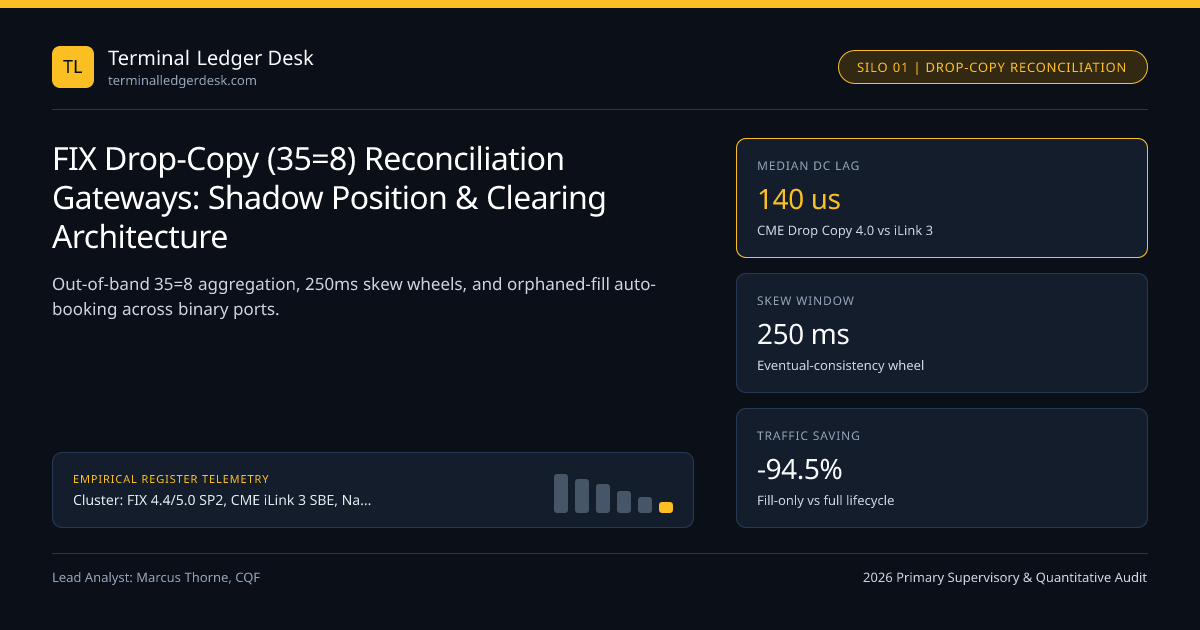
Direct-market-access desks executing simultaneously across 24 binary Nasdaq OUCH, Cboe BOE, and CME iLink 3 ports cannot rely solely on trading-thread callbacks to guarantee firm-wide risk accuracy: a crashed strategy process or severed cross-connect leaves its local in-memory position blind to resting orders that continue filling on the exchange book. Out-of-band ExecutionReport (35=8) Drop-Copy gateways close this visibility gap within 110 to 240 microseconds by streaming an independent, exchange-generated mirror of every order acknowledgement, partial fill, modify, and bust directly to middle-office shadow ledgers and clearing prime brokers.
Architectural Separation Between Primary Order Ports and Drop-Copy Streams#
In institutional execution infrastructure, trading sessions optimize relentlessly for minimum round-trip wire latency, pinning isolated CPU cores and stripping non-essential clearing metadata. Drop-copy sessions optimize instead for completeness, fan-in aggregation, and fault isolation. Hosted on separate physical NICs, separate switches, and often separate geographic links from the primary colocation execution rack, a single CME Drop Copy 4.0 or Nasdaq FIX Drop port multiplexes execution events originating from dozens of underlying SenderCompID or binary UUID trading sessions.
As outlined in our FIX, SBE & OUCH Session Architecture Guide, CME Drop Copy 4.0 encapsulates the exact raw outbound payload (or normalized FIX 4.2/FIXT tags) alongside ApplID (1180), ApplSeqNum (1181), and the originating trading session's TargetSubID (57) / SenderSubID (50). Even if a colocated trading blade in Aurora DC3 suffers a kernel panic, the Chicago or New York risk monitor receives continuous 35=8 fill notifications over Drop Copy and can trigger an out-of-band port purge.
Two-Tier Drop-Copy Modes: Fill-Only vs Full Order-Lifecycle Mirroring#
Exchanges and liquidity aggregation bridges expose two distinct subscription granularities on Drop-Copy ports:
- Trade / Fill-Only Drop Copy (
ExecType 150=F, G, H): Transmits only actual balance-changing executions, trade corrections, and trade busts. Clearing brokers and post-trade settlement engines prefer Fill-Only feeds because message volume is 15x to 40x lower than quote/cancel traffic, preventing high-frequency market makers from overwhelming middle-office FIX parsers. - Full Order-Lifecycle Drop Copy (
150=0, 4, 5, 8, F, G, H): Mirrors everyNew,Canceled,Replaced, andRejectedevent in addition to fills. Sponsored-access prime brokers subject to SEC Rule 15c3-5 and CFTC Reg 1.73 require Full Order-Lifecycle Drop Copy so their shadow pre-trade risk control ledgers track worst-case open-order notional (LeavesQty 151) in real time.
| Exchange / Prime Venue | Primary Trading Protocol | Drop-Copy Protocol & Spec | Source Session Correlation Tags | Application Gap Recovery |
|---|---|---|---|---|
| CME Globex (Aurora) | iLink 3 Binary SBE | CME Drop Copy 4.0 (FIX) | ApplID (1180), TargetSubID (57) | ApplicationMessageRequest (35=BW) |
| Nasdaq Equities (NY4/Carteret) | OUCH 5.0 / RASH | Nasdaq FIX Drop / OUCH Drop | ClOrdID (11), Port Mnemonic, ExecID | FIX ResendRequest (35=2) |
| Cboe US Equities & Options | BOE v3 Binary | Cboe FIX Drop Copy | TargetSubID, SenderSubID, ExecID (17) | Session Sequence Replay |
| Multi-Bank FX Bridge (Bridge Engine) | FIX 4.4 / Proprietary | STP Post-Trade 35=8 Feed | Account (1), PartyIDs (453), ExecID | TradeCaptureReportRequest (35=AD) |
Cross-Venue Drop-Copy Specification & Reconciliation Matrix#
Reconciling multi-venue positions across equities, futures, and OTC FX platforms such as SaxoTraderGO and institutional ECNs requires normalizing heterogeneous source-session tags.
- HaltCondition : Driftnotional(t) > Limitdrift OR |Edc(t - W) \ E_prim(t)| >= 1
- Where:
- W = 0.250 seconds (250 ms reconciliation settlement window)
- E_prim(t - W) = Set of primary gateway fills aged >= 250 ms
- E_dc(t - W) = Set of Drop-Copy (35=8) fills aged >= 250 ms
- Edc \ Eprim = Set difference (fills present on Drop Copy but unknown to primary OMS)
- Limit_drift = $250,000 gross un-reconciled notional threshold
- Worked Orphaned-Fill Detection Example:
- At t = 10:15:04.100, Blade-03 crashes after sending 20 ES futures @ 5,850.00 ($50 multiplier):
- Notional = 20 * 5,850 * $50 = $5,850,000 filled on CME Globex at 10:15:04.101
- Drop Copy 4.0 delivers 35=8 (ExecID=99104A) at 10:15:04.101140
- At t = 10:15:04.352 (W = 250 ms elapsed): |Edc \ Eprim| = 1 AND Drift = $5.85M > $250k
- Action -> Auto-inject +20 ES into Risk Ledger & fire MassAction (35=q) halt on Blade-03.
Solving the Asynchronous Drift Window in Real-Time Shadow Reconciliation#
Because primary binary fills (e.g., Nasdaq OUCH 5.0 taking ~45 us) arrive ahead of out-of-band Drop Copy 35=8 frames (~180 us), naive equality checks (Pos_primary == Pos_dropcopy) raise false mismatch alarms during active bursts. Production reconciliation engines implement a windowed eventual-consistency state machine:
Every execution Event Key (Venue, ExecID Tag 17)—deduplicated via idempotent PossDupFlag & ExecID hash tables—enters a pending-match wheel with a 250 ms grace timer:
- Case A (Primary First -> Drop Copy within 250 ms): Normal healthy path (
99.94%of fills); entry cleared cleanly. - Case B (Drop Copy First -> No Primary after 250 ms): Critical Orphaned Fill! A trading gateway dropped a fill or a rogue/manual session traded outside the OMS. The reconciler immediately injects the missing position into the unified margin clearing engine, updates VaR in the Terminal Margin VaR & ES Calculator, and alerts desk supervision.
Handling ApplLastSeqNum Gaps on Multiplexed CME Drop Copy 4.0#
On multiplexed CME Drop Copy 4.0 gateways, a session-level MsgSeqNum (34) check guarantees only the Drop Copy pipe itself dropped zero TCP frames; it does not prove that the upstream bridge between an iLink 3 MSGW and the Drop Copy aggregator missed nothing! Engineers must additionally track ApplID (1180) (the source iLink session ID) and ApplSeqNum (1181) / ApplLastSeqNum (1350).
If ApplSeqNum jumps on a specific source session, the reconciler issues an ApplicationMessageRequest (35=BW) targeting that exact RefApplID (1355) range rather than resetting the entire multiplexed Drop Copy TCP socket—avoiding the replay storms analyzed in FIX ResendRequest vs GapFill storm control and the FIX, SBE & OUCH Topic Hub.
Frequently asked questions
Can a firm submit or cancel orders directly over a standard FIX Drop-Copy session?
No. Standard Drop-Copy sessions are strictly unidirectional read-only reporting streams from the venue to the subscriber (excluding administrative Heartbeat, ResendRequest, or CME 35=BW recovery queries). Emergency cancellations must be routed through a dedicated Cancel-On-Disconnect or MassAction risk port.
Why does primary binary order entry receive fill confirmations faster than the Drop-Copy gateway?
Primary protocols like Nasdaq OUCH 5.0 and CME iLink 3 emit compact binary acknowledgements directly from the matching partition gateway, whereas Drop Copy aggregates events across multiple partitions and formats verbose ASCII FIX tags before transmission, adding 100 to 250 microseconds.
What causes a Drop-Copy session to show zero sequence gaps while still missing a trading port fill?
MsgSeqNum (Tag 34) tracks only the TCP hop between the exchange Drop-Copy server and your receiver. If an internal message bus drop occurs inside the venue before aggregation, Tag 34 stays contiguous while ApplSeqNum (Tag 1181) jumps—which is why monitoring Tag 1181 is mandatory.
How do multi-strategy hedge funds route consolidated Drop-Copy fills back to individual portfolio books?
Execution gateways embed deterministic strategy/book identifiers inside ClOrdID prefixes, Account (Tag 1), or SenderSubID/TargetSubID (Tags 50/57), allowing the central Drop-Copy normalizer to demultiplex every 35=8 report to the exact sub-ledger in sub-microsecond lookup time.
Publication record
- Published
- 14 November 2026
- Updated
- 15 November 2026
- Author
- Marcus Thorne, CQF
- Review
- Review not recorded
- Automated fact check
- Passed in the stored pipeline record
- Source URLs
- 3 recorded
AI assistance recorded: anthropic/claude-opus-4.6. This field does not establish human review or source verification.
Academic & Institutional Attribution
Cite This Research & Embed Live Data Card
Standard academic & institutional research paper citation format.
Marcus Thorne, CQF. (2026, November 15). FIX Drop-Copy (35=8) Reconciliation Gateways: Shadow Position & Clearing Architecture. Terminal Ledger Desk. https://terminalledgerdesk.com/reports/drop-copy-execution-report-tag-35-8-oms-reconciliation-architectureRelated Fix Protocol Sbe Ouch Session Latency & Institutional Briefings
Explore Fix Protocol Sbe Ouch Session Latency Hub (20) →Fix Protocol Sbe Ouch Session Latency
FIX 4.4/5.0 SP2, CME iLink 3 SBE & Nasdaq OUCH 5.0 Session Latency Architecture GuideFix Protocol Sbe Ouch Session Latency
Nasdaq OUCH 5.0 Binary Order Entry: SoupBinTCP Framing & Optional Tag AppendagesFix Protocol Sbe Ouch Session Latency
Nasdaq TotalView-ITCH 5.0 & MoldUDP64: L3 Multicast Order Book ReconstructionFix Protocol Sbe Ouch Session Latency
CME MDP 3.0 SBE Market Data: A/B Multicast Arbitration & Snapshot SynchronizationFix Protocol Sbe Ouch Session Latency
Cboe BOE v3 Bitfields vs NYSE Pillar Binary Gateway: Wire Efficiency & LatencyFix Protocol Sbe Ouch Session Latency
FIX/FAST Protocol PMAP & Stop-Bit Decoding: Why Exchanges Migrated to SBEFix Protocol Sbe Ouch Session Latency
Zero-Malloc FIX Repeating Groups: Parsing NoMDEntries (268) & NoPartyIDs (453)Fix Protocol Sbe Ouch Session Latency
FIX Heartbeat (35=0), TestRequest (35=1) & Linux TCP_USER_TIMEOUT Dead-Peer DetectionMatching Engine Clob Colocation Ptp
Solarflare Onload / ef_vi vs DPDK Kernel Bypass: NIC RX/TX Ring & PIO TuningMatching Engine Clob Colocation Ptp
FPGA Tick-to-Trade Pipelines: Cut-Through PCS/MAC & Sub-200ns Order TriggeringMatching Engine Clob Colocation Ptp
IEEE 1588v2 PTP Clock Synchronization: GNSS Grandmasters, Boundary Clocks & NIC PHCMatching Engine Clob Colocation Ptp
MiFID II RTS 25 & FINRA CAT Clock Drift Audits: 100us HFT Traceability Compliance
Terminal Ledger Desk Data, Benchmarks & Contributor Records
CC BY 4.0 Open Data
Open Institutional Datasets (CSV / JSON) →
Download desk-compiled quantitative series & schemas.
2026 Reference Matrix
2026 Institutional Benchmarks & Thresholds →
Statutory capital, clearing, margin & rate conventions.
Editorial Records
Authors & Review Records →
View named contributors where those records are available.
Complete Index
Master Research & Dossier Archive →
Browse all published briefings by topic pillar & date.