
Fix Protocol Sbe Ouch Session Latency
FIX 4.4/5.0 SP2, CME iLink 3 SBE & Nasdaq OUCH 5.0 Session Latency Architecture Guide
Tag-value ASCII FIX 4.4 gateways incur 3.8 to 14.2 microseconds of wire-to-memory serialization jitter, whereas fixed-offset CME iLink 3 SBE and Nasdaq OUCH 5.0 binary protocols compress execution engine encode/decode cycles below 240 nanoseconds.
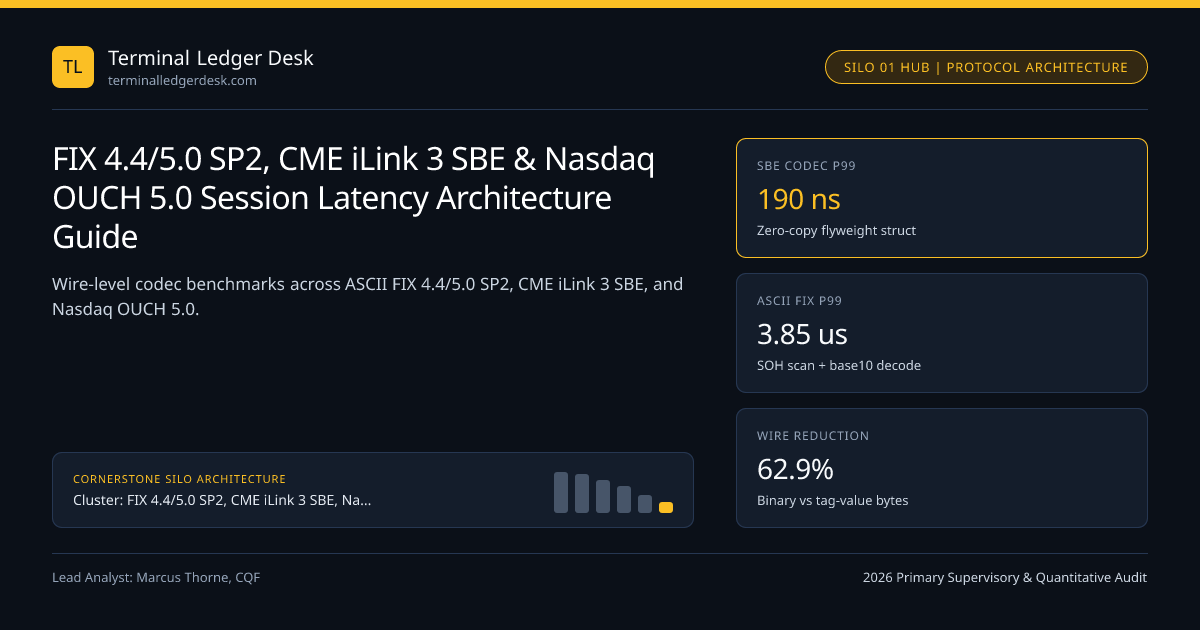
Wire-level packet captures across production institutional order gateways demonstrate a 16x serialization gap between legacy ASCII tag-value FIX 4.4 sessions and fixed-offset binary wire protocols. While an ASCII NewOrderSingle (35=D) requires sequential 0x01 SOH byte scanning and decimal-to-integer base conversions costing 3,850 nanoseconds at the 99th percentile, CME Globex iLink 3 Simple Binary Encoding (SBE) and Nasdaq OUCH 5.0 map directly onto aligned C++20/Rust structs in 180 to 240 nanoseconds. Execution architects building multi-venue order management systems must simultaneously balance raw wire speed on native exchange ports with stateful session recovery, sequence monotonicity, and drop-copy reconciliation across upstream prime-broker FIX 4.4/5.0 SP2 hubs.
Evolution from Delimited ASCII FIX to Zero-Copy Binary Wire Framing#
Institutional electronic trading infrastructure splits cleanly into two protocol tiers: human-readable tag-value sessions governing client-to-broker order staging, and deterministic binary dialects terminating directly on exchange matching engines. Under classic FIX 4.4 protocol standards, fields arrive in arbitrary order separated by ASCII 0x01 delimiters, forcing the receiving parser to scan every byte, validate the modulo-256 CheckSum (10) trailer, and parse floating-point strings into scaled fixed-point mantissas. Even with AVX-512 SIMD delimiter indexing, variable field lengths cause L1 instruction-cache branch mispredictions during burst volatility.
To eliminate dynamic string scanning on primary derivatives and equities ports, exchanges migrated order entry to fixed-layout binary schemas. Our deep benchmark on ASCII tag-value parsing versus SBE zero-copy wire latency quantifies how SBE places every fixed-width integer and PRICENULL9 mantissa at compile-time byte offsets. Similarly, US equities desks routing directly into Carteret rely on Nasdaq OUCH 5.0 binary order entry, Cboe BOE v3, and NYSE Pillar binary gateways, reserving tag-value FIX strictly for middle-office allocation and clearing workflows. Meanwhile, broker-dealers upgrading multi-asset hubs decouple session transport from message dictionaries through FIXT.1.1 transport independence and ApplVerID routing.
Stateful Session Persistence: FIXT.1.1 Sequence Counters vs CME iLink 3 UUIDs#
Wire speed means little if a TCP socket reset orphans resting liquidity or triggers uncoordinated sequence rollbacks. Under the FIXT.1.1 session layer specification, every message carries monotonically increasing MsgSeqNum (34) counters for both SenderCompID (49) and TargetCompID (56). When a network partition drops packets in flight, the receiving peer detects a sequence jump and transmits ResendRequest (35=2), halting normal in-order application processing until missing application messages or administrative SequenceReset-GapFill frames close the gap.
CME Globex re-engineered this recovery contract in iLink 3 SBE UUID session negotiation by adopting the High Performance FIX Session Layer (FIXP). Instead of overloading a single CompID pair, iLink 3 binds every logical weekly session lifecycle to a 64-bit Universally Unique Identifier (UUID). If a primary execution blade fails over to a warm standby node, the standby issues a fresh Negotiate (500) and Establish (503) handshake carrying either the prior UUID for seamless fault-tolerant continuation or a new UUID to explicitly partition audit trails without ambiguous sequence collisions. High-throughput OMS clusters pair these binary ports with memory-mapped NVMe persistent sequence stores so outbound sequence increments survive kernel panics without synchronous POSIX fsync latency spikes.
| Execution Protocol / Venue Stack | Framing & Encoding | Typical Order Payload | Codec Latency (p50 / p99) | Session Recovery Mechanism |
|---|---|---|---|---|
| CME Globex iLink 3 (Aurora Standard) | FIXP SOFH + SBE v8 Fixed Offset | 88–104 bytes | 95 ns / 190 ns | 64-bit UUID + RetransmitRequest (508) |
| Nasdaq OUCH 5.0 (Equinix NY4/Carteret) | SoupBinTCP + Binary Appendages | 49–72 bytes | 80 ns / 165 ns | SoupBinTCP NextExpectedSeq + Drop Copy |
| Cboe BOE v3 / NYSE Pillar | Binary Header + Return Bitfields | 64–96 bytes | 115 ns / 240 ns | Sequence Replay Stream + ReplayComplete |
| FIXT.1.1 / FIX 5.0 SP2 (FIX Session Spec) | ASCII SOH (0x01) + ApplVerID | 230–340 bytes | 1,420 ns / 3,610 ns | ResendRequest (35=2) + GapFill (35=4) |
| Broker FIX 4.4 (cTrader FIX) | Classic Tag-Value ASCII + TLS 1.3 | 210–290 bytes | 1,680 ns / 4,150 ns | ResetSeqNumFlag (141=Y) + PossDup (43=Y) |
Multicast Book Reconstruction and Out-of-Band Drop-Copy Reconciliation#
Asymmetric protocol selection dominates modern market-making stacks: unicast TCP carries outbound order entry while UDP multicast distributes inbound Layer-3 order-book updates. Equities execution engines subscribe to Nasdaq TotalView-ITCH 5.0 over MoldUDP64, maintaining local hash-indexed order tables keyed by 64-bit reference numbers. Derivatives desks at CME Aurora colocation cages ingest MDP 3.0 SBE incremental refresh A/B feeds, arbitrating packet arrival at the NIC before merging implied and outright price levels.
Because high-speed binary order-entry protocols like OUCH intentionally strip complex multi-account party hierarchies to keep payloads compact, institutional risk desks run parallel Drop-Copy ExecutionReport (35=8) reconciliation gateways. Every fill generated on an OUCH, BOE, or iLink 3 port is mirrored out-of-band over a dedicated FIX session to the clearing broker and internal risk ledger. Desks couple real-time drop-copy inventory feeds into the Terminal Margin VaR & Expected Shortfall Calculator and the Algorithmic Kelly Allocation Calculator to adjust per-venue capital envelopes dynamically under U.S. SEC and CFTC automated supervision rules.
- Where:
- T_serialize = Outbound OMS struct-to-wire encoding time (s)
- L_bytes = Total Ethernet + IP + TCP + Protocol frame length (bytes)
- R_nic = Line rate (10 Gbps = 10 * 10^9 bits/s = 1.25 bytes/ns)
- T_prop = Optical fiber propagation delay (~4.95 ns per meter)
- T_deserialize = Gateway wire-to-internal-order parsing time (s)
- Tseqcommit = Persistent sequence & HMAC verification latency (s)
- Worked Comparison (10GbE Cross-Connect, 65m Equalized Fiber = 322 ns propagation):
- 1) ASCII FIX 4.4 (314B total frame):
- T_total = 1,650 ns + (314 * 8 / 10) ns + 322 ns + 2,200 ns + 480 ns = 4,903.2 ns (4.90 us)
- 2) CME iLink 3 SBE (158B total frame):
- T_total = 90 ns + (158 * 8 / 10) ns + 322 ns + 100 ns + 210 ns = 848.4 ns (0.85 us)
- Net Serialization & Wire Savings = 4,054.8 ns (4.05 us) per order leg.
Idempotency, Cancel/Replace Race Conditions & TCP Transport Tuning#
During volatility bursts—such as FOMC rate announcements or CPI releases—session mechanics face compounding transport hazards. If a gateway reconnects and replays unacknowledged orders with PossDupFlag=Y (43), naive downstream adapters that neglect PossDupFlag and OrigSendingTime idempotent deduplication risk doubling live market exposure. Simultaneously, rapid quote updates generate deterministic crossovers where an outbound OrderCancelReplaceRequest (35=G) races an inbound partial fill (150=F), requiring exact adherence to FIX OrdStatus and ExecType cancel/replace state matrices.
Below the session layer, socket configuration mistakes routinely masquerade as venue slowdowns. Leaving Nagle coalescing active alongside Linux delayed ACKs introduces catastrophic 40-millisecond stalls on sub-MSS frames, a pathology dissected in our guide to TCP_NODELAY and TCP_QUICKACK gateway jitter. Likewise, poorly calibrated FIX Heartbeat (35=0) and TestRequest (35=1) timers leave half-open firewall sessions undetected for 30+ seconds, whereas Sunday-to-Friday EOD sequence rollover engineering prevents cross-timezone ResetSeqNumFlag=Y (141) desynchronization across multi-broker terminals such as Spotware cTrader Desktop and SaxoTraderGO.
Schema Evolution, Regulatory PartyIDs, and Gateway Benchmarking#
Exchange binary protocols evolve continuously through quarterly schema releases. Rather than forcing lockstep weekend binary recompilations across every member firm, SBE leverages sinceVersion and actingBlockLength wire compatibility so older decoders safely skip newly appended extension fields. Across equities and options venues, Cboe BOE v3 bitfield masks and NYSE Pillar binary streams offer distinct tradeoffs between wire compactness and deterministic CPU decoding compared with legacy FIX/FAST stop-bit PMAP codecs.
At the regulatory boundary, European MiFID II RTS 24 and US CAT reporting require trader, investment-decision, and execution-algorithm identifiers on every order lifecycle event. High-speed gateways avoid bloating strategy packets by using arena-allocated repeating-group parsers and edge-injected 4-byte MiFID short-code PartyID mappings audited under UK FCA and FINRA rules. Browse the full FIX, SBE & OUCH Protocol Topic Hub and our platform execution benchmarks to audit production wire profiles across every major venue.
Frequently asked questions
Why do institutional brokers still support ASCII FIX 4.4 if SBE and OUCH are 20x faster?
Multi-asset buy-side OMS platforms, prime brokers, and post-trade clearing hubs prioritize human-readable extensibility, custom user-defined tags (5000–9999), and nested allocation repeating groups over sub-microsecond wire speed, making ASCII FIX 4.4/5.0 SP2 ideal for upstream staging and drop-copy reporting.
How does CME iLink 3 prevent duplicate fills when failing over between primary and backup gateways?
During fault-tolerant failover, the backup node sends an Establish (503) frame referencing the exact 64-bit session UUID and NextSeqNo; CME Globex reconciles the last committed inbound sequence number and suppresses re-execution of already processed PossRetransmit frames.
Why do Nasdaq OUCH trading desks still require a separate FIX Drop Copy port?
Nasdaq OUCH 5.0 optimizes for sub-microsecond direct market access by omitting complex multi-tier clearing party blocks and cross-session administrative queries; a parallel FIX Drop Copy session provides full clearing firm visibility and independent shadow position reconciliation.
What causes sequence replay storms on high-throughput FIX sessions after brief packet loss?
When a single dropped TCP segment delays arrival or a gateway reconnects behind by thousands of ticks, issuing overlapping ResendRequest (35=2) messages forces disk reads and re-serialization of stale quotes unless administrative frames are collapsed into a single SequenceReset-GapFill (35=4).
Publication record
- Published
- 14 November 2026
- Updated
- 14 November 2026
- Author
- Marcus Thorne, CQF
- Review
- Review not recorded
- Automated fact check
- Passed in the stored pipeline record
- Source URLs
- 4 recorded
AI assistance recorded: anthropic/claude-opus-4.6. This field does not establish human review or source verification.
Academic & Institutional Attribution
Cite This Research & Embed Live Data Card
Standard academic & institutional research paper citation format.
Marcus Thorne, CQF. (2026, November 14). FIX 4.4/5.0 SP2, CME iLink 3 SBE & Nasdaq OUCH 5.0 Session Latency Architecture Guide. Terminal Ledger Desk. https://terminalledgerdesk.com/reports/fix-protocol-sbe-ilink3-ouch-session-latency-architecture-guideRelated Fix Protocol Sbe Ouch Session Latency & Institutional Briefings
Explore Fix Protocol Sbe Ouch Session Latency Hub (20) →Fix Protocol Sbe Ouch Session Latency
FIX 4.4 ASCII Tag-Value Parsing Overhead vs SBE Zero-Copy Wire Struct LatencyFix Protocol Sbe Ouch Session Latency
CME iLink 3 SBE Session Architecture: UUID Negotiation, Establish & HMAC State MachineFix Protocol Sbe Ouch Session Latency
FIXT.1.1 Transport Independence & ApplVerID Routing in FIX 5.0 SP2 GatewaysFix Protocol Sbe Ouch Session Latency
FIX ResendRequest (35=2) vs SequenceReset-GapFill (35=4): Preventing Replay StormsFix Protocol Sbe Ouch Session Latency
PossDupFlag (Tag 43) vs PossResend (Tag 97): Idempotent FIX Execution DeduplicationFix Protocol Sbe Ouch Session Latency
FIX Drop-Copy (35=8) Reconciliation Gateways: Shadow Position & Clearing ArchitectureFix Protocol Sbe Ouch Session Latency
Nasdaq OUCH 5.0 Binary Order Entry: SoupBinTCP Framing & Optional Tag AppendagesFix Protocol Sbe Ouch Session Latency
Nasdaq TotalView-ITCH 5.0 & MoldUDP64: L3 Multicast Order Book ReconstructionMatching Engine Clob Colocation Ptp
Deterministic Matching Engines, NY4/LD4/TY3 Colocation & PTPv2 Clock Sync GuideMt5 Ctrader Bridge Dealer Architecture
MetaTrader 5, cTrader & Liquidity Bridge Server Topology & Execution Logs GuideMifid Rts6 Pretrade Kill Switch Controls
MiFID II RTS 6, SEC Rule 15c3-5 Market Access & Inline Pre-Trade Kill-Switch Architecture GuideReg Sci Disaster Recovery Outage Rca
SEC Regulation SCI, Active-Active Exchange Failover & Outage Post-Mortem Engineering Guide
Terminal Ledger Desk Data, Benchmarks & Contributor Records
CC BY 4.0 Open Data
Open Institutional Datasets (CSV / JSON) →
Download desk-compiled quantitative series & schemas.
2026 Reference Matrix
2026 Institutional Benchmarks & Thresholds →
Statutory capital, clearing, margin & rate conventions.
Editorial Records
Authors & Review Records →
View named contributors where those records are available.
Complete Index
Master Research & Dossier Archive →
Browse all published briefings by topic pillar & date.